Okinawa

My friend Tiki sarcastically said that all Americans who visit Japan go to Okinawa. It is set to rain and get really cold in Tokyo for the next three days. So we did the American thing.

As we drove from the airport towards our resort, we passed an area with bars and strip joints. Jo said “marine base” and sure enough we soon passed the Marine base. A bit later we passed an A&W restaurant and a McDonalds. Jo said “Air Force base, and a minute later we drove past the US Air Force base at Kadena. I guess Jo knows her brothers well! Or Okinawa.

Okinawa is very different from Tokyo or Osaka or Kyoto. For starters, it’s not an urban jungle. Okinawa is where Hawaii meets Japan. Vivian found it unnerving and kept referring to Tokyo as “real Japan”.

The island is pretty. We walked a bit, hiked to a waterfall recommended by Beth, and drove to the best cherry blossom viewing spots though the peak had passed. Jo and Evan went down to the beach and got in the water. We ate breakfasts at Hawaiian pancake places and dinners at yakinikus where you grill your own dinner at your table. The scallops and squid were good but the wagyu beef specially cut for the grill is to die for. We celebrated Vivian’s 13th birthday at the best yakinuki in town.

The other thing Vivian got for her birthday was to scuba dive. She literally no instruction beyond equalizing her pressure and purging her mask, hastily explained mostly in sign language while we were on the way out in the dive boat. But Vivian flipped backwards off the boat and we stayed down for about 30 minutes at about 25 feet and the dive instructor stayed with her. She loved every minute off it and stared and the fish and coral in fascinated awe. Sadly about 90% of the coral was bleached. First thing she said once we were back topside and the regulator was out of her mouth? “When can we do this again”?

Hiroshima

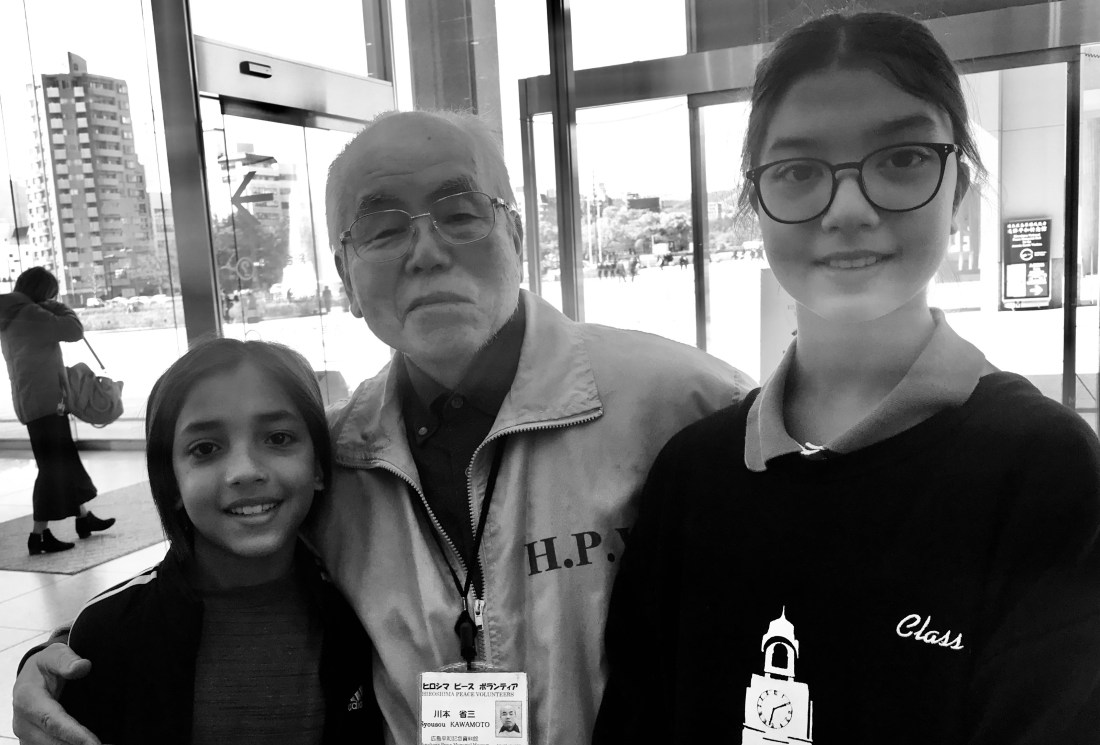
We walked through the Hiroshima Peace Park at ground zero and visited the museum and memorial hall. It was a surreal and emotional experience for all of us. An old man, one of the docents at the museum, asked us our country of origin when we entered. With a smile he nodded and greeted us when Jo said “USA”. We wondered if they have made their peace with Americans. At the museum there were a lot of Japanese school kids on field trips, with open notebooks and pencils in hand. The overriding sentiment was sadness. Most of the exhibits and stories had to do with the day of. What was it like when 60,000 lives ceased to be within a few seconds of 08:10 on August 6th of 1945, and what happened to the others in the following hours and days.

When we exited the museum, the old man gave Vivian and Evan a couple of the famous origami cranes of peace. There wasn’t a dry eye around.

Later, as their writing assignments, Vivian and Evan wrote about their visit. Evan focused on the technicalities of the bomb – the design of Thin Man versus Fat Boy, radioactivity, critical mass, etc. Vivian wrote as if she survived the bomb and returned home to find her little brother dying.

Ramen-ya

Eating in Japan has been an adventure. The foods are amazing and the restaurants are super specialized. A ramen noodle place is different from an udon noodle place which again is not the same as a soba noodle shop. We went to a solo seating ramen restaurant in Kyoto, and we loved it so much that we came back a second time. Here’s a quick run down of how it works: go to the machine at the entrance of the restaurant and select the type of broth you want, and extras like soft boiled egg and sliced mushrooms and push the buttons as you would in a vending machine (an average bowl is about 1200 yen or $12). Then you pay the machine and out pops a small printed ticket.

The waiter directs you to your spot inside. You sit on a stool in a long room facing a narrow counter partitioned off from your neighbors to your right and your left. A water dispenser and ceramic cups are to one side. An opening in the wall in front of you is covered by a bamboo blind. To your right is a packet holding blank forms and a pencil. Take a blank form and fill it in. You select the richness of the broth, the amount of garlic and spice (on a scale of 1 to 10), and other stuff. You put your ticket and the filled form on a designated spot on the counter and press a button. Your waiter appears on the other side of the bamboo blind, raises it, greets you, collects the paperwork and lowers the blind. Meanwhile your party sits at their own stools along the same counter. You’re separated from each other by wooden partitions on the counter. Some times the partitions are hinged and can be folded back to allow interaction with your neighbor.

After a while the bamboo blind is raised and a steaming bowl and ramen and extras are placed in front of you on the counter. The waiter says something in Japanese that I didn’t understand and then bows deeply from the waist but his working space is narrow so he has to bow sideways. Given the geometry of the opening you just see the top of his head as it is lowered to counter height. Then the blind is closed and you are left to contemplate your ramen. Slurp well and enjoy.

Jo described this to a friend who said “like a prison visit”. I guess it is, but tastier.

Kyoto

We took a Shinkansen from Tokyo to Kyoto, cruising at 300 km/h while enjoying nice views of Mt. Fuji along the way. I did not know that in the 53 year history of Shinkansen they have carried more than 5 billion passengers without a single fatality.

We woke up our first morning in Kyoto to unexpected snow. Jo and I let the grumbling kids stay at home and we went to Kinkaku-ji. We watched the golden pagoda serenely glistening in the morning light while huge soft snowflakes floated down around us. The crowd of tourists was meanwhile less serenely pushed through a stockade of fence-work around the beautiful grounds. I guess it’s just the sheer number of us. Tourists are the worst : )

In the gently falling snow, Jo and I walked on to Ryaon-ji, the combination of fifteen famous rocks and bits of moss enclosed in a sublime courtyard of manicured gravel. I sat and contemplated the garden from the ancient wooden steps of the pavilion for the third time in my life till my slippered feet got too cold. We returned to the gate, got our shoes, and walked through the moss gardens – Jo’s favorite part.

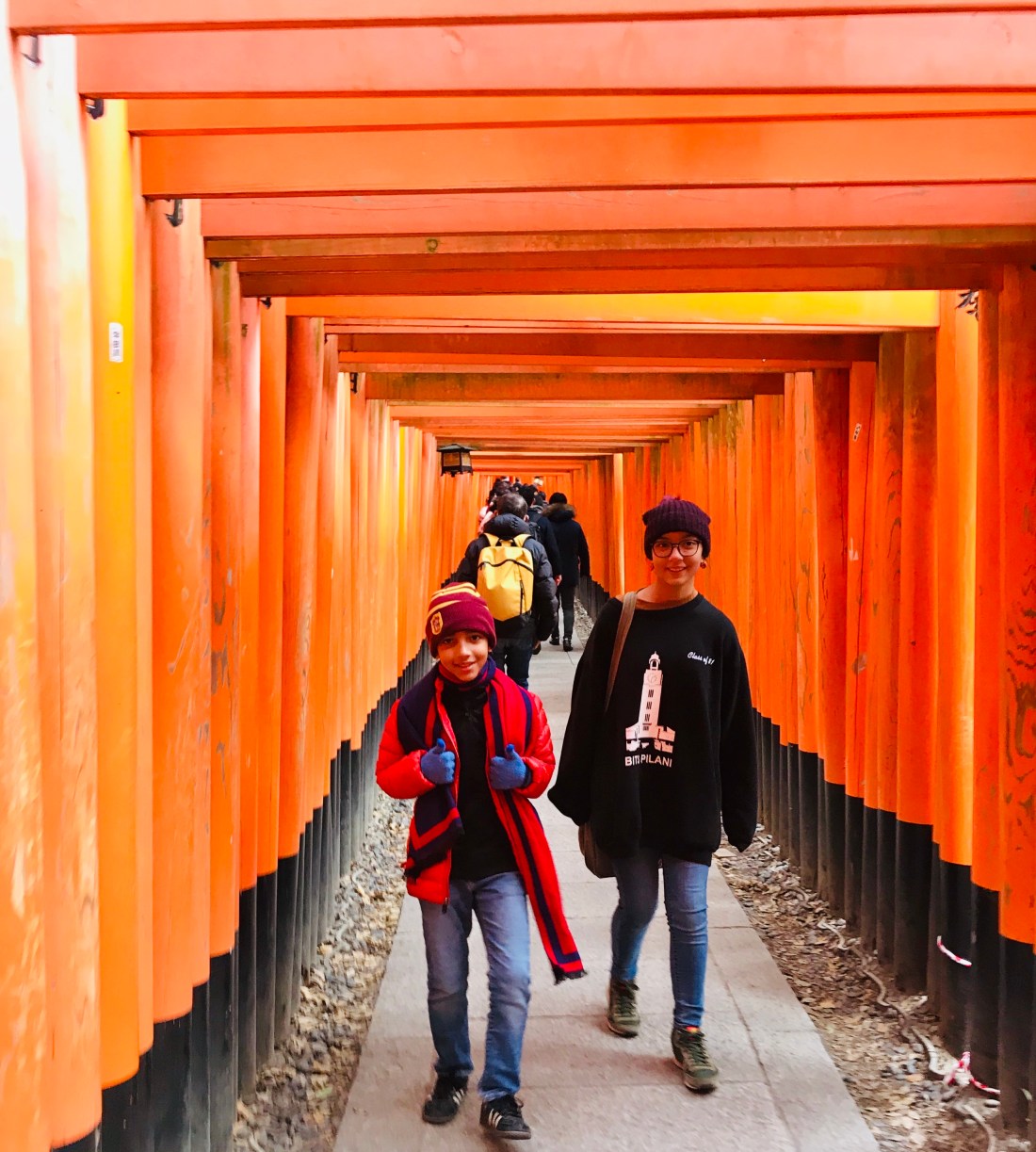
Kyoto is a city chock full of temples, shrines, and gardens. One of the most picturesque is the Fushimi Inari shrine with the thousand orange torii gates built on the path to the shrine. We met three young ladies from Canada on vacation. They were dressed in kimonos (there are kimono rental shops in Kyoto for this purpose). So Jo and I got into a discussion about cultural appropriation. We don’t see eye to eye. The kids rolled their eyes.

Speaking of cultural appropriation, the torii of Fushimi Inari was the inspiration for the Christo and Jeanne-Claude installed art project consisting of seven thousand orange gates with saffron curtains arrayed around Central Park in the winter of 2005. Remember that?

One afternoon we took the metro to Arashiyama, a small town north west of Kyoto. It has a famous Buddhist temple and gardens and a “bamboo forest”. The “forest” (you get it, I’ll stop quoting the word now) is an overgrown bamboo plantation that is no long economically viable or necessary. It is beautiful. Someone put a half kilometer long path through the forest. The government added the place to the list of Japanese soundscapes. Condé Nast named it among the 50 most beautiful Places On Earth! Result: every tourist in Japan comes here and posts a picture of herself to her Insta account that her friends enviously like about for one second and then forget (I’ve used the female gender to show my disdain for the patriarchy).

We’ve been having fun with eating out in Japan. I’m leaving behind a tsunami of unacceptable behavior. Like the time in Tokyo at an izakaya when the waiter brought me a large (like 3-4 liter large) bottle of sake after he got me my sake. We later thought he wanted to show me the bottle he poured my sake from. Meanwhile I tried hard to undo the cap and get some more. Luckily I was unsuccessful. So I was bent of making a good impression at an izakaya we visited for dinner in Kyoto. This place has maybe 8 stools along a counter in a room so narrow that people further down from you pretty much wait till you are done – the classic first-in-last-out method from queueing theory.

With a little help from Jo (she took a semester Japanese sometime during her education) and an English to Japanese crib sheet on the menu, I said “Sumimasen, mizu wo kudasai”. Jo said that the other three other patrons of the restaurant and the chef and his assistant stopped breathing, waiting for every sound that came out of my mouth. When I finished they all broke into muted applause. The chef poured me a glass of water. Phew. I asked if I could take a photo of him. He posed with my teppan-grilled squid.

On our way out of Kyoto our cab driver gave us an impromptu tour of the city. He used a hand-held translator that worked pretty well. One of the places he stopped was the original head office of the Nintendo Playing Card Company. Then he dropped us off at the train station where we caught a train to Ōsaka.

Though, at some point we are going to have to talk about cultural appropriation.

Tokyo

The attendants bow outside on the curb as our airport bus departs from Haneda Airport. About an hour later the bus drops us off at Shibuya not far from the famous intersection that 3000 people cross every time the lights change. We take a cab to our Airbnb in Motoyoyogicho and meet Keko, our host who shows us to our tatami mat covered room with futon mattresses on the floor. We’ve embarked on our 21 day Japanese adventure.

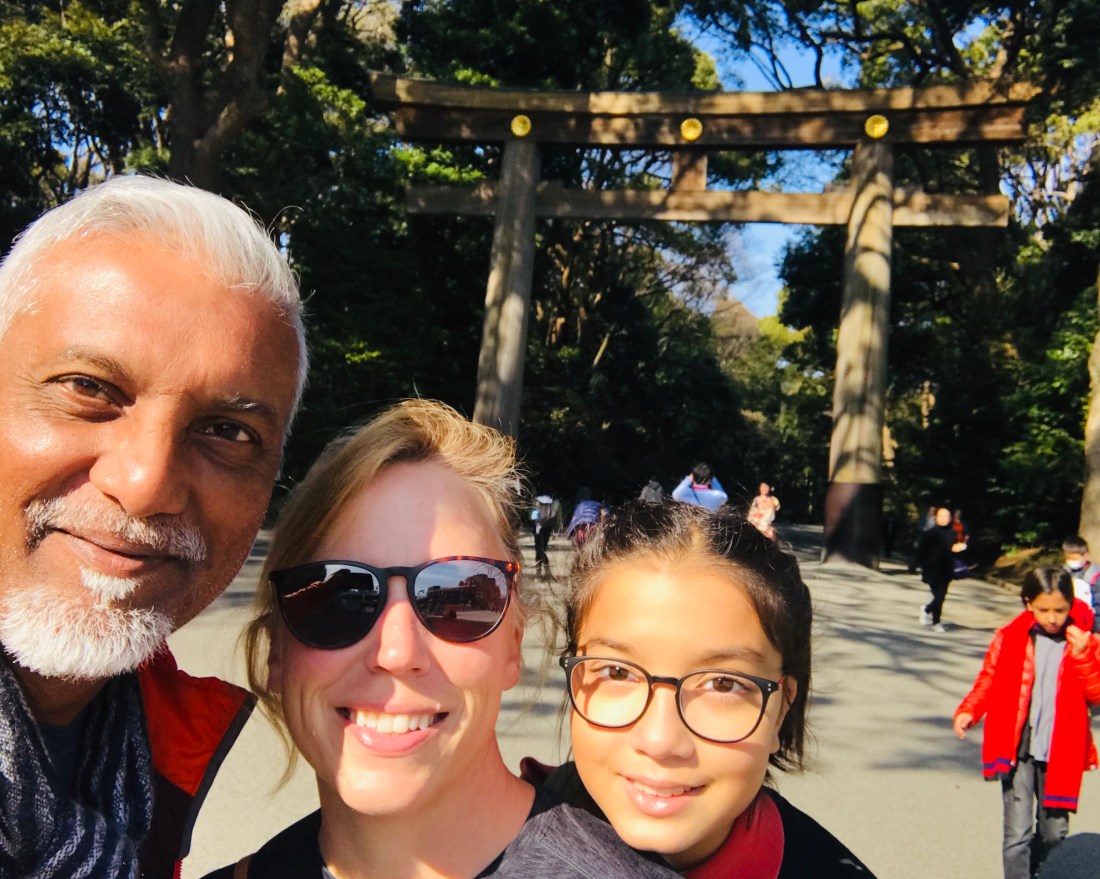
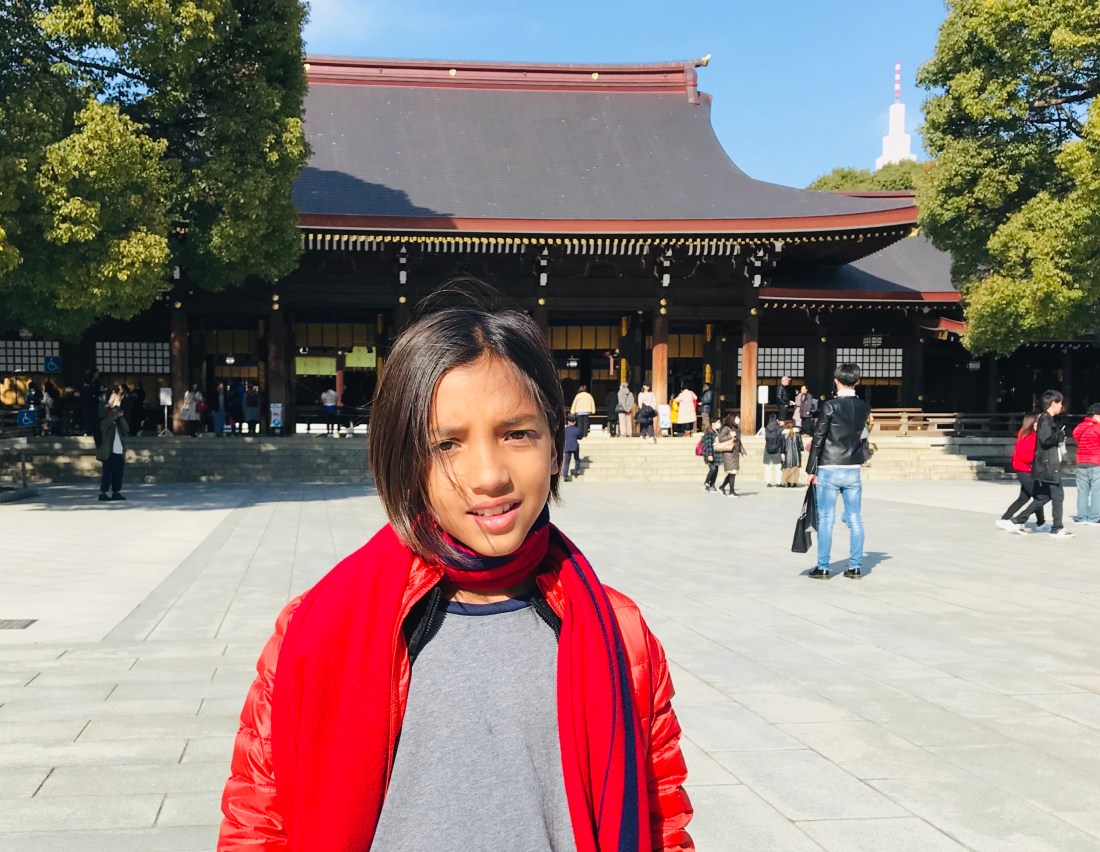
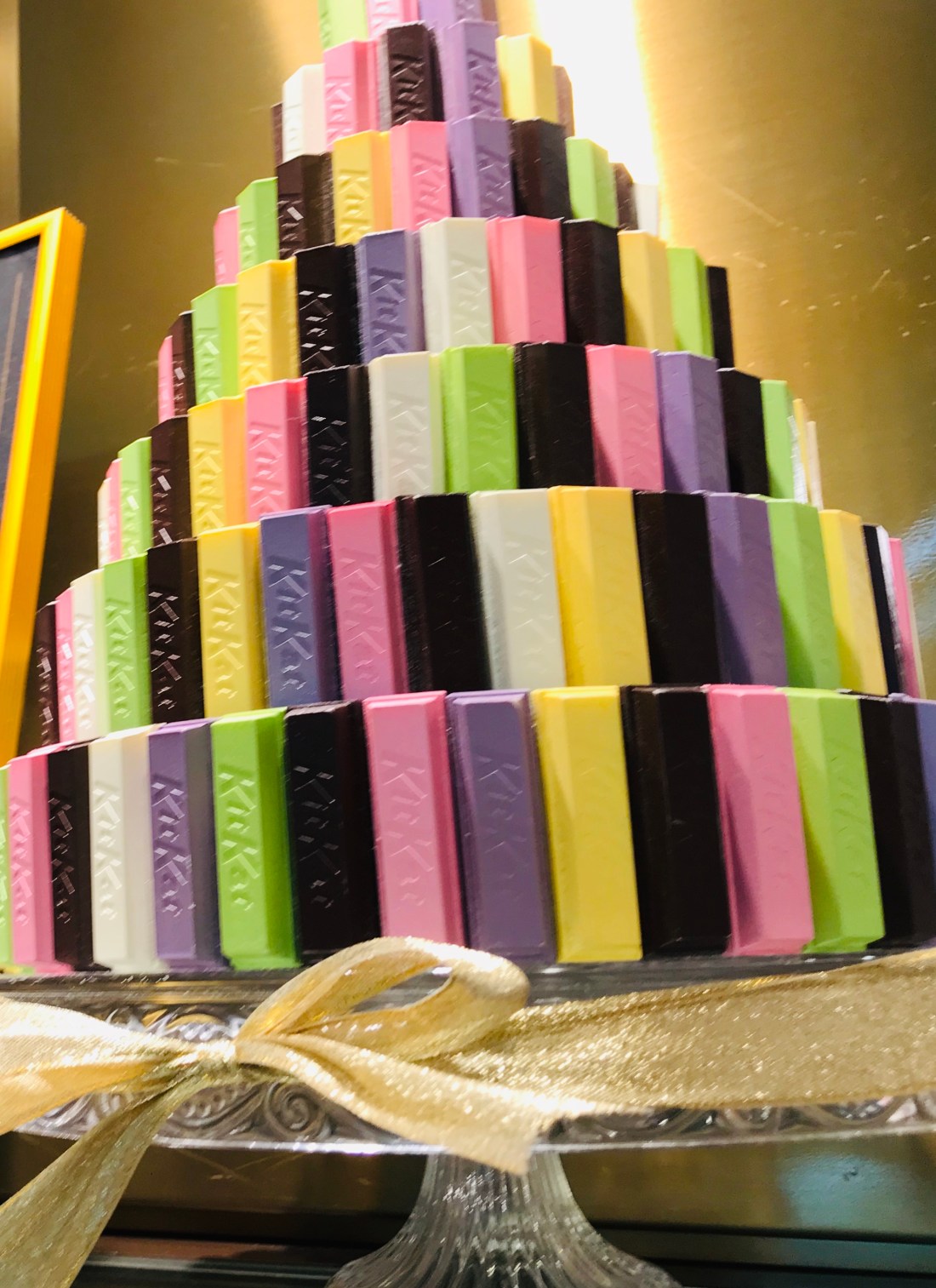
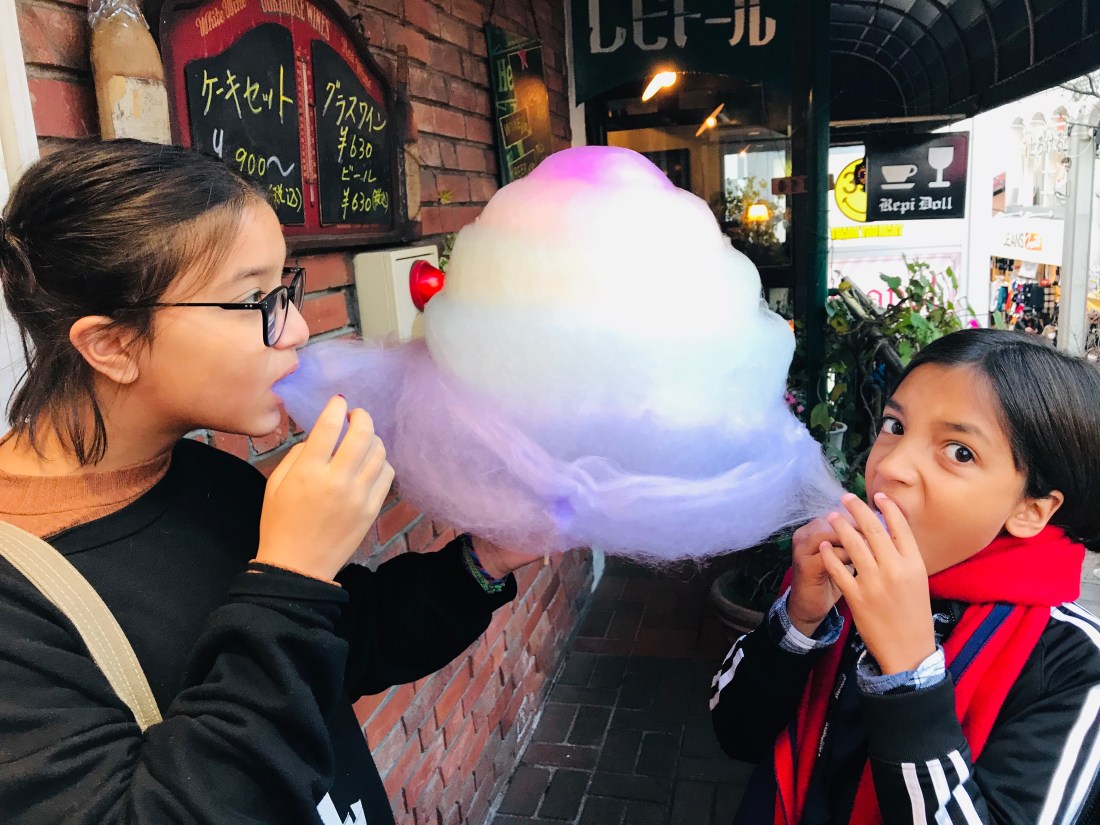
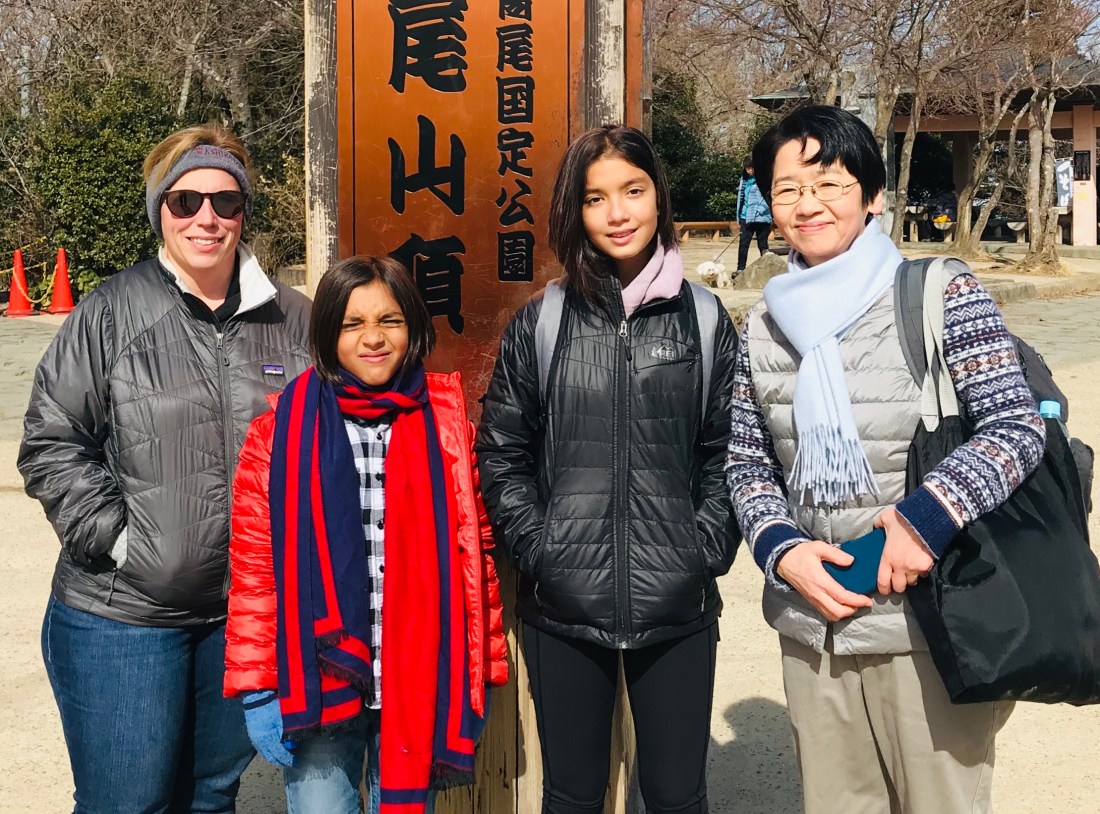
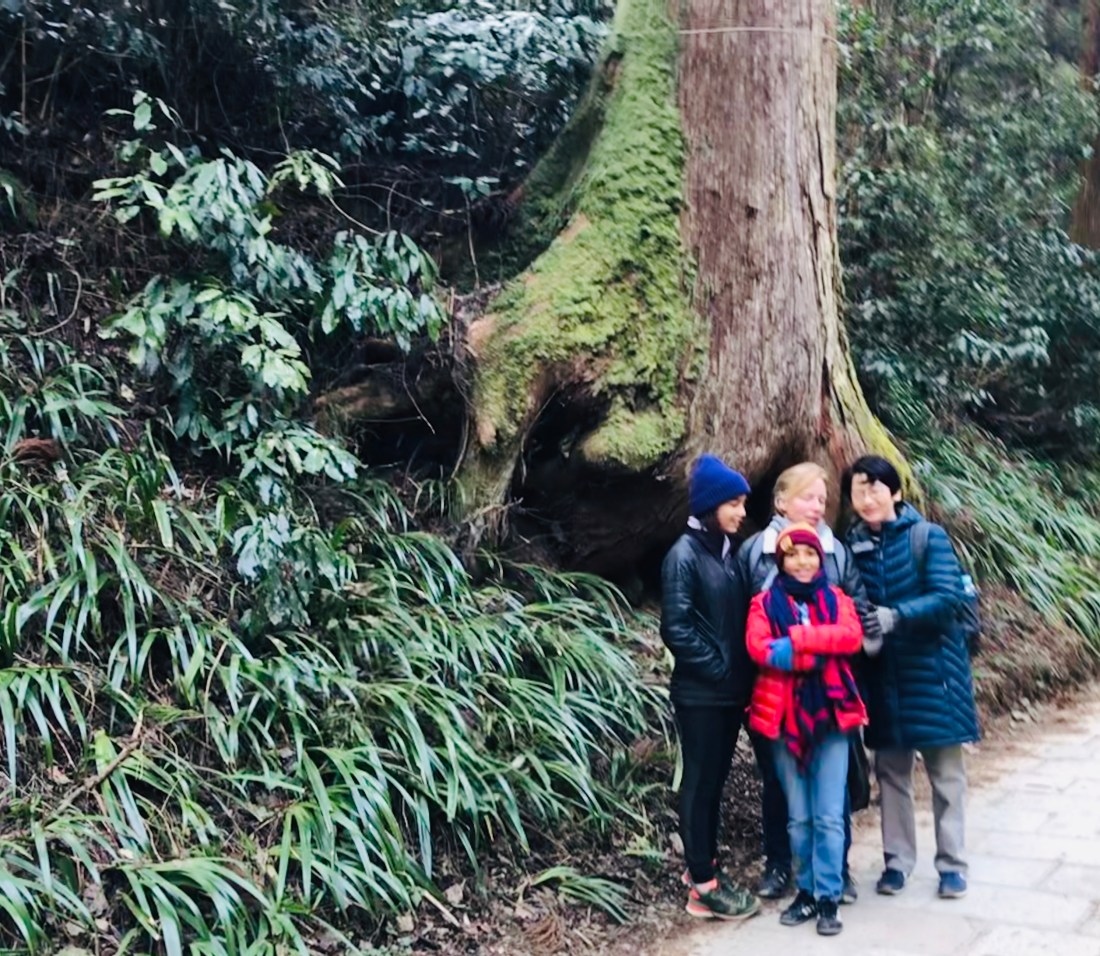
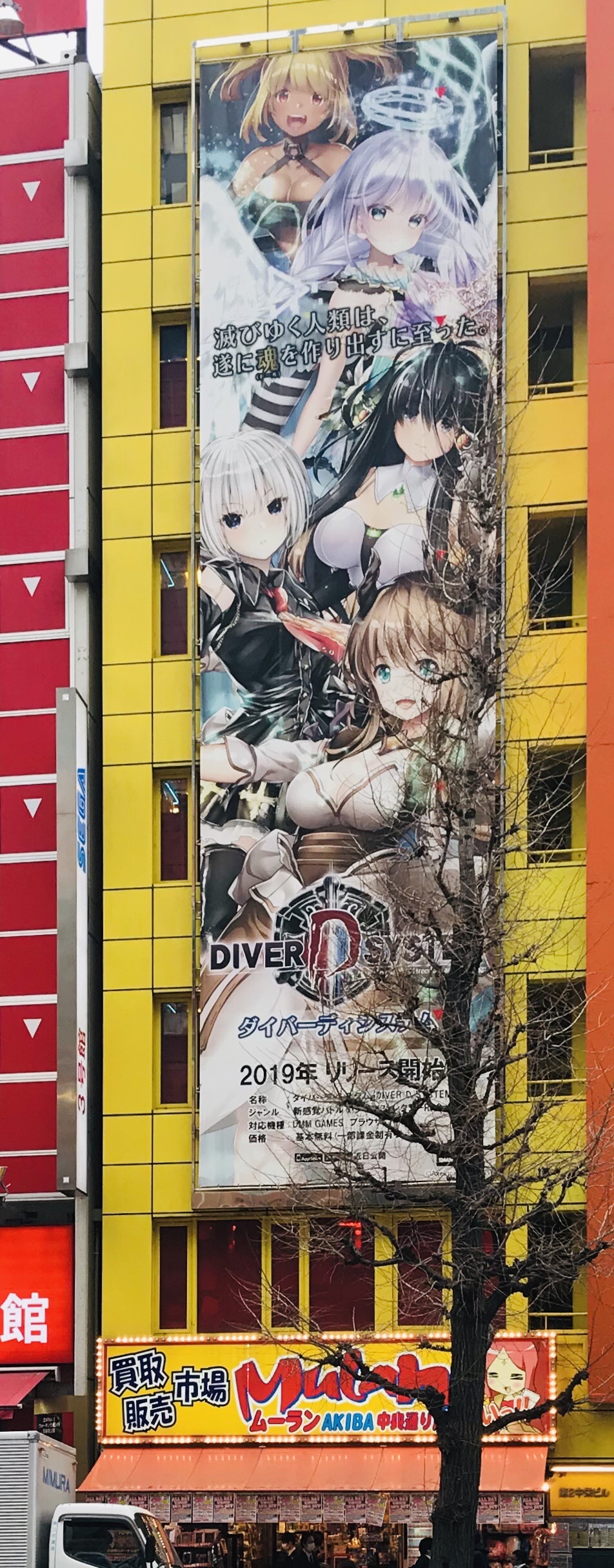
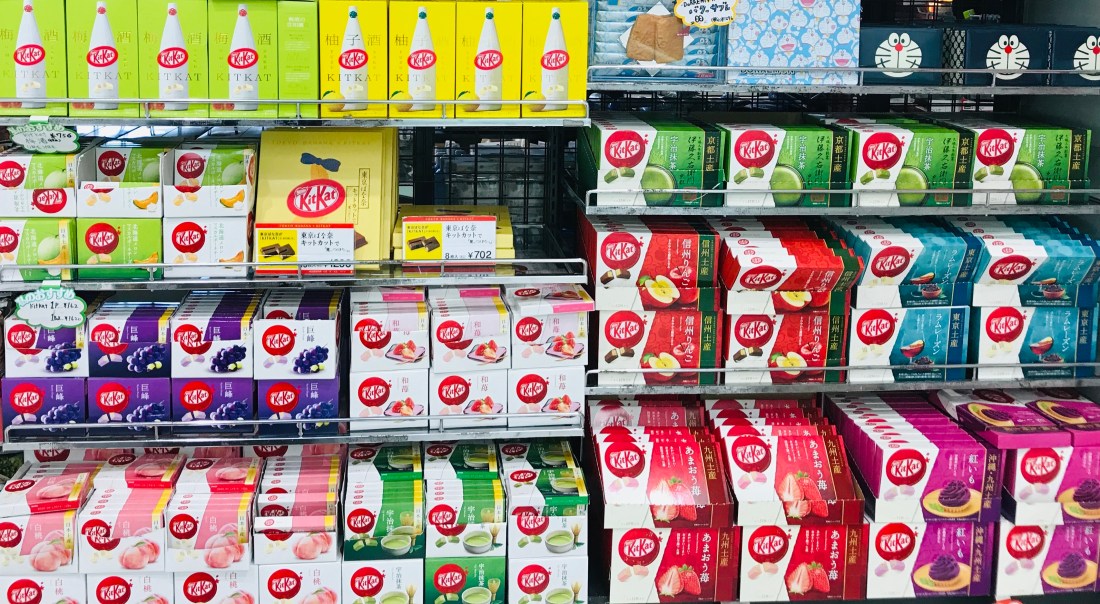
We marvel and big things and tiny details in Tokyo. The bathrooms everywhere are spotless and are equipped with lux Toto models that have heated seats and various washing options. The traffic, both automobile and human powered, at building exits and around construction sites, is deftly directed by men in white gloves and glowing batons who bow and wave gracefully. Mothers (usually, though there were a few fathers) take toddlers to school in the morning on their bicycles with double child seats and rain covers, pedaling their way through narrow streets and park roads. Children younger than Evan board the subways on their own, in smart navy uniforms and hats and backpacks, to and back from schools. We pass through Shinjuku station where tens of thousands of people transfer smoothly with no jostling, forming neat lines to get on to escalators or into spotless trains. We stroll through Harajuku filled with young people dressed in the most interesting ways and Vivian and Evan buy giant cotton candy. We get take away lunch at the gourmet food shops below the Takashimaya mall that make Whole Foods look like a country outpost, but realize that there is no place to sit and eat because the Japanese don’t eat in public. We wander through the serene grounds of the Meiji Shrine and read about the history of Japan opening up to the rest of the world after 250 years of self imposed isolation (though their version stresses on the actions of the Meiji emperor while the American version pivots on the arrival of Commander Perry and the militaristic might of the US navy). We walk past displays of KitKats in dozens of flavors and colors, ready for Valentine’s Day. We sample onegiri (salmon and rice wrapped in dry seaweed) from various corner stores in our quest to find the very best. We eat at izakayas, tiny restaurants where a single chef prepares everything and you have to select the cup for your hot sake. Vivian and Evan get pretty good at navigating the seeming labyrinth of the Tokyo rapid transit system (over 800 stations serviced by a dozen different operators providing 40 million passenger rides a day) that turns out to be amazingly user friendly and the best way to get around. They can find our home station of Yoyogi-Uehara on the maps and learn to look for it and other connecting stations when it is time to hop off the trains. We visit the old Senso-ji shrine and walk past the rows of wooden stalls selling everything from Hello Kittys to dorayakis, red bean paste filled pancakes, and Evan buys his fortune by randomly pulling a numbered bamboo stick from a box and then opening one of a hundred small drawers filled with notes about your future. We spend a day with our friend Prartho, hiking to the top of mount Takao, an hour west of Tokyo, and follow it up with a lovely long dinner at a Korean barbecue restaurant near the Shimo-Katazawa station. We visit the famed electronics and video gaming hub of Akihabara and Vivian and Evan buy souvenirs for their friends in Austin from the gacha machines that swallow three hundred yen and spit out a plastic egg containing a plastic toy. We are beckoned on the streets by “maids” from the maid cafes and by building sized posters of child-faced anime girls with big boobs, and are reminded everywhere of the uncomfortable intermix of the cultures of cutesy and smutty.

We try to find answers by sampling tiny slices of life in the city and end up with dizzying collages of wonder and surprise and more questions and an appreciation for the impenetrable urban experience that is Tokyo. Evan is excited beyond anything he’s seen so far and slumps onto Jo’s lap at the end of each day on the train ride back home. Vivian vows to return here when she’s older, “probably for college”. Our work here is done. Thank you, Tokyo.

Arriving in Tokyo

Japan is our most anticipated destination. Evan and Vivian love Japanese food (mostly udon and ramen) and Vivian has been teaching herself manga and amine art for a couple of years.

When we reached Da Nang airport in Vietnam for our flight to Tokyo, we got our last bowls of pho and picked up some free masks. Everybody, literally everybody else at the airport were already in masks. The coronavirus has hit the headlines.

At Haneda airport in Tokyo fewer people are in masks. Jo had booked us rooms at the airport hotel. We get into bed. By 01:30 Evan and I turn out the lights. A half hour later as we are about to fall into deep sleep I feel like I’m on a waterbed and someone is gently but forcefully rocking the waterbed.

“Hey Evan, is your bed shaking too?”

“Yes it is”

I get out of bed and stand up. “Uh oh, the floor is shaking too. It’s an earthquake!”

We draw the heavy blackout curtains back and look out of our 9th floor window. Cars and buses and trains are running normally outside. We see some people walking in the street below. The shaking has stopped. No one is running down the hallway outside.

Welcome to Japan, I tell Evan. He isn’t perturbed. I check google to confirm that there was a 5.3 earthquake a few minutes ago. We turn off the lights and close the window curtains and go back to sleep. Next morning Jo tells us of an almost identical reaction in her and Vivian’s room while we sit across from the airport Seven-11 and eat onigiri and marvel at the variety of KitKats and we plan how to make our way to the Airbnb.

Hoi An

I look out of the window as we come in to land in Da Nang. Below us forest covered mountains abruptly give way to fields of newly planted paddy. They look like freshly brushed patches of green velvet broken by islands of villages and crowded cemeteries. I take lots of photos that I know will look crappy later. From the air I can see that Da Nang is a modern city of high rise buildings, soaring bridges, and a long strip of white beach. We land but we leave immediately for Hoi An, about 45 minutes away.

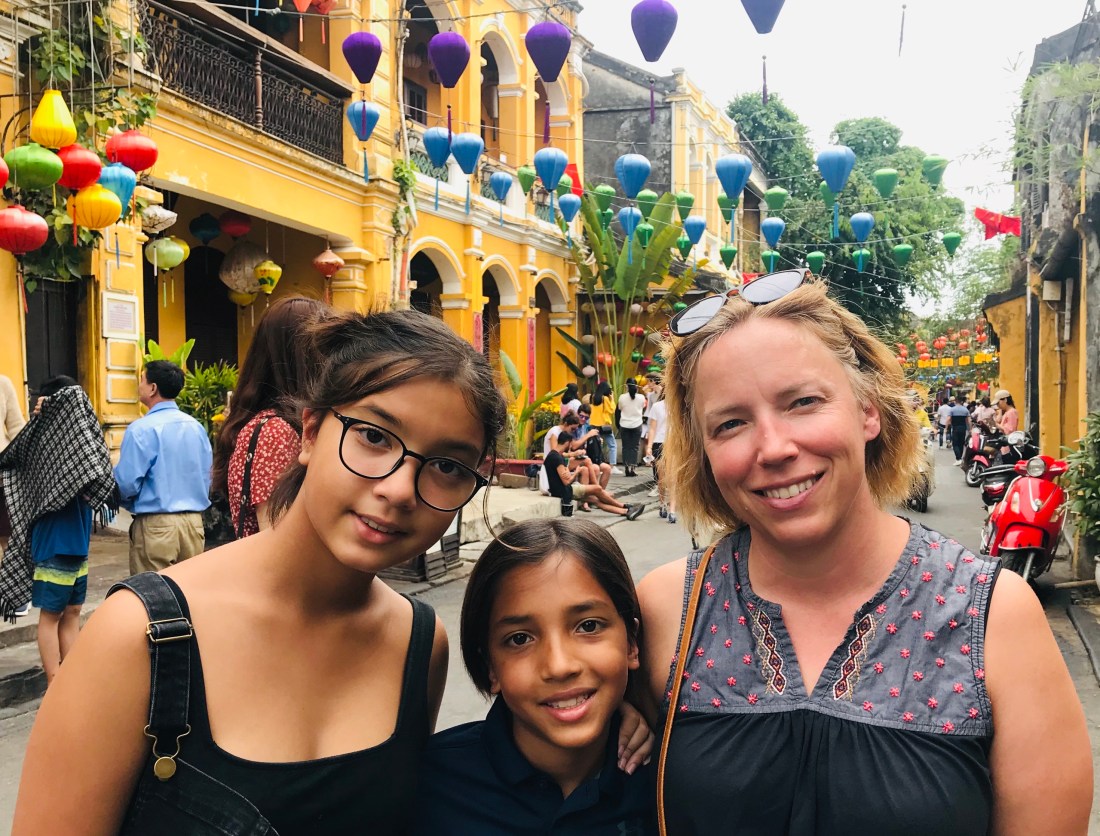
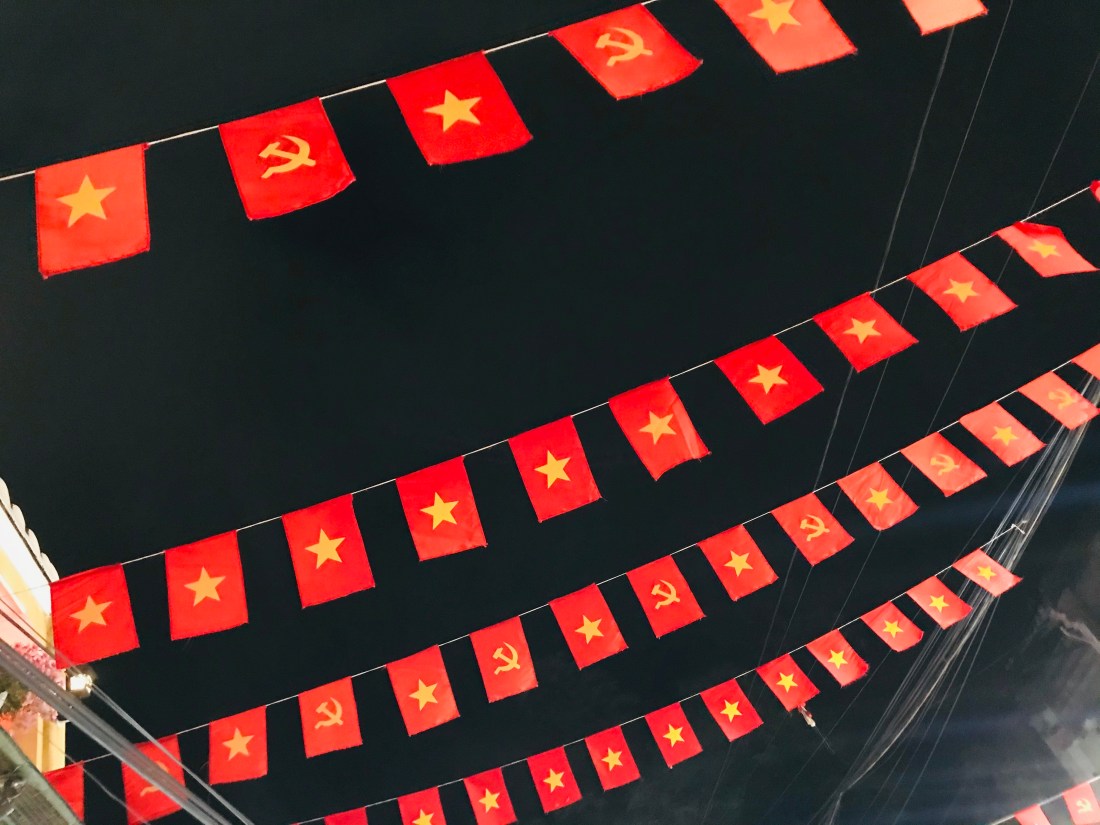
By the time we check in to our hotel it is getting dark outside. Tomorrow is the start of Tet, the week long lunar new year celebrations. The lady at the front desk tells us that it’s a good time to go see the flowers at the Ancient Town. Yet, a few minutes later when I step off the hotel shuttle bus on to the main street of the Ancient Town, I am unprepared for what I see. It is as if an immense flower bomb had exploded.

The main street is bordered by flagstone sidewalks, probably 15 feet wide on each side. But there isn’t an inch of space on the sidewalks because they are full of pots of blooming plants and bonsai fruit trees of every color and size. There is a sea of yellow chrysanthemums and orange marigolds. There are red cockscombs and bonsai kumquat trees laden with plump miniature orange fruits and bonsai apricot trees fluttering with delicate yellow blossoms.

Because the sidewalks are full of blooming merchandise, people are walking on the street along with thousands of scooters and mopeds. Entire families dressed for winter are drive-by-window-shopping in slow motion. Children stand on the scooter seats for better views of the flowers. People stop and buy their flowers which are then loaded on to the scooters and wedged between a family of four. Bigger orders are delivered by garden carts pulled by scooters or bicycles. Supplies are replenished the same way. There is celebration in the air. And while it’s one step away from complete chaos, things are moving relatively smoothly.

I wander around in this impromptu flower market wonderland and I get lost. My phone is almost dead (too many aerial paddy field photos). I stand on a busy corner (they all are) and try to orient myself. An old lady walks over and helps me. We don’t speak a word of each other’s language but she gets me going.

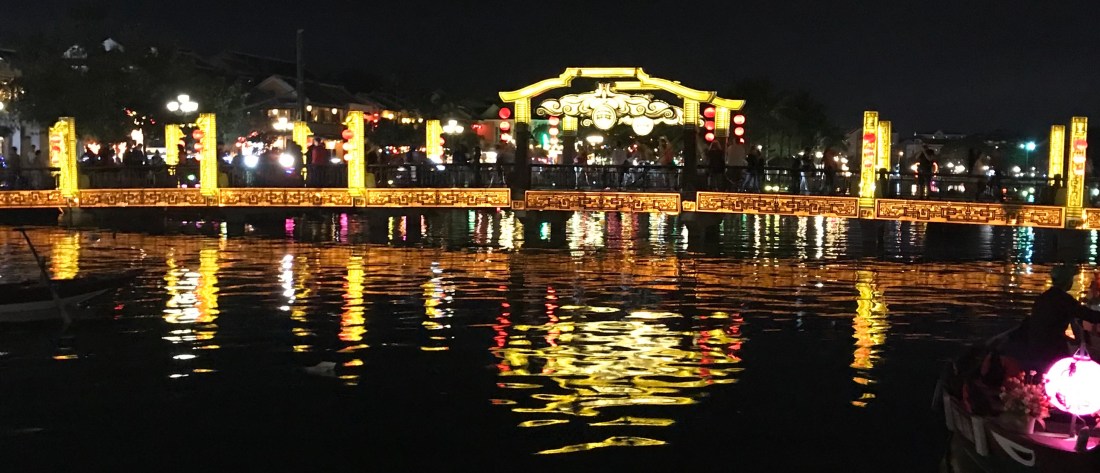
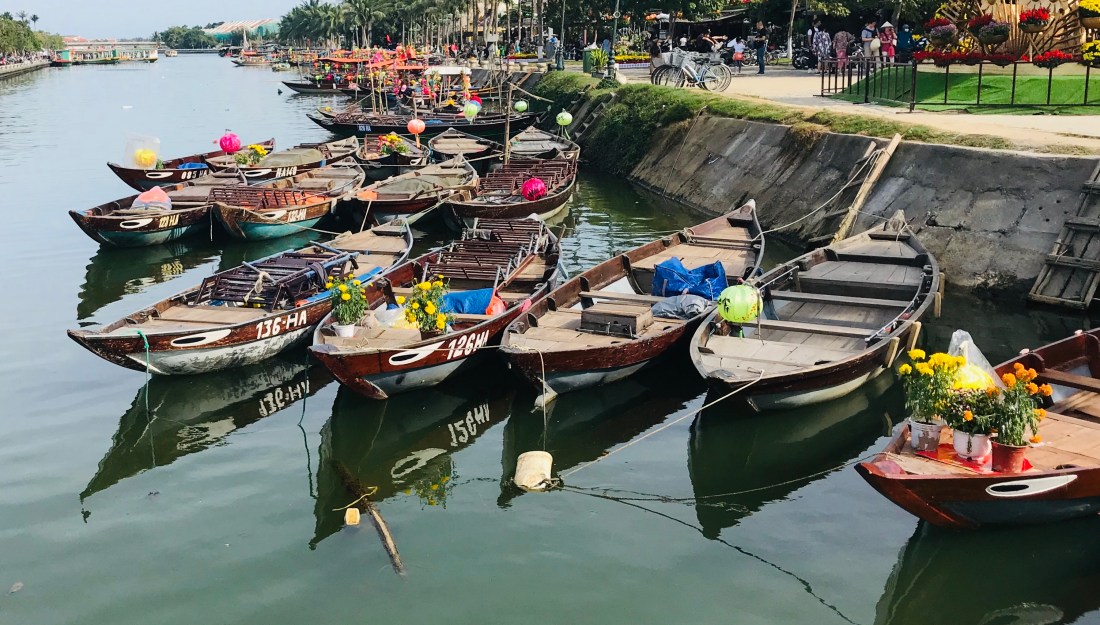
The Ancient Town is ablaze in paper lanterns gently swaying in the breeze. The bridge across the main canal is lit in gold and red. Thousands of people throng the cloth and tailor shops and cafes and restaurants. Some shops are already closed for business due to Tet. The owners and families and employees are sitting at long tables at the store front enjoying delicious dinners. Pots of yellow chrysanthemums (likely bought from the center of town where I was) adorn shop entrances. Row boats in the canal are being festooned with lanterns.

I find a quieter cafe and sit down at a table on the sidewalk and order a beer. It’s delivered by a studious looking 10 year old girl in glasses. I watch the world go by. Foreign tourists, locals, families, mostly walking, a few bicycles. Row boats slowly float by on the canal. The lady who owns the restaurant tells me that by tomorrow evening you’ll be able to cross the canal by stepping on boats. And that by the day after every flower at the market will have been sold.

I order an item that looks nice on the menu – stir fried morning glory and rice. When it arrives I am blown away by the simple yet exquisite taste and texture. This is what I’ll eat at least once every day in Vietnam. But this particular one will taste the best.

After a late and lazy breakfast at the hotel restaurant on the banks of the same river further downstream, I return with Jo and the kids to the Ancient Town. Everyone is stunned by the sidewalk flower market as I was last night. We stop at an ATM and I withdraw the local currency. I explain to Evan that you can get about 23,000 Vietnamese dongs for one dollar. Weak laughter, they are immune to dad jokes. I’m walking around with a million dongs in my pockets and I keep chuckling.

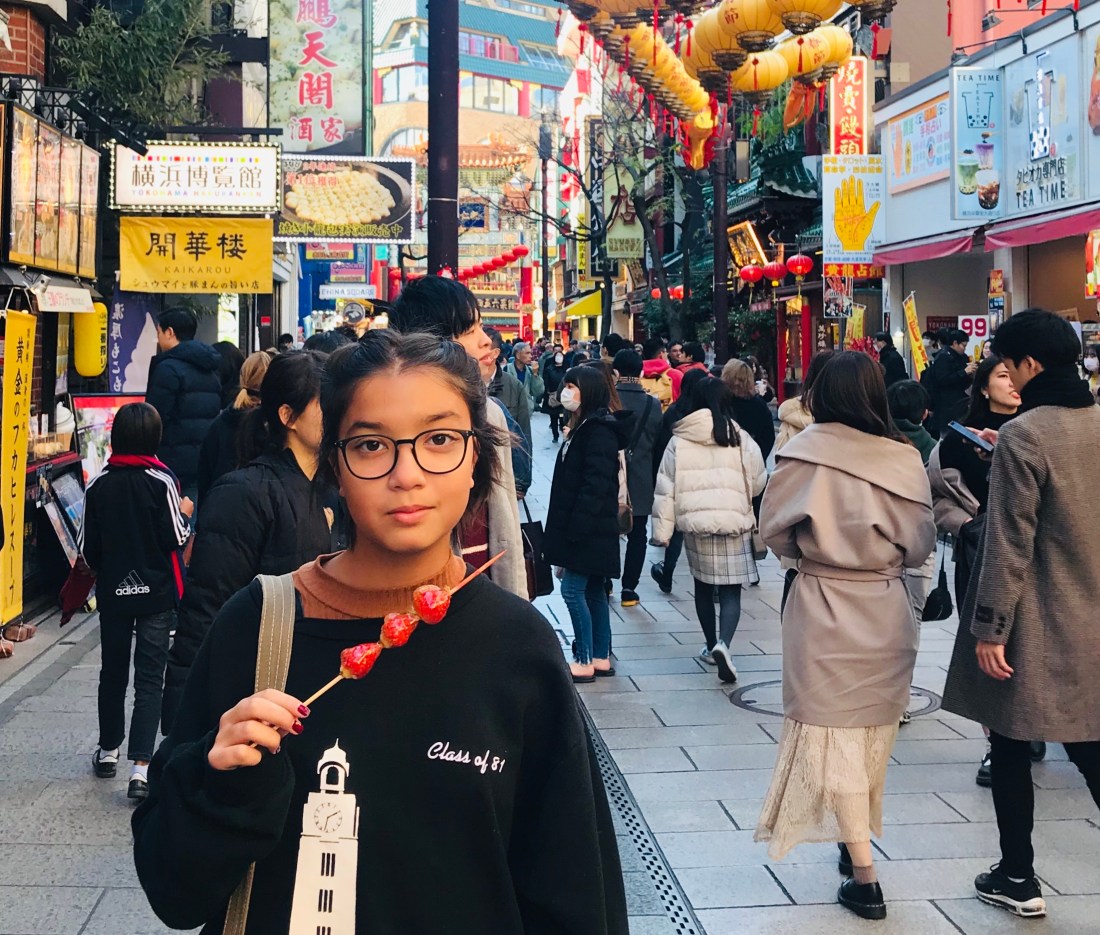
We wander around the narrow streets. The lanterns still look amazing in the day light, their bright primary colors punctuating the predominant yellow of most buildings. Vivian wants bubble tea. Jo finds a place on Google. It’s called Alley and Vivian declares that the brown sugar bubble tea is to die for. Evan is hungry so we go back to my cafe from last night and I introduce my family to the owner. Evan says that his pho is amazing. I can sense we are going to like it here.

We have plans to spend four days in Hoi An and then move on. There is so much to see in Vietnam. Ive been emailing with our friend in Austin who has family in Vietnam and she has given us a wealth of information. We can’t decide whether we should go to the famous Ha Long bay with its emerald waters and towering islands. Or Ho Chi Minh City to the south or Hanoi or Sa Pa where paddy terraces have been cut out of mountains. We punt and decide to stay put in Hoi An for our entire time in Vietnam.

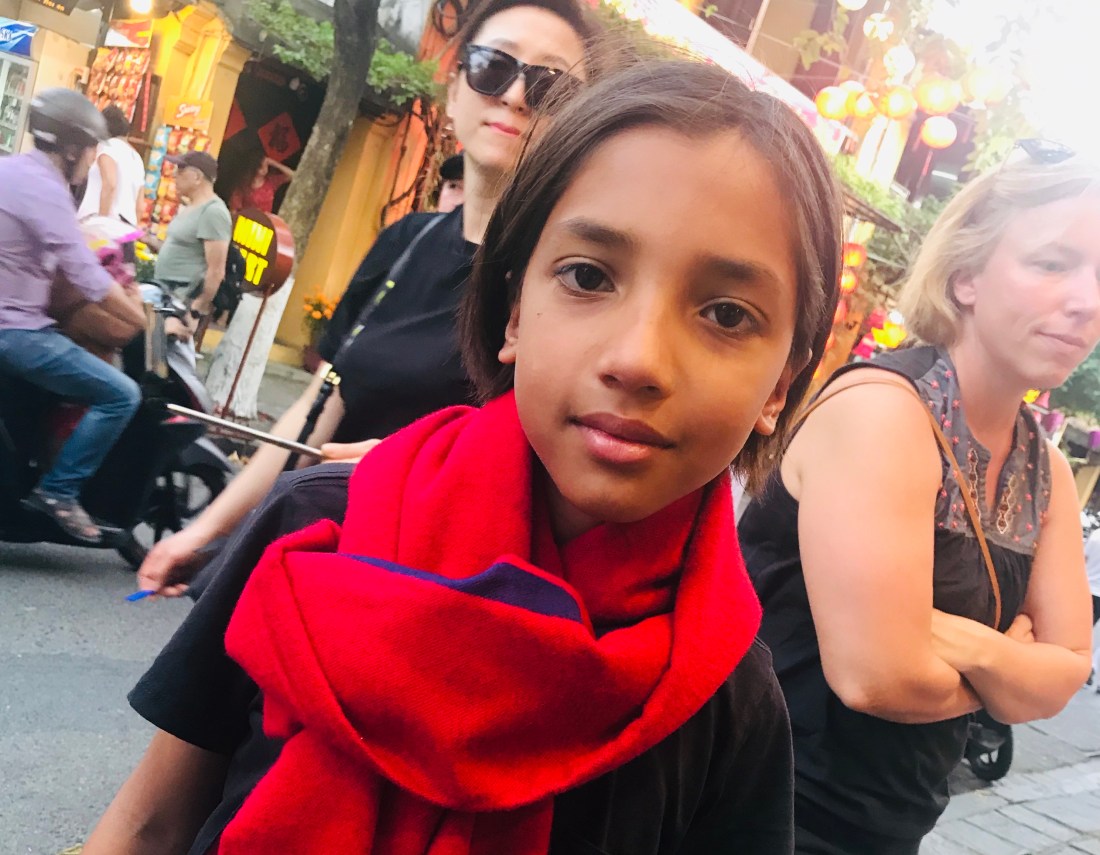
On the first day of Tet, many locals are dressed in red. Evan insists on buying a red scarf that he proudly wears everywhere. I learn how to say Chu mung nam moi and greet everyone over enthusiastically. Initially they wonder if I’m choking but then I’m warmly greeted back. The ladies are all dressed in traditional Ao Dais and look striking.

We return to the bubble tea shop everyday. Vivian and sometimes Evan and I have a bubble tea problem that Jo is immune to. The food is uniformly good everywhere and quite unusually, we all like it. I’m in stir fried morning glory heaven. Evan tries a freshly made heavenly banana and Nutella pancake on the street that the lady expertly makes with what look like two paint scrapers and a large flat griddle. We settle into a comfortable rhythm that is hard to find while traveling. The kids don’t see much of Vietnam but they know parts of Hoi An very well. We really enjoy our brief rest in this tiny but truly enchanting corner of Vietnam.

Approximately during this time news of nCoVid-19 starts penetrating JoEllen and my news feeds. The day before we leave Vietnam the WHO declares that the coronavirus is a global health emergency.

Siem Reap

Apparently Siem Reap wasn’t much of a place – just a collection of hotels to house the couple of million tourists there to see Angkor Wat. But guide books now tout Siem Reap as a destination worthy of a visit if you happen to already be there. Definitely a back handed insult. We went to check it out anyway.

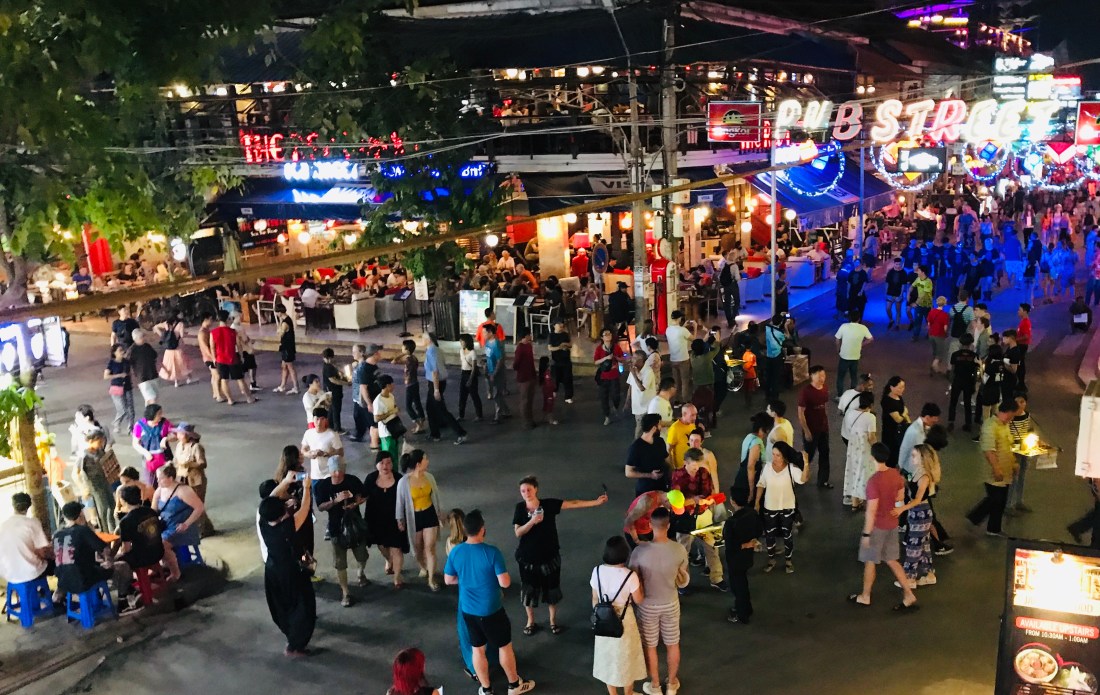
The food market was bustling. The night art market smelled like a tourist trap from even across the river, besides Evan was done walking and hungry by then. So we walked to Pub Street for a cold beer, hamburgers and wood fired pizza, all three of which were pretty good.
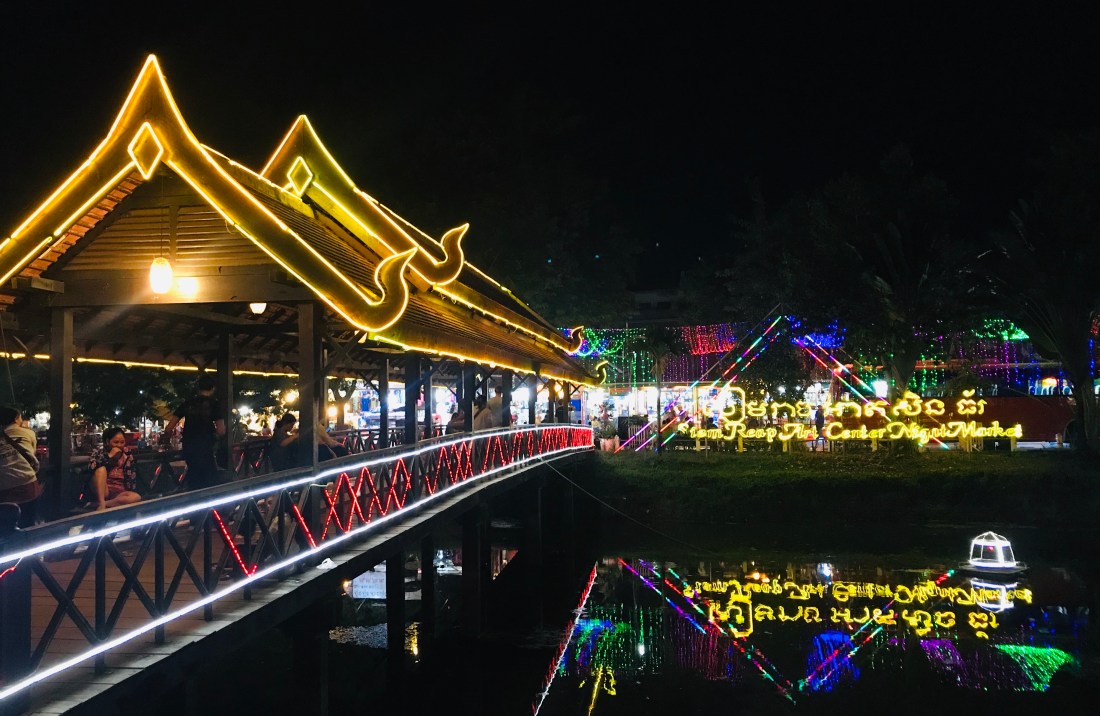
We sat on a open wooden veranda in the coolish night air above the street and watched the crowds. One group of black clad hip looking teens walked up the street rolling a giant speaker and amp. They set up shop below us at the crossroad and performed some dance moves to thumping music. A crowd assembled to watch. Then the kids distributed cards – probably invitations to a longer length event, we wondered – and rolled their act to the next intersection.

Besides Angkor, I knew of three other phrases that I associated with Cambodia – Pol Pot, Khmer Rouge, and the killing fields. During our few days in Cambodia I tried to piece together what Jack and bartenders and tuktuk drivers said about them.

The history of modern Cambodia is very complicated because of the large number of actors: French colonizers exiting stage left, the Americans in a loosing war with the Viet Cong in neighboring Vietnam, China striving to counter Soviet influence in South East Asia, the Cambodian royals, Vietnam itself post American war (as they call the Vietnam war over there), Marxist-Leninist communism, and Thailand. Everyone partnered with and (not or) fought each other in various permutations. They managed to kill millions of Cambodians over the course of two decades through civil war, coups, political purges, carpet bombing, infighting, land mines, old fashioned war, forced marches, torture, famine, and mass killings. During Pol Pot’s reign as Prime Minister in the later half of the 1970’s it is estimated that one in four Cambodians lost their lives. The population from the cities were forced to move to the countryside and work in farms. The sudden shift to agrarianism ironically led to massive food shortages. Everybody had to work very long hours in rice fields and money was abolished. Teachers, doctors and scientists were executed and every else had to undergo reprogramming. Nowhere else that we’ve travelled have we heard of such diabolical social experiments. Mugabe’s reign in Zimbabwe comes closet to the Cambodian disaster but falls well short by any misery index.

On our last morning I’ve gotten more used to hearing my name when people say good morning in Khmer. “Arun suasdey”.

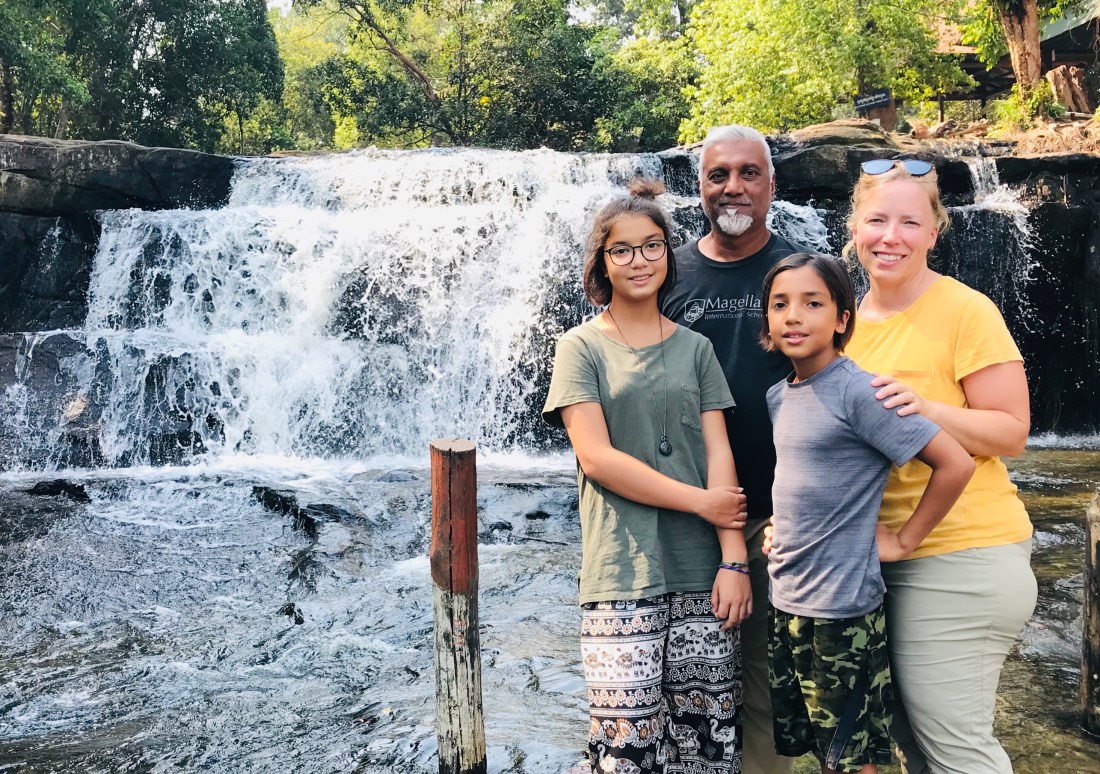
Jack is on time at the lobby, again. Three pick-ups on the dot. Whether he’s an exception or not, we now think of all Cambodians as very punctual people, which isn’t a common trait in south east or south Asia. Today Jack is taking us to a neighboring village. Our driver drove up a long winding dusty mountainous road which is one way towards the village in the morning and then at noon becomes a one way down from the village. We climbed a lot of stone steps to the top of a rock which has been sculpted into a giant reclining Buddha. Then we walked to a clear shallow mountain stream whose rock bed had been inscribed with a thousand Shiva Lingas. We saw Hindu pilgrims from India worshiping on the banks of the sacred stream. Then we walked downstream to a water falls where locals and tourists were changing into swimsuits and enjoying a swim. Vivian and Evan had enough of sightseeing and we headed back to town, but first stopped to buy some sodas and dried jack fruit. The Cambodian boy in the picture looks like he’s Evan age but he is the same age as Vivian. His mother was chatty but he blushed red and got very shy when his mother asked him to talk to Vivian.

We stopped at a nice roadside restaurant for lunch. Evan surprised the waiters by trying to eat all the rice he could get (he swears it’s the best rice he’s ever tasted). Then we headed to the airport and off to our next destination, Vietnam.

In 1978, Vietnam invaded Cambodia and toppled the terrible Pol Pot regime. They were welcomed by the people. But they stayed on as unwilling occupiers for the next ten years and soured their welcome. Add that to their historical enmity back from the times of the Cham kings invading Angkor Wat when the Khmers ruled over most of what is now Cambodia, Vietnam, Laos, and parts of Thailand. And so it appears that Cambodians don’t like their Vietnamese neighbors. They see Vietnam’s rising prosperity and tourism, and they recognize their demographic inequality (their 16 million to Vietnam’s 95 million), but almost everybody I spoke with didn’t like that we were going to Vietnam next.

Cambodia, even outside Angkor Wat is interesting. The people are super nice. Things are ridiculously cheap. We didn’t have to get any Cambodia local currency (Cambodian Riels). For transportation in tuktuks and street food, a dollar bill usually suffices, with no change offered or requested. Food is more difficult than Thai or Vietnamese cuisine with which we are more familiar. But hey, ask Evan and he’ll be happy to tell you the rice and chilly fish sauce is the best.

Cambodians seem to be at a restive peace with themselves. They have one of the longest ruling non-monarch head of state in the world – their Prime Minister has held that office since 1985, not without controversy. People, especially the young, are looking for change and opportunity. But the horror of modern Cambodia is a stark reminder to most that an unfulfilled peaceful existence is better than returning to a bloody strife.

Angkor Thom

I had an inkling that my family didn’t want to spend all day looking at eight hundred year old temples. So Jack and I had an afternoon session of more sightseeing while the fam chilled back at the hotel.

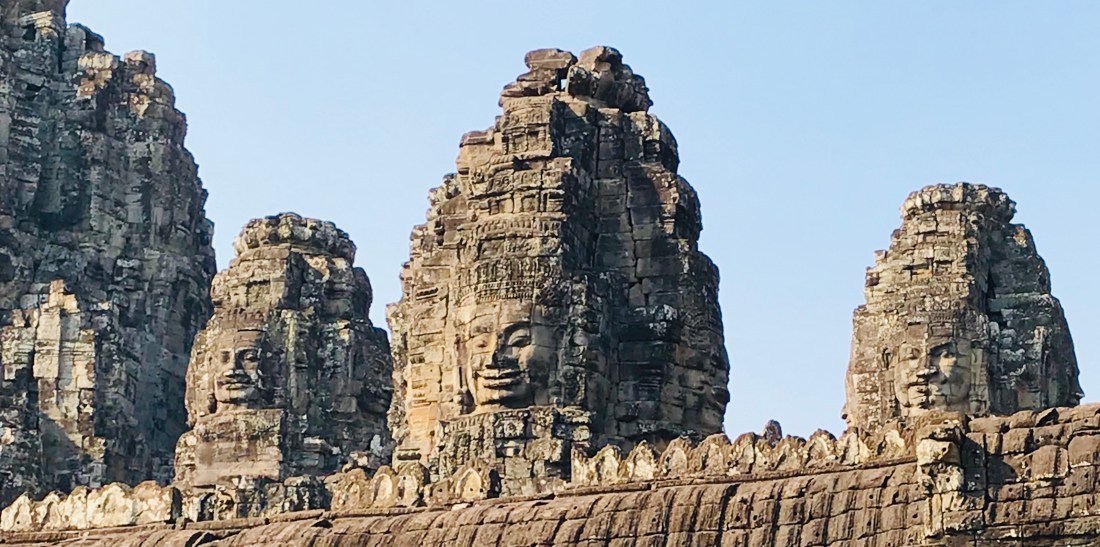
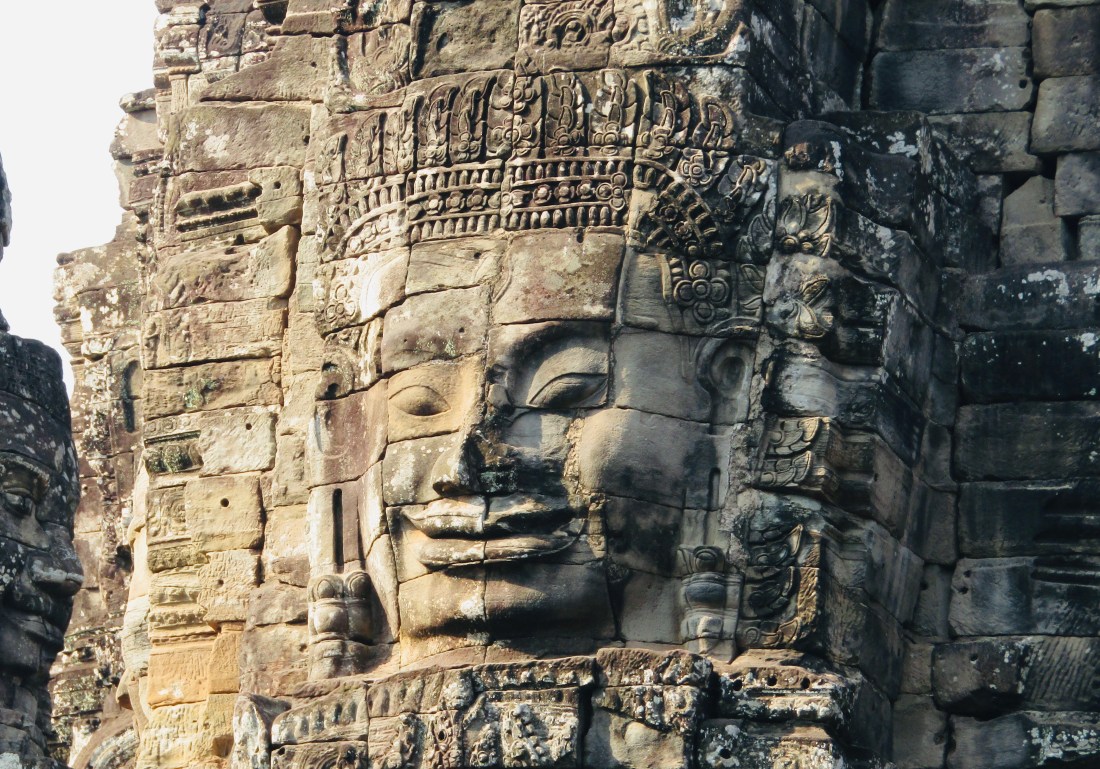
We started with Angkor Thom and it’s central temple, Bayon. This was Jayavarman VII’s answer to Angkor Wat. Bayon is a huge Buddhist temple and it’s striking feature is the 54 towers of stone, each with four serene giant faces on four sides.

There is some question about who the 216 almost identical giant faces belong to. Some think that they are an idealized version of Jayavarman VII’s face. If that were true he must have had a giant ego. He would surely have been a good friend of the Donald if they had been contemporaries. Others believe that the faces belong to the bodhisattva of compassion, Avalokitesvara.
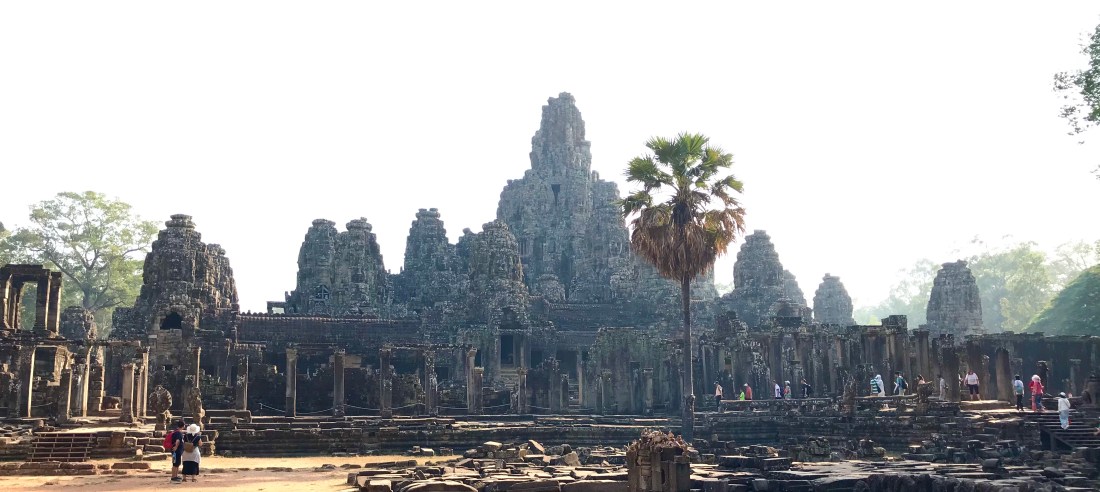
Whatever the truth, there’s something about seeing so many serene giant faces smiling down at you. I happily smiled back.

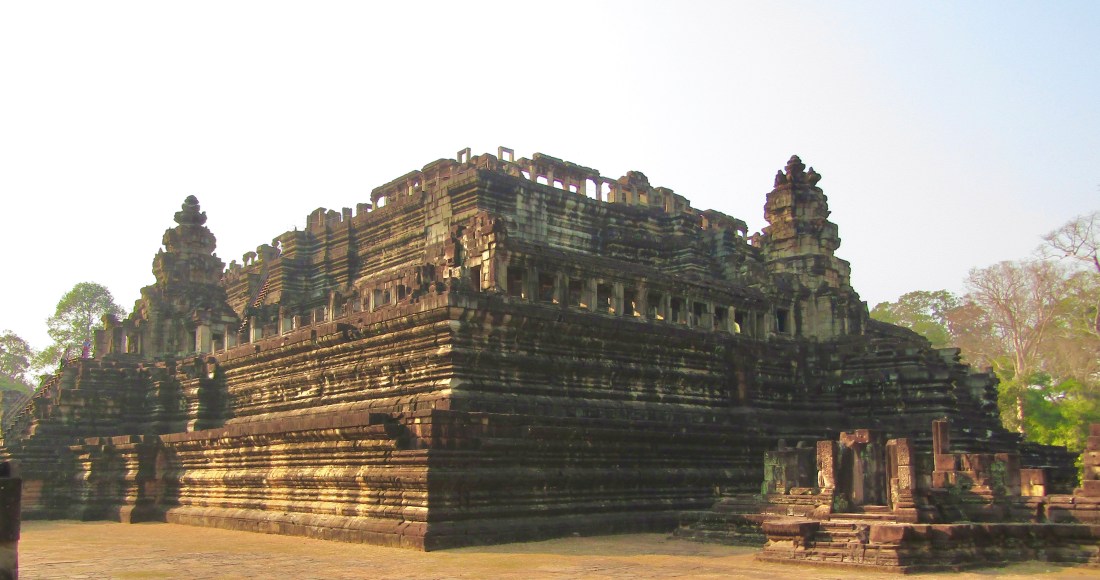
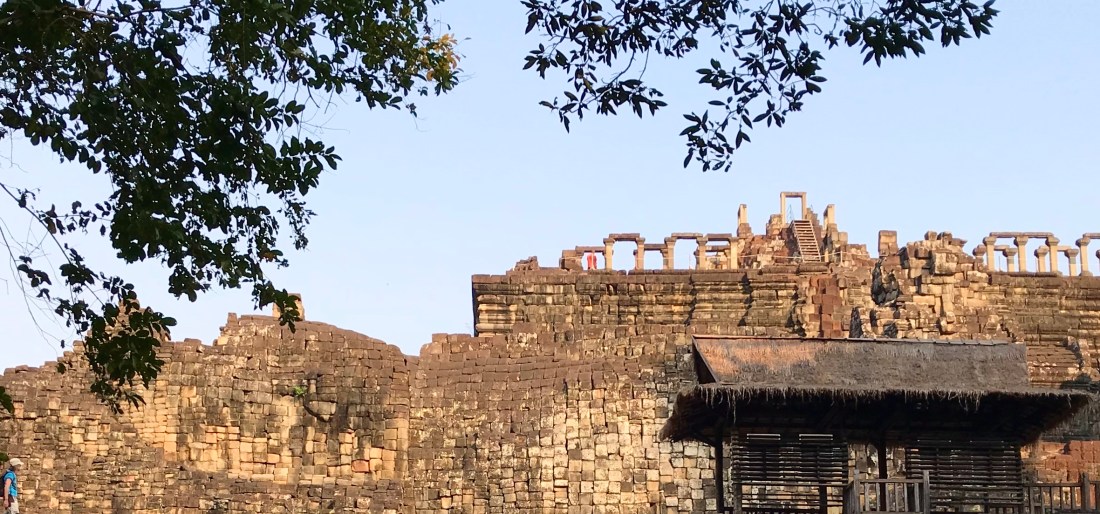
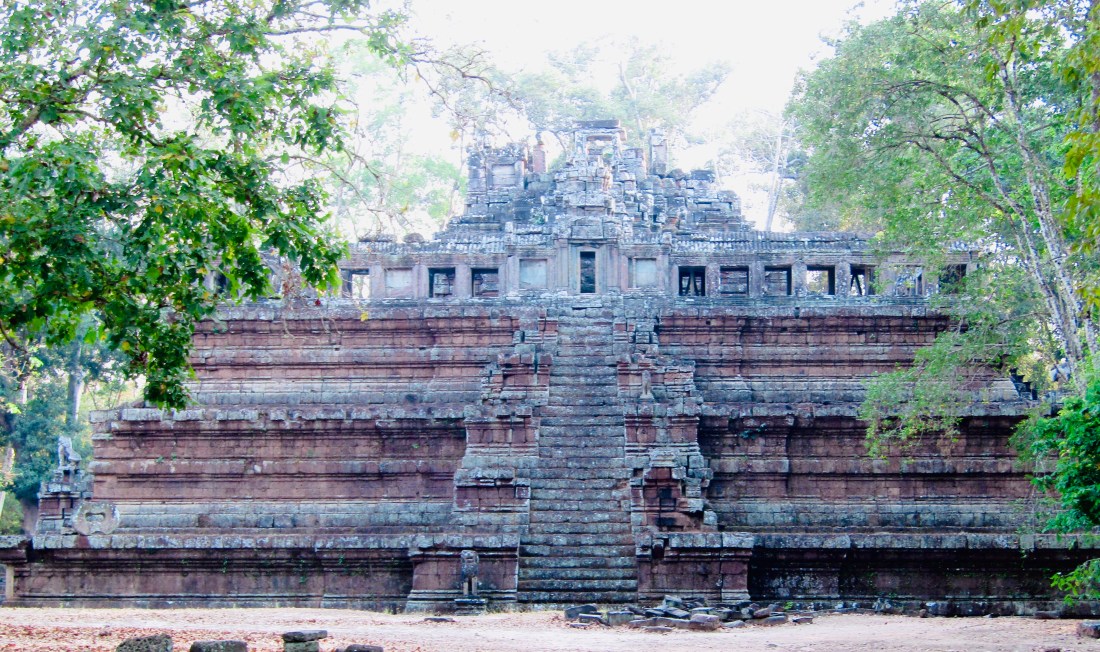
From Bayon we walked over to its older neighbor, the massive Hindu Shiva temple called Baphuon. Built to resemble the mountain home of Shiva, this man-made structure is almost as imposing as a mountain, with steep steps leading to what is the top now. An additional wood and bronze tower used to sit up here. The fashion show runway-like stone bridge leading up to the temple is the place to be photographed in Cambodia according to Jack and during our time here I saw multiple photographers and brides in spectacular wedding dresses hard at work.

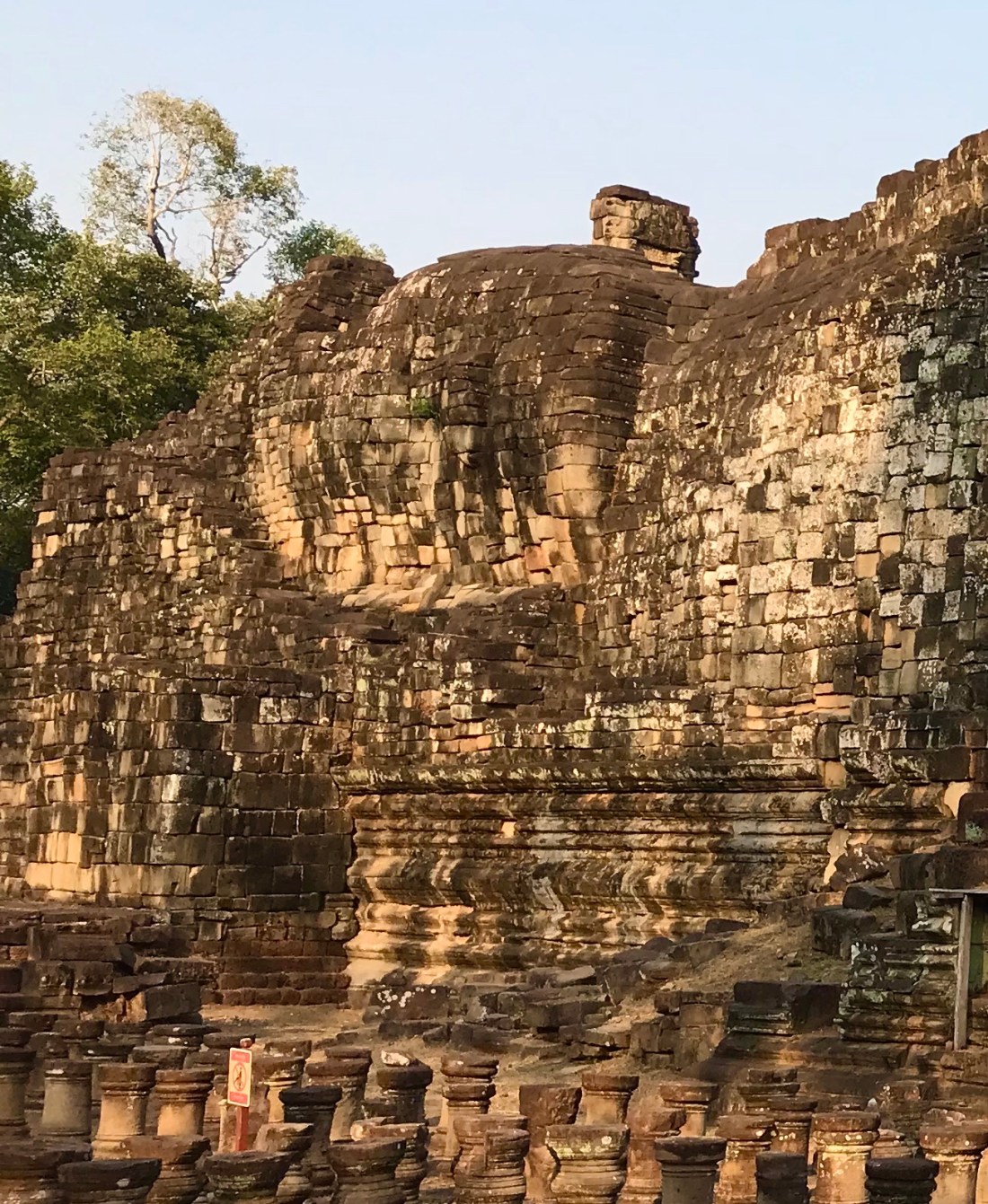
A few hundred years after it had been built, probably around the 15th century, the tides of religion turned again and the Buddhists reclaimed this Hindu temple. The whole immense northern wall was rearranged into a huge reclining Buddha. It’s hard to spot but here are a couple of photos anyway.

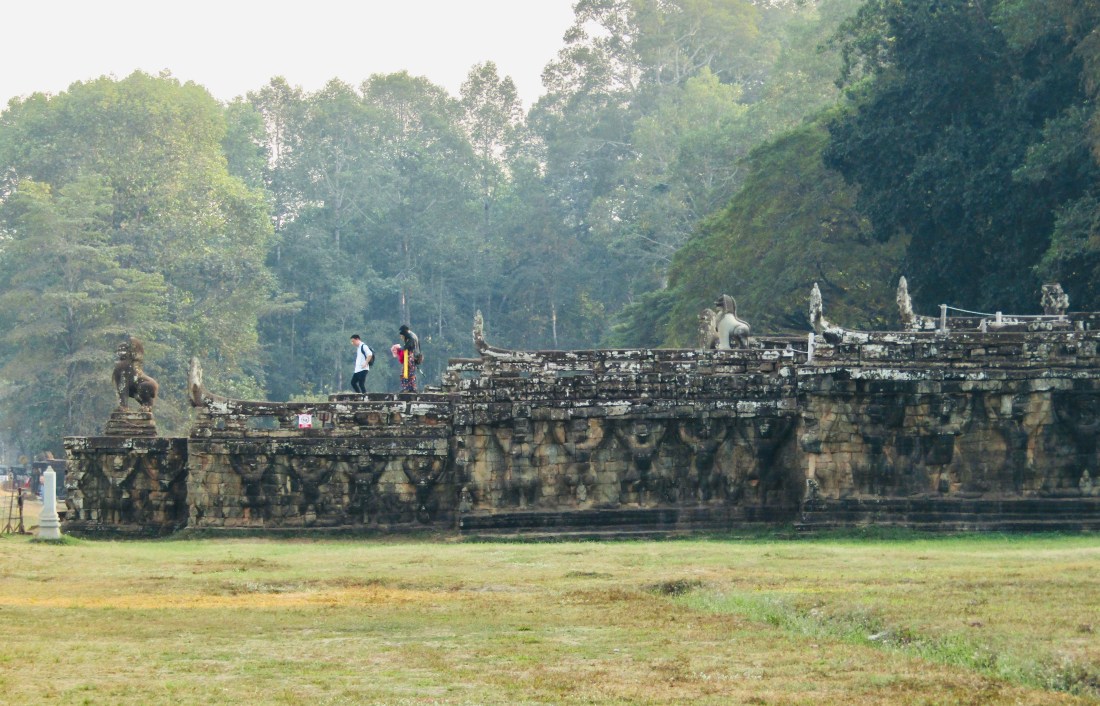
From here we walked to the next structure – the king’s palace and swimming pools and the elephant terrace overlooking a massive field from where events were witnessed by the royals.

We finished and drove out of Angkor Thom through the beautiful Tonle Om gate and over the moat.

The bridge over the moat is representative of bridges small and large and modern and ancient all over Cambodia. The rail on the sides consists of a series of humanoid figures holding a long snake between them. The head of the snake is a giant fanned and hooded multi headed thing. This is Vasuki, the king of serpents who is usually found coiled around Shiva’s neck.

The bridges memorialize one of Hinduism’s favorite stories when the gods used the snake to churn the oceans. My summary, most likely inaccurate: the gods were weak (probably due to something stupid one of them had done). They needed to drink amrit, the nectar of immortality, to regain their strength and power. But the amrit had to be churned from depths of the cosmic oceans. Only a heavenly mountain was big enough to be used as the churning rod, and only Vasuki was long and strong enough to be the rope to tie around the mountain and be pulled to and fro from both ends. But the gods were weak and couldn’t do this by themselves. Vishnu got them to ask the demons to help. The demons took the head end of Vasuki, leaving the tail end for the gods. Then Vishnu turned into an avatar, a giant turtle, on whose back the mountain could rest while it was churned back and forth. A lot of valuable things were churned up including the nectar of immortality. Along the way poisonous fumes from Vasuki’s mouth (the gods had tricked the demons into holding the head end of the snake knowing this would happen) destroyed most of the demons. More trickery was used by the gods to finish off the remaining demons. The gods got their nectar and lived happily ever after.

The moat under the bridge of gods and demons is beautiful in the evening light. In the distance amongst the lotus there are a couple of boats. I sit and look at this for a while imagining life here a thousand years ago. And just like that after a lifetime of waiting my day at Angkor Wat is over.

The Tomb Raider Temple

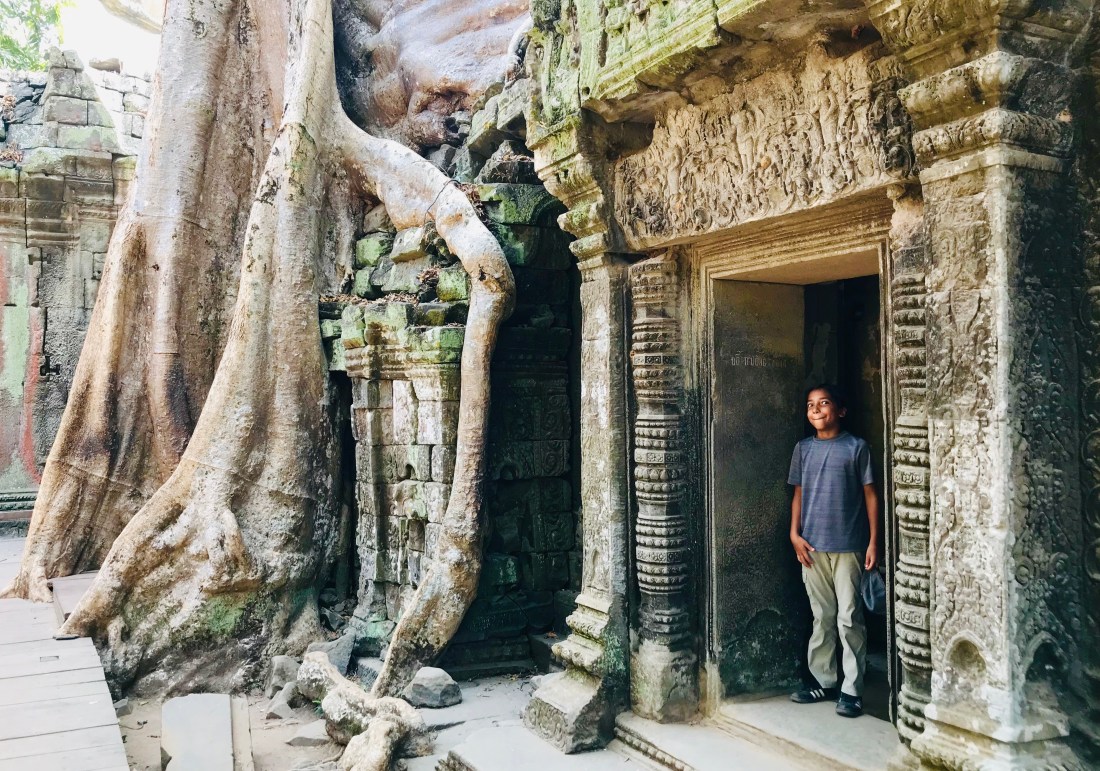
Yep. That’s what the guides call it. But the temple was very popular even before the movie. It is notable as one of the few big temples that has been left with giant spung trees sprouting out from the stonework. Early western historians had decided that the buildings were too far gone so they cleaned up around the moats but left the trees, roots and all, intact.

The modern name of the temple is Ta Prohm. Jack says that when the French man “discovered” the site there was an old Cambodian man sweeping the yard. He didn’t speak French. When asked what it was called, he told them his name, Ta Prohm.

Ta Prohm is huge. At one time, the monastery supposedly housed tens of thousands of monks. It was built by Jayavarman VII, one of the first Khmer Buddhist rulers. He beat the invading Cham who had sailed up the river from Vietnam and had defeated the Khmer army. The victorious Jayavarman became the Khmer king and went off on a building spree including 102 hospitals and other public works. Then he built the massive Bayon temple and the surrounding city of Angkor Thom, and several other temples including Rajavihara, the royal monastery, now called Ta Prohm.

The roots of the giant spung trees look like molten cake batter that has slowly oozed out of an overflowing cake pan and dripped down the sides of the ancient stonework, solidifying into graceful flowing patterns. Or I am hungry.

Jayavarman VII was Buddhist. The temple is Buddhist. But now it was the turn of the later Hindus to alter a few Buddha statues into Shiva lingas (vertical cylinders of stone with rounded tops, symbolic of Shiva’s penis).

So here is where I discovered another of Jack’s qualities. He loves taking photos of his clients using their cameras. In an instagram obsessed world that is a good thing. For me and especially Jo it was at times a bit much. But I learned the art of vertical pano and trick pano from him. Jack took the vertical pano photo of us and the two hundred foot tall spung tree. I took the trick pano of Evan at two places at once! Vivian and Evan recalled that my friend Sharath had used the same vertical pano technique in Bhutan, but a bit more laboriously than Jack.

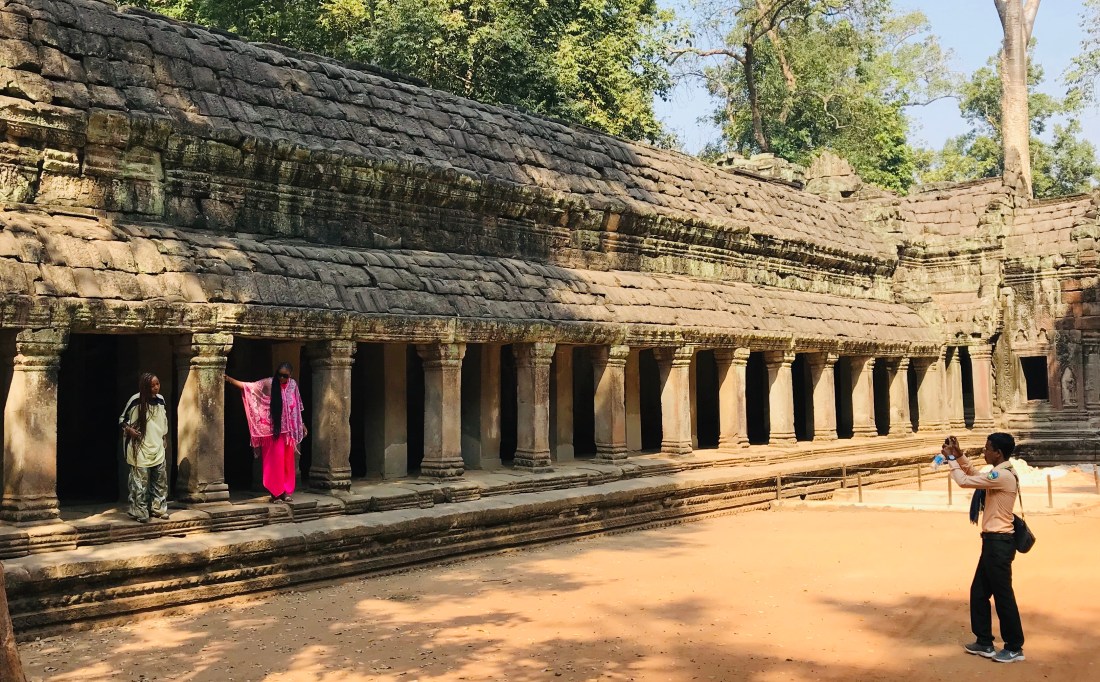
Other visitors noticed Jack’s aptitude with the camera. Here is a photo of Jack taking a photo of a couple of tourists who asked if he could photograph them. This photo shows a relatively intact portion of the temple. It has been newly reconstructed by the Archeological Survey of India who have partnered with Cambodia to help stabilize and reconstruct portions of Ta Prohm. In other spots around Angkor, we saw groups of archeologists and historians from Japan, Germany, France, and other countries hard at work putting these giant 3-D puzzles back together again.

By now Vivian was hungry and on the verge of being hangry (which also explains why she’s in fewer photos). Jack hurried us through short cuts at the temple and we walked back to the car. Along the way we found a group of Cambodian musicians playing under a tree. They had lost limbs to land mines, and had a sign that said that instead of begging they were making music and accepting donations.

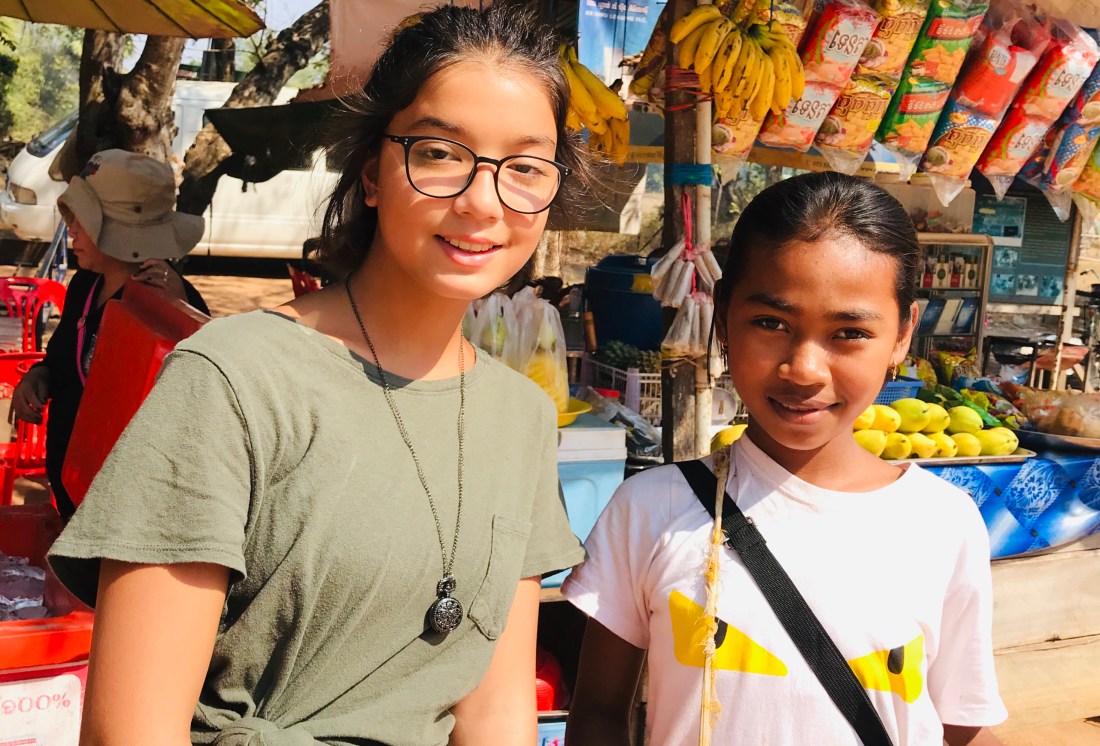
At the car park an enterprising young girl Vivian’s age helped us buy snacks and sodas, interpreting for the elderly owner who didn’t speak English. We met this girl for just a moment but she made an impression. We wondered about her life and what she’d grow up and do. In a different world would she be class president and play the lead role in the school play and then later star in a movie like the Tomb Raider set in a distant exotic land?