Konark

Orissa, now (and before the careless mispronunciations of the British Raj) known as Odisha, is a state in India famous for its ancient temples. In Old Bhubaneswar, there’s a working temple or the archeological ruins of a temple around every corner. The temples are beautifully constructed in the Kalinga style, with a tall beehive / sugar loaf shaped main sanctum, preceded by three pyramidical roofed outer halls, and a huge surrounding courtyard, all made out of intricately carved sandstone. Here’s a picture of the Rajarani temple we visited after sunset on our first evening in Odisha. It was built in the 11th century and is an archeological site now.

The star attraction for me is the Konark Temple. The Lingaraja temple and the Jagannath temple are visited by many more pilgrims and are in far better shape, but they are off-limits to non-Hindus. No one asks unless you don’t look Hindu. Jo doesn’t.

The Konark temple was built around 1250 CE to the Sun god. Most of the temple is gone but what remains is still definitely worth visiting. It was built on a huge stone platform with stone wheels and horses to resemble a gigantic chariot. Alu and I visited Konark with my parents when I was a bit younger that Evan is now. I still recall the amazement I felt.

We get there late morning and it is already hot and humid. Sharath secures a guide and we dutifully pretended to listen to his rambling but distinctly non historic history about the construction of the temple. Then we proceed to get a guided tour around the massive stone chariot base in a clockwise direction.

And then things get tricky. Many of the carvings are from the Kama Sutra. Our guide proudly says “man and woman making love, polygynous, polyandrous, lesbian, everthing”. I wonder how my parents navigated the visit with two prepubescent boys 49 years ago. I’ve never heard a word about sex or anything of a sexual nature ever pass my mother or father’s lips in the presence of their children. Then we get to this sculpture.

And the guide said “69”. To which Evan say, without even caring to look at it, “Wow. There are so many sculptures and he knows this is the 69th one. Why is this one famous?”. Jo replies that he would need to be a bit older before he understands. Behind poor Evan’s back we joke about the moment he gets it. “Oh – that’s why the guide said 69!”

We wander past twenty foot tall walls laden with carvings of long phallused men and sensual women in every imaginable sexual position. This temple was built as an offering for fertility which may explain why. Vivian is quite stunned by the display. The guide is subtle with his descriptions till he finds Sharath and me alone, separated from the women and children for a few minutes. Pointing to a carving directly in front of our eyes he starts “and here she is sucking his penis while the other woman is….”. I hurriedly rejoin the women and children.

Konark, in spite of, because of, or independent of the sexually explicit carvings, is beautiful. After Konark we have a nice lunch at a breezy beachside restaurant – tandoori whole Bhetki (red snapper) and beer and rice and prawns. Then the non-Hindus 😂 return to Bhubaneswar in one car while the rest of us (😂😂) proceeded to Odisha’s most sacred site – the Jagannath temple in Puri. That is a cultural experience and a whole blog post by itself. Late evening we return to the mall in Bhubaneswar that belongs to Sharath’s friend who planned and hosted our trip and stay in Odisha. I got the kids some food to go from the food court (momos and masala popcorn chicken) and bought myself a pair of pants that they re-hemmed in 10 minutes. It’s nice to walk around a mall where you’re a friend of the owner. The day before, we even sat down for 10 minutes of a movie in a luxury three-screen movie house on the second floor.

Indians are by and large a dour lot when you pass them on streets or run into them casually. Bank tellers, immigration officers, or retail store cashiers see no need for a forced professional perkiness. When I first arrived in the US more than three decades ago and spoke to the AT&T operator (that’s how long ago) I was always surprised by her sincere-sounding but fully-scripted gratefulness for my “using AT&T”, which at that time had a virtual monopoly on long distance international calling. Back at home the implied attitude would have been “fuck off and don’t disturb me again”.

But Indians who you may meet even indirectly through someone else’s friendship are your friends. They invite you in to their homes and dinners and parties and vacations with a sincere and genuine friendliness that is unique.

At the end of our visit to Odisha, I think Vivian and Evan will remember that more than the temples. That and the 69 carving.

Diwali in Hyderabad

Back in 1912, Sarojini Naidu described the bazaars of Hyderabad beautifully.

In The Bazaars of Hyderabad

What do you sell, O merchants?Richly your wares are displayed.Turbans of crimson and silver, Tunics of purple brocade, Mirrors with panels of amber, Daggers with handles of jade.

What do you weigh, O ye vendors?Saffron, lentil and rice.

What do you grind, O ye maidens?Sandalwood, henna and spice.

What do you call, O ye pedlars?Chessmen and ivory dice.

What do you make, O ye goldsmiths?Wristlet and anklet and ring, Bells for the feet of blue pigeons, Frail as a dragon-fly’s wing, Girdles of gold for the dancers, Scabbards of gold for the kings.

What do you cry, O fruitmen? Citron, pomegranate and plum.

What do you play, O ye musicians?Sitar, Sarangi and drum.

What do you chant, O magicians?Spells for the aeons to come.

What do you weave, O ye flower-girls? With tassels of azure and red? Crowns for the brow of a bridegroom, Chaplets to garland his bed, Sheets of white blossoms new-garnered To perfume the sleep of the dead.

What do you code, O ye developers? In Ruby, Python and R.

What do you sell, O ye Apple Store? The iPhone 11 is a star.

How are you, O ye Hyderabad? The traffic runs amok. The air quality isn’t great. But we are in luck. ‘Cause it’s better than Delhi’s. So nobody really gives a fuck.

Not withstanding my poor rhymes things are getting better in my original hometown. The metro is running which has taken some traffic off the roads and most importantly the busiest streets aren’t dug up. The air is better at least around Diwali time. And the younger generation does give a fuck.

With Jo and my style of no-planning-ahead planning, we could have ended up anywhere on Diwali but we really did try and it worked out. The kids were here for Diwali back in 2011 when my Dad was still alive but they don’t remember that any more.

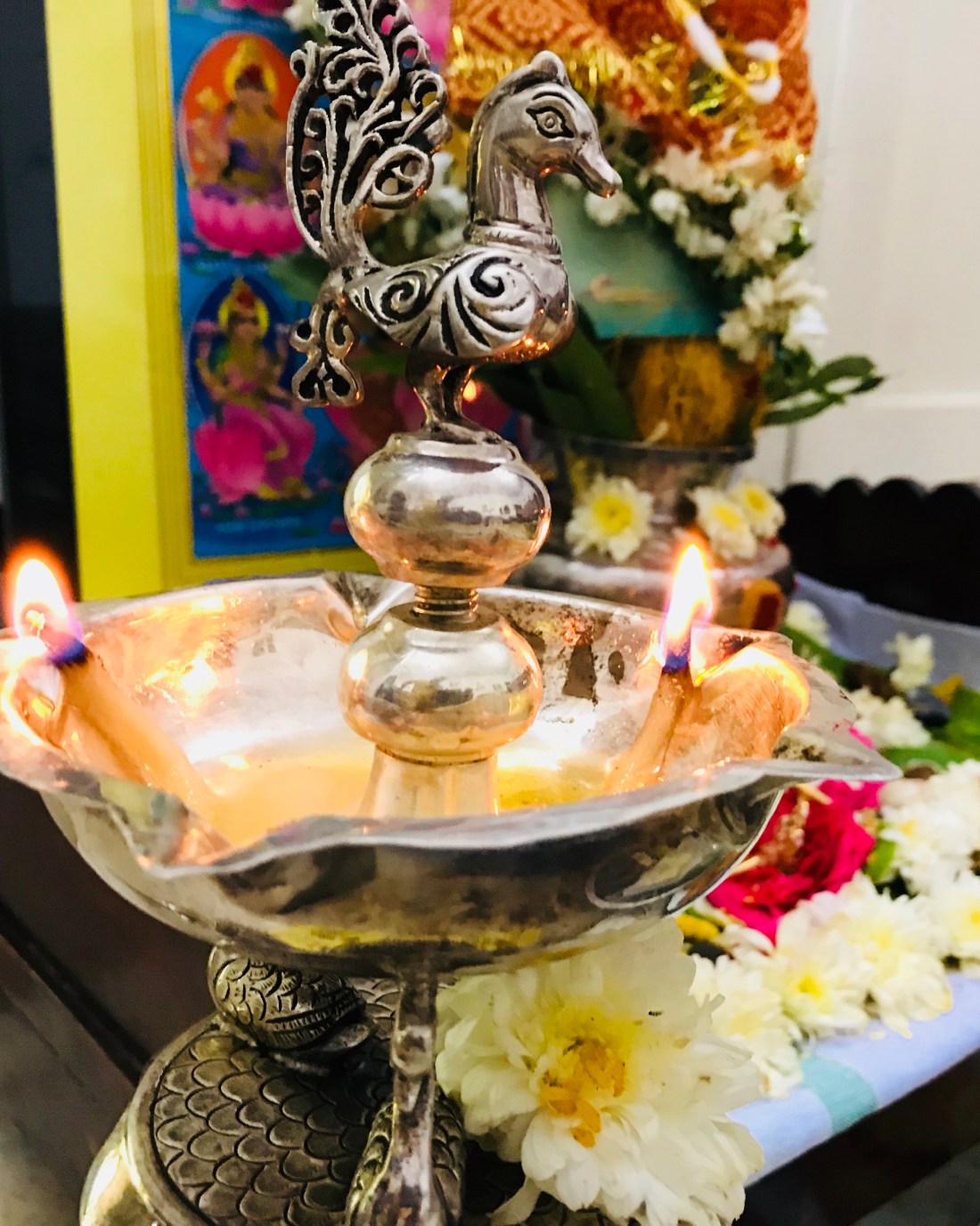
The sheer quantity of firecrackers are a fraction of what they used to be. They pollute the air so the next generation of Hyderabadis are using them sparingly. The noise is a sheet of continuous rolling thunder for hours instead of days. The sky is lit up in flashes now instead of solid mid day at night. The air, while cleaner, is still full of celebration. We started the morning with Laxmi puja and ended after midnight at Kali pujo.

The Choudary’s gave us new traditional clothes for Diwali. Partha helped Evan set off firecrackers. Jo played DJ and showed off her cool moves, aided by a nice bottle of wine. The kids convinced Sharath (pretty easily) to buy them Budhi-ki-Baal (old lady’s hair, or cotton candy) at the midnight Kali pujo fair. And Messi is the only dog I’ve known who didn’t give a shit about fireworks exploding everywhere.

Happy Diwali to your family from ours. May your days be filled with light and happiness.

Mykonos

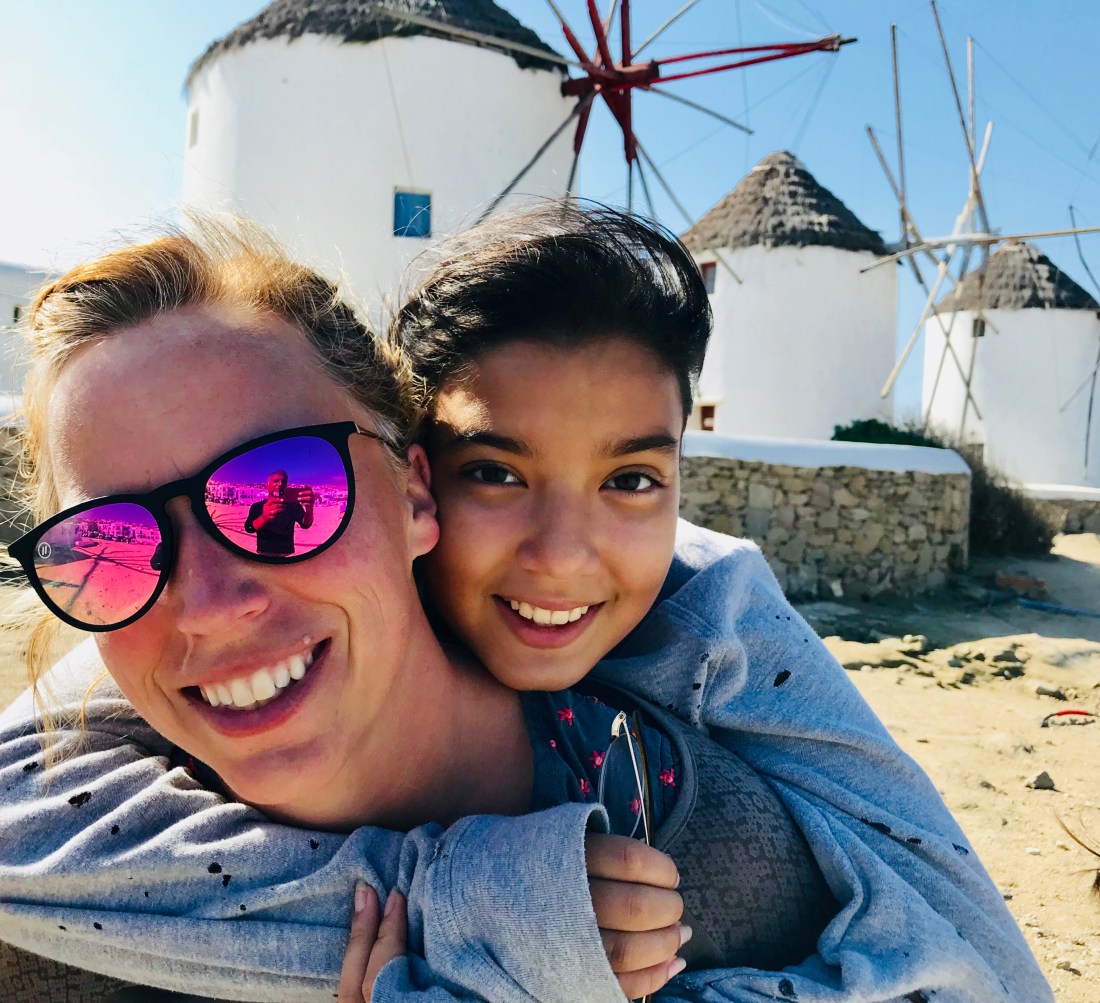
A few days before our Nile cruise was to end we searched for where to go next. Rain was forecast in Goa, Kerala, the Maldives, and Seychelles. So we booked tickets from Aswan to Cairo to Athens to Mykonos where it wasn’t raining and spent a week doing nothing on the beautiful Cycladic island.

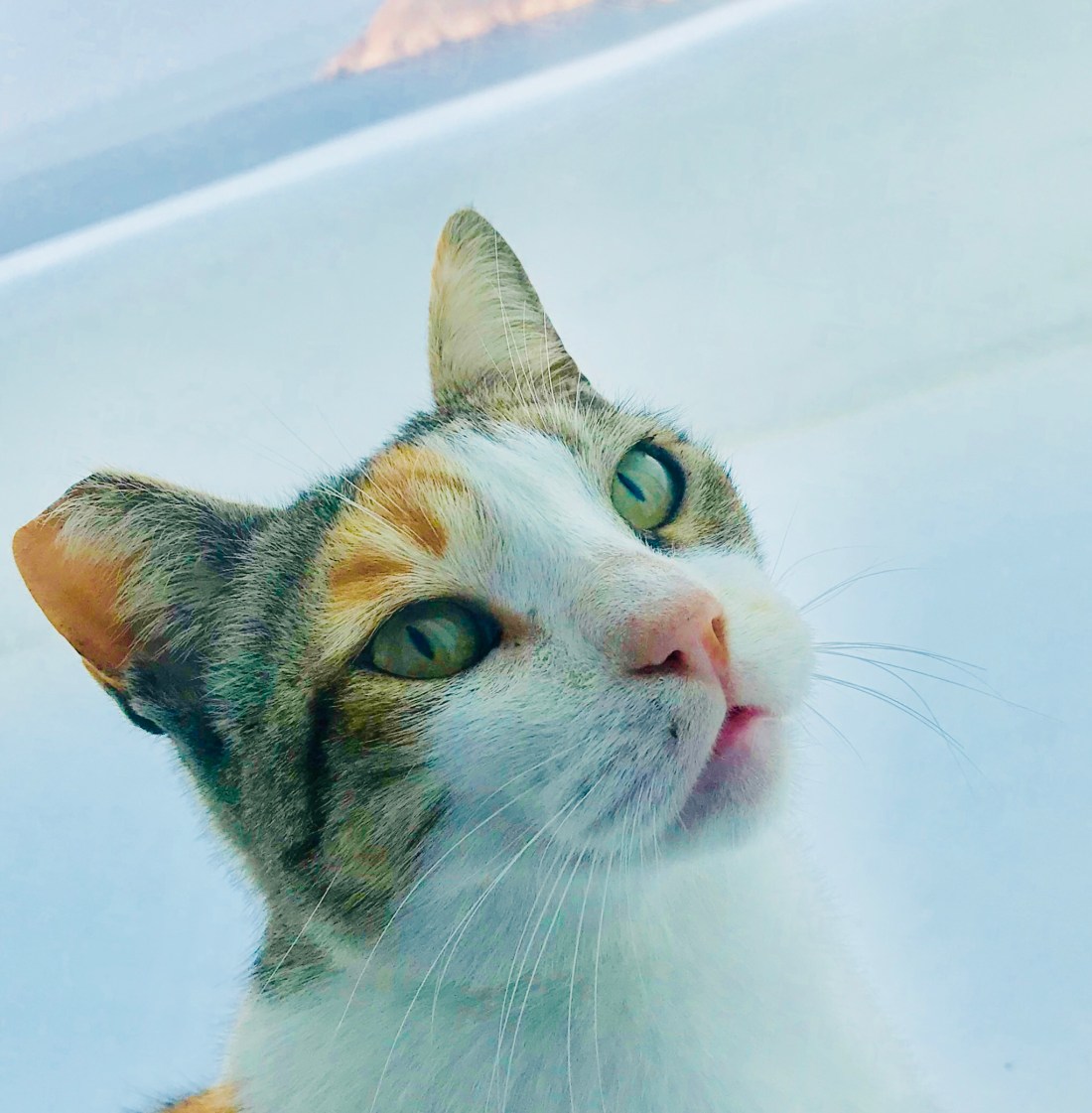
There is something fishy going on between cats and the Greeks. Athens was full of thousands of the cutest cats. We found cat food carefully put out on street corners. It was the same at Mykonos. Our neighbor and landlord had several beautiful kitties. One particular fellow sat outside our door or on our kitchen window for a week, meekly coming in a few times.

Desert Ramblings

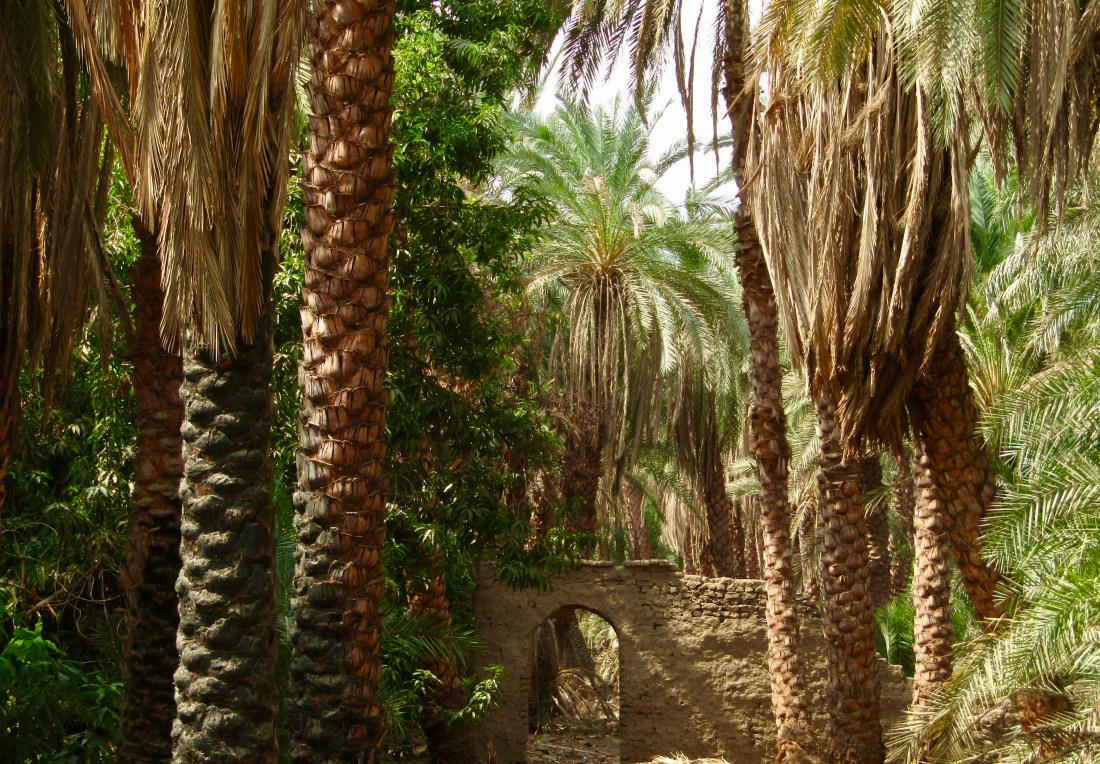
As we slowly sailed up the Nile propelled by gentle warm breezes, the kids had the opportunity to observe life in and around the river. Geographically Egypt is simply the desert plus the Nile. There is a drastic and sudden transition from one to the other, from fertile greenery to stark desert.

The annual rainfall is 1 mm. We witnessed a smallish sand storm from our dahabiya. It ended with a few drops of rain. This may be the entire year’s rainfall. Where there is no Nile water, there is nothing. But life around the Nile is lush and filled with water.
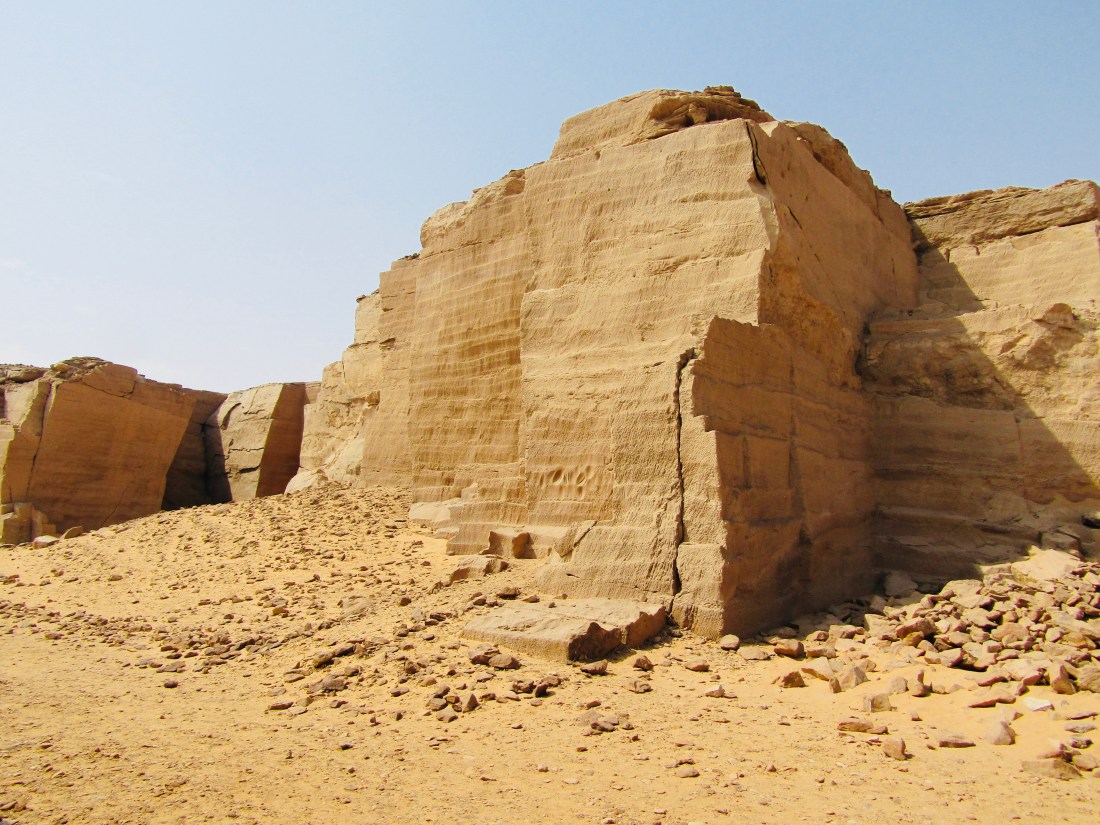
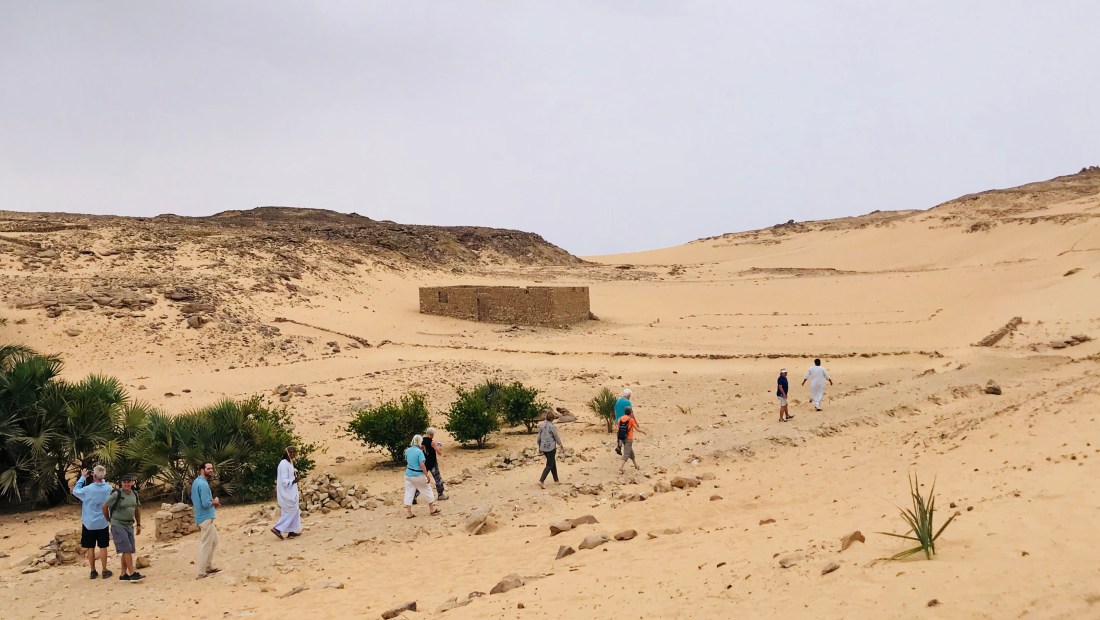
A few steps past where the greenery ends, we visited the sand stone quarries at Gebel el-Silsila. On both sides of the Nile, during the New Kingdom, workers armed with bronze chisels and hammers and wooden wedges chipped away at sandstone. Closely spaced chisel groves mark the efforts of workmen 3500 years ago as they painstakingly quarried the desert one block of stone at a time.

When you see a massive ancient structure like the Great Pyramid or the pylons and obelisks at the Karnak temple, you cannot help but think of the engineering that went into creating them. A few thousand years ago the available tools were ropes, pulleys, levers, logs, skids, sledges, and ramps. And humans and animals to power the whole thing.
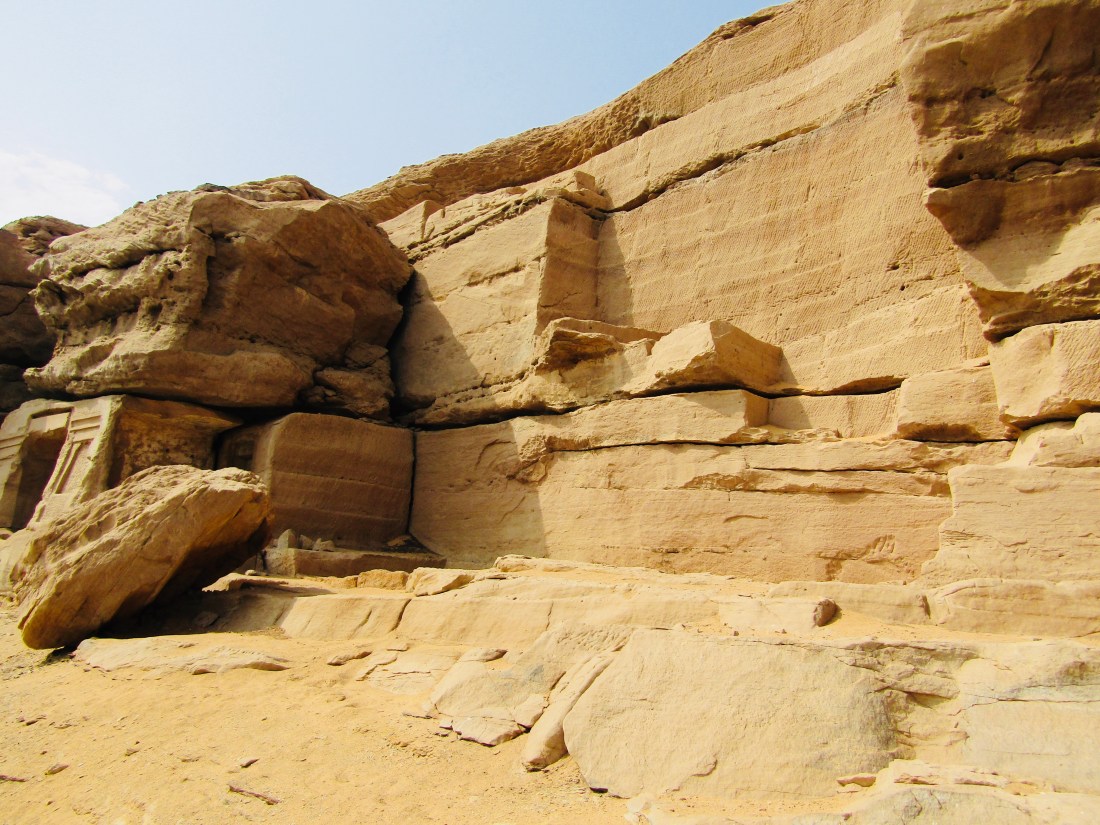
Nearby, hollowed out rooms in the rock served as offices for accountants. Workers were paid by measuring how much less their bronze chisels weighed. More wear indicated more work. There are inscribed rules for holidays and time off for family weddings and funerals. The pharaohs visits to the quarries from their cities many miles downstream, supposedly to thank the workers for their work, are marked on temple walls. Archeologists are still uncovering burial chambers and worker villages. Burials show carefully preserved mummies along with beer and bread for the afterlife. Similar discoveries have been made in the Luxor necropolis and in Giza at the site of the Great Pyramids. Our guides went into long spiels about how the quarry workers, craftsmen, and artisans felt they were doing God’s work and were held is high regard in society and how they were well paid. There was plenty of slavery during the Pharaohs but the prevailing academic opinion is that the workers were not slaves. Here’s an excerpt from the National Geographic (https://www.nationalgeographic.com/history/magazine/2017/01-02/egypt-great-pyramids-giza-plateau/)

Yet these laborers, far from being slaves, were privileged civil servants, and beneficiaries of a number of enviable perks. Analyses show they enjoyed a protein-rich diet, practically unheard of among the rest of the Nile Valley’s inhabitants. Evidence that broken limbs and fractures had been set correctly strongly suggests adequate medical care was provided.

This is in direct contrast to my perception about how the Egyptians monuments were built. I picture thousands of slaves pulling and pushing giant blocks of rock while being brutally whipped by burly taskmasters who ripped away slave women’s clothing while throwing their babies in the air. An exhausted slave falls to the ground and is crushed slowly to death under a giant moving stone block. Another slave stops to comfort and grieve and he’s beaten soundly. The work goes on.

This is the Hollywood Egypt Slave Meme. It turns out that Herodotus, the Greek historian who lived a thousand years after the New Kingdom, could be the creator of the slave meme. And then there’s a certain popular book about an exodus. I have read neither Herodotus’ history book, nor the good book.

The Egyptians are trying hard to change my perception. But calling bullshit on the founding myth of an entire people is controversial.

So I googled it because that’s how you become an expert, right? Back in 2001, a Rabbi David Wolpe who is considered among the most influential Jews in the world said, in a sermon on Passover’s eve (the man had a sense of timing!) that archaeologists had not found evidence in the desert to support the biblical account of the Israelites’ exodus from Egypt.

Here’s an excerpt from the NYT: (https://www.nytimes.com/2001/06/02/us/religion-journal-a-rabbi-s-look-at-archaeology-touches-a-nerve.html)

In raising this subject, Rabbi Wolpe was hardly revealing a secret about contemporary archaeology. For a decade, a growing number of Israeli archaeologists have been quite public about their work, which has generated controversy in Israel and which includes discoveries that have led to another theory, that the Israelites gradually emerged as a people from among the Bronze Age population of Canaan, rather than militarily conquering the land, as the Bible tells.

Having said that, the good rabbi had to do some fudging with words like “spiritual truth” and “historical fact”. Truth and fact apparently aren’t the same, especially in the realm of faith.

I googled some more and found this on a website called Bible Inspectors. They link 11 articles related to whether Hebrew slaves built the pyramids. Not interestingly the answer depends on your religion and your religiosity, and are neatly categorized as “Christian Answers”, “Jewish Answers”, and “Secular Answers”. I was looking for “Correct Answers” and whatever the opposite is (“Spiritual Truth”, perhaps). Here’s the website:

https://bibleinspectors.com/posts/2016/5/18/were-the-hebrews-actually-held-as-slaves-in-ancient-egypt

There are people in this world who deny the Holocaust even when the horrible facts are undeniable. So I wondered if the questioning of the story of the Exodus is like that. But I stopped googling when I started running into Egyptian slave fandom websites (you don’t have to look too hard) and other opinions from the fringe that attempt to explain African American slavery as a side effect of white people enslaved in Africa. This was too far down the google rabbit hole for my poor atheist brain.

So I’ll give up my amateur research and end with some ageless and priceless graffiti I found inscribed on the ancient sandstone cliff walls of Gebel el-Silsila, a sign of thinking men everywhere. Somethings never change.

The Nile

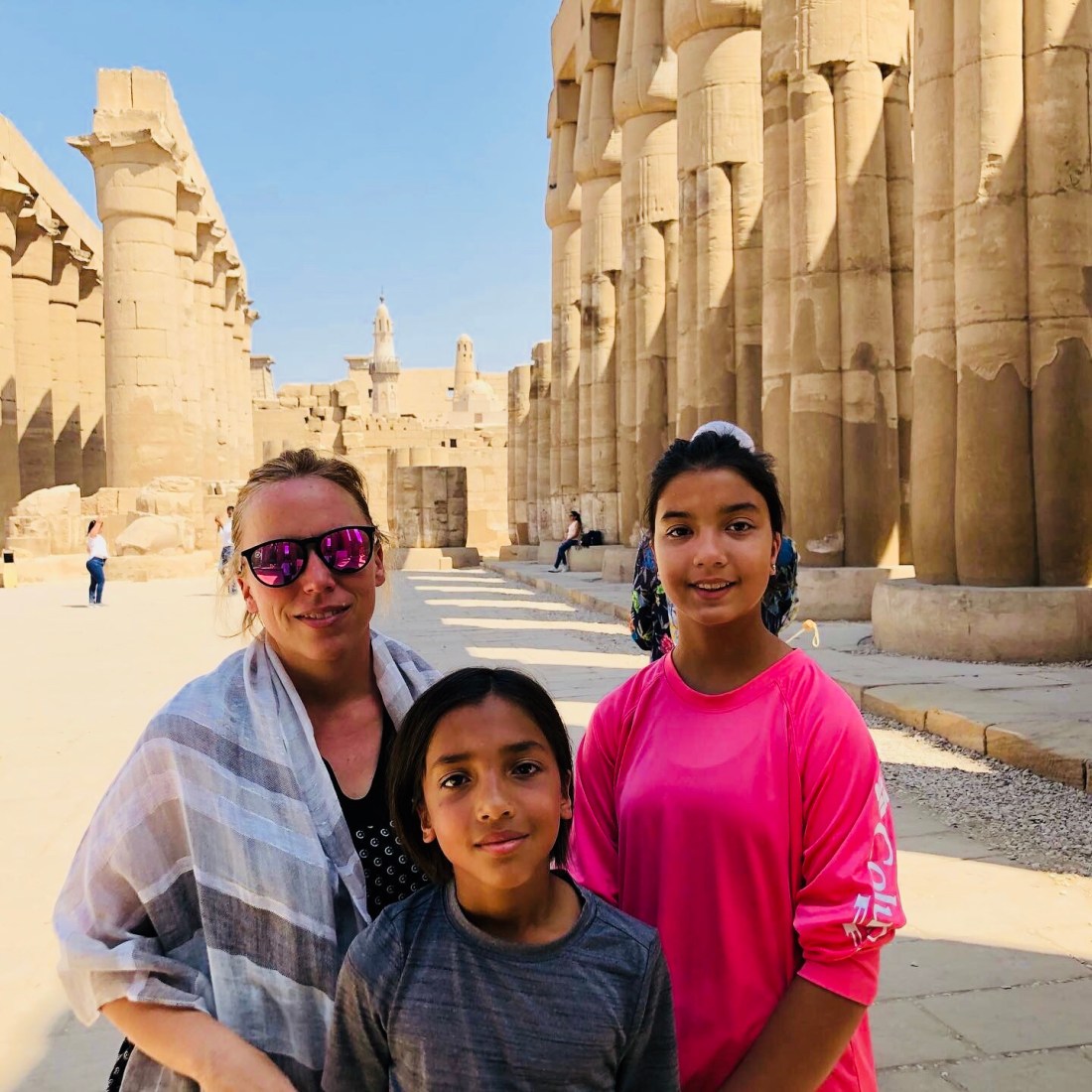
We landed in Luxor (“Lu” as in Lulu – “ks” along with a clearing of the throat – “oh”) before breakfast and it was already hot. Luxor, later known by he Greeks as Thebes, is literally the greatest open air museum you can imagine. This is the region of the Upper Nile (remember, the Nile flows northwards) and the people here look like their Lower Nile counterparts from Cairo but with skin as dark as mine.

We don’t have enough time to see everything in Luxor. So we agree to see the two main temples, Karnak and Luxor, which are on the east bank, get lunch, and then get to our guest house on the west bank, leaving our luggage for the duration in the taxi of a taxi driver we just met at the airport. We risk never seeing our bags again but the people we have met in Egypt are honest. We decide not to squeeze in the famous necropolis on the West Bank, including the Valley of the Kings where pharaohs like Tutankhamun, Nefertiti, and the various Ramesses were buried. We know that our eyes will glaze over after 2-3 hours of Intense Egyptology.

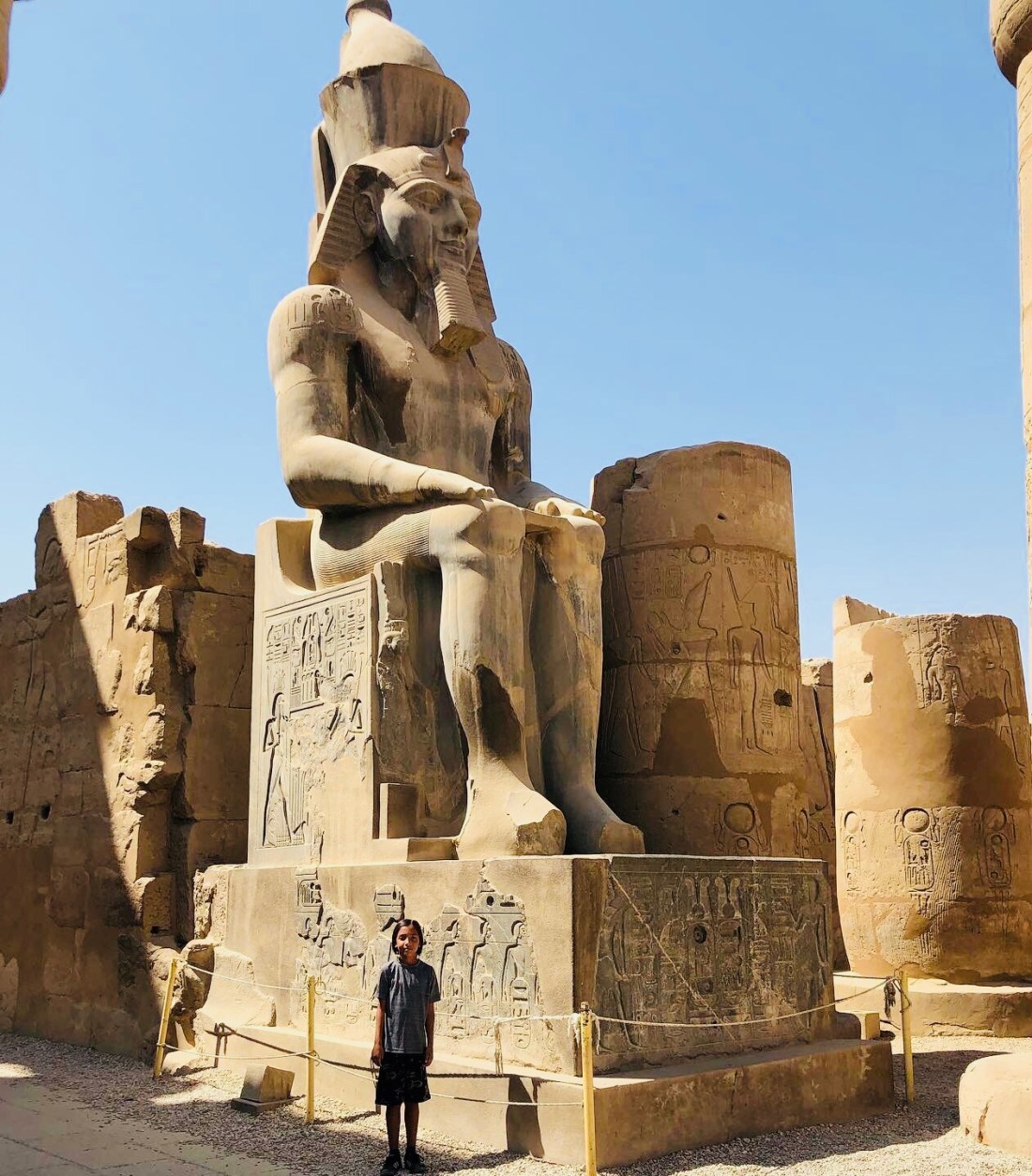
Karnak temple is a sprawling colossal place. It has been built, rebuilt, and added on to by many pharaohs and dedicated to multiple gods, and was regarded one of the most sacred places in ancient Egypt. We restricted ourselves to the precinct of Amun-ra, the Egyptian King of Gods fused with the Sun God – about as powerful as gods get. You enter through the huge pylons past a row of ram-faced sphinxes. Inside is a hypostyle with 104 enormous columns – mostly built by Ramesses II. Then there’s Hatshepsut’s giant obelisk – a monolithic tower of inscribed granite rising almost 100 ft into the air, making it the world’s biggest obelisk. Incidentally, the obelisk at the Place de la Concorde in Paris is a smaller cousin of this and came from here.

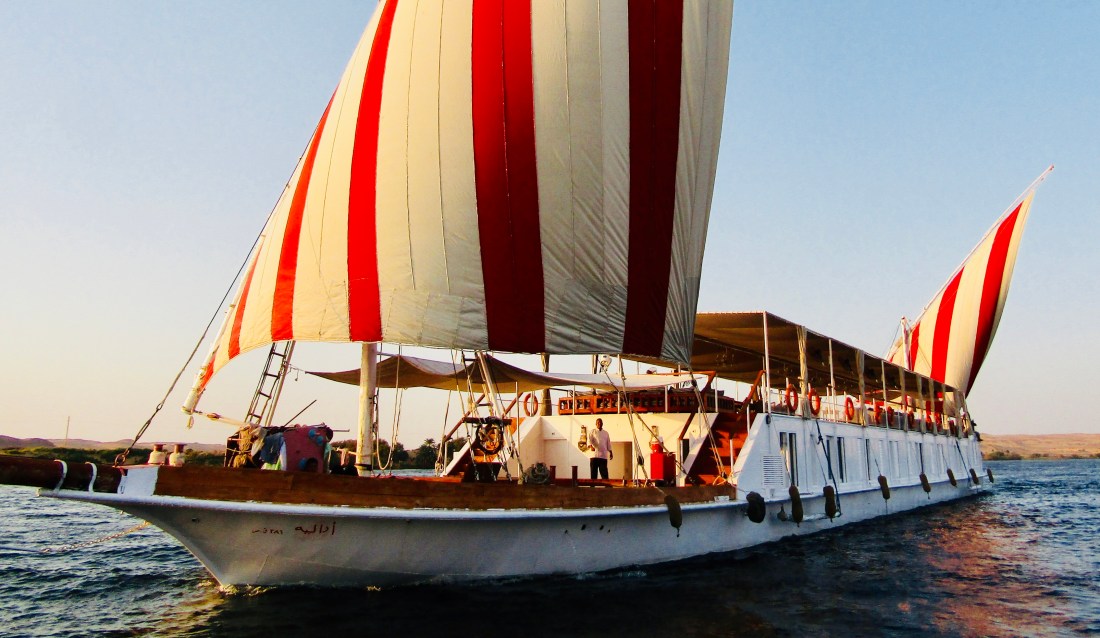
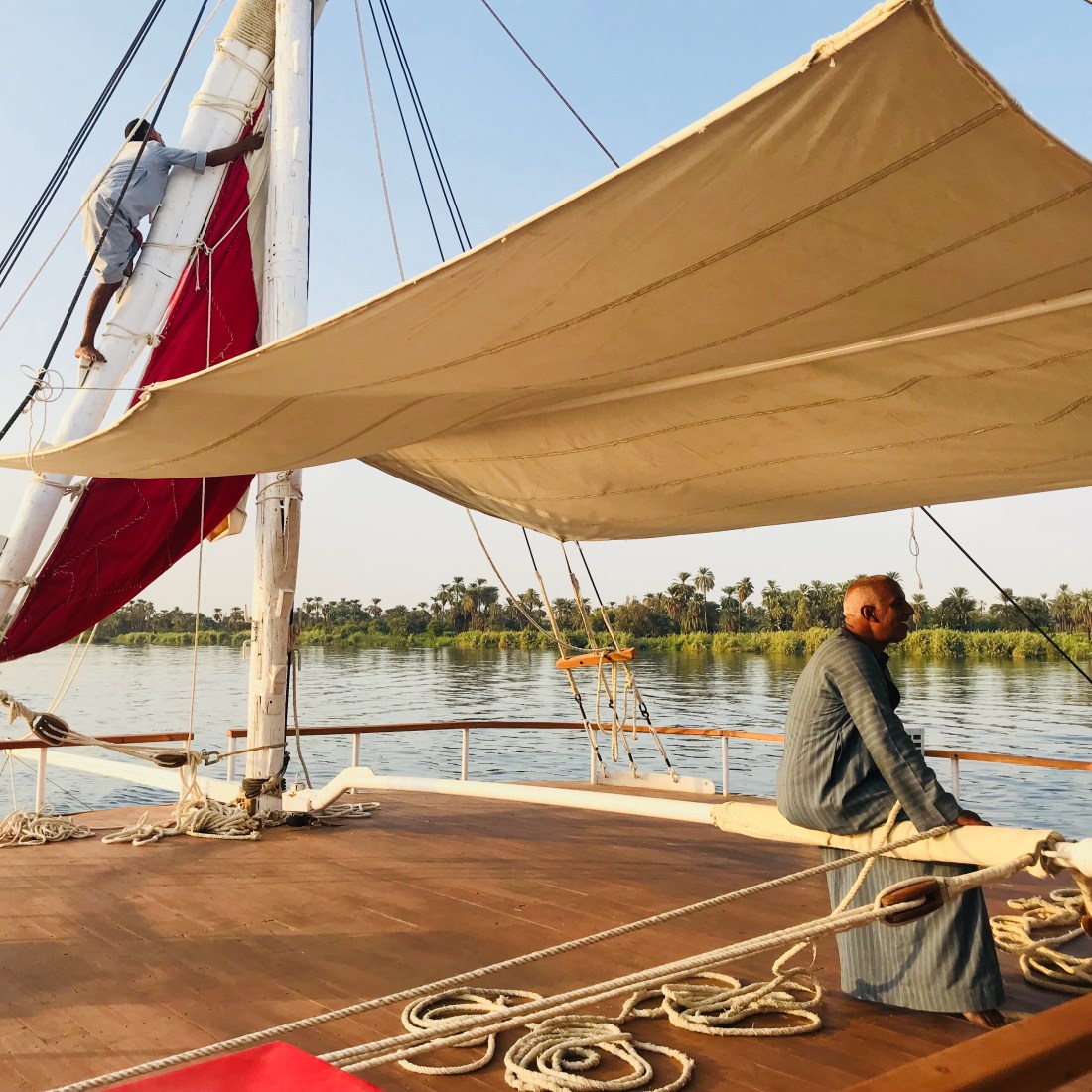
The next morning, after a rooftop breakfast at the guest house overlooking the hills of the Valley of the Kings and the mortuary temple of Ramesses III at Medinet Habu, we were driven about an hour south to the ancient town of Esna. Here we board the Adélaide, a dahabiya with 10 beautiful white cabins below, an expansive open deck covered with low sofas and cushions upstairs, and two triangular red and white stripped cotton sails on either end.

The Adélaide is a traditional shallow bottomed double masted wooden ship of the type that have sailed the Nile for thousands of years. She is the newest member (this is her fourth voyage) of the fleet of four dahabiyas belonging to a Mexican American, Enrique, a French designer, Eleonore (I think they are married), and Memdouh, their Egyptian boat builder and business partner.

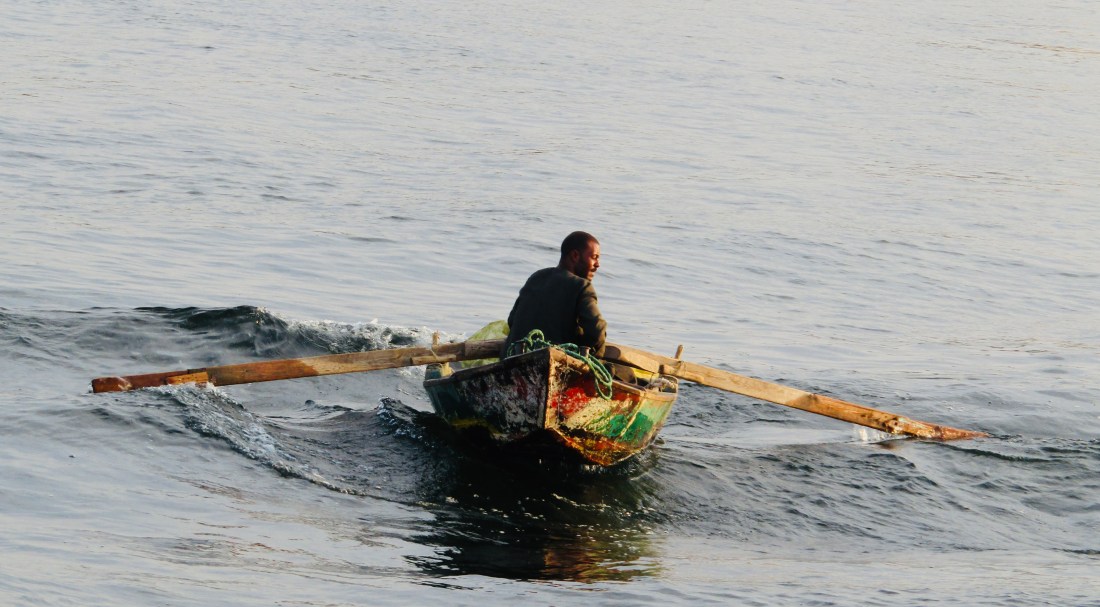
The company has slowed the trip down the Nile to five nights – you could drive from Luxor to Aswan in three hours. We weren’t sure how Vivian and Evan would react to this but they loved it. Vivian asked if we could redo the trip again the next week. The dahabiya takes five sailors – to climb the masts and set the sails, to navigate at the giant helm, and to secure the boat to the shore for our frequent excursions. During periods of calm, the sails are put away and the dahabiya is towed by a long line attached to its tug. Soon after boarding I expressed interest in the boat. I was invited to sit and smoke a cigarette with its crew by Captain Sayed.
We ate, swam, walked, slept, read, and chatted our way to Aswan. The food was simple but delicious. Eleonore says they hire the best chefs from top hotels and then ask them to “cook like your grandmother did”. We take informal hikes through villages, and date and mango orchards, and the desert which is never far away. We go on guided visits to the main archaeological sites on the way. At Kom Ombo, there is a temple to the crocodile god Sobek and a large collection of mummified Nile crocodiles. At the narrowest point on the Nile we visit the enormous quarry at Gebel el-Silsila where entire hills of sandstone were once quarried to power the massive projects built by the pharaohs. We swim in the Nile. The current is swift – you walk along the shore upstream or are taken there on the tug and swim or simply float downstream. Eleonore isn’t a spring chicken but she swims more often than anyone else. Evan is worried about Nile crocs but once he is in the cold refreshing water he’s hooked. We get to know our fellow passengers from Tucson, Denver, California, London, South Africa, Cardiff, and Australia as the days go on. Everyone eats together at a long table and one night a group of Germans from a sister ship join us for dinner. A couple of times the crew and staff show up after dinner with drums and there’s an impromptu dance party on the deck – accompanied with hip shaking that would make Shakira proud.

The days pass easily. At the end, we say goodbye to our new friends with invitations to visit them in different countries. Vivian and Evan got tonnes of compliments for being such amazing fellow passengers, leaving Jo and me baffled.

Egypt is beautiful. Egyptians are warm and welcoming, not withstanding the fact that I was often mistaken for an Egyptian or they were trying to sell me something. When they guessed “India?” I still got a big open smile and a handshake, even in tiny villages. Vivian and especially Evan got special attention and treats from almost everyone they interacted with.

I asked just one person about the future of Egypt, so my dataset is just one data point. “Will your children have a better life than you?” The answer was a clear and definite “no”. His parents had a better life than him. He thinks the trend will continue. I’m not sure why he thought that way but iPhones and video games made their way into his rambling reply. I am hoping he is an outlier.

Then there is the relationship with Israel. I started by asking our guide about Sisi. He said that Egyptians love their military and when Sisi came from the military they knew he was good. I asked if Nasser is considered a hero by Egyptians today. Our guide replied “No”. In further conversations I gathered that Sadat is, because he “won Sinai back”, while Nasser isn’t because he lost it to Israel. A satellite city in Giza is named 6th October City after the date Egypt Syria and Jordan initiated the Yom Kippur War in 1973. The date is a matter of pride in Egypt. But let’s hope that Egypt and Israel’s peace is durable enough to last our lifetimes.

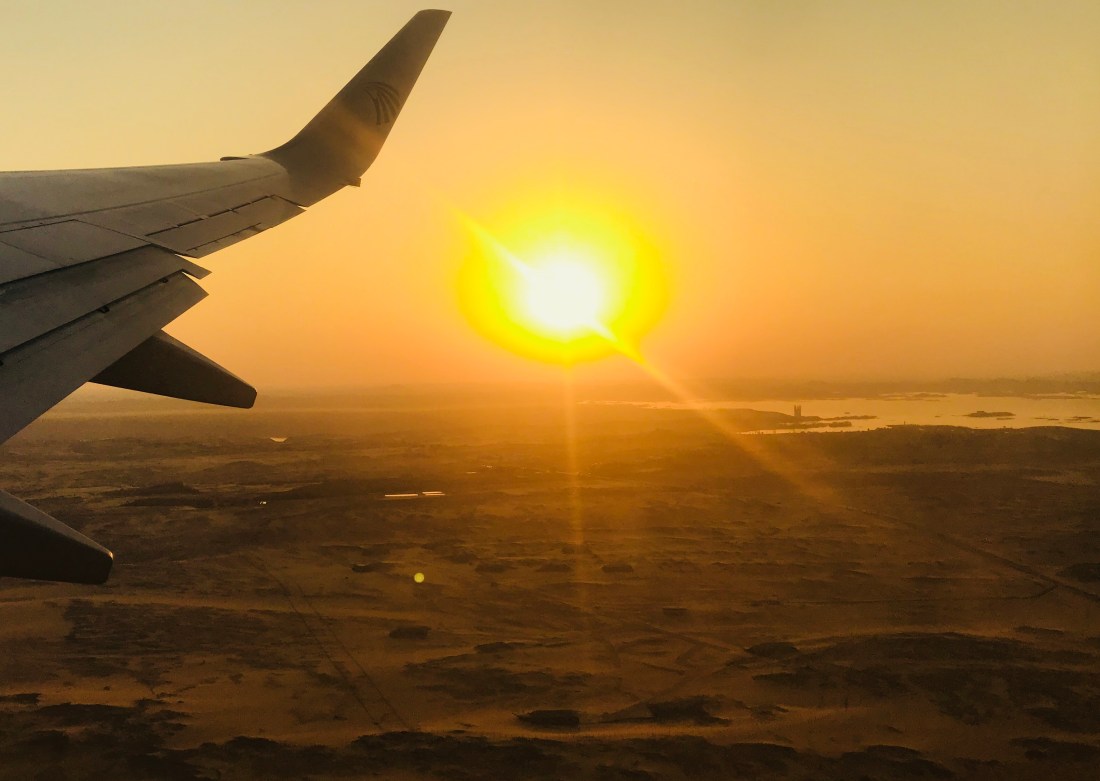
We left our lovely temporary floating home, the Adélaide, at 4am, taking a cab through the city of Aswan before dawn. You could tell electricity must be made somewhere close by because the city is lit up like Las Vegas. We got one last look at the beautiful Nile shinning like a pool of gold in the rising sun before our airplane turned into the desert for the trip back to Cairo, and then via Athens, to the island of Mykonos. Onwards, but I think Egypt is another country we’ll come back to another day. And I can see Vivian and Evan returning as adults.

Later that same evening, through the miracle of modern technology we were perched on top of a rocky hill in Mykonos looking at the same sun as it set in the West, the land of the dead according to the ancient Egyptians.

Cairo

From Greece we hoped to visit an as yet unplanned combination of Egypt, Israel, Jordan, and Turkey. Due to a fuck-up in the White House (both noun and verb), it didn’t seem like the best time to visit Turkey. So we booked our flight from Athens to Cairo and landed in Cairo on a quiet Friday morning.

We drove through the heart of Cairo from the airport to the east of the city to Giza in the west, crossing over the Nile. Our driver pointed out landmarks as he drove. To me Cairo seemed like a huge dust and brick colored sprawl. As we approached our guest house, the driver made a sudden u-turn and pulled up outside a fruit juice store. A minute later we were drinking fresh ganne-ka-ras (sugarcane juice). It tasted just like those at the Tank Bund when I was growing up in Hyderabad. The driver refused to take any money for it, and conveyed in broken English that it was his way of welcoming our family to Egypt.

Three weeks before this there were surprise antigovernment protests in Cairo’s Tahrir square over alleged corruption in Egypt’s military and government. British Airways cancelled regular flights between London and Cairo for a week. Two weeks before our departure the government clamped down on protests, effectively closing down the area around Tahrir square and arresting over 3000 protestors and bystanders, adding to their alleged cache of 60,000 political prisoners. Turkey at war was beginning to look like a better option.

This is us at Tahrir square with our guide. It is peaceful and completely normal looking. Security is high in tourist dominated areas, just as in Europe. Our guide and driver tell us that Cairo is one of the safest cities in the world, and that Al Jazeera always makes up news stories to make Egypt look bad. “If you watch TV you think there is war in Cairo. Look, there is nothing. Only peaceful people.”

Al Jazeera is funded by Qatar. Qatar has been blockaded and ostracized by a Saudi-led broad coalition of Muslim countries since 2017, including Egypt, with tacit support from Trump. Qatar, which hosts the largest US Air Force base in the Middle East, is accused of having ties to terrorist organizations like the Brotherhood of Islam, the party that rose to political power after the 2011 Egyptian “spring”, and Iran. In 2012 Egyptians voted for Morsi. An Islamist member of the Brotherhood with a PhD from USC became president. After a year of fumbling around rather badly, in 2013 he was deposed in a coup by his defense minister, a General Sisi, amidst popular support for change. Thousands of Brotherhood protestors were allegedly massacred and the organization was banned as a terrorist group. Sisi ran for president and won overwhelmingly. The protesters three weeks ago in Tahrir square accuse the Sisi government of corruption.

Tahrir square looks peaceful. After visiting the fabulous Museum of Egyptian Antiquities at one end of the square we ate at a light but very tasty lunch at a local favorite called Felfela, just off the square. The road leading into Tahrir was guarded by police in full SWAT armor. Armored anti riot trucks guarded every entrance into Tahrir square. They are tucked behind the streets so you can’t see them from the square. But the city bustled around the trucks and cops and everything appeared normal. Even the SWAT police looked bored.

It is difficult to wrap my head around the history and heritage of Egypt. Indians have been at it for as long, as have the Chinese and many others. But Egypt is unique. From before 3000 BC till Cleopatra of Mark Anthony fame, the rulers of Egypt have been called Pharaohs. They come from different places, belong to different families, and formed different dynasties. But they ruled all of Egypt – both upper and lower Egypt, built massive temples, engaged in the funerary rite of mummification, wrote in hieroglyphics, depicted themselves in sculpture in similar ways, and wore the double crown – the red crown of lower Egypt, and the white bowling pin crown (named by Evan) of upper Egypt. The place to start understanding 5000 years of Egyptian history is at the Museum of Egyptian Antiquities, with a good guide to take you through a tiny fraction of the displays.

Here Evan is looking at a statue of Thutmosis III from about 3500 years ago, considered one of ancient Egypt’s greatest warriors. This statue was originally in the enormous Karnak temple in Luxor. He was the sixth Pharaoh from the 18th dynasty of the New Kingdom. This statue is one of 120,000 items at the museum. Even the best intentioned eyes glaze over quickly.

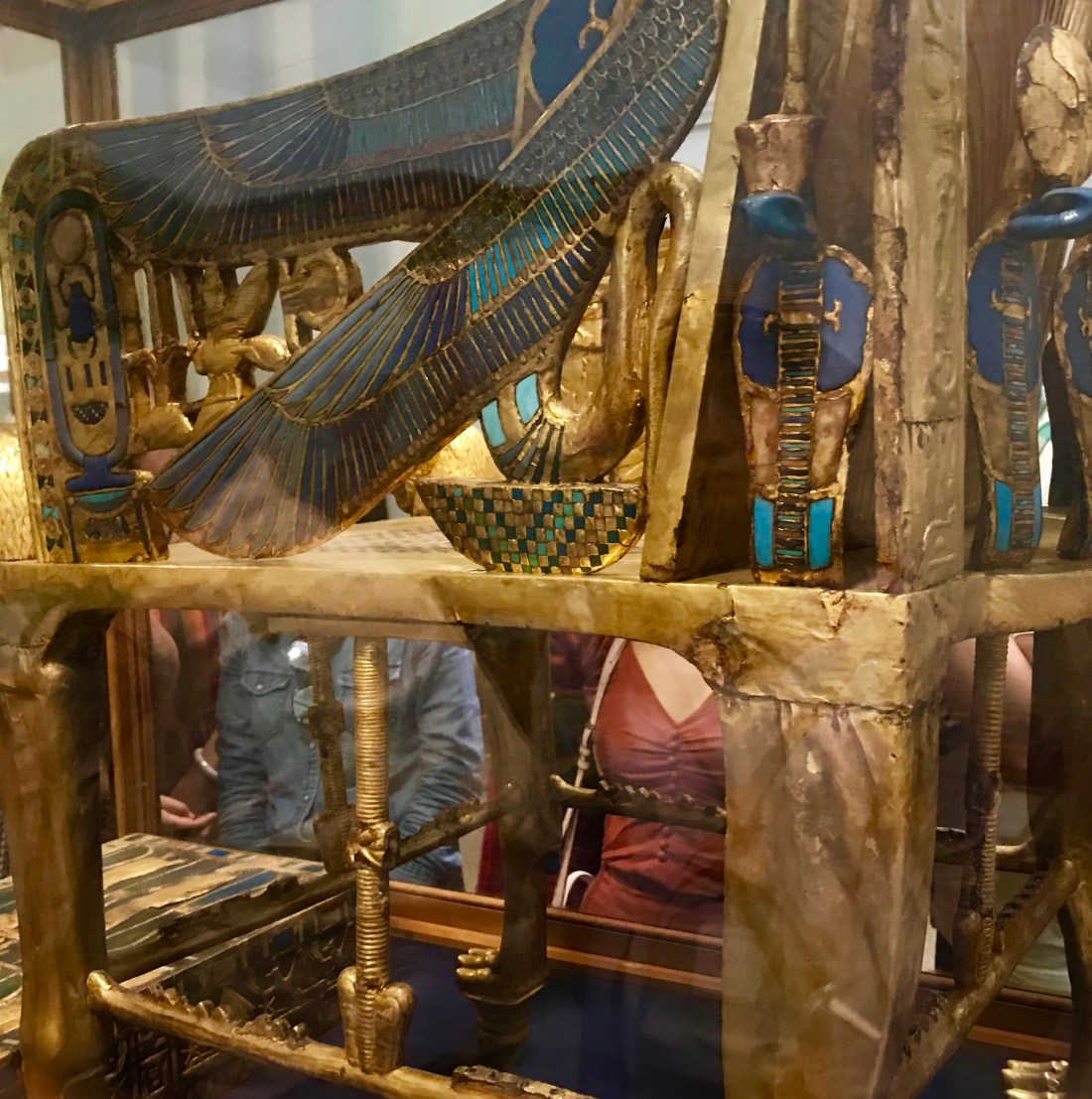
The section that displays the contents of Tutankhamun’s tomb is jaw-dropping. Gold death masks, huge gold sarcophagi, chariots, weapons, thrones, and even his sandals are on display. You aren’t allowed to photograph Tut’s death mask and a few other items but everything else is right there with seemingly little overt security. Similarly the royal mummy room is astonishing.

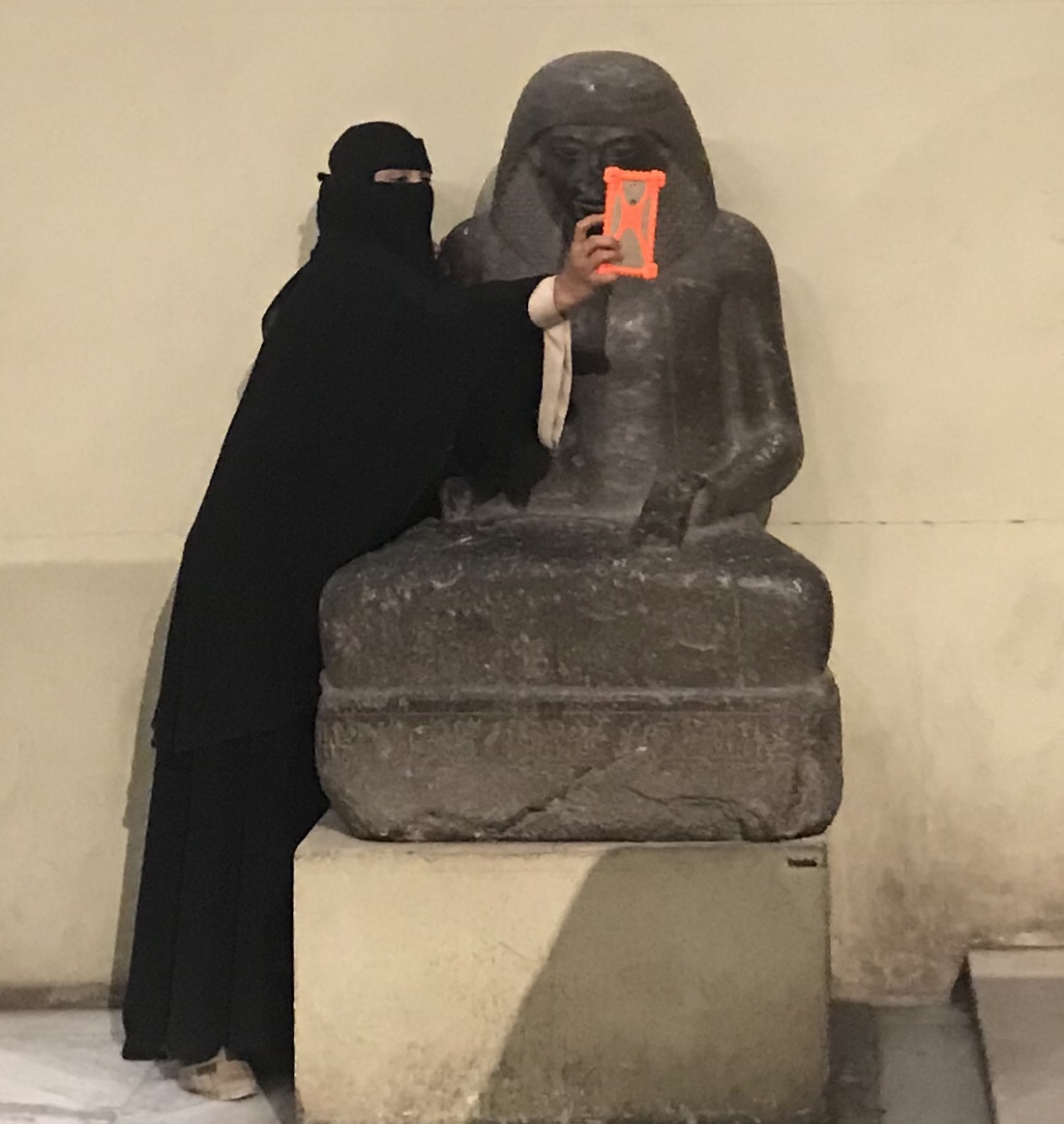
Then here’s something you don’t see everyday – a young lady in a full burka taking a selfie with a statue of a seated pharaoh.

We visited the great pyramids the next day. Our guesthouse is located just across from the Sphinx and the pyramids. The guesthouse roof gave us a great view of the Giza complex and good look at the light and sound show at night. I grabbed a beer and we settled down on a couch on the rooftop balcony to watch it. The kids wandered off quickly. Then I lost Jo. I made it to the end of the show but I’m glad I didn’t pay for it. After a while I felt bad for the poor neighbors who are subjected to Omar Sharif’s nightly narrations and deafening recorded orchestral music.

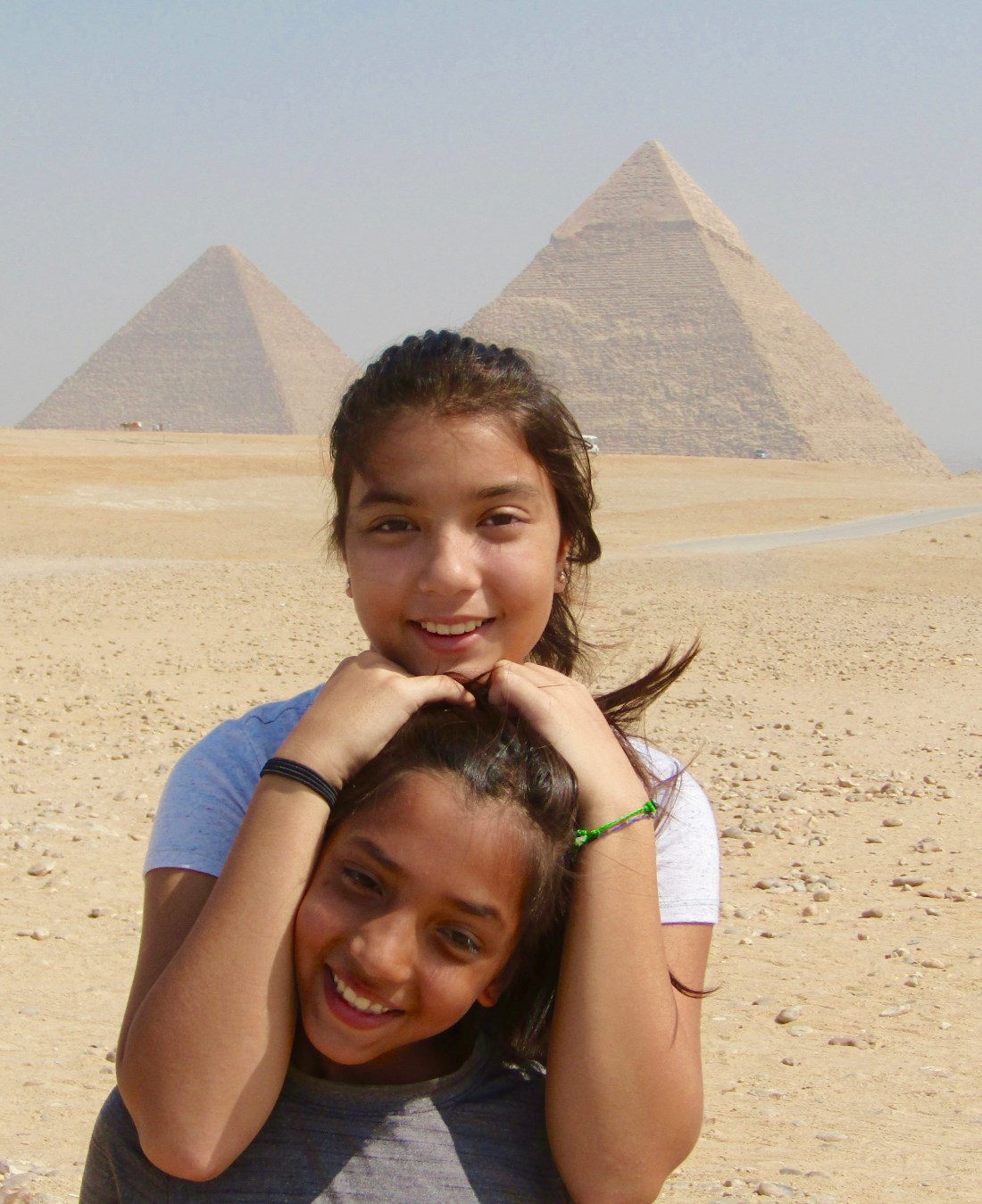
The pyramids are magnificent. We got there early but so did everyone else. The first pyramid is the biggest and is that of Khufu (called Cheops since Greek times). We climbed up and into a tiny rough rock tunnel to see the chamber inside the pyramid. After waiting inside the tunnel in the stifling heat for about 20 minutes and having tourists disregard the queue and get in the way of people coming out, I started to feel that if just one person freaked out, it could result in a stampede. Vivian wanted out, and the first time Evan voiced a similar feeling, I gathered them up and left.

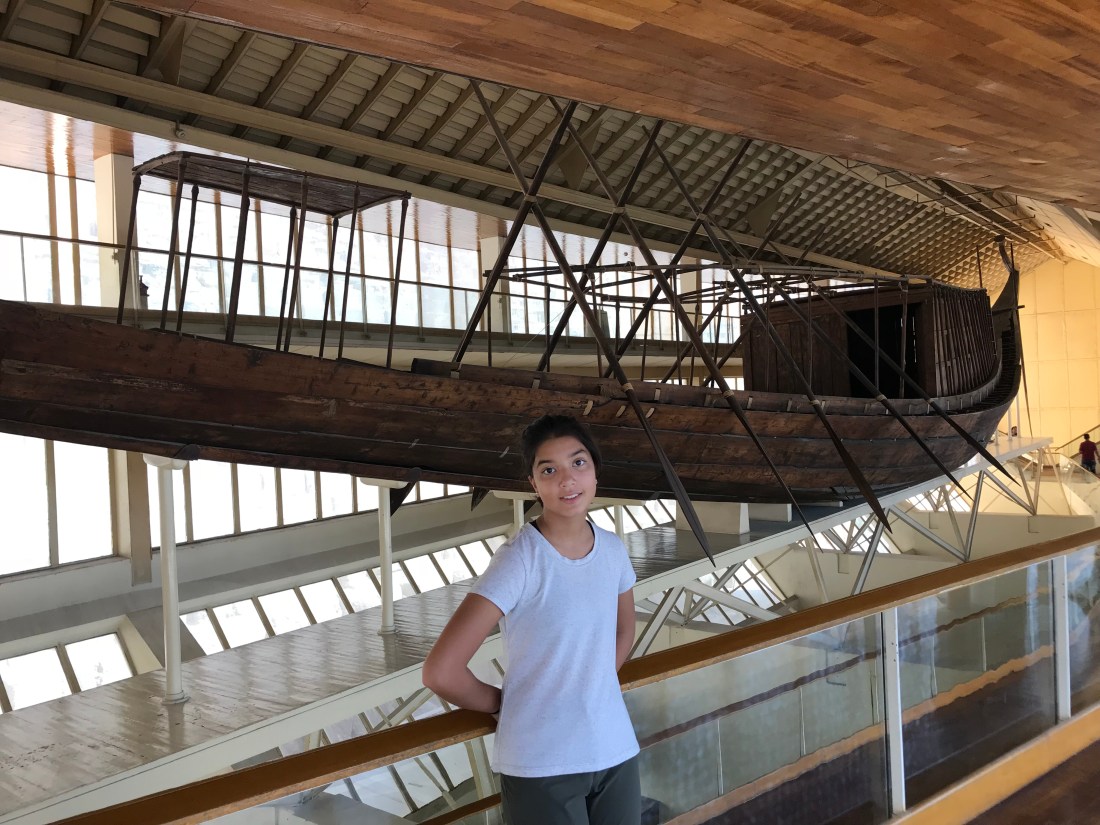
We toured the reconstructed boat found in a pit next to the pyramid and walked around the outside. This pyramid was the tallest structure in the world from when it was built in 2500 BC to about 1300 CE – for more than 3800 years. It was built so precisely that modern construction methods would be hard pressed to replicate it. The entire base of the mammoth structure is within plus or minus 15 mm form the horizontal. The structure’s sides line up with the true cardinal directions within a fraction of a degree. The base is an almost perfectly squared square. The ratio of the perimeter of the base to the height of the pyramid is almost exactly 2Ï€. All this leads to speculation. Our guide, who was so sensible at the Egyptian Museum the day before, turned into a full-on History Channel’s Ancient Allens conspiracy theorist. He explained that the pyramids are really more than 25,000 years old. The Old Kingdom found the already constructed pyramids and used them for their tombs. The pyramids were completely submerged during Noah’s flood. And the boat that they unearthed next to the pyramid isn’t Khufu’s ride to the next world after death. It is Noah’s Ark. Jo told me to ask our guide how Noah got all the animals into this boat.

After visiting Noah’s Ark I decided to try the tunnel one more time. Jo and the kids waited outside. It took me about 50 minutes. The rough tunnel is called the Robbers Tunnel. Then there is an ascending passage that is tiny – about 3 foot tall and 3 foot wide that you have to crawl up along with people coming down. That widens into the tall Grand Gallery which continues to slope upwards. At the end of that is the hot and humid King’s Chamber – a high ceilinged room of plain granite somewhere inside the pyramid. The only content is an empty burial crypt of rough granite that is larger than the width of the grand gallery leading egyptologists to believe that it was placed in there during construction before the massive 80 ton granite ceiling blocks were moved into place. The crypt was found empty. It is believed that the Great Pyramid was raided many times, possibly even during antiquity. Recently imaging techniques have unearthed new unexplored empty spaces in the Great Pyramid. It is safe to say that we don’t have a clue about many aspects of this iconic structure.

After we finished mucking around the pyramids we drove down to the mortuary temple complex and the Sphinx. Even less in known about the Sphinx which led to more speculation and rampant theorizing from our guide.

At this point we were ancient-Egypted-out. But we continued to Saqqara to see the first pyramid – a step pyramid structure like the ones in Mexico and Central America. We entered two tombs and saw intricate well preserved artwork and hieroglyphics.

Then we just had to say no. We couldn’t take another word of history. There was a lot more to see. We didn’t make it to Memphis or Dahshur. And we had just skimmed the top even at the places we did manage to visit. At stores and restaurants in Cairo we were met warmly and made to feel welcome, especially Vivian and Evan. It is a chaotic huge city of 37 million inhabitants and can do with a power wash (Jo’s comment) and a lick of paint. But I’d like to go back and see it properly someday.

Athens

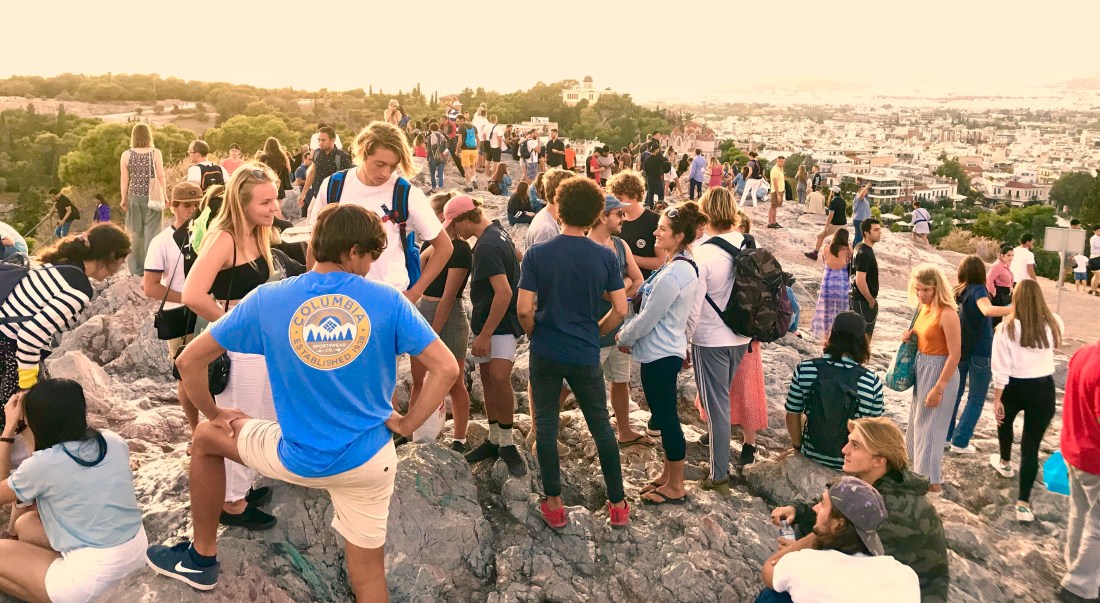
Our first good look at the Acropolis was late in the afternoon. After landing in Athens and taking a cab to our apartment we went to the Plaka area for a late lunch. We stuffed our faces with everything on the menu and then walked up the back road to the Acropolis with the intention of visiting it. But google lied to us and the ticket office was already closed for the day. So we climbed up on a well-worn rocky outcrop just to the west of the Acropolis with about a thousand other people of every ethnicity and race and watched it in the rays of the setting sun.

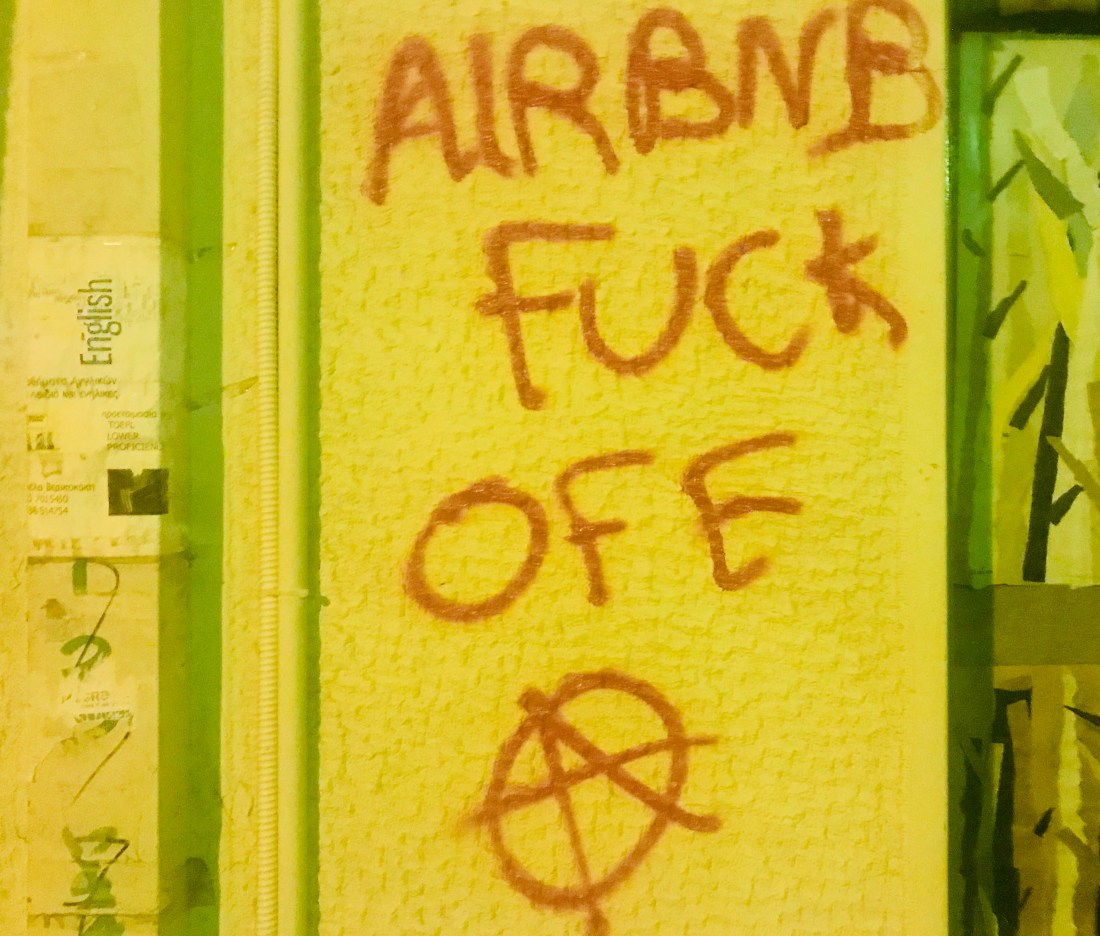
The next morning we ate the best chocolate croissants so far at Kekko’s, a cafe near our apartment and walked past graffiti urging us to go back home and for Airbnb to fuck off. Ignoring them, we made our way to the enormous Temple of Olympian Zeus – one of the biggest temples in Greece. Construction started in the 6th century BC. The temple was finally finished by Hadrian, the Roman emperor (of Hadrian’s Wall fame) 638 years later. Of it’s 104 colossal columns only 16 stand today but they still convey what it must have felt like to stand before it in its full glory.
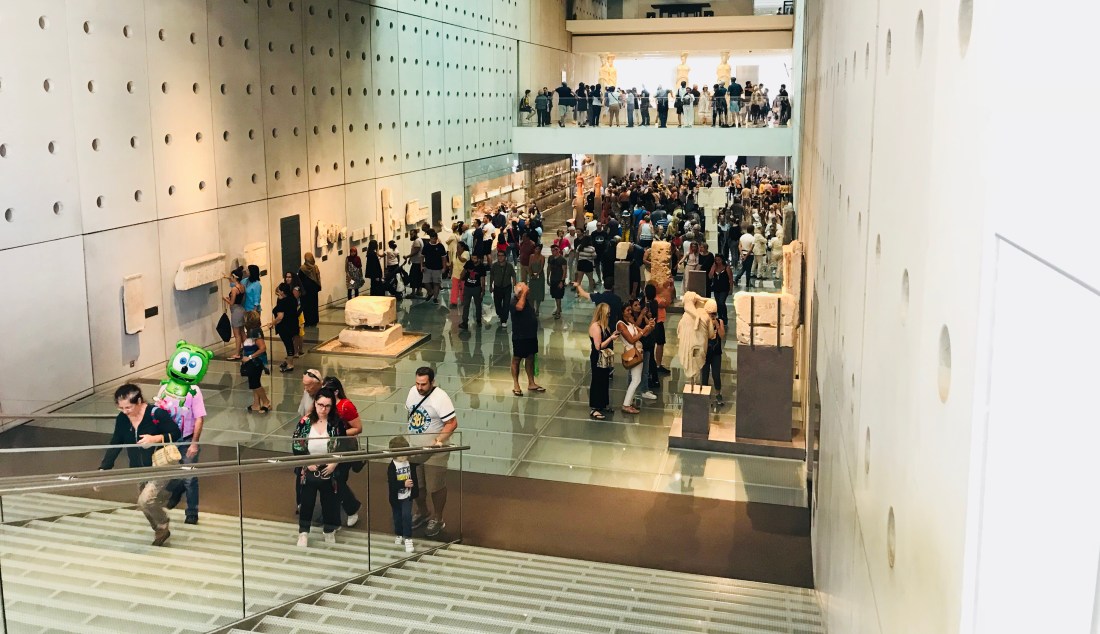
Then we got to where I was itching to be – the Acropolis Museum. Celebrating its 10th anniversary, the museum displays its contents in an amazing way. Starting with the archaic period you slowly start developing a sense of what the Acropolis must have been like over the many millennia, going back to the Bronze Age.

The hall dedicated to the Parthenon is set askew from the rest of the museum and is aligned to the actual Parthenon instead, which you can see outside its glass walls. The friezes, metopes, and pediments are displayed just as they would in the Parthenon, except they are at eye level. I read up a bit on the gods and the depicted stories so I could keep up with Evan later.
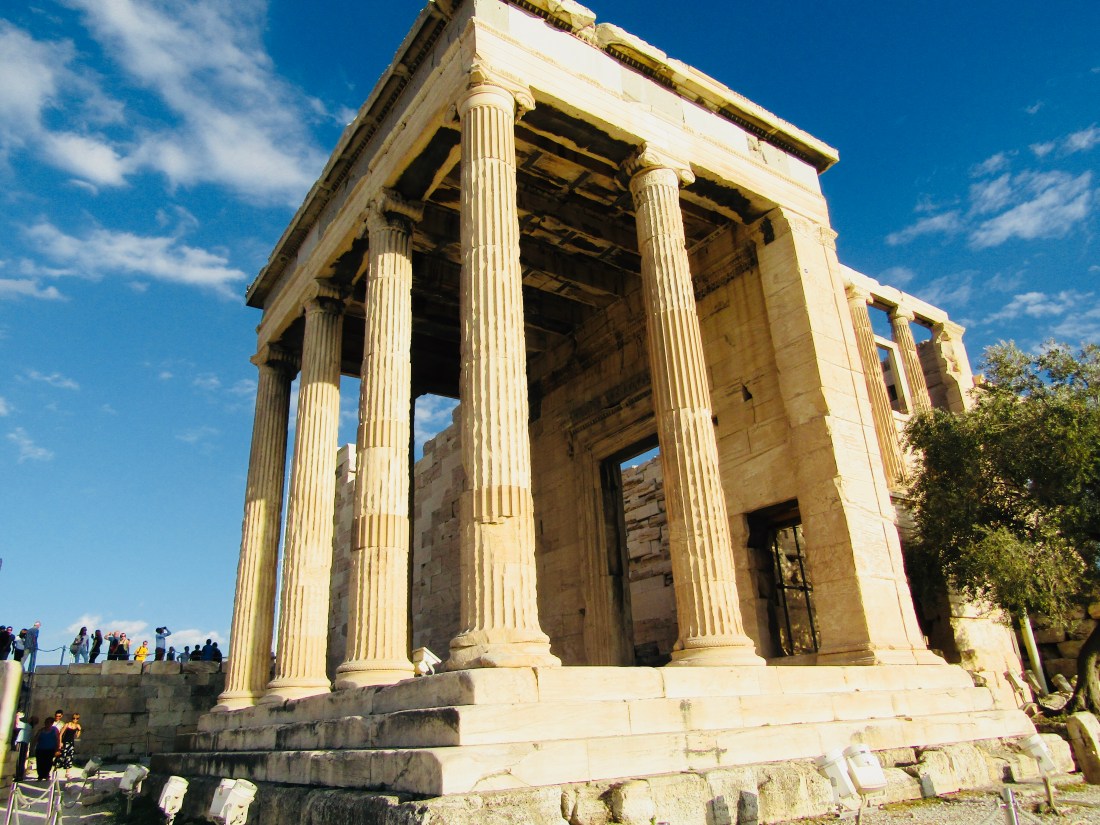
That afternoon we finally climbed up the steps of the Acropolis. Evan was full of information when we got to the spot where Athena is said to have competed with Poseidon for patronage of the then unnamed city (sorry, unavoidable spoiler alert). Poseidon struck his trident on the rock and gave the citizens a spring. But the god of the sea could only conjure up salt water in his spring. Athena offered an olive tree and won. Evan wasn’t happy though. According to another version of the story, Poseidon offered the horse. “Imagine, horse versus olive tree! What were the Athenians thinking?!”, Evan said multiple times in a very exasperated voice. He hates olives.

All good things come to an end. We ended our trip to the Acropolis at a gelato store.

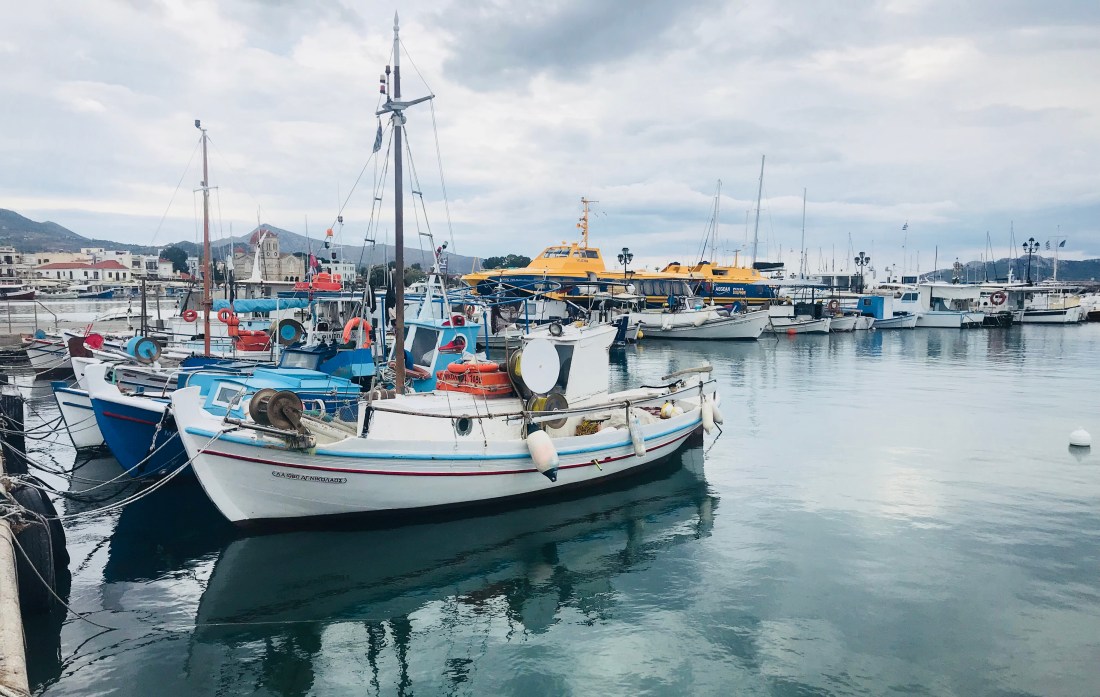
The next day Vivian complained of a stomach ache. Between late evening and mid morning she threw up several times. When she felt better we took s short ferry ride to the island of Aegina. Evan threw up there. That night I too hurled. The next day Jo went through the other symptoms but never did actually throw up. In about three to four days the bug ran through us. Luckily we recovered pretty quickly without any medication and carried on.

When we all felt better, we walked from our apartment up to Aristotle’s Lyceum. It was an unremarkable piece of land in a very nice part of Athens. The lyceum was destroyed by Sulla, the Roman general, when he crushed Athens in 86 BC. Aristotle had taught here till 323 BC and many other luminaries had learned and taught here in the ensuing years. Thousands of books and botanical samples were also destroyed when Sulla razed the lyceum to the ground.

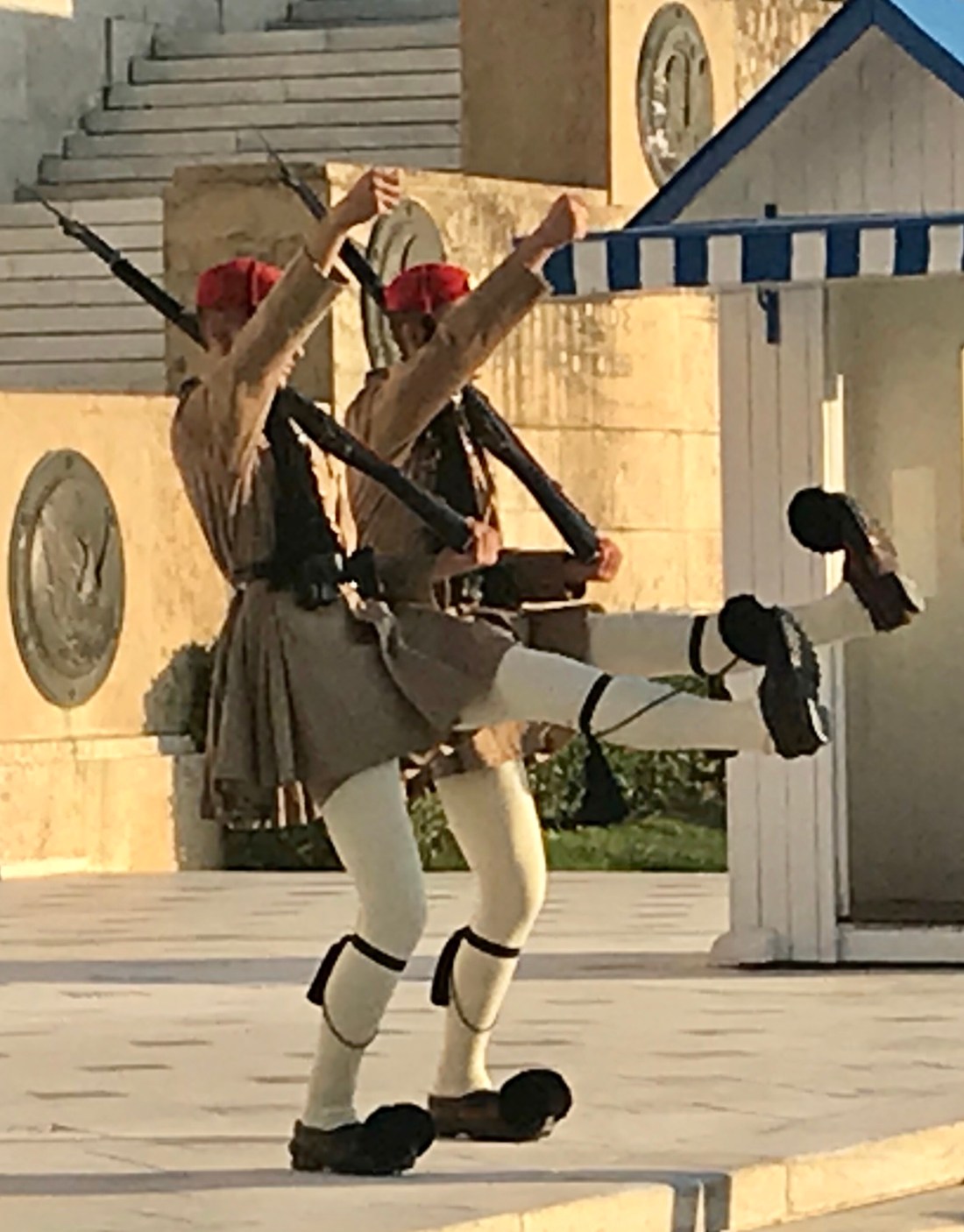
From here we wandered to the Tomb of the Unknown Soldier in Snytagma square and witnessed perhaps the weirdest change of guard in the western world.

On our final day we went to Cape Suinion and visited the Temple of Poseidon built in 440 BC. The location is perfect – perched high above the startlingly blue waters of the Aegean at the southern end of the Attic peninsula. Along with the temple, there are fortifications and remains of a small town. This was one of the locations where the population could retreat to during times of war.

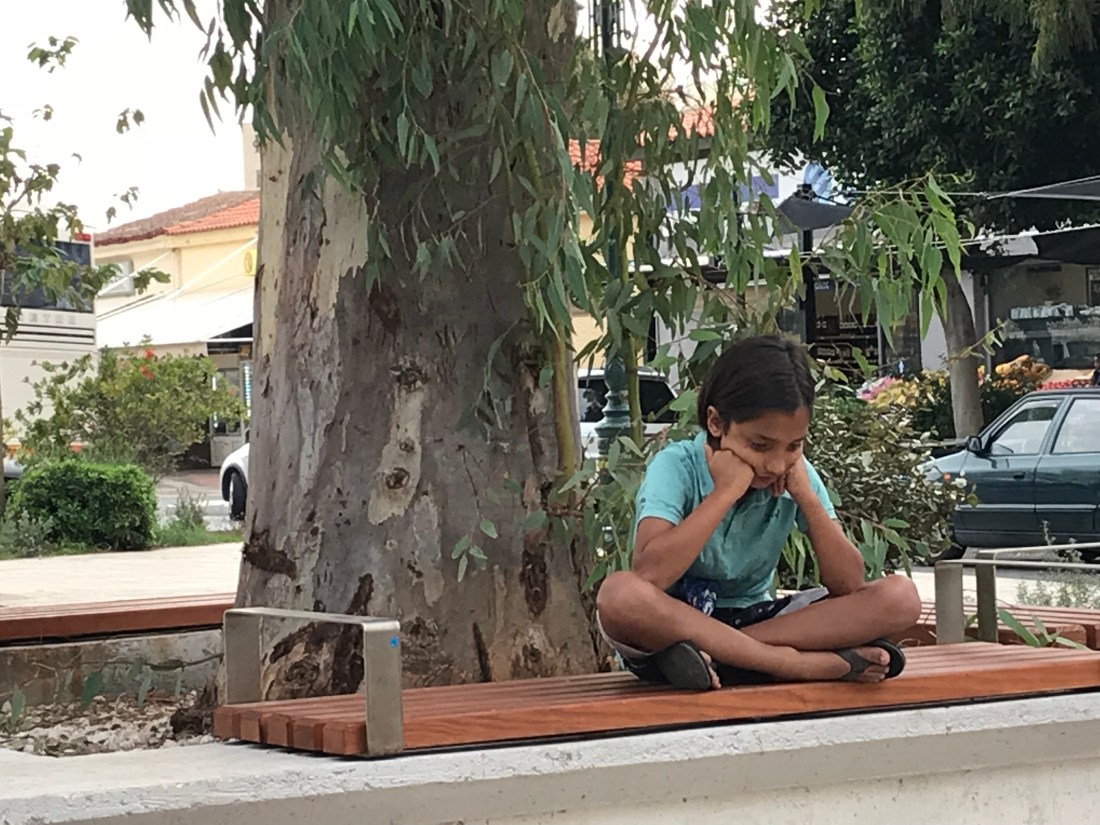
Afterwards we drove around the coast and stopped at a small town for gelato. Evan sat under a eucalyptus tree and even resisted gelato because he was mad at Vivian about something. He appears to be in deep thought.

Speaking of deep thinkers, it’s not the Greek gods and the temples in the Acropolis that made Athens special (though it is what tourists like us flock here for). Back when the rest of the world was still mired in monarchy and would stay that way for another twenty five hundred years, the Athenians were writing constitutions and experimenting with democracy. In version one they had an aristocracy who elected leaders from amongst themselves to run the city state and command its armies. In version two they divided themselves into four classes, and even the poorest class could participate in electing their leaders, though they could not themselves be elected. The demos, the people, were gaining power. In the most successful iteration, anyone could hold office. In the span of a human lifetime, this one spot on earth saw the likes of philosophers like Socrates, Plato, and Aristotle, and other notable contemporaries like Sophocles, Pericles, Herodotus, Phidias, and Demosthenes. Imagine being a fly on the wall of the agora of Athens during this time (I’m having to imagine even harder because the agora is an open plaza with no walls, but there are plenty of flies here :-).

As smart as they were, they essentially fought their way to their demise – with enemies from far away, like the Persians, and with their neighbors, the other Greek states.

Lessons to be learned here for mankind, for us, and for Vivian and Evan. But I think we’ll have to come back when they are older and not puking up their guts. Next up – Egypt!

Around Dubrovnik

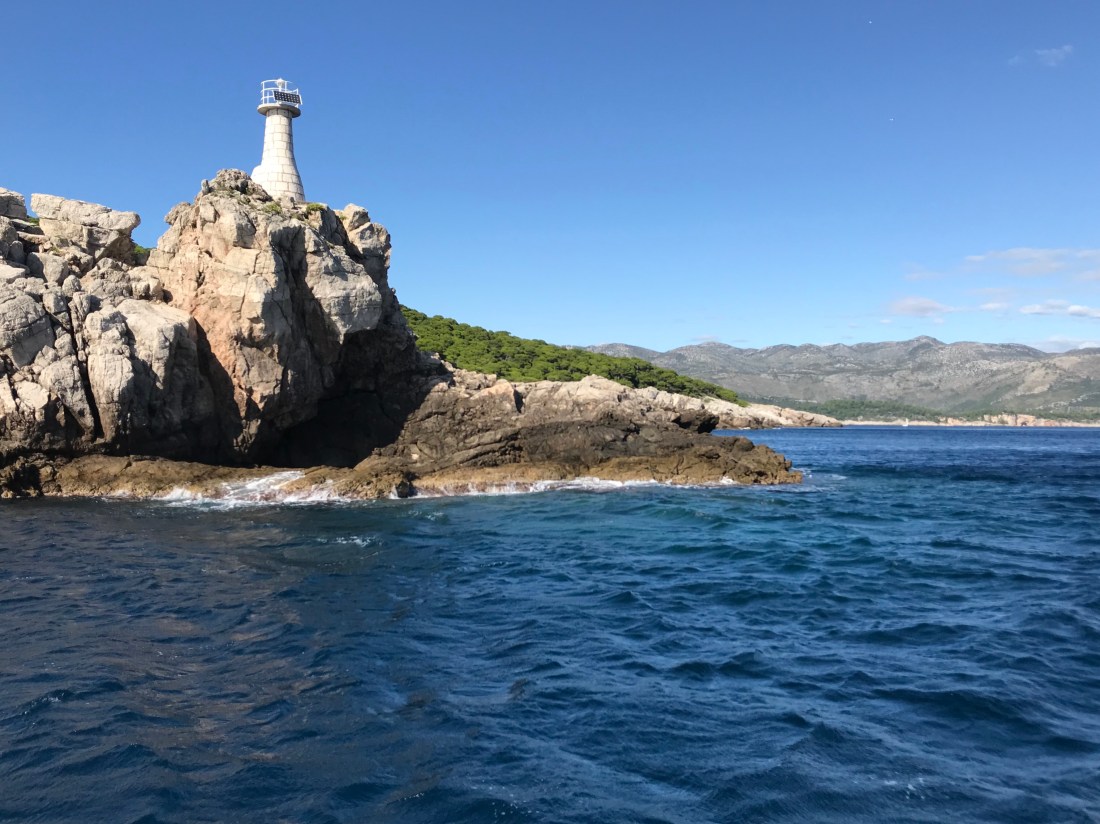
You can’t see everything in one trip. We never made it to Croatia’s famed islands or to its fabulous parks and waterfalls. On our last full day in Croatia we took a boat to the small islands of Kolocep and Lopud. Evan and I got to jump in the clear blue waters of the Adriatic and snorkel and explore a few caves. We walked around the small village of Donje Celo, but it was early October and things were already closing up after the busy summer tourist season.

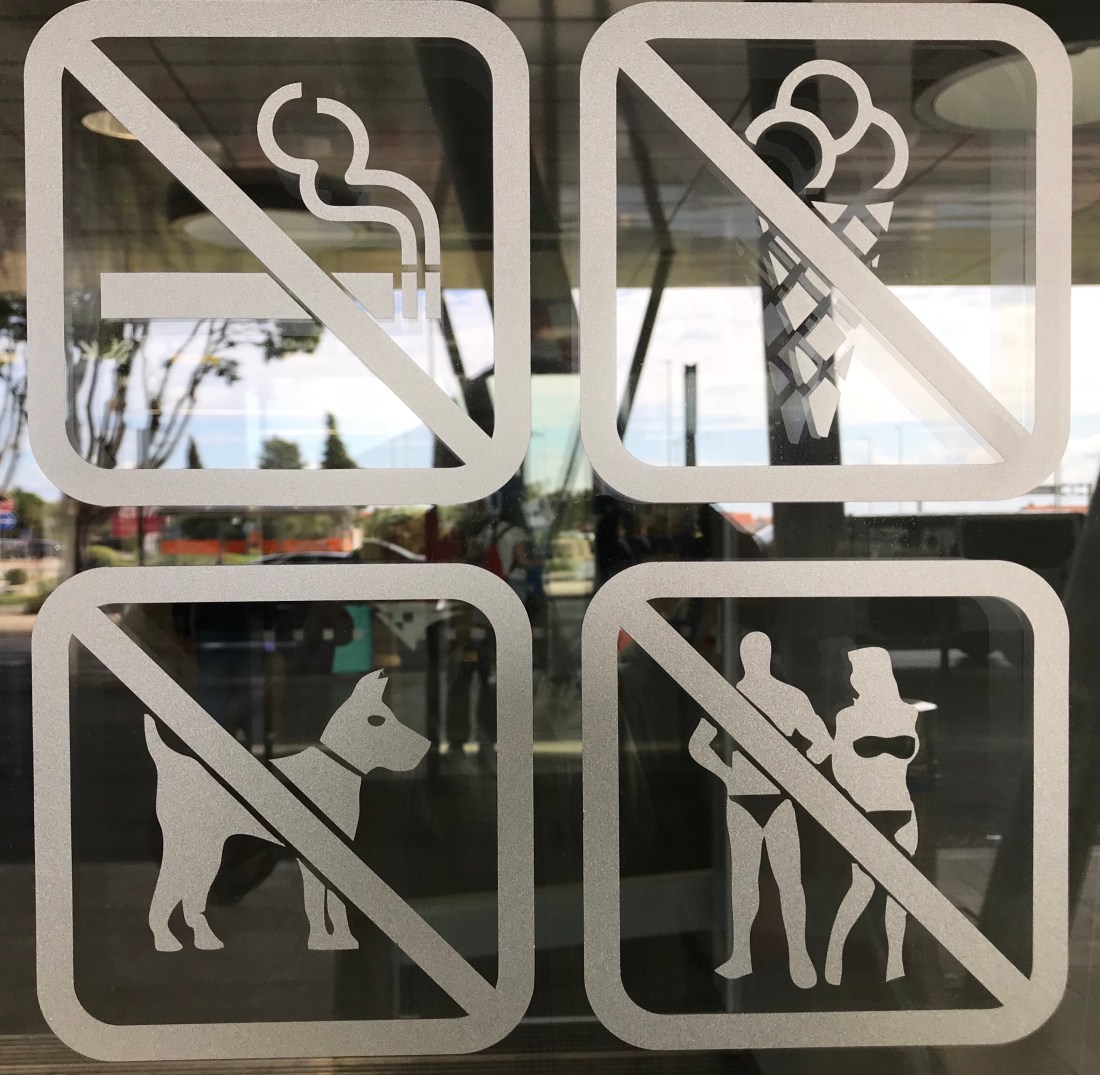
We drove to the airport next morning, stopping to admire the view of Lokrum island and the cruise ship that had anchored all night. Among my last memories of Croatia is the sign at the door at the Dubrovnik airport. They have very specific instructions about what is kosher.

Dubrovnik

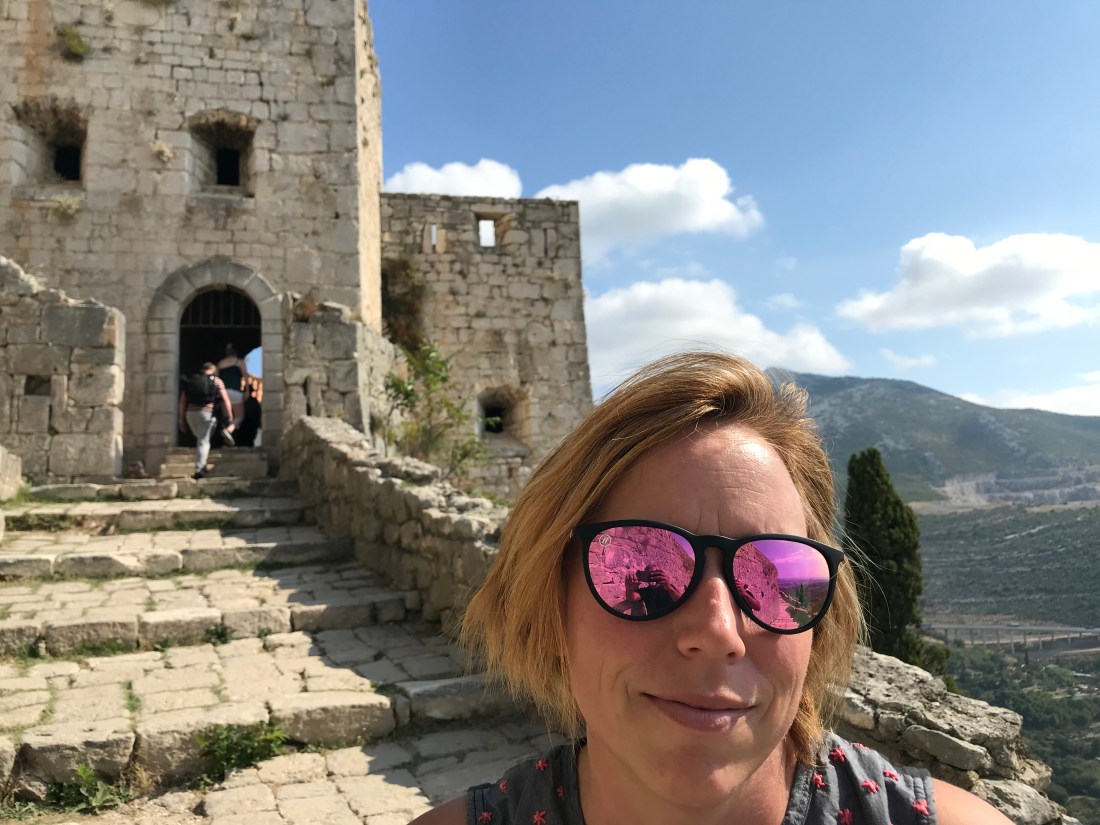
We rented a car at Split airport and drove south down the crazy beautiful Dalmatian coast. Our first stop was the fort of Klis, a two thousand year old strategic fort that saw lots of action through the centuries. Since the Middle Ages it was captured by the Ottomans, recaptured by the Venetians, captured by Napoleon, and most recently absorbed into the global psyche as a location in Game of Thrones.

We walked around the walls and through the fort, admiring the views of Split down below in the distance and the peaks of the mountains around it, imagining thousands of soldiers battling to death here in the Middle Ages. Then we went to a restaurant famous for its grilled lamb and ate a nice lunch and drove on towards Dubrovnik. The drive was beautiful. A bit further inland we drove past towering peaks shrouded in fog and deep valleys with a few tiny villages. But once we descended from the mountains down to the sea we passed towns and farms. We stopped at a farm stand and bought a 2 kg bag of delicious oranges and some dried figs.

And then for 20 km, we left Croatia and drove through coastal Bosnia-Herzegovina, an otherwise landlocked country. The area around Dubrovnik is cut off from the rest of Croatia and can only be reached by sea or by passing through this section of Bosnia-Herzegovina called Neum. This geographical strangeness can be traced back to a treaty in 1699 when the Habsburg Holy Roman Emperor defeated the Ottoman Empire and added most of Central Europe to the Austro-Hungarian empire. Two small buffer zones were created on either side of Dubrovnik to separate them from their rivals, the Venetians. The northern buffer zone is Neum. These territorial boundaries were respected during the formation of modern Yugoslavia after WW-I. Further, when Croatia and Bosnia-Herzegovina came into existence in the early 1990’s, Neum remained with Bosnia and not Croatia. Amazing what you can google.

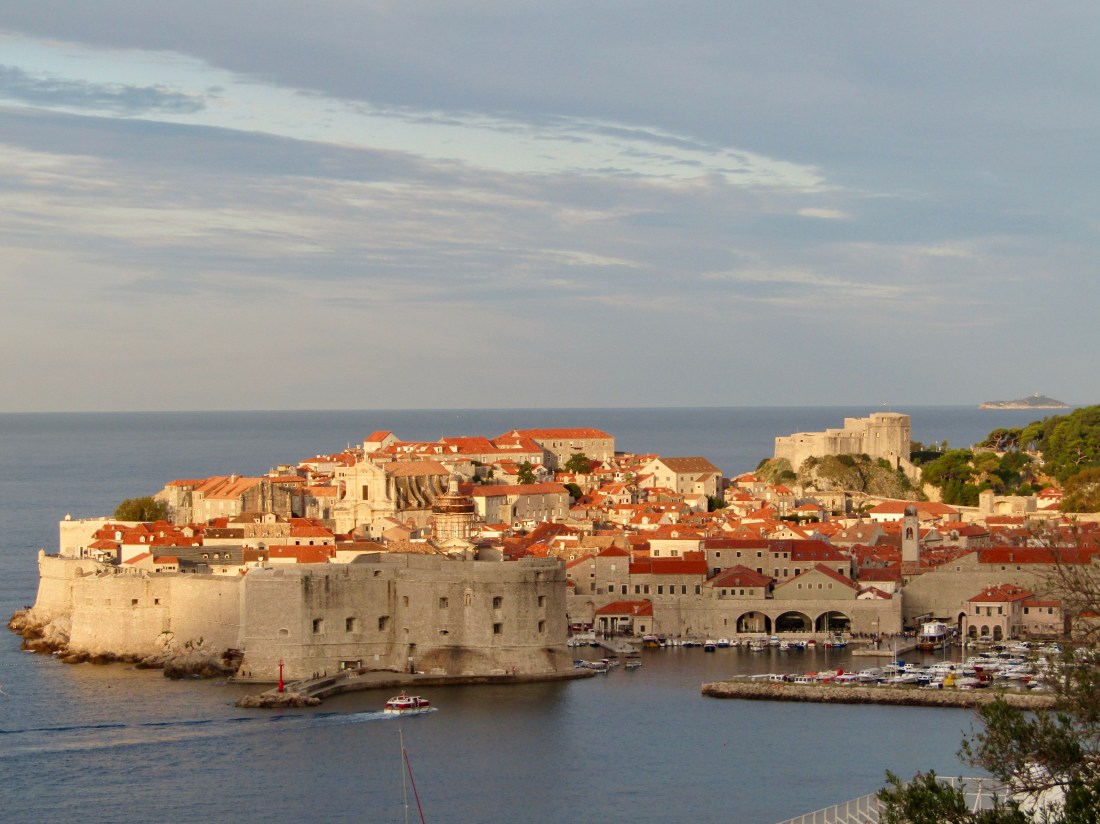
Dubrovnik has been called the Pearl of the Adriatic. The old city is still fully enclosed in huge walls. The land rises up steeply from the old city and newer parts of the city cling to the sides of hills. Steps, not streets, lead down to the old city. Here’s the view of the old city from our Airbnb at sunrise.

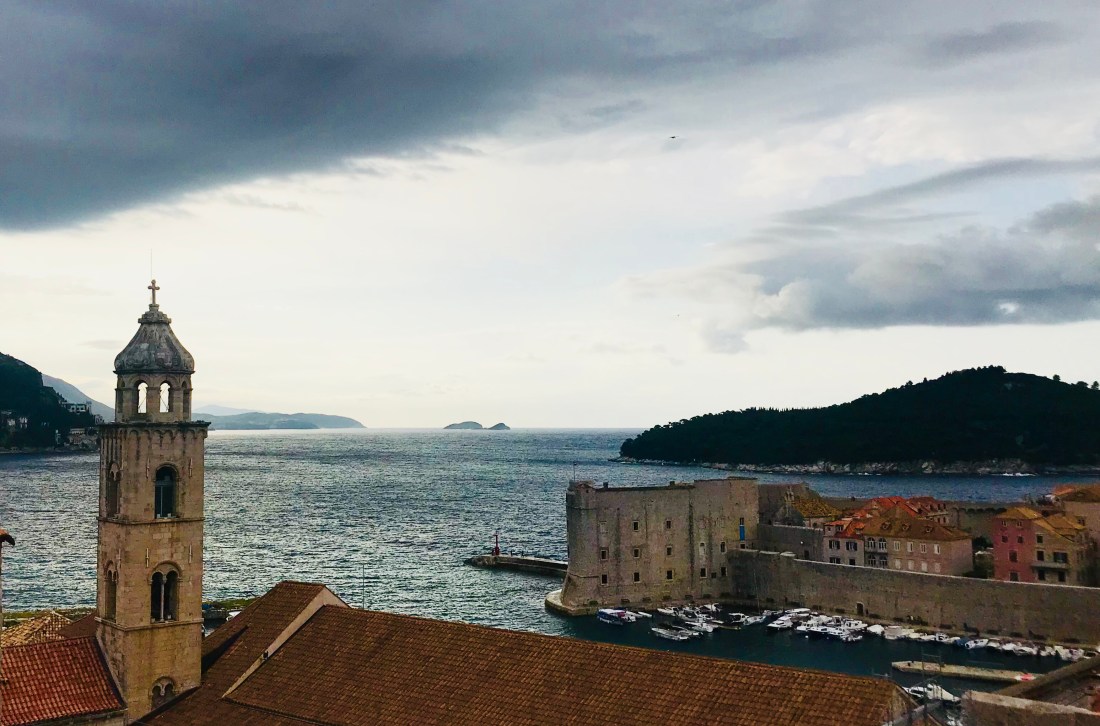
One morning we climbed up the several flights of steps to the top of the city walls. We did this before the crowds got there. It looked like a storm was brewing but the rain held off.

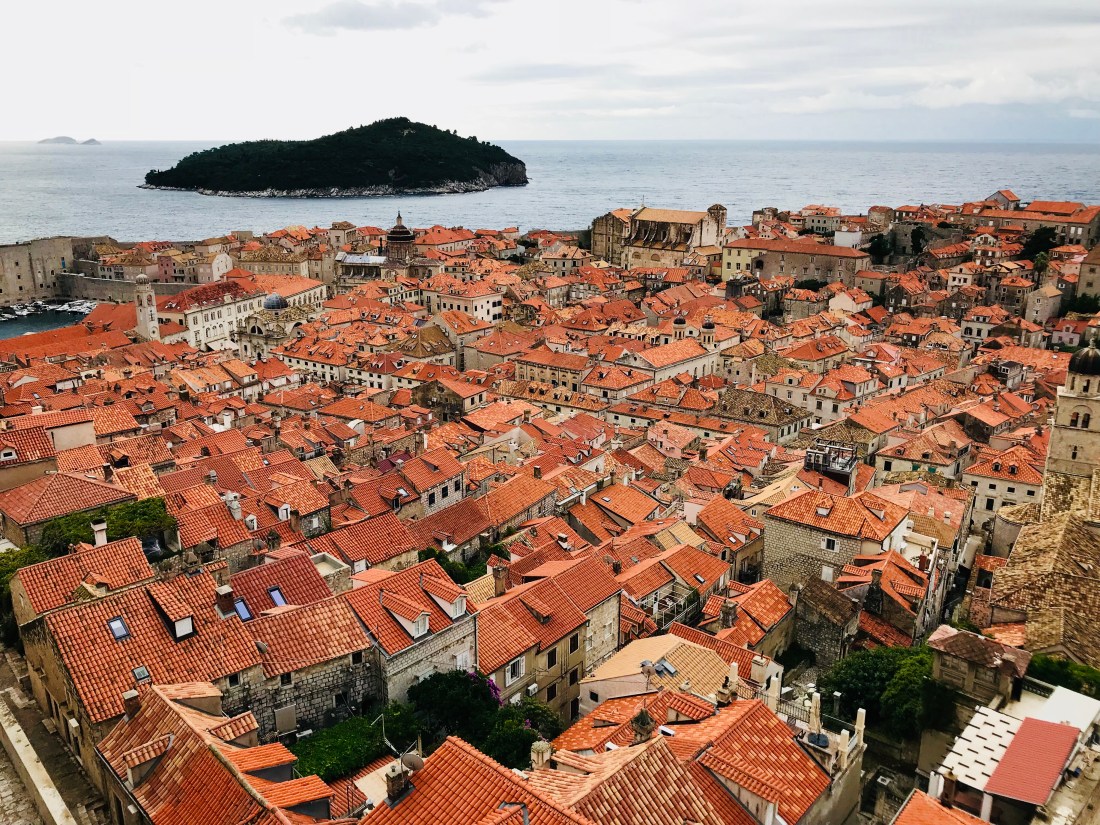
We admired the red roofed city and the fortifications around the town. And came across a rather peculiar shaped basket ball court. And I got a shot of Evan looking very pouty.

Just as we climbed down from the walls it started raining. We decided to wait it out at a cafe over breakfast. But by the time we finished breakfast every tourist was trying to shelter in cafes and we felt bad hogging a table. So we made a break for it and walked through old city in the pouring rain up to the gates and tried to find an Uber or a cab.

After trying for a few minutes we agreed to tromp through the rain. There was so much rain that even the steep streets were flooded and the stairs that connect one level of the city to another were cascading waterfalls. We splashed our way home and arrived completely soaked!

Split

Split puns are flying high as our flight from Venice comes in to land in Split.

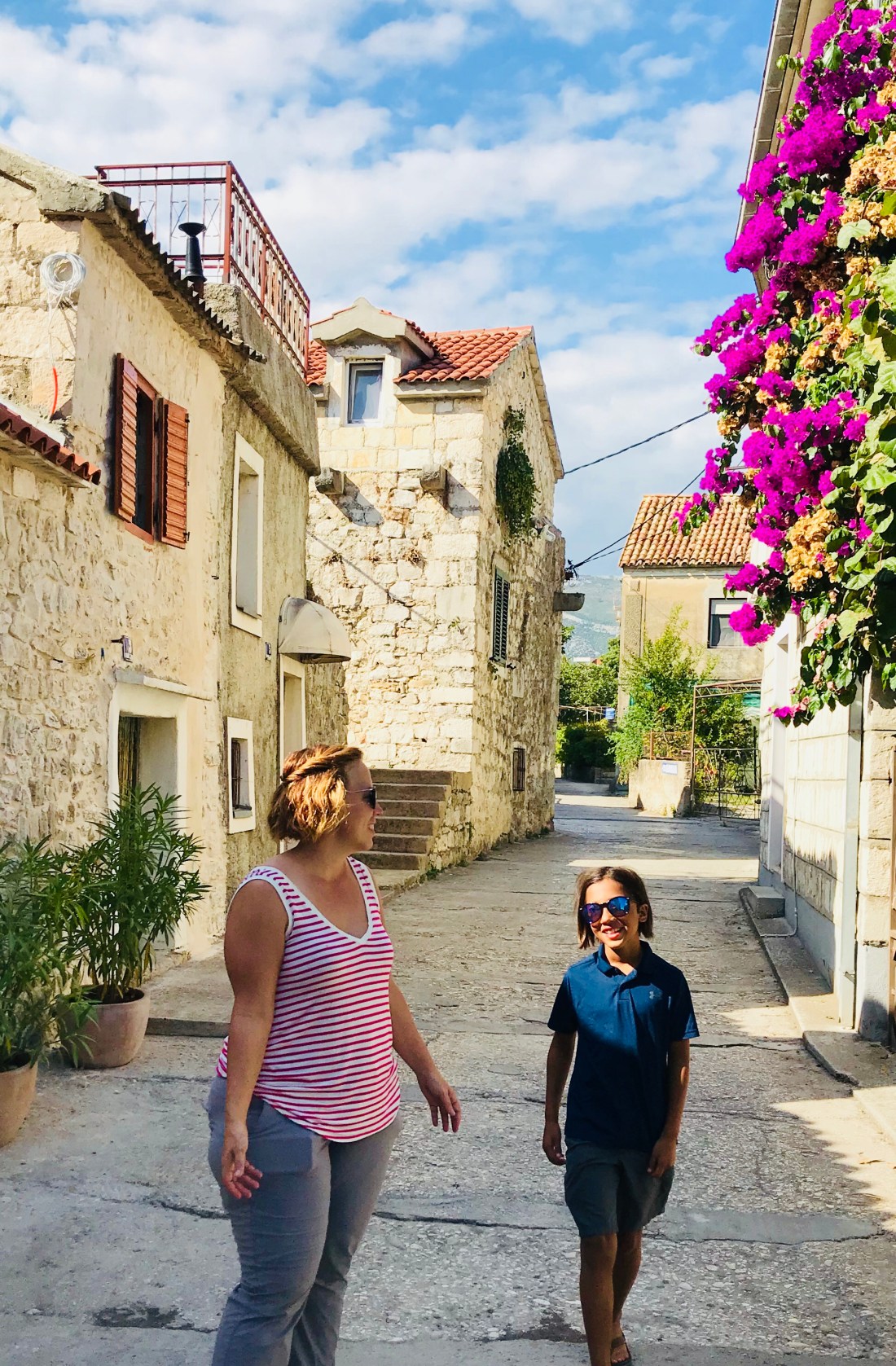
We’ve booked an Airbnb just hours ago – which seems to be how far ahead we are able to plan these days. We are on the top floor of a 17th century waterfront castle (in reality a nice sturdy stone building) with a bar / coffee shop underneath in the sleepy fishing village of Kastela Stari halfway between the historically (and touristically) famous cities of Trogir and Split on either ends of the bay.

After the usual squabble over beds and bedrooms between Evan and Vivian, for the third time this trip we have that Sand Island feeling of exhaling and relaxing and enjoying the beautiful view.

Jo and I start with a drink outside and then we left the kids to their homework and electronic device and walked down the waterfront for sunset and enjoyed our time together without the brats. Then we retrieved them (after some debate) and walked over to a restaurant and sat a couple of feet from the crystal clear waters of the Adriatic and tasted grilled Croatian food for the first time. Wow. The eggplant and zucchini were so delicious that I could have skipped the meat. And we learned our two words of Croat (bog – hi, and hvala – thanks) from our waiter.

We didn’t do much. One afternoon Jo, Evan, and I rented bicycles and rode along the promenade over to a couple of other neighboring towns (there are seven castle towns on the coast next to each other). Another time Jo and the kids walked over to our beach a stone’s throw away and spent the afternoon at the beach with speedo-clad old men and families. We bought ice cream in tubs from the local Tommy mini market and a bag of pre-crushed Oreos (they sold Cabernet and Merlot in 2 and 3 liter bottles for about five bucks). We ate grilled meats, fish, and vegetables at the nearby restaurants. There was a bakery a couple of doors away that made good croissants. The bar downstairs always had cold Ozujsko on tap for me, an iced Somerset cider for Jo, and a table at the edge of the water. And I guess we spent some time there because one day Vivian commented rather unsubtly “Aren’t you guys drinking a lot?”
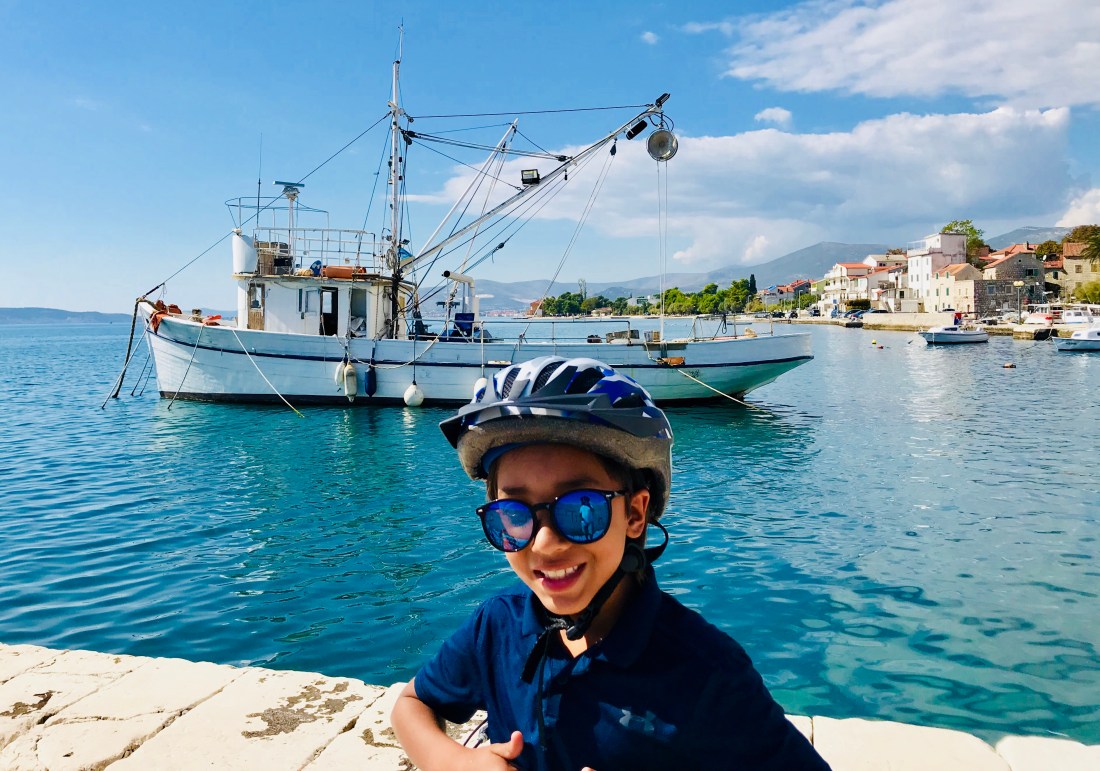
We were supposed to be visiting the amazing Croatians islands starting with Brac right outside the bay, home to the famous celebrity studded party town of Hvar. But we were happy doing nothing in our castle-village by the sea.

We dragged ourselves up and called an Uber and finally went to Split. On the longish drive over we learned that our driver was in the Yugoslav army. He talked about how he had Serbian friends before the homeland war. But today, even a soccer game between the Split home team, Hajduk, and visiting Serbian teams could be dangerous. Interestingly, he missed the days of Broz Tito. “Everybody was taken care of. Now you see homeless people”, he complained.

My dad used to visit the old Yugoslavia on business when I was in high school. Tito was nearing the end of his reign and his life. Back then I remember my dad saying that if it wasn’t for Tito who was forcing the different Balkan people to live in relative peace together, they’d be at each other’s throats.

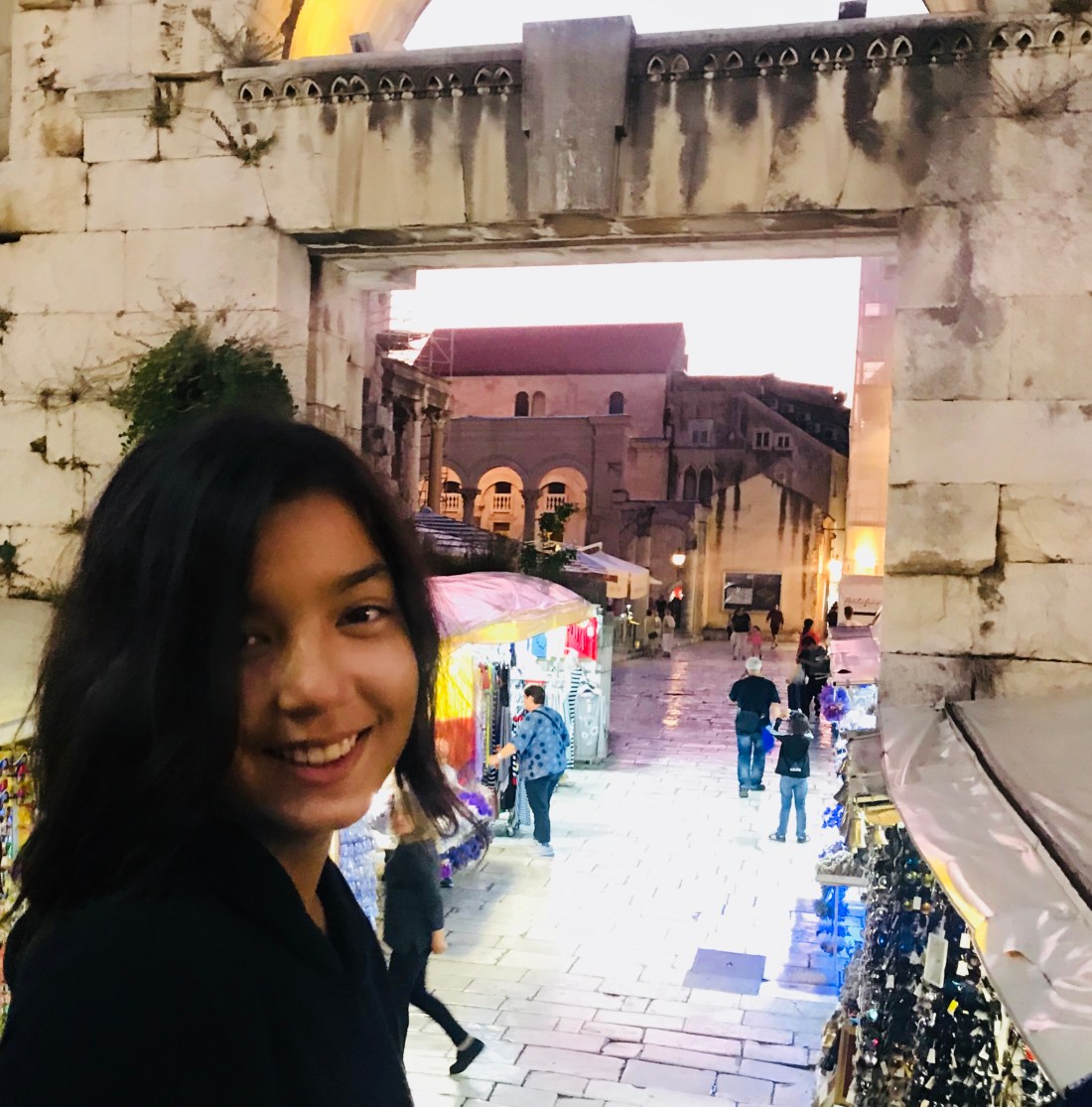
We spent a lovely evening in the Diocletian Palace. The Palace was built by a Roman emperor about 1700 years ago as his retirement home and Old Split has slowly occupied it over the years. And when it was time to go home I was going to call the Uber driver who had given me his number. But a young cab driver had started chatting with Jo and was angling for our business. When I told him I’d rather Uber because it was cheaper, he pointed to his BMW cab and said “But Uber is shit car”. It wasn’t exactly true but it was getting late and Vivian needed to use the bathroom. So we went back to Kastela Stari in the cab with the kids giggling and muttering “Uber is shit car”.