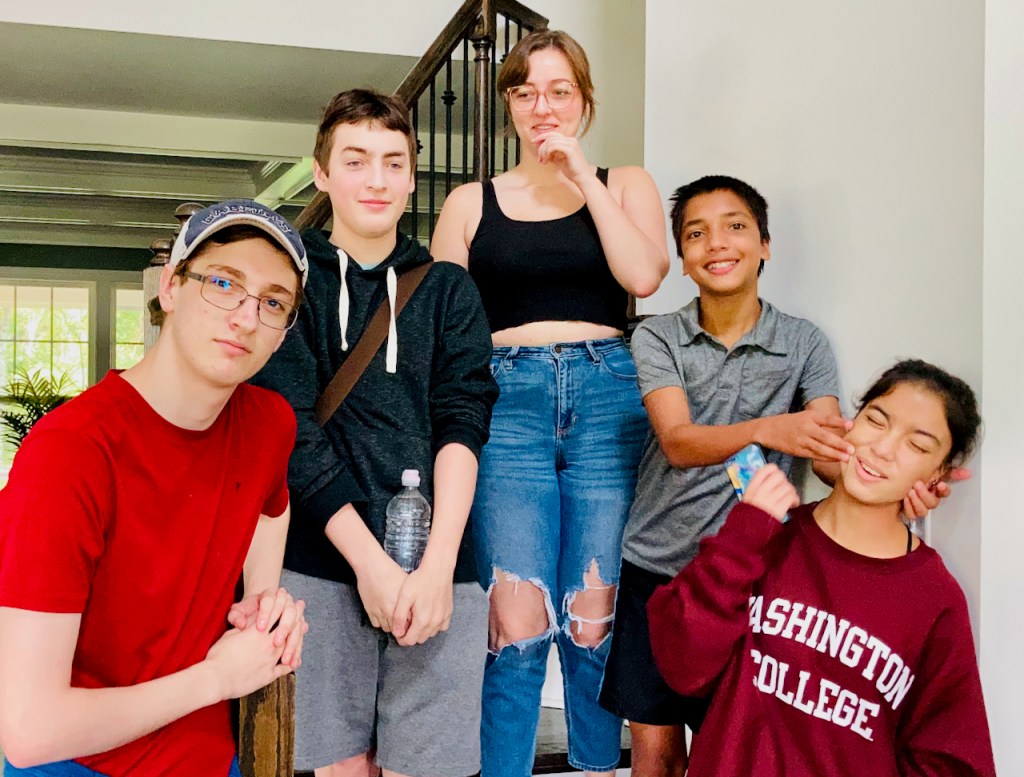
In Virginia, Vivian and Evan got to hang with their cousins. And we did fun adult things with Aaron and Beth like visiting a brew pub and arranging a seafood boil. Not to take away from any of these fine activities and people, but we also got to go to the Mariners’ Museum in Newport News!
My family groans when we enter museums. I like to read everything and view everything s-l-o-w-l-y. If its a maritime museum, it feels as if time has stopped. Or even reversed. Jo first experienced this time freeze when we went to the maritime museum in Halifax many years ago when we were there for Michelle and Alu’s wedding (in a sad irony, as I type this Michelle and Alu are both in Halifax today for a less joyous event). About five years ago we went to the Vasa museum near Stockholm. That was a treat but also a torture because Jo and the kids were done and ready in a mere 5 hours!! So I was pleasantly surprised when Jo took Aaron’s suggestion to go see the Mariners’ Museum. Hell – it was pouring rain anyway and admission is just a buck. One dollar. What could go wrong?
I won’t bore you with the details. If you are interested in the first battle of the ironclads, this is where they are restoring the salvaged remains of the USS Monitor. This tank below contains the full 21 1/2 foot rotating turret of the ship, slowly being electrolysed back into life after having spent a hundred years in her watery grave. The photo above is a model of the Monitor’s arch enemy, the CSS Virginia, and in the background is a full scale mock of the ship.
The Monitor and the Virginia were the world’s two first ironclad battleships to do battle. They pounded each other at close range for hours on a March morning in 1862 in the calm enclosed waters between Newport News and Norfolk and changed the course of naval battles and American history from that moment forward. Neither ship won, but neither ship suffered much damage. According to historians, if the Monitor had not arrived when she did, the Virginia may instead have steamed north up the Potomac and shelled the White House and the Capitol with impunity and today we wouldn’t be trying to outlaw the Confederate Flag.
The museum tells the fascinating story of how both these ironclads came about and the circumstances of their first meeting. I hurried through everything as fast as I could, finished, walked back to where the family was waiting patiently, and realized that this was just one exhibit in the fascinating museum. If you are within a hundred miles of this place, go take a look. Even Vivian, Evan, and Jo would agree.
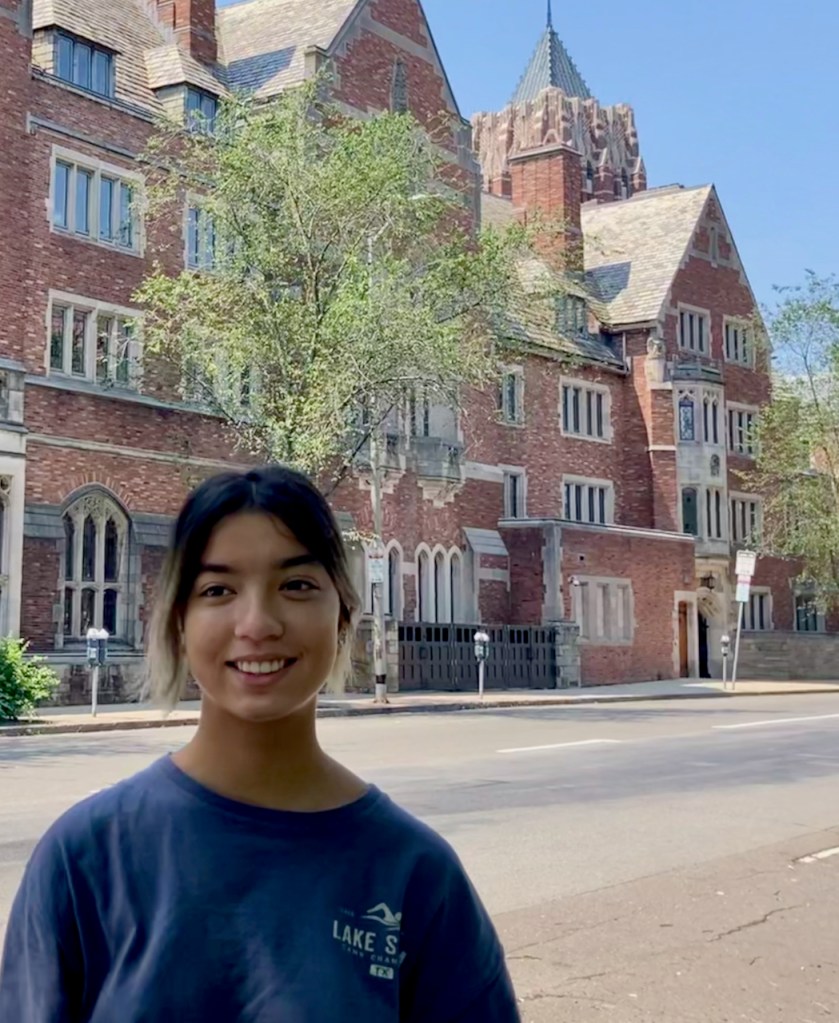
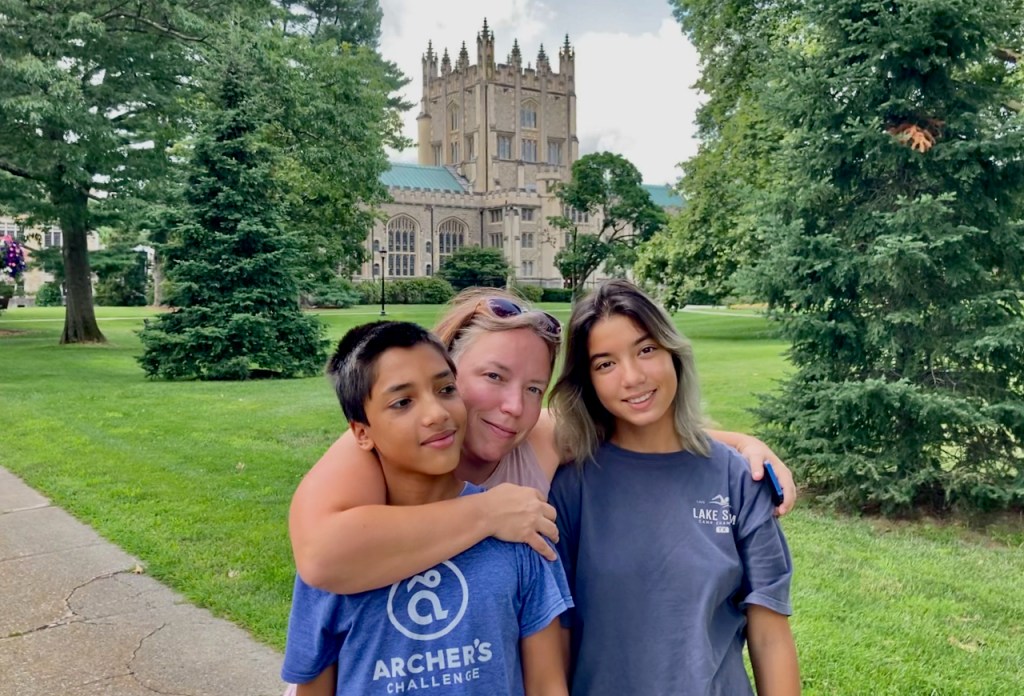
Our little baby is starting high school in a week. And our littler baby is headed for middle school. Being the plan-years-ahead types of parents we are decidedly not, we surprised ourselves by driving Vivian and Evan around a few college campuses while we travelled. Jo got the idea from a friend with a son of Vivian’s age. We drove to or through Colby, Harvard, MIT, Yale, Vasser, Washington College (Jo’s alma mater), URI, and William and Mary. We were in the neighborhood of Brown and Johns Hopkins, and perhaps a handful others that we didn’t get to. While it would be wonderful if Vivian or Evan have to choose between these schools, that is unlikely and moreover it isn’t the point. We wanted to show them what campuses look like and to inspire them a bit. And we would have had to literally drive out of our way to avoid most of these colleges. Besides, my philosophy about colleges and their campuses is simpler: go to the best college that will have you. Period. Of course I say that after having enjoyed the campuses of the Hyderabad Public School and Pilani, which makes me sound pretty damn insincere.
We had a joke about these campuses. They are all, with the exception of MIT and a couple others, old and prestigious liberal arts colleges. But they award degrees in the sciences and often engineering too. These colleges have different buildings for Jewish Studies and African American Women’s Studies but there was usually The So-and-So Science Hall. Science is a nice umbrella term, but come on. Now, I admit that here too I’m guilty of hypocrisy. In Pilani, the physics, chem, and bio departments were all in the S-Block but it was a small school with only four interconnected buildings for all the different academic departments. Going further back, in HPS we learned science till the 7th grade. From the 8th grade Biology, Physics, and Chemistry are different subjects with their own textbooks and separate teachers and labs. So I am more than weirded out by the American system of learning “science” well past one’s tweens. But judging by the number of Nobel prize winners in the sciences (haha) from the US versus India, I should let that one pass, shouldn’t I?
Vivian and Evan enjoyed the brief visits and Vasser, Yale, and Harvard were Vivian’s favorites. These kids may belong to the last generation whose parents are willing to pay ridiculous sums of money to institutions associated with historic buildings and campuses. Delivery of high quality higher education in other ways will happen within a few decades. So if you’re Evan’s offspring reading this blog post in 2050, I can understand if you are bewildered. What is this so-called “college tour” you “blog” about, Grandpa?
Growing up I didn’t enjoy history lessons at school. It was this dry pedantic subject filled with dates and facts that were perhaps imbued by historians with greater precision than they meritted. I could “mug” – the word used in the Hyderabad Public School for memorize. So I could easily fill four sheets of single ruled foolscap paper in neat cursive writing in Parker Washable Royal Blue ink about the details of the battle between Alexander and Porus in 326 BC. Or how Muhammad bin Tughlaq hastened the downfall of the Delhi Sultanate during his disastrous reign in the 1300’s though he was a genius. I got top grades but history had no fascination for me. Besides, it is burdened by one huge unredeemable fact. It’s in the past. When you are 13, life is about the present. And perhaps the future.
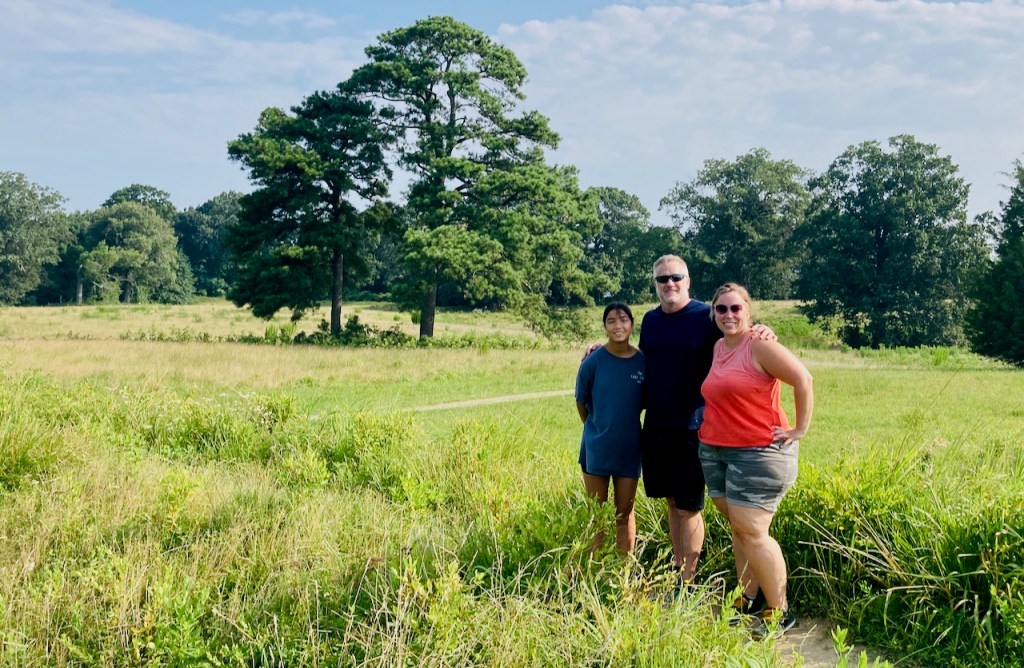
Understandably I wasn’t jumping with excitement when Jo planned a visit to the site of the Battle of Yorktown in Virginia with Aaron as our guide. I went along and hoped that the kids would find it interesting.
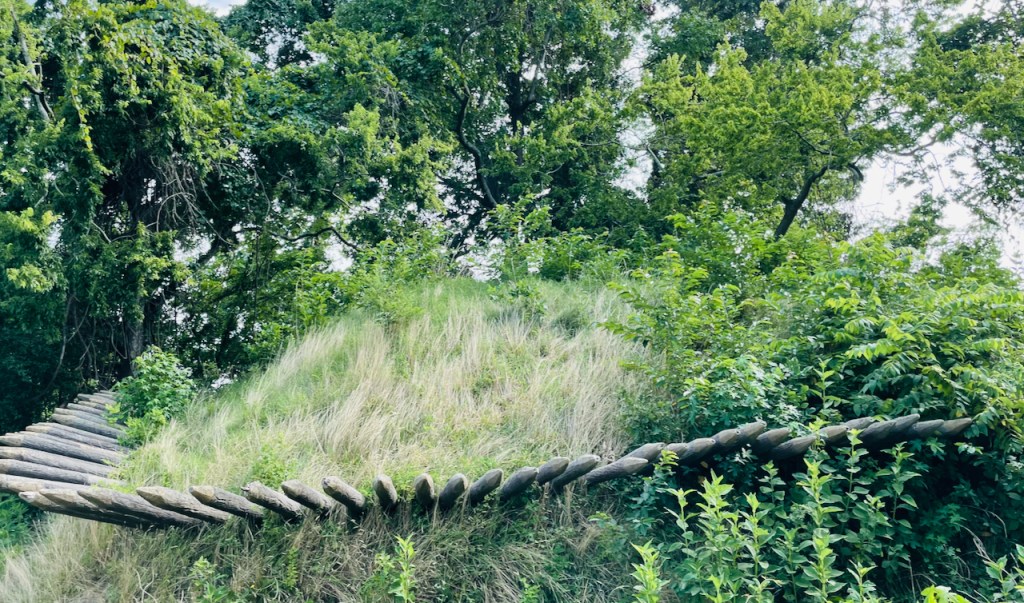
Sometime during the last few decades historians have recreated the earthen lines of the allied forces from historical data. The French and Washington’s troops attacked Cornwallis and his English troops holed up in Yorktown in October 1781. The French provided a naval blockade along the York river to prevent the British from resupplying from the water. Aaron explained all this as we walked along the trenches and earthworks, imagining cannon balls and mortar shells raining down on both sides that were separated by less than half a mile. Then we walked up to Redoubt Number 10. Redoubt is a new word in my vocabulary. We learned from Aaron that it is an enclosed defensive fortification that is usually separate from the main fort and is a often a raised earthen structure. In the case of Yorktown the redoubts had steep earthen walls and sharpened timber palisades and trenches under them that made scaling the redoubt difficult, especially when someone from above was shooting musket balls at you.
With their stores dwindling, the British tried to defend the town as the Americans began construction of another, closer trench line. The second trench line was directly under the fire of the last two redoubts the British forces held, allowing Cornwallis’ men to pour artillery onto the troops digging furiously. Washington and his French counterpart, Lieutenant General Comte de Rochambeau, realized the only way they could complete the second line of trenches, and thus get their troops and artillery close enough to storm the town, was to take the two last redoubts.
On the evening of October 14th, two assault parties formed to attack the two redoubts, designated “Redoubts 10 and 9.” A French band under Major General Baron De Viomenil began their attack on Redoubt 9, while LTC Alexander Hamilton commanded the Americans attacking Redoubt 10. Both forces numbered 400 men, and neither had loaded weapons. Instead, the troops fixed their bayonets and followed teams of sappers to the bases of the redoubts. Each redoubt was surrounded by an abatis, or sharpened tree branches tangled together similar to modern day barbed wire, which required the sappers to tear down. The Soldiers, now under heavy musket fire from the British, dropped fascines (bundles of sticks tied with yarn) into the ditch surrounding the redoubt, and placed ladders to climb the sides of the fortification.
The fighting within the redoubts digressed into violent hand-to-hand combat. Washington reported on the assault, simply stating the allies “advanced under the fire of the Enemy without returning a shot and effected the business with bayonet only.” The French captured one hundred and twenty British and Hessian soldiers in thirty minutes, while the Americans captured seventy in Redout 10.
The next morning, the second line of trenches included the two redoubts, allowing the Americans and French to bombard the British incessantly. The British commanders realized there were no reinforcements coming and supplies were running dangerously low. Finally, on the October 17th, Cornwallis sent a drummer boy and an officer to discuss the terms of his surrender.
Vivian and Evan had of course learned about Hamilton’s role not from history books at school but thanks to Lin-Manuel Miranda, so they sang it from the walls of the redoubt.
Cornwallis’ surrender marked the end of the last major battle in the American war of independence. Having lost here, the British next sent him to the Raj as the Governor General of India. Aaron pointed out that this one man was responsible for trying to subjugate people on both sides of our family. History is a lot more fun when you learn about it standing on what was once a blood stained battlefield. And when you have a personal dislike for the enemy commander. Asshole.
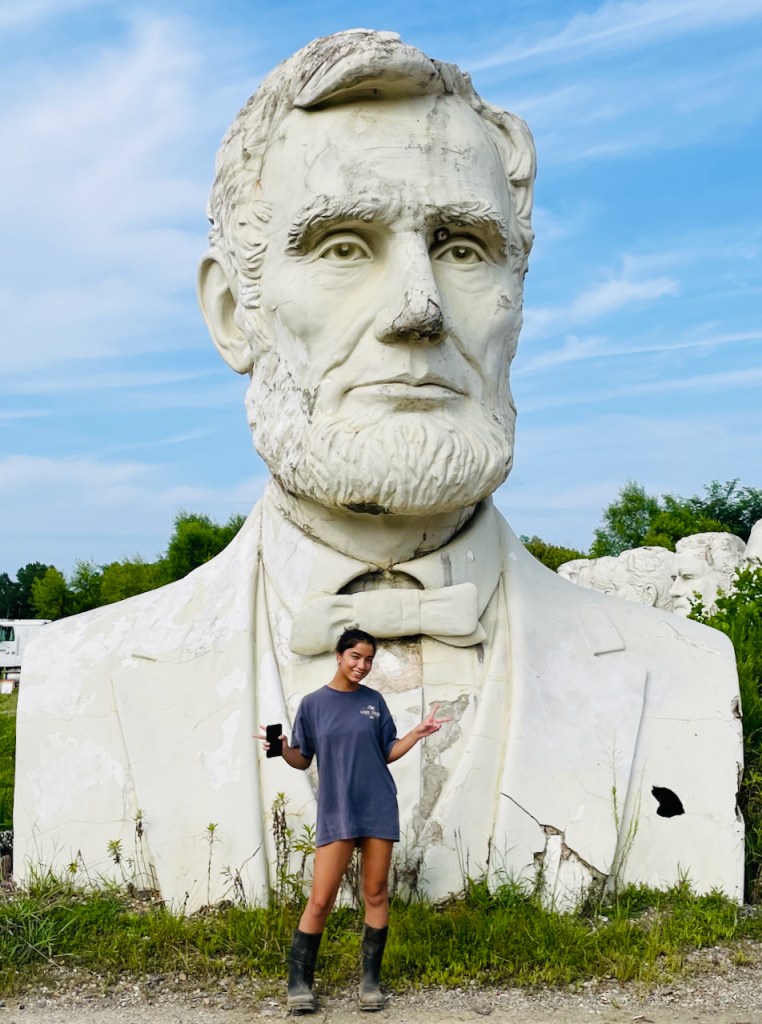
When we were in Virginia Beth found this pretty amazing place for us all to visit. So five cousins and four adults drove over, parked, and then found this post apocalyptic graveyard of 43 oversized US presidential busts. Once they adorned a private park nearby but it went bust (haha) so they were slated for demolition at the concrete and stone crushing business where they still rest today. To bring them here, the top of each head was broken open to expose the steel framework inside. Then the bust was attached by chain through that opening to a crane and rocked it back and forth till it came loose from its pedestal. The 5-10 tonne statues were hoisted on flatbeds and driven over and deposited unceremoniously here. Abe fell off the truck and the back off his head is blown off. Art imitating life?
Grass and shrubs grows around busts. In some places the ground is squelchy and our provided rubber boots sank ankle deep into smelly muck. We wandered around the statues and assigned their dominant personalities to them. Washington the general. Abe the uniter. Clinton smirking slightly. “It depends on what the meaning of the word is is”. Senior Bush with his lipless frown. Shrub trying to do the tough guy look but ending up only looking vacant.
The statues are one of three series made by Houston artist David Adickes. The first presidential park was in South Dakota near Rushmore in the hope that after people had partaken the giant forms of Washington, Jefferson, Abe and Teddy, they’d want more. The private enterprise didn’t work out but the statues are apparently still there nestled among towering evergreens at the foothills of the Black Mountains. The statues resting now at this stone crushing facility in Virginia was the second attempt. New busts await in Adickes’s outdoor studio under Highway 59 in the middle of Houston, slated for a third presidential park in nearby Huntsville.
A photographer of discarded buildings and his friend give tours of the Virginia statues in the evenings when the stone crushing plant isn’t working. Admission goes towards one day rehabilitating the busts. The guide has a presidential quiz for visitors. Aaron knew most of the answers. I was the first to only answer one. What shipment did JFK receive hours before signing the Cuba Embargo in 1962? Cuban cigars. Specifically 1200 Upmann petits.
I don’t know if the kids learned any history. Perhaps just the weird human need for immortality.
I’ve been wondering about statues. Evan stood next to the seated 19-foot white marble Abe at the Lincoln Memorial last week. Lincoln looks worn and tired after the war even as he stares stonily towards a distant horizon with resolve. The world’s tallest statue was completed in India a couple of years ago. It is a statue of Vallabh Bhai Patel, a freedom fighter and founding father. That it was built in recent times is as amazing as its size – three times taller than Liberty. In the US and England, we are busy toppling statues of people who were once heroes and are today recognized as being boobs. Morals change faster than statues erode.
U.S. troops pulled down a giant statue of Iraqi President Saddam Hussein hours after coalition tanks rolled into the center of Baghdad. At school, you learned history from a book, or a computer, or a television. You did not learn it from a statue. Statues don’t educate, they celebrate.
I gave an AI at writesonic.com the above paragraph (taken from two different articles on the internet) and asked it to write me a blog post. It asked me some simple questions and had me select from a few options and 30 seconds later I have a blog post. I’d like to think the AI isn’t as good as me yet (and I recognize that I’m not very good). In the Conclusion section she seems to have gone off the rails. And she does like to drop names. But in the near future, passable essays will be written by AIs. What does that mean for writers and consumers of text? Should Evan practice writing or coding?
Anyway, here’s what writesonic’s AI produced.
What happens when you Remove a Statue: A Thought Experiment
– written by an AI
U.S. troops pulled down a giant statue of Iraqi President Saddam Hussein hours after coalition tanks rolled into the center of Baghdad. At school, you learned history from a book, or a computer, or a television. You did not learn it from a statue. Statues don’t educate, they celebrate.
When a statue disappears, so does the history that it represents. Then comes a gap in our collective memory that would never have happened had the statue not been there in the first place. I was speaking to a Muslim student at a U.S. college who told me how horrified she was to hear her grandparents and great-grandparents call the U.S. a criminal empire that killed and displaced millions in the name of “freedom and democracy” in Iraq. Most Americans are not as familiar with Saddam Hussein as they are with our vice president, Dick Cheney, who told his staff to forget the new Iraq. “Let’s not lose the old one.” Saddam has been dead for seven years. Osama Bin Laden for more than a decade.
What happens when you remove a statue?
They are removed, defaced, or destroyed. The person might be made a martyr, as in the case of the Chinese terrorist, Guo Boxiong, who was made a martyr by the Chinese for refusing to do his duty in World War II, or the South African apartheid martyr, Steve Biko, who was made a martyr by the South African government. The journalist Roger Cohen uses the phrase “cultural cleansing,” which I agree is a bit of a misnomer. He means “the destruction of ethnic identity,” which is one approach, but I disagree. People have always been motivated by identity, but the reason we insist on education is to increase understanding.
Conclusion
Dionysus, the goddess of wine, came out of the mist and carried the pallbearers of Virgil to the valley of the dead. In the Grove of Kousoul, the remains of those who have conquered death and returned to life are re-enacted by the god. Many goddesses and goddesses-in-training are cast into the underworld, but Dionysus will ensure their victory over death. Because Greek mythology and its myths make the world, it seems myopic to not at least acknowledge that it exists. Nothing gives me greater pleasure than watching the moon fill a dark sky. We do not know what we do not know. The moon is majestic and elusive and impressive and helps me appreciate the power of the earth.
To me the state of Virginia seemed like a southern extension of Washington, the civil war notwithstanding. I assumed it was suburbia for DC with really bad traffic. Then Aaron moved here. And Jenny. And Jen. So we came here to see them. After all what’s there to see in Virginia? We have been pleasantly surprised.
We stayed near Jen for the first few days. We were in Falmouth, a small town just north of Fredericksburg. We stayed in the Basil Gordon house on the banks of the Rappahannock, built in 1820 by its namesake, the first known millionaire in America. Our next door neighbor was the Moncure Conway house, a historic home and hospital during the civil war. Slave holding was common when these houses were built. Moncure Conway, though a Virginian, was an abolitionist and is credited with taking 30 slaves from his parents’ home to their freedom in Ohio. Chatham manor was up the hill from us. George Washington’s childhood home was a mile away. Walt Whitman was here. So were Jefferson and Robert E Lee. Over 15,000 soldiers were killed around here during the civil war. History seeps out of everywhere. The brick walls of the spooky basement of the Basil Gordon house talk to us. The winery where Jo and Jen and I went for a glass of wine was in the field where Stonewall Jackson’s arm was amputated a few days before his death. My morning walk in Pratt park takes me through battlefields. Virginia is in the center of American revolutionary and civil war history, like Panipat and Jallianwala Bagh rolled into one place.
We spent a few evenings happily eating and drinking and chatting with Jen and her new family. Thankfully all the kids got along, well enough to even plan future vacations. On our last day in Falmouth we visited our neighbor on the west side, the Belmont. This is the estate and studio of Gari Melchers, a famous American artist who I had not heard of till then. He seemed to have lived a successful happy life as an artist, producing highly regarded art. As we toured his 27 acre estate and his beautiful home, preserved like it looked in the 1920’s, Vivian and Evan wondered if it was necessary to be poor and starving or to cut off one’s ear to achieve fame in the art world.
The docent who showed us around Melchers’ studio asked us where we were visiting from. When we replied Texas, she asked us what was wrong with people there. “They think the vaccine is putting microchips into them”, she laughed. Virginians are making fun on how backward we are in Texas. Mr. Abbott, the world is laughing at your science. Or atleast a silver haired Virginian lady is.
They were on the wrong side of history once. But as I said earlier, we were pleasantly surprised by the Virginia of today. When you walk any place in the world, there is a possibility that you’ll exchange a greeting with a fellow walker, especially if there is eye contact. In Austin you could walk the three mile short loop around Town Lake and expect to say a few hello’s or hi’s or nod a few times. People are busily doing their own thing. Most have earbuds sticking out of their ears and are aurally occupied, like Vivian always is when I try to talk to her in the car. In Virginia, during my morning walks, the “good morning” rate was 100%. A quick hi won’t suffice. Everyone says good morning to each other, even when they pass you on a bicycle traveling in the same direction as you. I’m sure that doesn’t happen everywhere in the state all the time. But it was true during my short data collection period of four mornings in one particular park. In my unscientific study around the world, that is unprecedented.
We aren’t moving to Virginia tomorrow. But we will be happy to visit this beautiful state with her friendly people again.
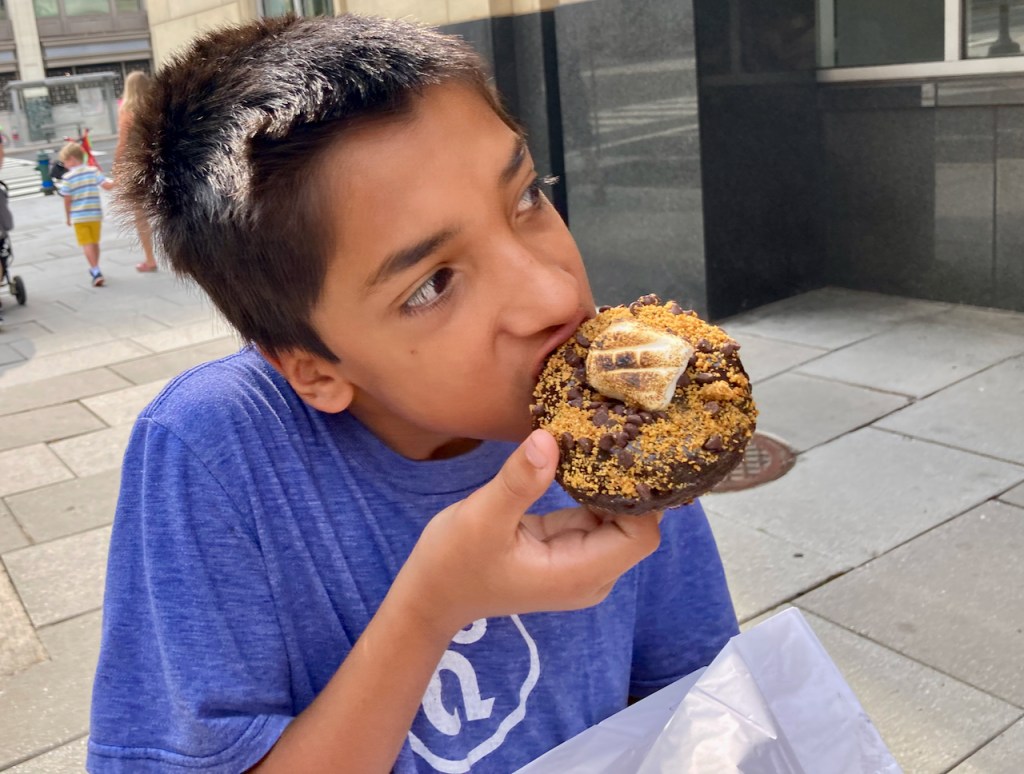
Jo, Jen, Evan and I drove up to DC on a Sunday morning. We started with a s’more donut for Evan and ended with a very nice lunch at Old Ebbitt Grill just a block away from the Casa Blanca. In between we walked. We wandered past Ford’s Theater and the people waiting outside Lincoln’s Waffle Shop, along the brutalist exterior of the FBI Hoover building, past the neoclassical doorways of the Robert Kennedy Justice building and up to the Natural History museum where people were already lining up to get in.
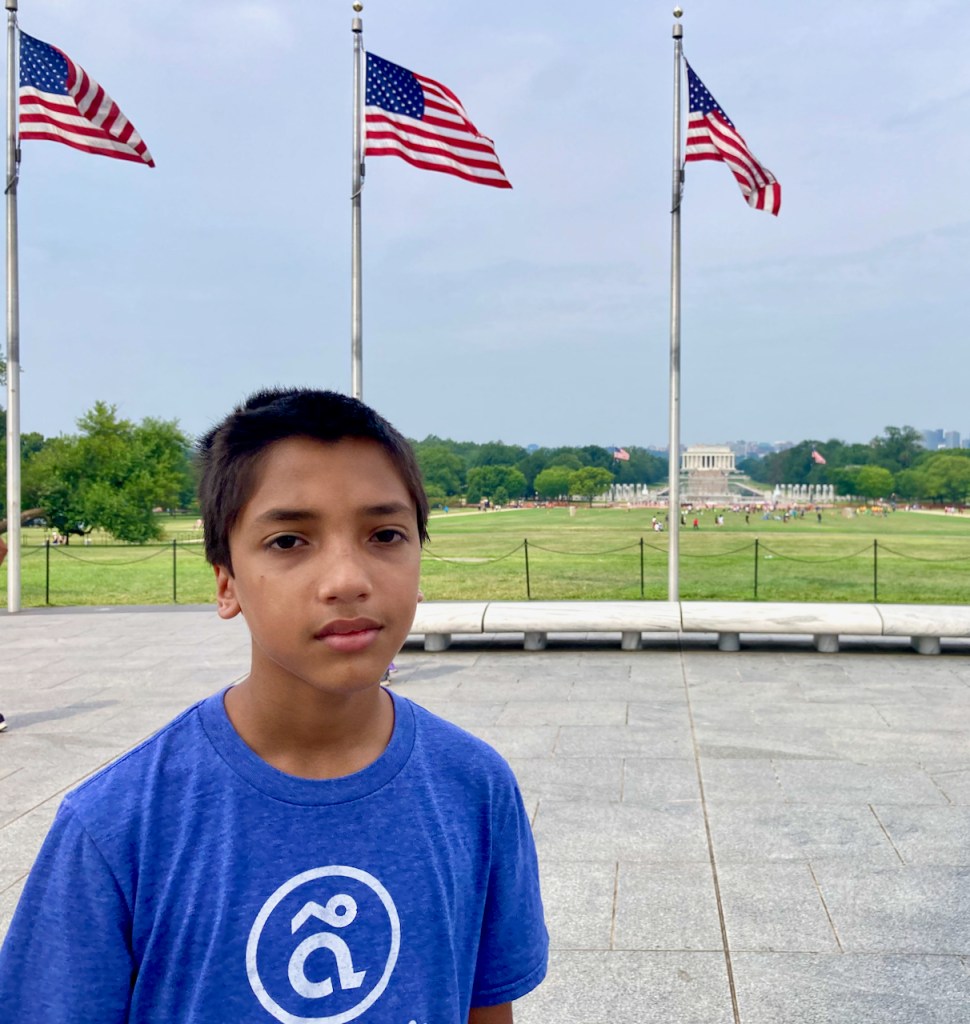
We stepped out on to the grass and the huge open space of the Mall with the Washington Monument to the west and the Capitol to the east and that’s when Evan realized that there was quite a bit of walking in his near future. I think this picture sums it up pretty well.
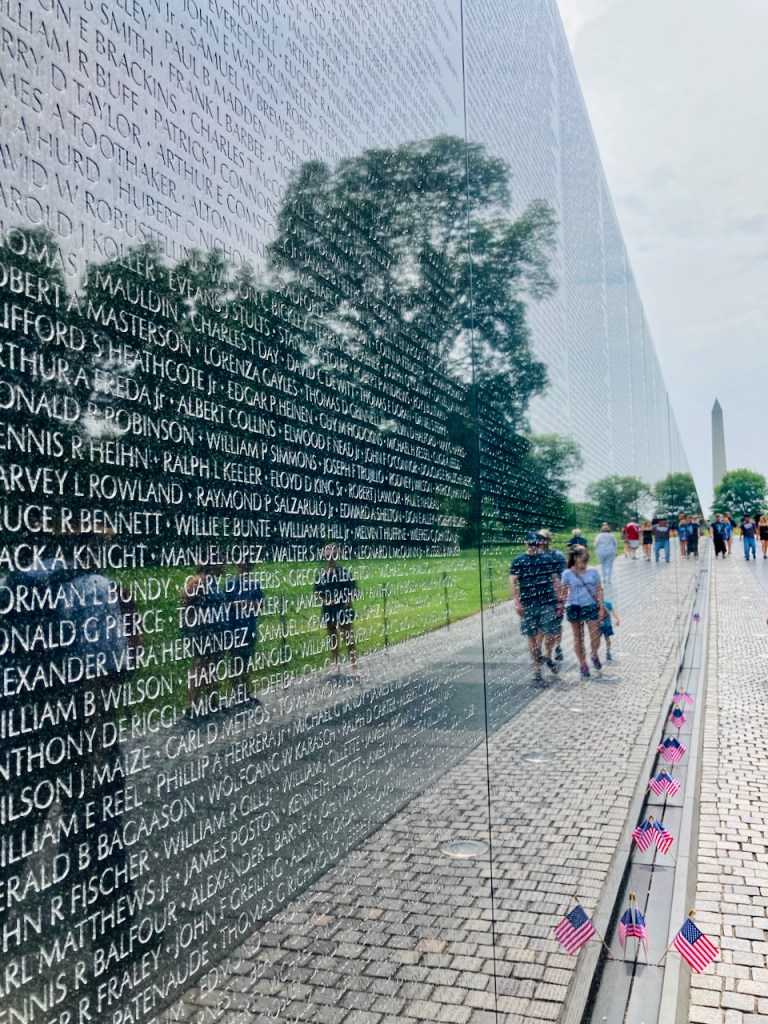
It was hot and muggy in the sun but there was a breeze and in the shade it felt okay. We stopped at the Washington Monument, WW II memorial, the Korean War memorial (it was closed due to construction), the Vietnam memorial, and the Lincoln memorial. At the WW II memorial, we stood in front of the Freedom Wall with its 4048 gold stars, each marking 100 American deaths. Evan was surprised to note on the plaque next to the wall that more Americans had lost their lives in the Civil War than in WW II.
I stood by Evan as he read the full inscription of the Gettysburg Address to the right of the seated Lincoln. I remembered standing right there and reading it three decades ago.
We walked around the Ellipse to the front of the White House, while Jo scootered up on a Lime. A smattering of Cuban protesters wearing “patria y vida” t-shirts were waving Cuban flags. Evan flashed a smile for the camera and then whined “how much longer?” The tall fences from the Trump era are gone. But in his memory we threw up in our mouths a little bit. And there endeth our trip to DC.
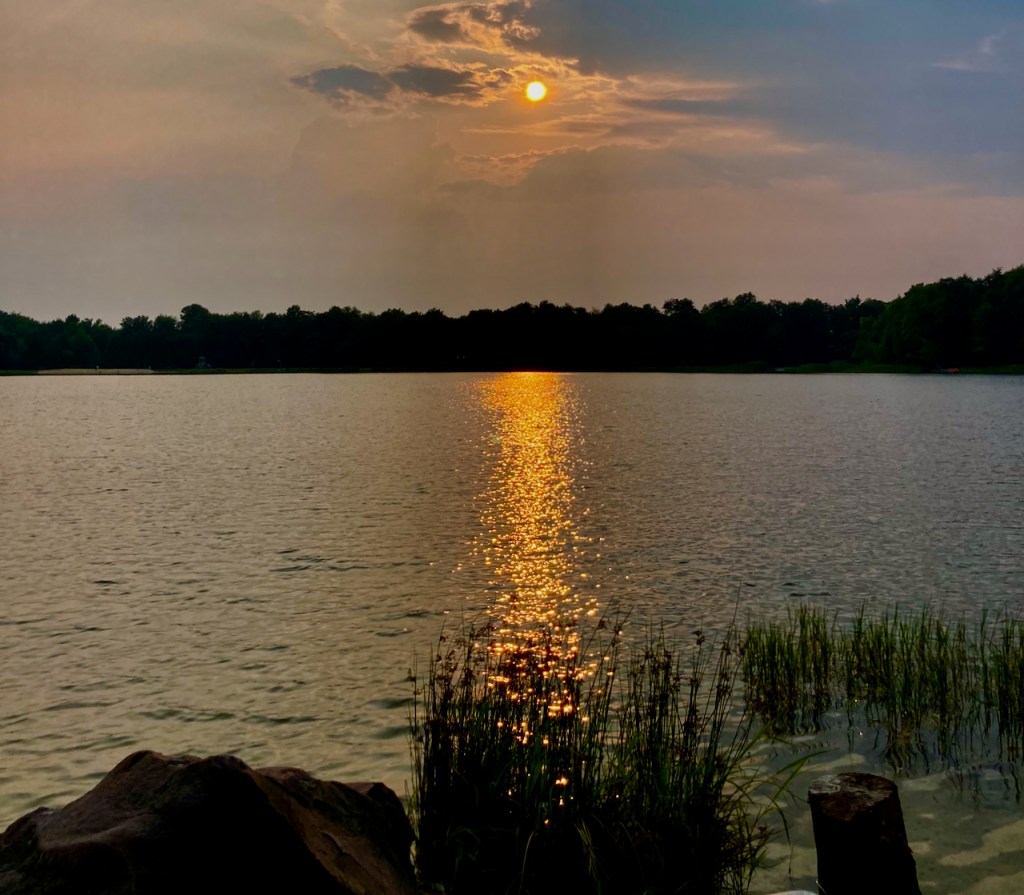
I wouldn’t have been able to tell you which state the Pocono mountains were in two weeks ago. Then Jo planned for us to meet our friends from Austin who vacation there every year. It wasn’t too far from where we were going to be wandering anyways. We are finding that everything in the north east is about 5 hours away. So we sallied forth from Wakefield after saying goodbye to Alu and Michelle, had lunch near the Yale campus in New Haven, stopped at Vassar near Poughkeepsie, crossed the Hudson, angled south to cross the Delaware near the borders of New York, New Jersey, and Pennsylvania, and arrived at the sleepy village of Pocono Pines that afternoon. It sits at a grand elevation of 1,800 feet but we aren’t going to be like those Englishmen who went up a hill but came down a mountain.
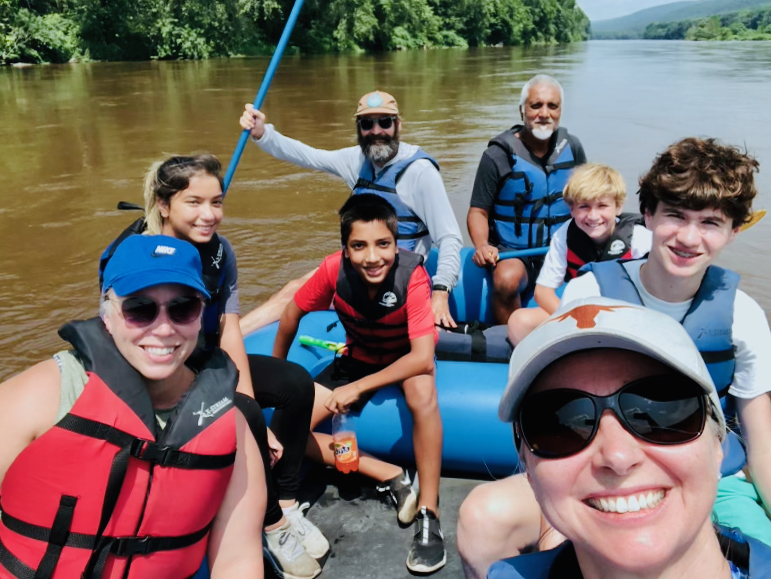
The area around the Pocono’s are lovely. Everywhere you look there’s a lake and a creek and a cascade. We hiked a bit, played some pickle ball, rafted down a very muddy and full Delaware, and had a nice dinner at our friend’s parents with a total of 14 people which would have been unimaginable a few months ago (and may soon be again).
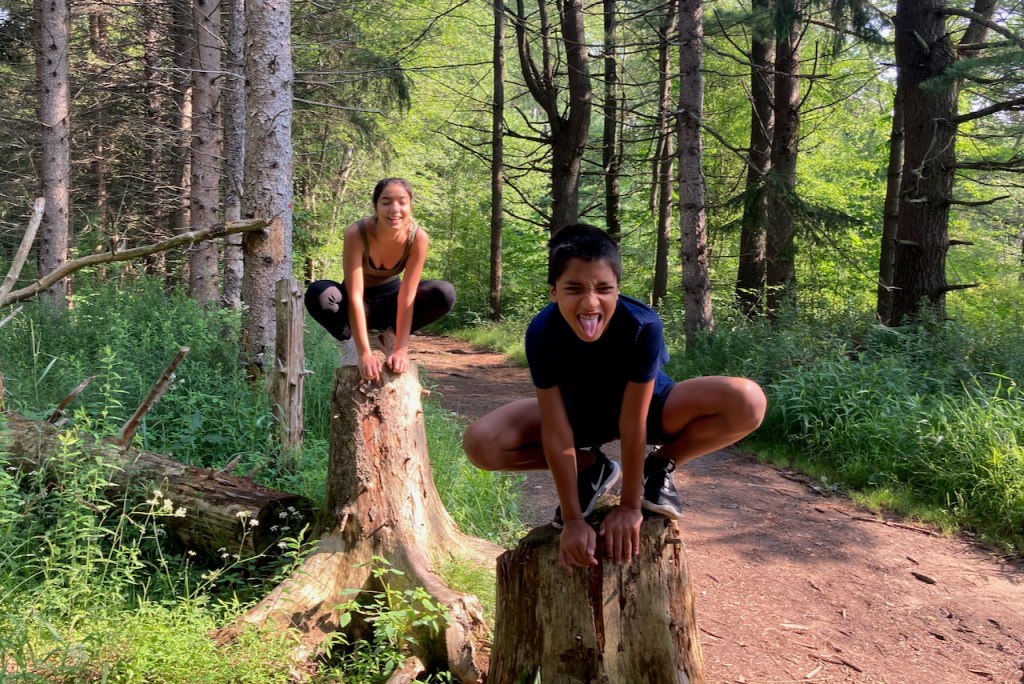
Vivian and Evan and Alu and I had watched Monty Python back in Martha’s Vineyard one evening. Since then Evan occasionally rides like a knight, trotting along while banging two rocks together to the tempo of hoofs beating. At a park in the Pocono’s Evan and Vivian did that and you can see Vivian “dismounting” here.
When the mile high sheets of ice from the recent ice age melted about 18,000 years ago, they left behind piles of rock and dirt that they had scraped and pushed along and pressed down upon. The furthest of these are called the terminal moraines, which Evan fondly calls “terminal morons”. The island of Martha’s Vineyard, separated by about five miles of sea from Cape Cod, is one of these glacial terminal moraines. In geological terms, the island is a newborn. The oldest rocks ever found on earth are almost four and half billion years old by comparison. Martha’s Vineyard was formed after humans first migrated from Asia to the Americas across the glacial ice bridges over what is today the Bering sea. Eventually the descendants of those early people settled the island. They are the Wampanoags. Then 420 years ago an English explorer “found” the island and named it after his mother-in-law or his daughter (apparently were both Martha). Here is a photo of the end of the terminal moraines near the Gay Head lighthouse (that’s the real name) at the south western end of the island on a foggy afternoon.
Our trip to Martha’s Vineyard wasn’t what we had planned. Michelle and Jo couldn’t make it, both taking care of urgent family matters. So it was Alu and me the the kids in a beautiful six bedroom Victorian in Oak Bluffs. We spread out over the house and its immaculate grounds and I let the kids sleep in and go crazy on their devices. Some days I didn’t see them till late afternoon. Martha’s Vineyard and particularly the town of Oak Bluffs isn’t like Austin. Black kids flew kites in the parks alongside white families. Black men and women sunbathed on the beaches and rode bicycles and rocked on porches that wrapped around beachside bungalows. The house we stayed at may have been owned by a Black family – the beautiful art on the walls depicted Blacks. The strange thing about all this is that we noticed it right away. It is different from “normal”. When people say that American history and identity is one in which whiteness is normalized, this is what they mean.
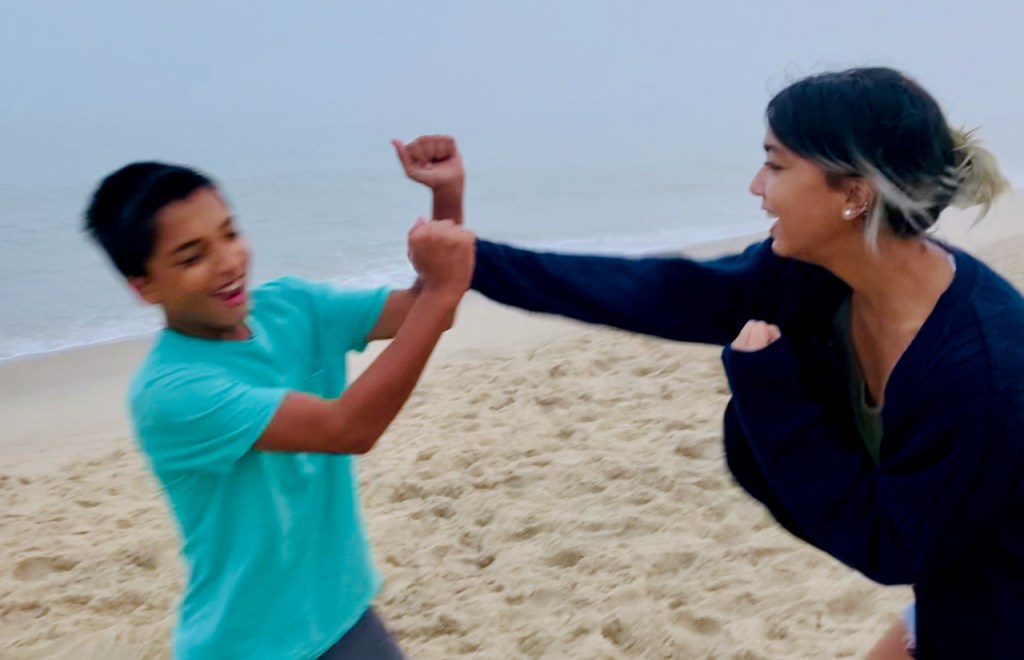
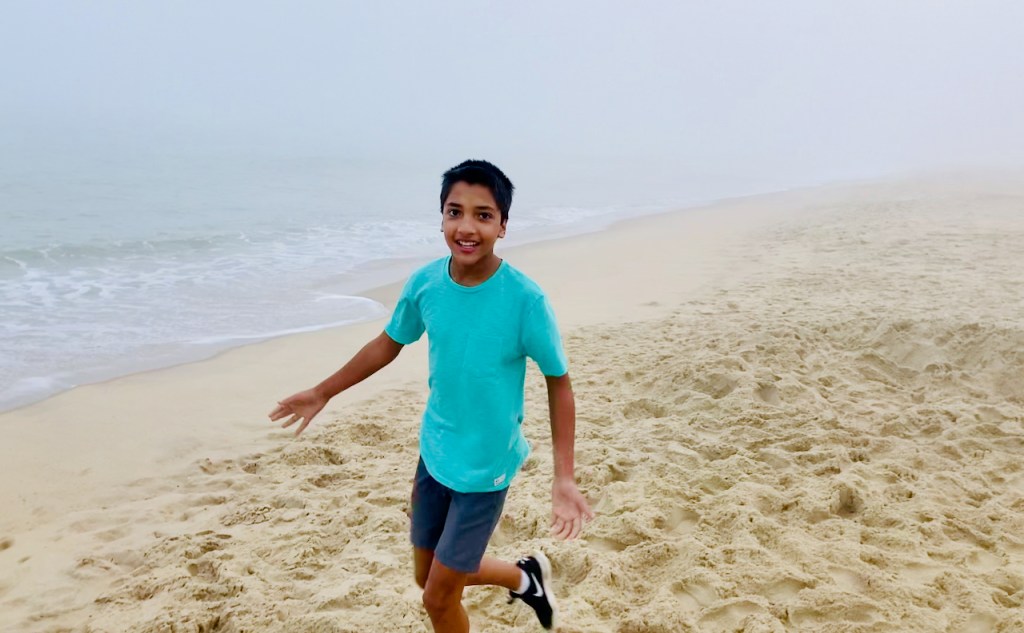
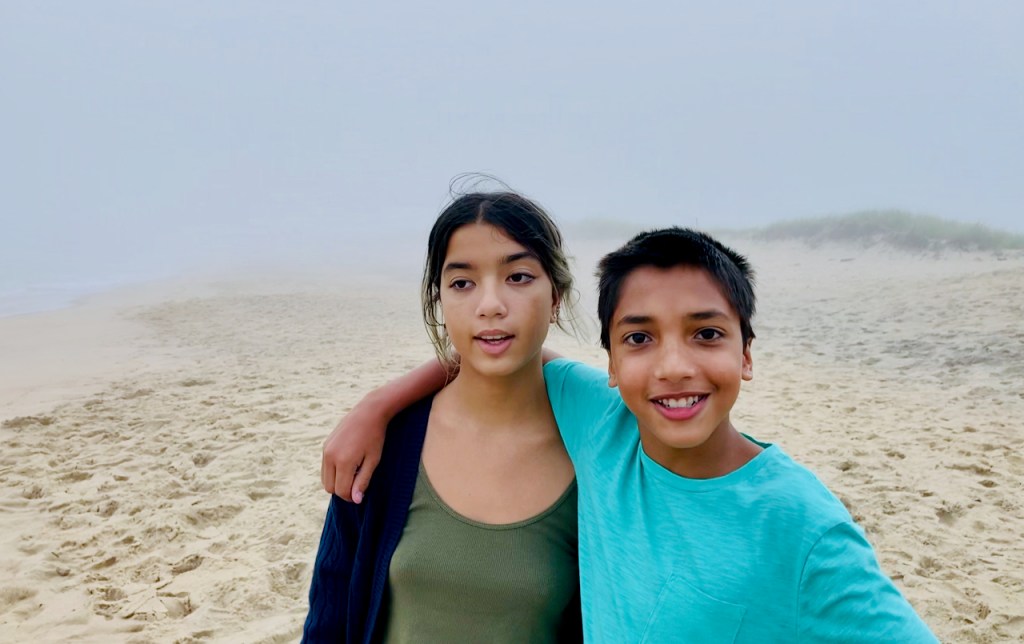
When I did see the kids once a while we walked a lot of beaches and played a short game of 2 v 2 soccer and ate ice cream and oohed and aahed at the island’s lovely homes and gardens and made good memories. One afternoon we left the perfectly sunny town of Oak Bluffs and by the time we arrived at Katama beach on the southern end of the island 15 minutes later, we were engulfed in fog. The breakers crashed on the beach but we couldn’t see them rolling in. Evan and Vivian found it a bit eerie but they chased each other around in the fog.
The morning we picked Evan up from his summer camp a few weeks ago I asked him if he ran out of books to read which he usually does. He said he had but that he was reading them all again. Most of what he reads is of the minecraft fiction crap genre. I was about to snidely comment why anyone would read something like that twice when he said “Dad, I reread The Disappearing Spoon. I understand the Bose-Einstein condensate”. “So what is it?” I asked. “You know what Heisenberg’s uncertainty principle says. If you keep cooling down matter, then near absolute zero the atoms almost stop moving and therefore almost have no uncertainty related to their momentum. So the atoms increase the uncertainty of their position by appearing bigger and overlapping into one another.”
Bose predicted this in 1920. A couple of scientists got the Nobel Prize in 2001 for experimentally proving this. Twenty years later my eleven year explains it to me. When I was eleven, I hadn’t even heard of the Bose-Einstein condensate. Kids today are smarter. They have a much better understanding of science. Yesterday, we walked around the Harvard campus. Vivian and Evan played between the giant sycamore trees while Jo and I strolled along the banks of the Charles. People in the buildings around us and in places like this around the world toil away to advance our understanding of our world, even if it takes one hundred years for that knowledge to trickle down to into our consciousness.
I am sitting in an airbnb in Cambridge, Massachusetts. It is gently raining outside. Yesterday Alu drove up from Wakefield. We dropped Jo off at the airport for a quick trip to Nebraska. The kids are keeping themselves busy indoors today. The average waiter in this town is smarter and better educated than me. It feels like a good place to be. Then I come across a story in Fox News. It was a rant from someone called Bob Schneider to his 940,000 twitter followers about Covid vaccines. I’m quoting from Fox. “Just say no… And keep saying no… Over half of the U.S. population is continuing to say no to this unapproved experimental gene therapy! ‘My body, my choice!'”, adding the hashtag, “2nd Amendment Is For This.”
It isn’t just that the kids at Harvard and MIT are smarter than Bob. It’s that Bob, bless his heart, and I live in different Americas. Just like the four blind men who observe an elephant and they all arrive at different incorrect conclusions, Bob and I can no longer agree on the nation’s history or purpose. George Packer recently wrote about this in the Atlantic: How America Fractured into Four Parts. I find his thesis very interesting. His four Americas have nice names, but don’t be fooled. Each hides something ugly. Here is my synopsis, but you should read Packer’s article.
Free America is the remnants of Reagan’s America. In Free American the myths of the self-made man and the western pioneer are alive and well. In Free America we’re individuals. We have a chance to make it. Get government out of the way (but not in the case of women’s wombs). Cut taxes. Deregulate industry. All are welcome to pursue happiness. Cloaked in the language of individualism, Free America pulls back from public investment and common good. There is no glue to hold individuals together. Government is hollowed out. When Walmart and Amazon push mom and pop businesses out of main street and into bankruptcy and when global trade moves manufacturing jobs overseas, corporations benefit, communities die. In Free America the marketplace is the final arbitrator of value. Free America appeals to people who have already made it, even on the shoulders of their long departed great grandparents. Free America is the promised land.
I have lived in Free America and snagged a crumb or two with the blessings of Ayn Rand under the watchful eye of Bill Gates (the capitalist, not the communist vaccine guy) and Alan Greenspan.
Smart America is born from the democratization of higher education in post-war America. This is the America of college educated un-unionized professionals in technology, medicine, research, design, consulting, law, the media. They populate the ivory towers of higher education. They trust in globalism and the free flow of capital and people around the world which they believe will eventually benefit everyone. Smart America welcomes new ideas and a diversity of people and thought (up to a point). Smart America relishes yoga, sushi, espresso, crossfit, shopping at Whole Foods. Smart America is cosmopolitan and multicultural. Smart Americans could be from anywhere. Smart Americans are the meritocracy. In Smart America your skills alone determine your rewards. Smart Americans intermarry each other and raise their kids and do all they can to pass on their advantages to their children. In doing so they create a hierarchy just like the robber barons they replaced. A child today who is not from a family of college educated parents is almost as disadvantaged as he would have been 70 years ago.
I identify in multiple ways with the Smart America of Clinton and Obama. If the opportunities are truly equal, the results will be fair.
Real America is Sarah Palin’s America, hardworking religious patriots living in the mythical heartland, toiling away with their hands in factories and mills, growing our food, fighting our wars, fixing our cars, the salt of the earth. Real America is decent people who help their neighbors. Real America is white non-college educated Christians fucked over by free trade and immigration. In Real America experts and elites are full of shit and science is irrelevant. International organizations and treaties are bad. Real America is religious. Real America is proud. Real America is not open to new ideas. The identity politics of sex and idea of systemic racism are utter nonsense in Real America. God, guns, and liberty (of the Don’t Tread on Me type) come before equality, democracy, and even truth. Smart America who has no need for patriotism has yielded it to Real America who then clothed it in stark white Christian nationalism. But Real America is not just a rebellion against Smart America. Free America’s misadventures in Iraq, the financial crisis of 2008, and libertarianism have failed Real America. The bankers got bailouts. Real America got foreclosures. The only thing that trickles down is shit and opioids. Politicians since the ages have praised Real America. But Donald Trump’s insurrection finally gave Real America a way to participate in self-government.
My relationship with Real America is dubious. I fail to intersect along any of the three main dimensions. I’m non-white, college-educated, and non-Christian.
Just America is Packard’s fourth and final faction. Born of injustice that traces a direct line to the shame of America’s original sin of slavery (ignoring the other original sin of genocide for now), Just America is a young angry reactionary revolution. Just America is the fight, not the aspiration. Just America views us through the lens of race. Incremental change hasn’t worked. Rosa was supposed to have sat, Martin walked, and Barack ran, so we could all fly. Smart America didn’t fix anything. Instead, schools suck, prisons are overflowing, the police is rotten. Free American’s free-wheeling capitalism is marginalising communities and destroying the planet. Just America is in the lived experience of being alienated and subjugated by a dominating discriminating exploiting culture day after day after day. Just America is in finally saying enough. Just America is in the language and identity of oppressed groups. Equity, not equality is the answer. Reason, objectivity, rationality, and individual freedom are oppressing powers. Just America sees nothing of value to save in America, nothing to redeem. Just America defunds and topples and riots.
I am hopeful of Just America. But more than that I am scared of Just America and its new forms of discrimination, new hierarchies of hate, new structures of separation.
Will the four persons who have visual impairment, out of their own free will, in the quest for the bigger truth, and because God wants it so, and also for justice for past blindnesses, just get their fucking shit together so that they can see the elephant. Or is Heisenberg on to something bigger than the mere secrets of the universe. Is uncertainty all that there is?