Gansbaai

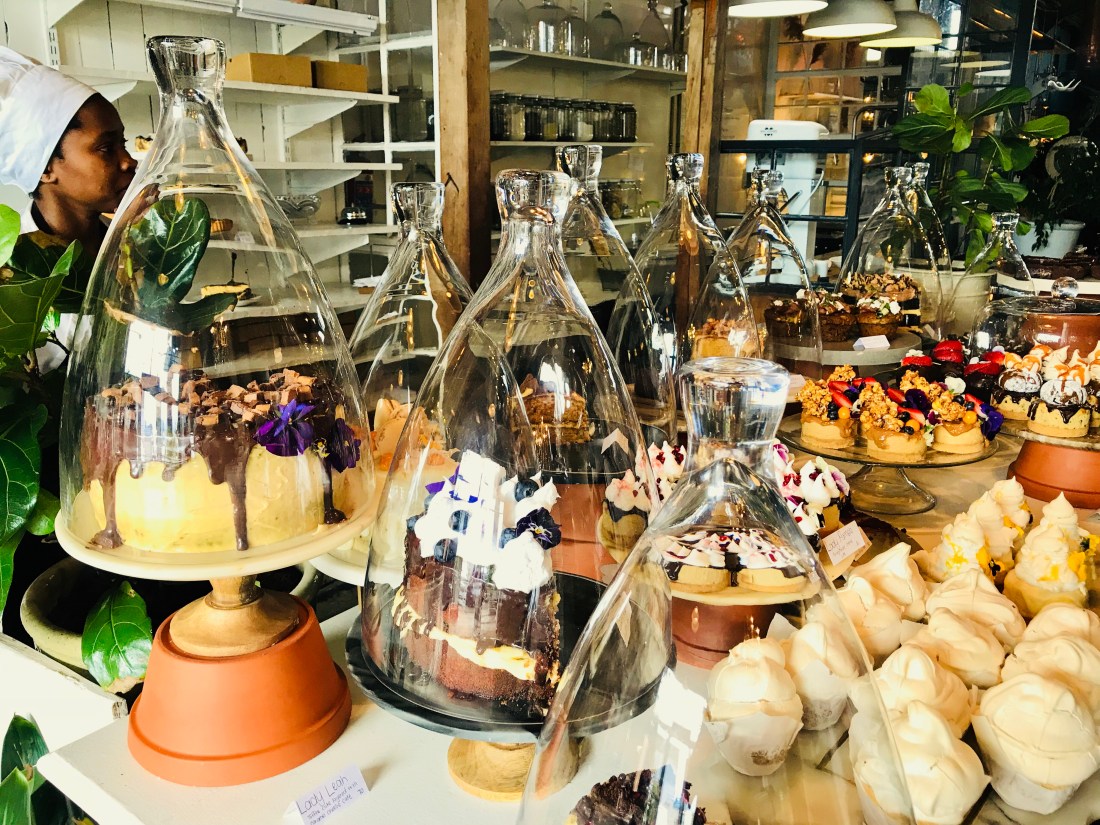
Eventually we reluctantly said goodbye to Cape Town and drove off in a rental car towards the south. Our first stop was at a funky place called Pajamas and Jam in the burb of Somerset for breakfast. The selection of cakes and breakfast goodies was amazing, though Vivian, Jo, and I agreed that our caramel Nutella hot chocolates were heavenly.
Then we made our way along the beautiful eastern side of False Bay through charming coastal towns to Hermanus and then to Gansbaai. Bay is baai in Afrikaans. The the “G” pronounced with a clearing of the throat.

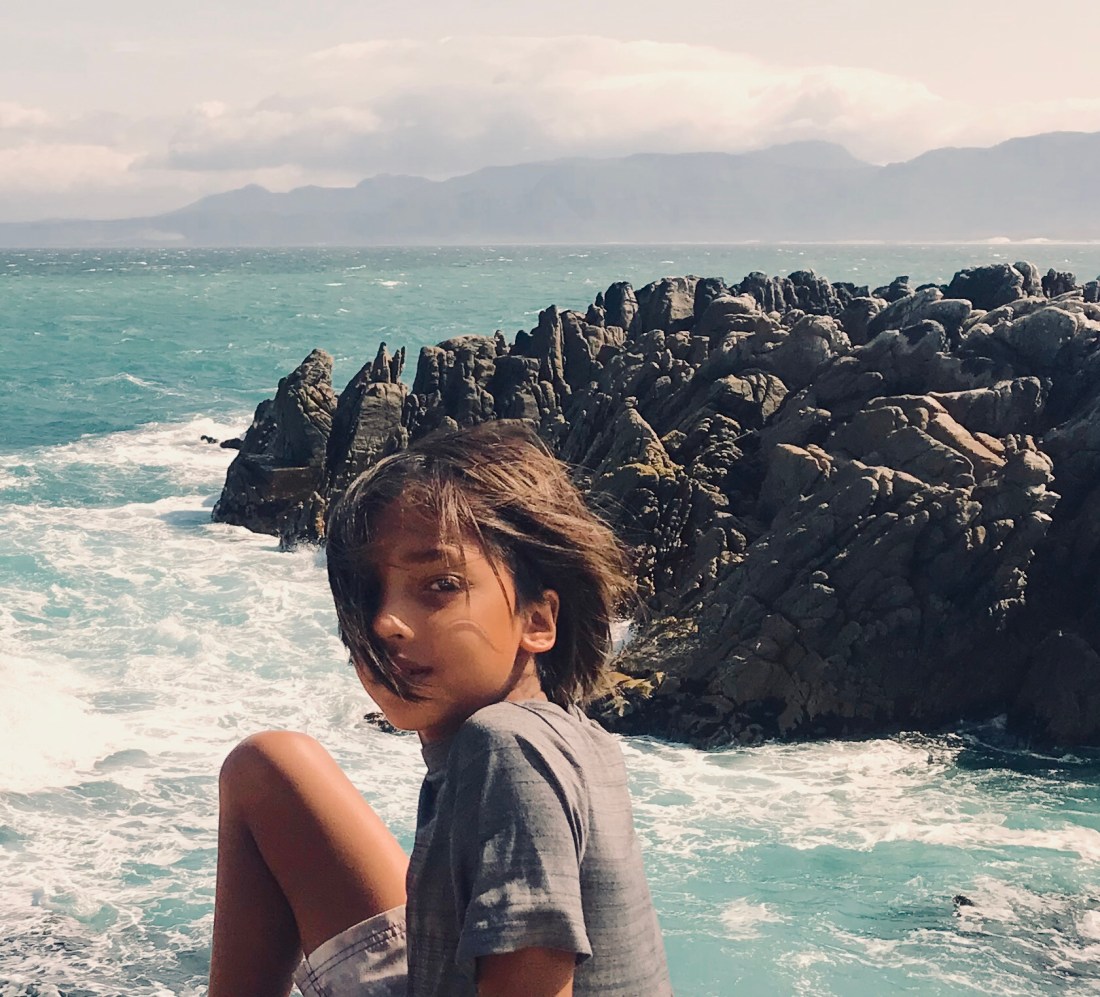
We had booked a place on Airbnb called the Whale Tail. When we arrived it was like the feeling we had when we got to Sand Island in Kenya. From the front lawn (and all the rooms) there was a sweeping view of the sea with the town of Hermanus about 30 km away on the other side of the bay and the mountains rising up behind. To the right the wide bay ended in a nature preserve with pristine beaches and sand dunes and rocks a couple of miles away.

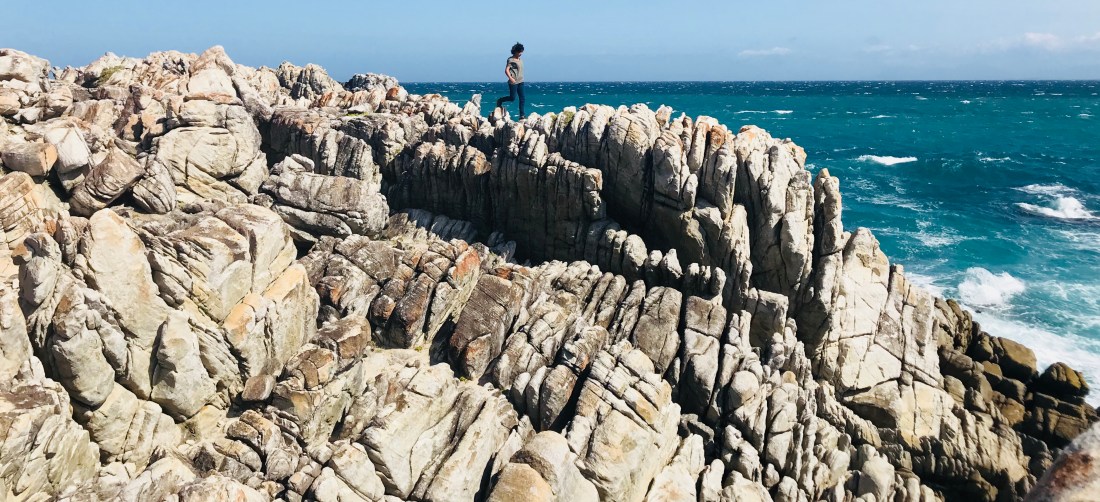
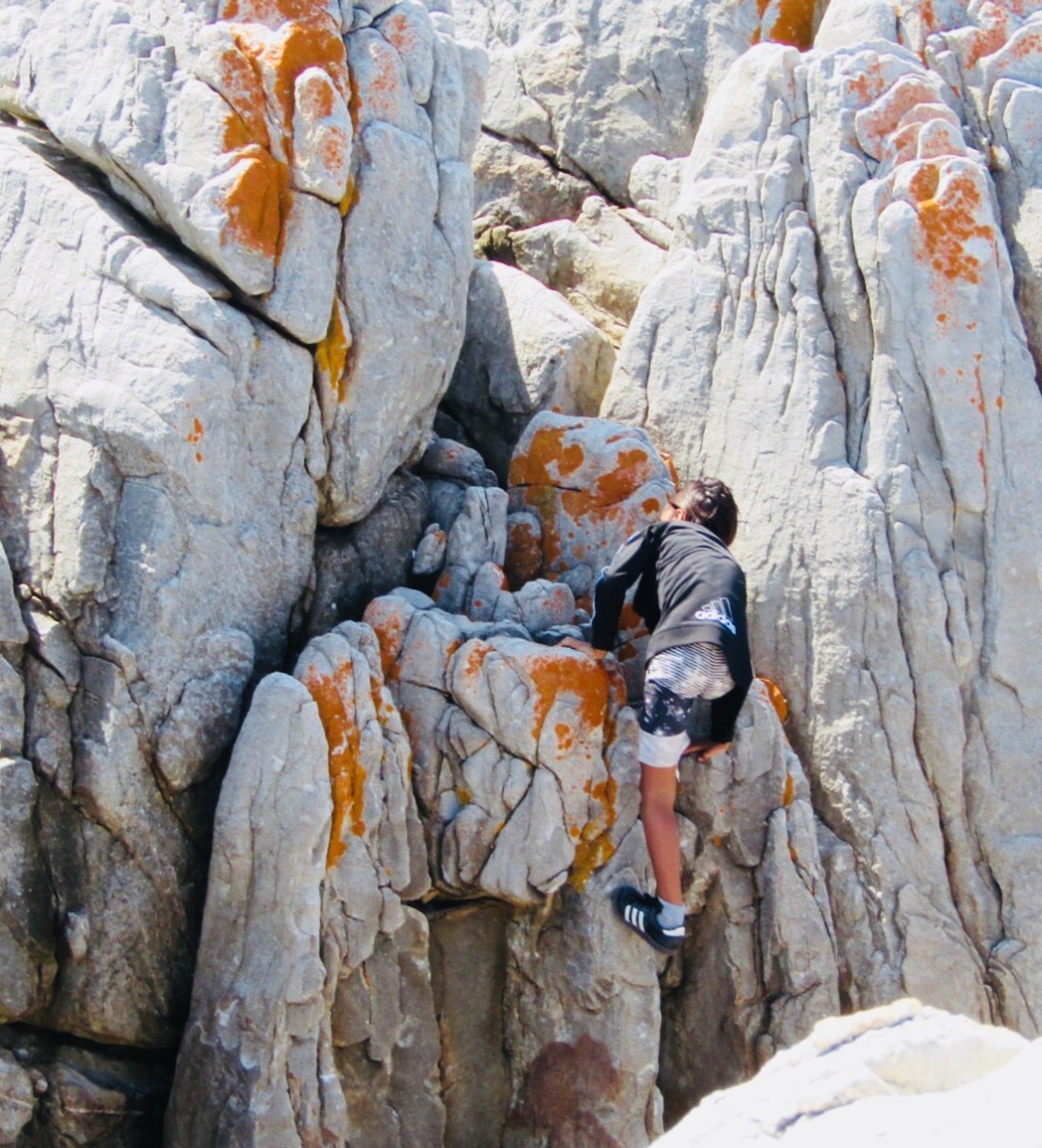
We dumped our luggage and went out to explore the rocky shore – with inlets and cliffs and hidden caves.

Over the next few days we walked along the paths at the edge of the shore a couple of times a day. We explored large caves that were inhabited by our ancestors a few tens of thousands of years ago. Evan and I left Jo and Vivian perched on top of a rock by the bay and ran up and slid down giant sand dunes till we were exhausted (which took me about 5 minutes).

One afternoon Tim, our Airbnb host loaded us into his four wheel drive and took us for a tour of the “township” and the coast further out of town. We inspected beautiful tidal pools and saw poachers in wetsuits going out to collect abalone. Abalone from this region fetches top prices in the global seafood market. Attempts to govern sustainable fishing has given rise to a Chinese blackmarket. They pay local young colored South Africans in drugs to poach abalone. The town has given up calling the cops because nothing happens. So now the locals turn a blind eye to the poachers and the poachers don’t create a security hazard for the locals. It works -unless you’re an abalone or an honest fisherman.
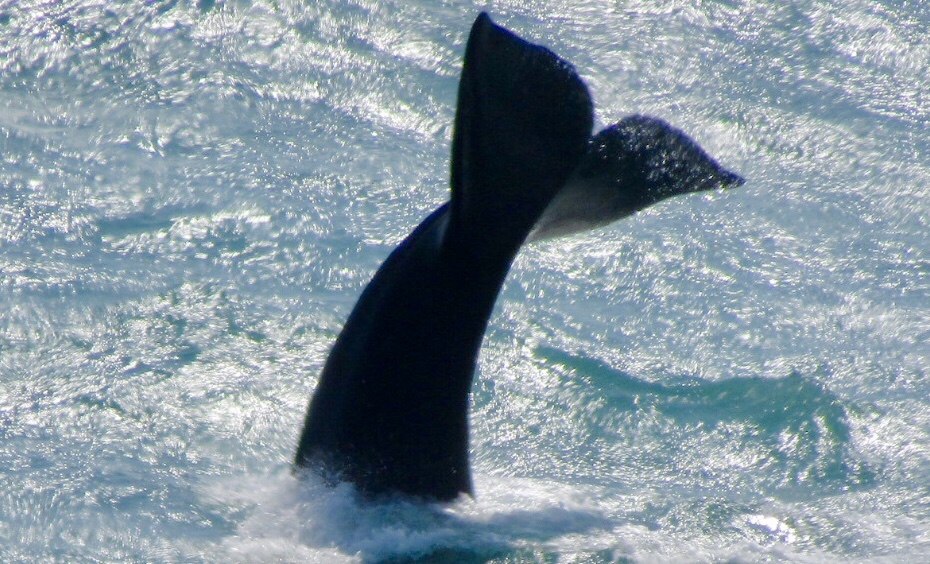
When we see or hear whales come close to the rocky cliffs we run out to see them, walking on the rocks as fast as we can to keep up with them. The calf usually frolics and breaches and does the headstand thing where its tail sticks straight out of the water while the mother, huge by comparison, staidly swims on, smacking one flipper periodically on the surface so that her calf gets used to that sound and stays close to her once they start their long journey to the cooler Antarctic waters.

Besides fishing and whale watching, the other huge business in town is shark diving in cages. We didn’t have to decide whether to try it or not – when we were in Gansbaai the seas were too rough and the trips were cancelled. You don’t actually have to dive – the cage isn’t fully submerged. The waters are chummed to attract great whites and the tourists, wearing snorkel masks and standing in the cages neck deep in water, stick their heads underwater to observe the sharks. Apparently last year two orcas killed three great whites to eat their livers, temporarily depleting the town of their prized sharks. Fortunately the orcas left and a few more great whites appeared. But those that understand orca behavior say that it’s only a matter of time before the orcas return – their large mammalian brains let them remember these things.

We drove about two hours to the southern most tip of Africa one day. It was cold and windy and more desolate here though there is a nice sized town just before Cape Agulhas. We quickly took a photo on top of the monument that marks the southernmost point and ran back to the car and drove to Gansbaai. Below the brass monument marking the cape there was a neat blue sign with a white line down the middle. On either side of the divider the words “Indian Ocean” and “Atlantic Ocean” were nicely printed. Alas the ocean and the beach looked the same in both sides of the sign and paid no attention to silly names given by humans.

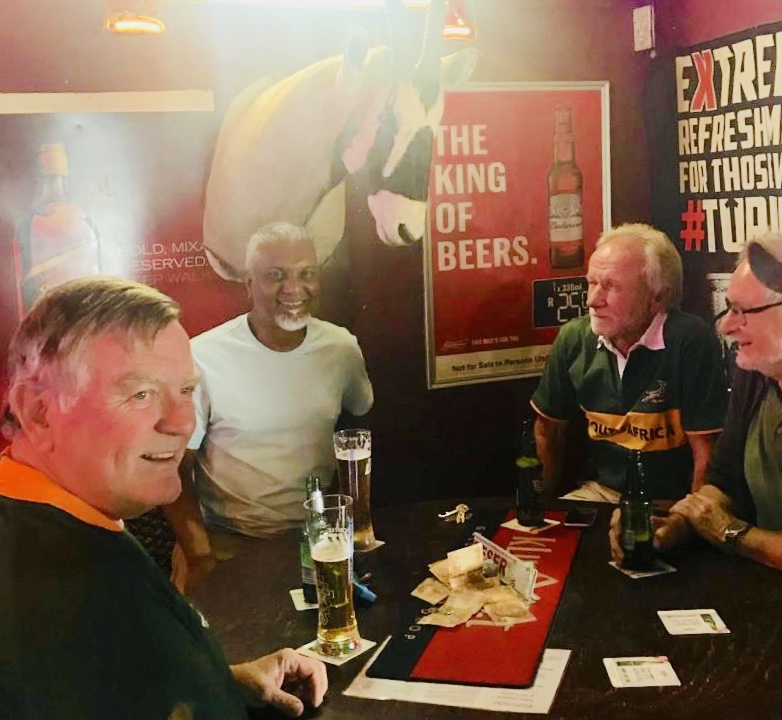
The Rugby World Cup is being played in Japan. “A real game, not like the American football you play with helmets and body armor” they said, though I told them I hadn’t ever played American football. Tim invited me to see the game (called a test) between two rugby superpowers – the South Africa Springboks and the New Zealand All Blacks. If you’ve seen Invictus (which we did a few days later one evening in Croatia) you know how important rugby and the Boks are to the South African psyche.

We walked into a smoky old bar where everyone except me was wearing the green and gold jerseys of the Boks and Castle beer flowed like water. I got a quick tutorial on rugby and when I correctly got the fifth round of beers they accepted me as one of their own. Except for the dead animal heads mounted on the wall I could have easily been in dive bar in Austin with old friends.
Later that evening the kids wanted pizza and on Tim’s recommendation we went to Mama Rita’s – a cute little place with very friendly staff and great food. As it was close to sunset and we were a couple of blocks from the sea I asked our waiter if we could take our wine glasses and go watch the sunset. We had ordered a bunch of dinner and hadn’t paid for anything yet and she had never seen us before but she didn’t bat an eyelid. Jo wasn’t sure if we should be walking outside with wine glasses. I told her this was South Africa – home to a lot of good wine. And we were just miles away from some big wineries.

We started crossing the street. I handed Evan my wine glass so I could get my camera out. Jo frowned at the growing list of bad civic behaviors. I shrugged and said that there’s so much real crime in South Africa the cops were busy enough. And a second or two later a cop car with lights blazing and siren blaring charged directly towards us.

A moment later the cop car turned away. Jo breathed a a sigh of relief and went back to dinner. Evan and I and the wineglass watched the sunset.

Back at Mama Rita’s I ran into a couple of my new friends from the smokey bar earlier that day. They had cleaned up and were with their wives. After they finished their dinner they stopped by our table to say hello to the family. We felt a tiny bit like locals : )
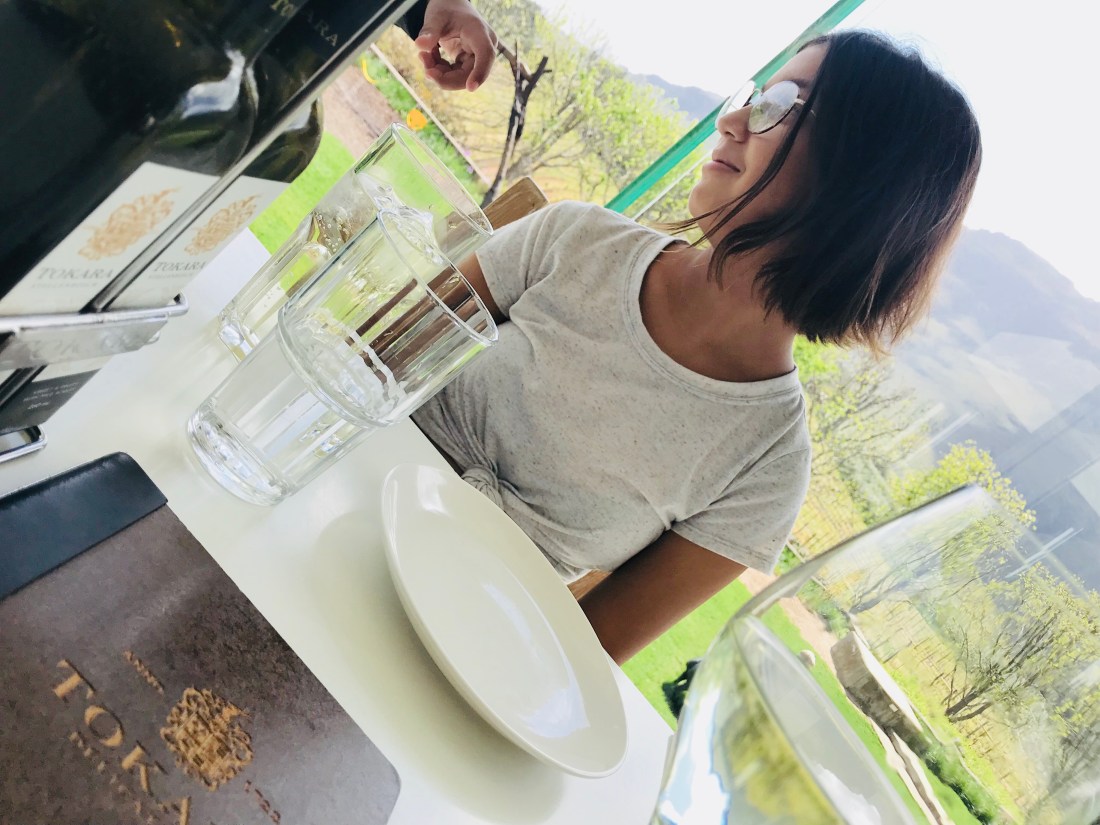
Later that week we took the inland route back to Cape Town. While the coastal roads were dramatic, the farms and green and golden endless rolling hills of wheat were a beautiful sight to behold. We thought of the views of Kansas along the turnpike – but more rolling and even more expansive and with occasional steep mountains thrown in. We stopped at the Tokari vineyards halfway between Stellenbosch and Franschhoek for lunch and then drove to Cape Town and got on one of the last Thomas Cook Condor flights. Our flight landed in Frankfurt at 05:00 on a gloomy cold Monday morning. Thomas Cook declared bankruptcy at 08:00, leaving about 600,000 travelers stranded worldwide.

In Frankfurt we rented a car, got some Euros from an ATM, got on the autobahn, and headed off towards Bavaria in the rain. It felt very strange not to be in Africa. Today is one day shy of two months since I left Austin. And everything is A-Ok.
Simon’s Town and Boulders

One morning in Cape Town Jo read about taking the local Metrorail out to its last stop on the Simon’s Town line. It is supposed to be a very scenic run. What about all the violence, we thought? What could be worse than being stuck on a moving train with a violent criminal, we wondered?

So a bit later our Uber driver dropped us off at Cape Town station. The Cape Town marathon was just about winding up and the participants were running by the front of the train station. We climbed aboard our train and tried to blend in as nonchalantly as we could. The tickets were ridiculously cheap. Vendors walked by hawking inexpensive food like bananas and hard candy. The train slowly chugged it’s way through endless stations. We heard a commotion and saw the conductor (supported by a couple of burly security people) eject a group of four people off the train for ticketless travel. They must have climbed back in to a different carriage because a few stations later the conductor had to throw them off again – this time she wasn’t half as nice about it.

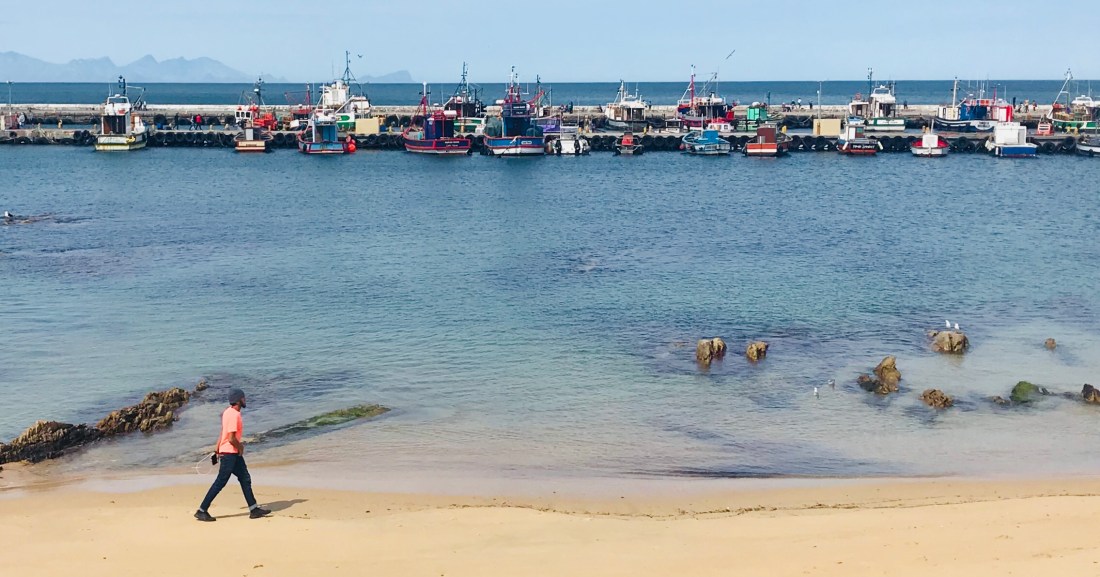
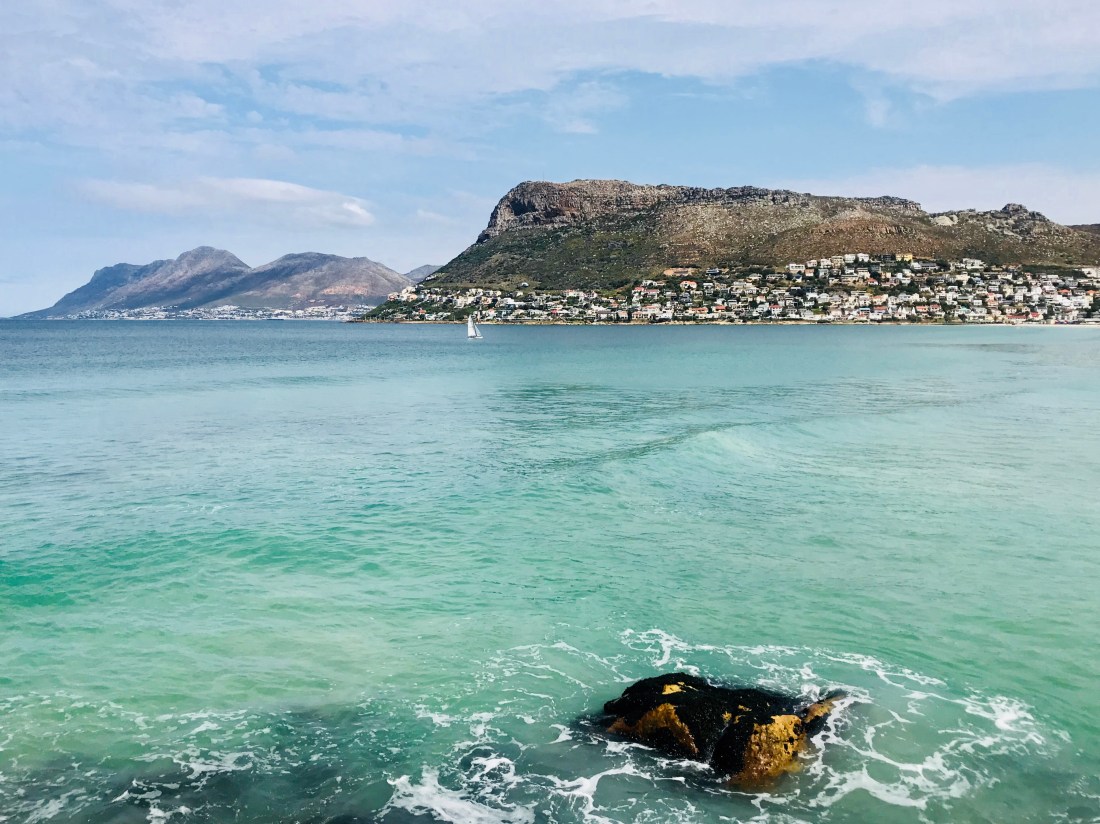
After Muizenberg the tracks ran by the very edge of the bay. The scenery was striking – the deep blue waters of False Bay with sandy beaches interspersed with rocky shores on one side, and steep hills rising up on the other. Small fishing towns were precariously perched between the hills and the ocean. We saw a couple of whales from the train!

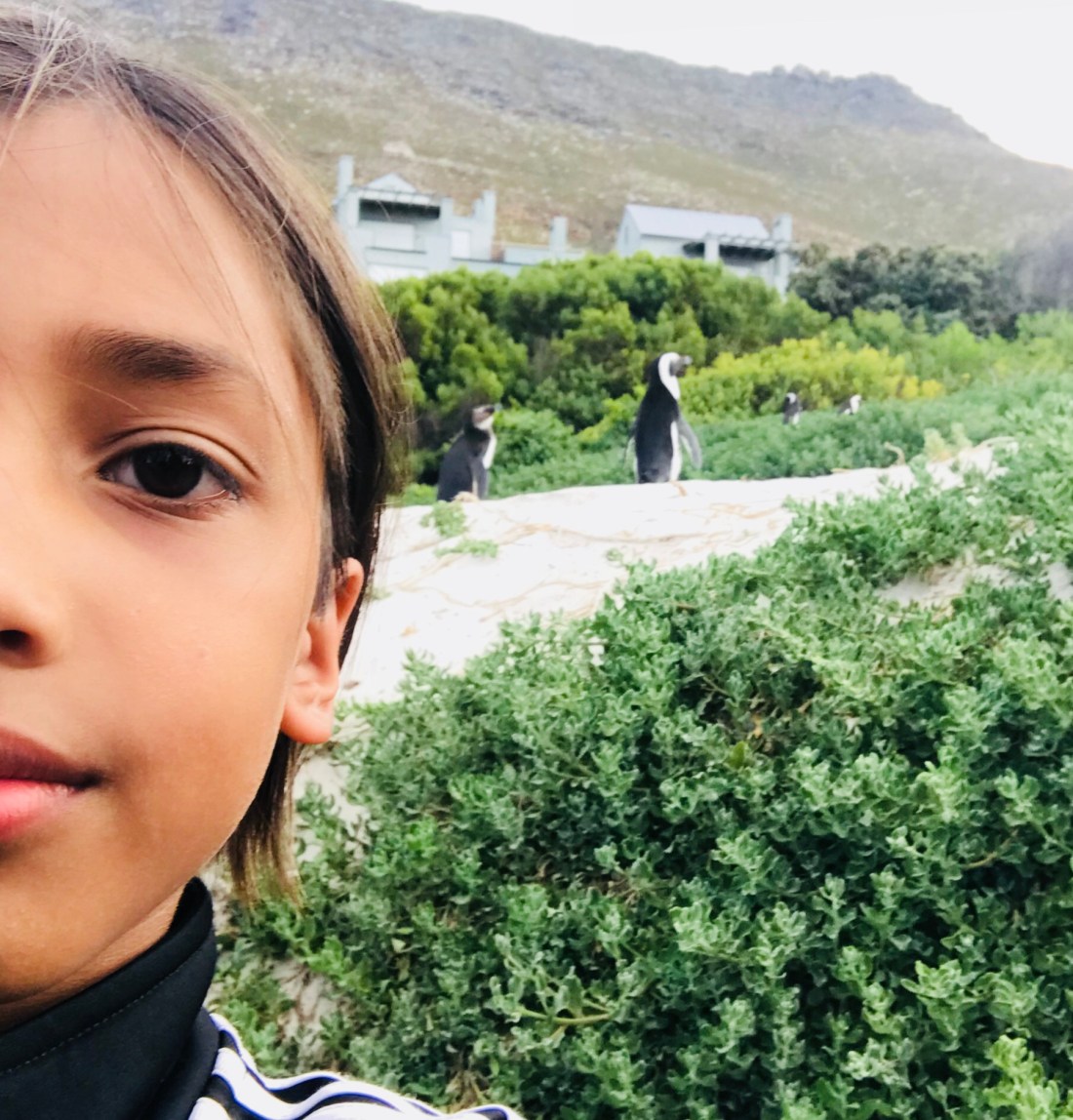
The train terminated at Simon’s Town and we walked into town for lunch and then to Boulders Beach to see the penguins. Hundreds of penguins waddling in and out of the water. Guaranteed to put a smile on anyone’s face. There were a lot of people out there to look at the penguins. Everybody was smiling.

At one point I told Evan that Vanessa had given a children’s book to Vivian nine years ago about the oil slick that endangered the lives of these penguins. An oil tanker had run aground near the cape and was leaking oil. Penguins and other marine animals were affected. Capetonians could volunteer to come in during work breaks and wash and take care of the animals. Once they had recovered, the clean penguins were returned to the ocean many miles away. The biologists soon noticed that the same penguins were back in the oil slick a few days later. They started tagging the penguins and learned where and how to reintroduce them back into the wild so they wouldn’t get back into the spill right away.

When I finished retelling Evan this story, a lady in a tour guide’s uniform standing next to Evan and me patted me on my back and said “That’s exactly correct. I’m glad you are sharing this story with your granddaughter.”

Evan and I giggled and then burst into laughter. Which left me with two options – explain, or be thought of as a boor.

“That a boy, and he’s my son” I said as politely as I could. The lady got it together and said “Oh my gosh. I’ve offended you both!”

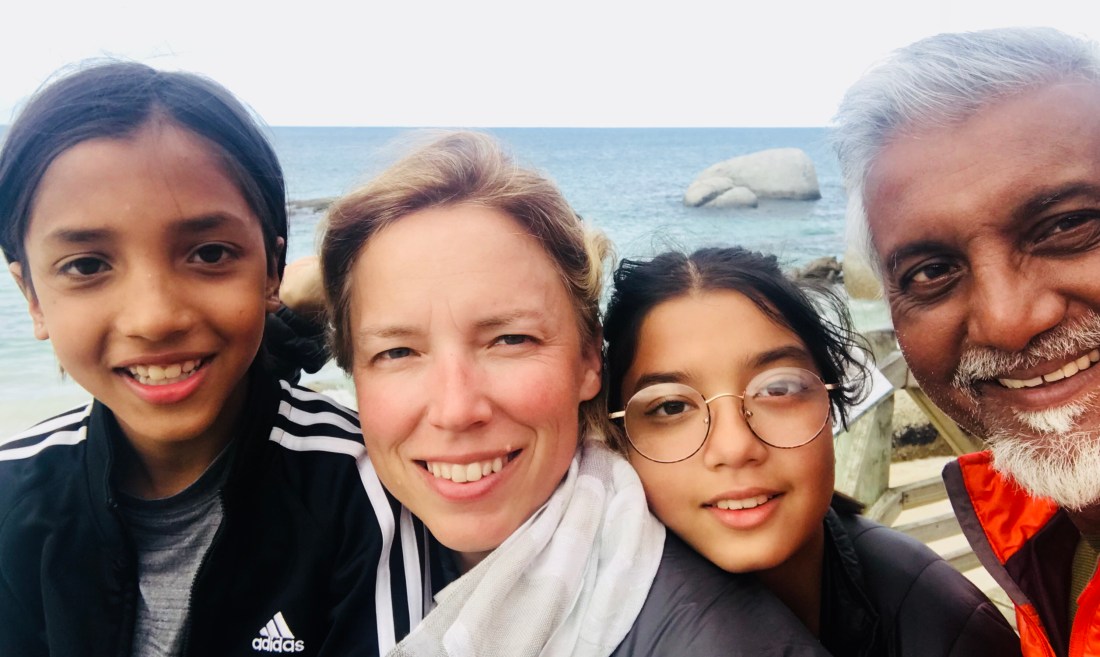
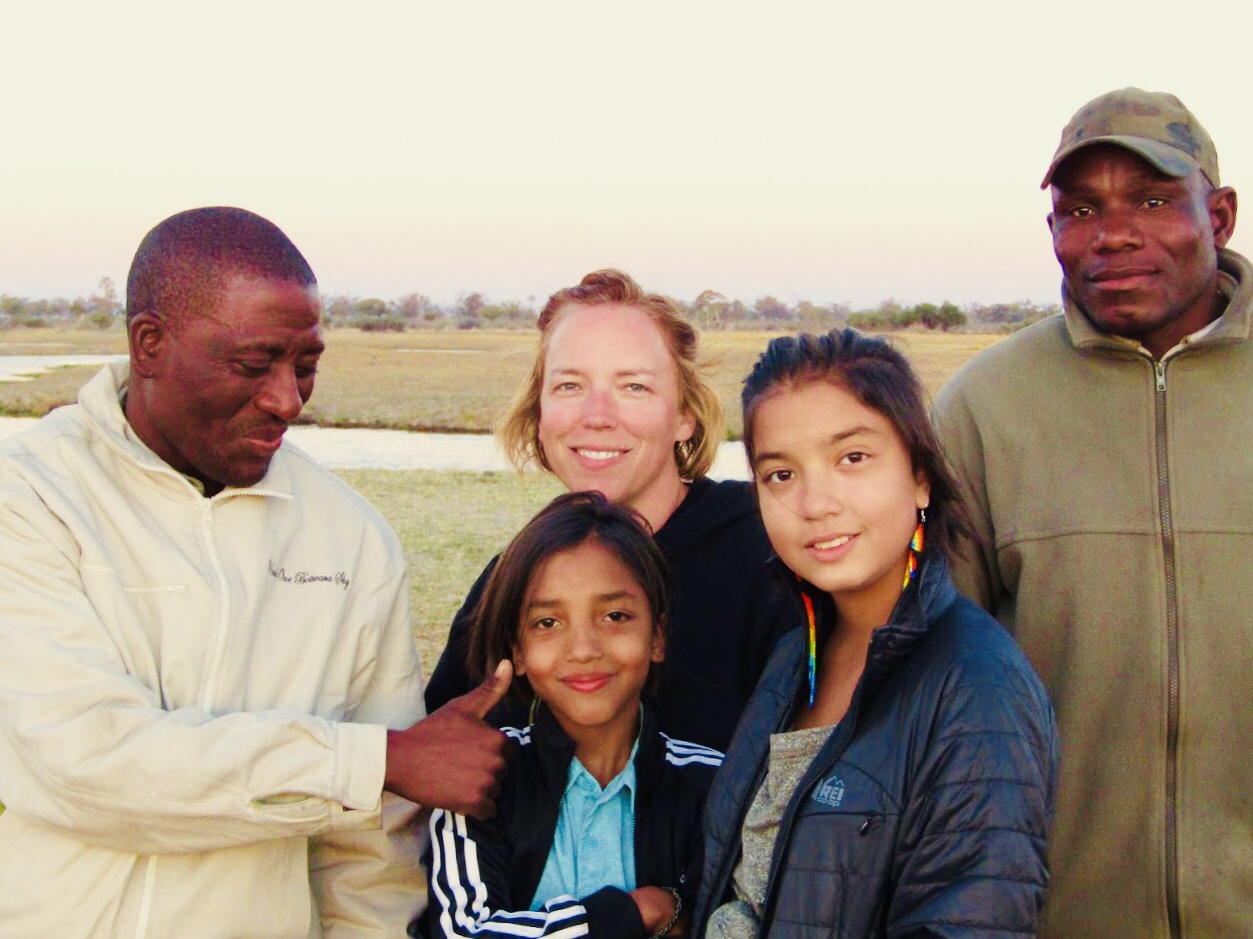
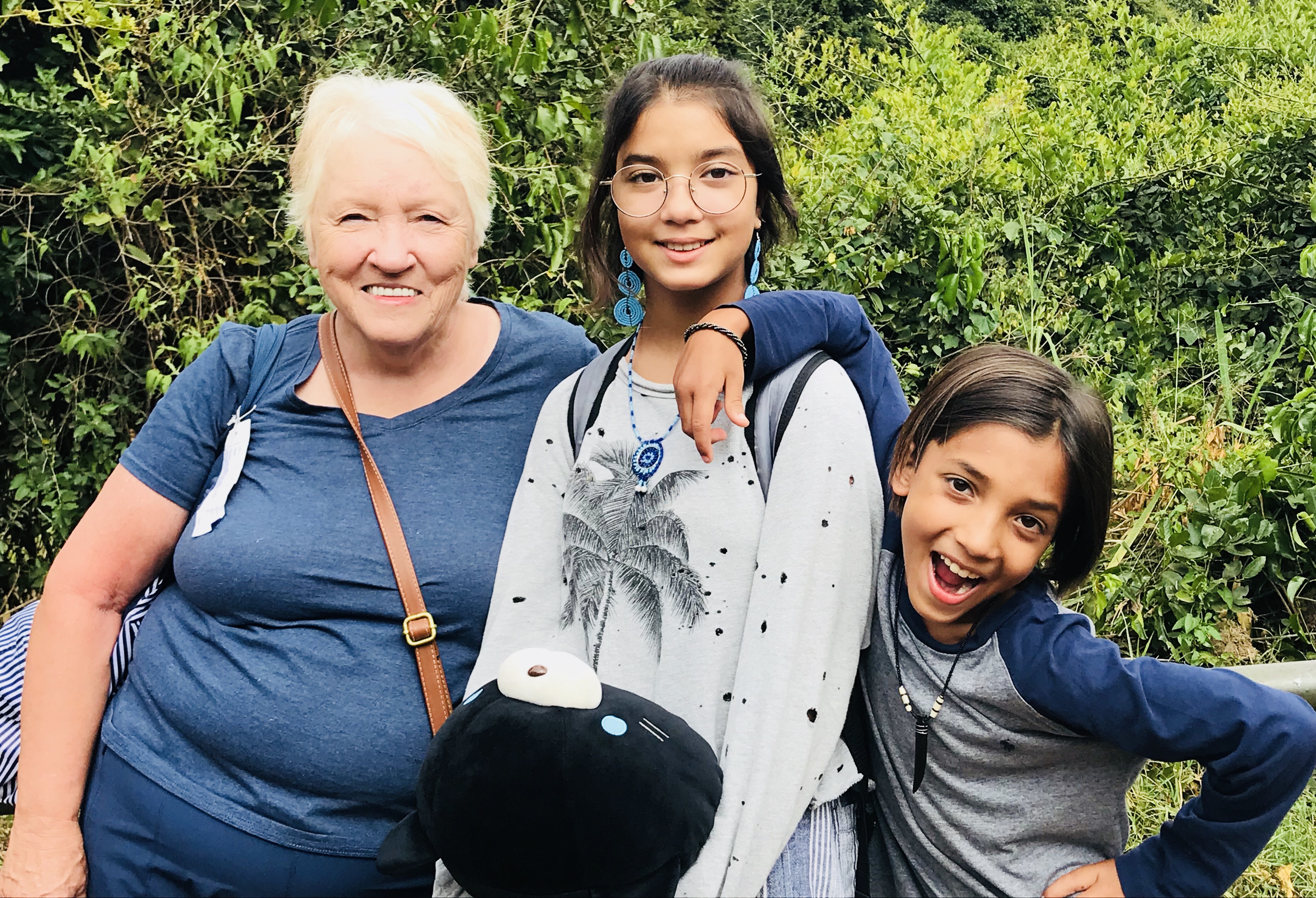
Here’s a family photo with my granddaughter and a couple of other random people.

By the time we were done with our penguin watching it was late in the afternoon. Not wanting to push our luck on a return train trip, I hailed an Uber. On the drive back, our driver concurred. “It’s late. There’s a couple of dodgy stations between Simon’s Town and Muizenberg. At this time of the day it could be tricky”. We sighed with relief and the words dodgy and tricky are now a part of the family travel lexicon.

Robben Island

One brilliant afternoon we loaded on to the Madiba-1 and took a trip to Robben Island, a little flattish island a few miles from the V & A waterfront in Cape Town.

In the central business district and the ritzy neighborhoods of Cape Town you could be forgiven for thinking you’re in Europe. The streets, stores, museums, people, weather, wherever you look, are stereotypically European. There is one thing however that is different. Violent crime. Quoting Evan, who heard it on the news, “it wasn’t very comforting [to learn that] crime rates are getting lower, because murder rates are getting higher”. Cape Town is one of the most dramatically beautiful cities I’ve seen. It is also by far the most violent. Uber drivers retell stories of narrowly avoiding violence (and sometimes not). Homes are defended by security systems that rival banks in other cities. Signs advertising the name of your favored armed response security company adorn every gate, door, and shopfront. Barbed wire is for wimps – Capetonians feel compelled to top their fences and walls with concertina and electrified wires. It is unclear why this is so. The modern history of apartheid and violent repression is also uniquely South African, but I don’t know if there is correlation, causation, or merely coincidence between the two.

Robben Island is stark reminder of apartheid. Apartheid, I think our kids now understand, isn’t racism or prejudice. It is a lawful system by which race was used to segregate and discriminate against the majority non-white population of South Africa from around 1950 till 1993ish. Vivian has studied a little bit about slavery and the civil rights movement in the USA, so she has a framework to which she can attach this concept. But for poor Evan this is novel and needed more explaining. How do you explain that 13% – the non- indigenous population – suppressed the rest based on their looks? Not centuries ago, but less than 30 years back, with support from America and Britain and politicians like Thatcher and Raegan.

We drove through a few small rural South African towns and noticed three distinct parts – the clean posh European looking part where the whites historically lived in larger well-separated homes with lush nice gardens, the scrunched together shanties with rusted corrugated metal roofs held down by old tires in the “township” where black people historically lived, and the part of town where the coloreds historically lived. To describe the current situation, omit the word “historically”. Once separated by the law of the land, the land is now divided by history. History is hard to change in a mere 26 years. History encapsulates opportunities and lives and livelihoods that change at a much slower rate – at a generational pace at best. Vivian and Evan hear Jo and I wonder aloud for hours during our beautiful drives around the Western Cape province about the future of South Africa. Do poor blacks and coloreds have a path to prosperity or will only the exceptional amongst them break the historical race barrier? Can an equitable and just solution be reached without draconian land redistribution policies which seem to end very badly (as in neighboring Zimbabwe)? How do South African whites feel about their unjust historical advantage? In Cape Town our Airbnb is in a very posh neighborhood where everyone drives nice German cars. Also everyone is white except for the neatly dressed help who walked up the sidewalks to clean, cook, and babysit. Them and our Uber drivers.

I came across an interesting study reported in 2012 (http://nymag.com/news/features/money-brain-2012-7/). Two psychologists rig a game of monopoly for two test subjects to play. One makes twice as much money every time – at the start of the game, passing go, in rent, etc. He (or she) almost always crushes the opponent. The interesting part is studying the behavior of the winner. The psychologists report that “Putting someone in a role where they’re more privileged and have more power in a game makes them behave like people who actually do have more power, more money, and more status. During the short 15 minute game, the rigged and hence predetermined winner is initially awkward about the inherent injustice that gives him his advantage. But soon he smirks at the predetermined loser. By the end he assumes the body language of a legitimately successful winner.

This particular study was designed to understand something else (are you a bigger asshole the richer you are). But I think it helps understand privileged behavior. I know that I win only because of the system. But I am quick to claim the mantle of a true winner. I can nicely convince myself that I did it by myself and that I deserve every bit of my success.

Back to Robben Island. When we arrived we drove through the village where the guards and their families lived – an all white guard force to make sure that it could not be infiltrated – to a forlorn coffee place on the island shore. Here’s what Cape Town and Table Mountain looked like from there on a foggy spring afternoon.

We stopped at the barbed wire enclosure that housed the guard dogs and the room where Sobukwe served his sentence in isolation, far from any other prisoner. The teacher and founder of the Pan Africanist Congress was deemed so dangerous by the white state that the legislature voted to amend the laws and enact the Sobukwe clause to re-imprison someone without due process after he has finished serving his sentence.

Our tour bus drove on the streets that the families of the guards took, separate from the ones that the shackled prisoners had to use on their daily trips to forced labor at the limestone quarry. The prisoners had created an extremely complex way to pass information between them. This allowed them to study the great texts and get an education. At the quarry during forced labor, they held their “seminars” secretly under the watchful eyes of their white guards. In his book, Long Walk to Freedom, Mandela recalls:

“In the struggle, Robben Island was known as the University. This is not only because of what we learned from books, or because prisoners studied English, Africaans, art, geography, and mathematics, or because so many of our men…earned multiple degrees. Robben Island was known as the University because of what we learned from each other. We became our own faculty, with our own professors, our own curriculum, our own courses…Teaching conditions were not ideal. Study groups would work together in the quarry and station themselves in a circle around the leader of the seminar. The style of teaching was Socratic in nature; ideas and theories were elucidated through leaders asking and answering questions.”

Our guide proudly announced that a majority of South Africa’s leaders since the end of apartheid had been graduates of Robben Island university. Just like Yale for American presidents : )

Our guide for the tour of the prison buildings was Peter Khube. He was a prisoner here from 1981 till the end of apartheid. Arrested and charged at 14 for two murders and public protests he arrived at Robben at 16. He spoke about the details of the prison and his daily life without bitterness. He is a tour guide here now because it is hard for him to get another job. The kids were shocked to learn that he was only 56. “Only two years older than daddy?” Evan exclaimed. Spending the prime of your life as a political prisoner at Robben Island isn’t the secret to the fountain of youth, apparently.

The convicted murderer readily agreed to my request for a photograph and embraced Vivian and Evan like a proud uncle.

Rra Dinare and Moremi Crossing

[Note: this happened in early September]

Rra Dinare means Father Buffalo in the language of the Botswana people (who are collectively called the Batswana, and one of them is a Motswana). I know nothing about the country – not the currency or the exchange rate or the capital or the name of the president. My ignorance about Botswana doesn’t have an opportunity to be rectified because we are in remote areas of the country. We have spent 6 days in two tented safari camps, flying into each in small aircraft. There is no internet or phone signal. Like Evan I often say “I don’t know”.

But Botswana, and specifically where we are – the Okavango delta, is the reason we are started our trip in Africa. Back many months and miles ago when Jo came up with the idea and pinned a world map on a wall in The White Wooden House in Austin, we each marked where we wanted to go. Evan chose obscure locations like Greenland and Outer Mongolia. Vivian’s first pick was Harbin in the far north of China, near North Koera and Russia. Jo chose Vietnam. Mine was the Okavango delta. Here we are.

The Okavango river starts in the mountains of Angola. Instead of finding it’s way to the ocean, the Okivango ends it’s journey in the sands of the desert in northern Botswana, in a giant inland delta. After the rainy season in Angola, the Okivango river floods the delta with rain water and turns the desert into a paradise for a few months each year. The flood covers large portions of the land under a couple of feet of water. Instead of the usual 4×4 safari truck, you get into a dugout canoe called mokoro and your guide poles the mokoro through the flooded landscape. The safari lodges are tented affairs built on high ground and then on stilts.

When we reached the delta, instead of a flood, there was a trickle. Locals say that the rains in Angola are probably late or lower than usual this year, but without much connection to the outside world they don’t know. And there is a local three year drought going on. So it is more desert than flood. There is water in the deeper channels and some green grass. But the flood plains are brown and dry. The Rra Dinare camp sat on stilts beside one such deep channel with water. They told us that a few weeks ago there was no water. While there is only a little of it now, the hippos, elephants, buffalos, impalas, giraffes, crocs, cranes, egrets, and other birds and animals are pretty happy to have it.

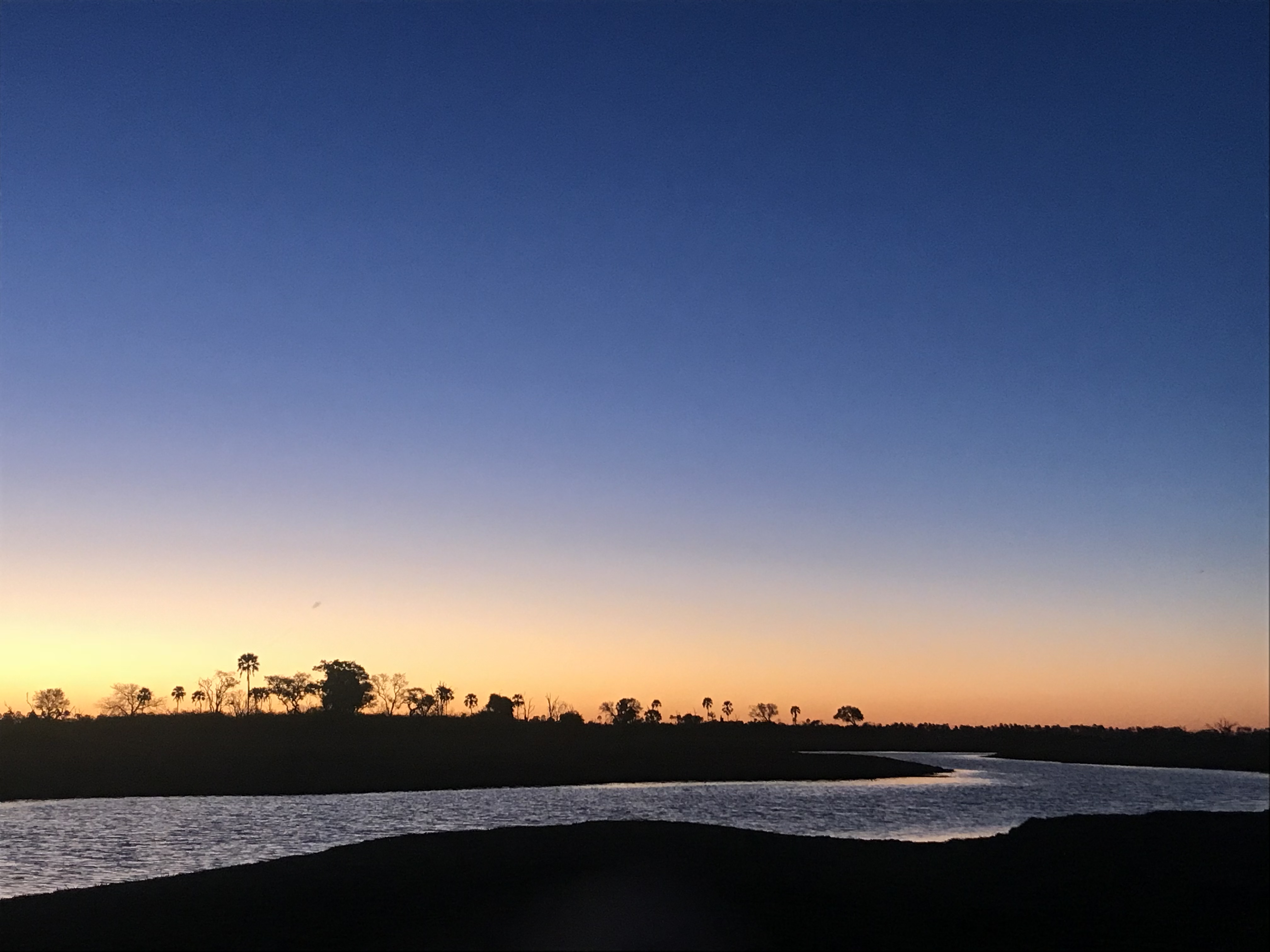
Our guide is T. Unlike other places we had been, he has a tracker, Boxer, who rides shotgun with him. The dirt is soft sand and everything leaves tracks. We learn to spot elephant, antelope, hyena, lion, rhino, buffalo, and hippo tracks. T and Boxer look for tracks as T drives us around, and every now and then they get out and follow tracks into the bush. They also do something else differently here in Botswana. Just before sunset they drive you to a safe spot where they set up drinks and snacks. You enjoy a glass or two of wine while munching on roasted nuts and biltong and chatting with the guides and watching the sunset. One evening just before sunset we saw a baby elephant and its mother at the river. The baby was less than a week old and hadn’t mastered walking yet. The mother had to use her trunk to bail the kid out of all kinds of trouble with gravity.

We usually drove around for a bit after sunset while T and Boxer looked for animals using a bright spot light. The bush comes alive after dark. The number of eyes that shine back at you is a bit erie. One day Evan said that he wished he had seen a wild cat. That night we saw a small leopard like animal called the African Civet cat.

Driving in the dry delta isn’t for the faint hearted. When you come up on a stretch of deep sand, the driver puts the vehicle in low gear (it’s always in 4 wheel drive) and guns it to maintain speed and not get stuck in the sand. The trails are twisty and have a lot of bumps, so you get jostled like a sack of cassava, and occasionally get whipped across your face by a branch of a tree close to the trail.

One day we came upon a group of wild dogs tearing into the carcass of an adult male impala. We had heard of the wild dogs. They look like dogs and are not hyena or wolves. They hunt in packs and are considered the most vicious predators. A pride of lion don’t succeed every time they set out to hunt, we heard. But the dogs get a kill every single time. And they are ravenous, killing multiple times a day. Their kills are very gory – instead of killing a prey they just start tearing off the flesh till the prey bleeds to death. Yeah, fun.

While the dogs were pulling the remains of the impala apart, we noticed that a new one showed up and made a yelping sound. Quickly the others made room for him at the carcass while one of the dogs who had been feeding took off in the direction that the new adult had come from. T explained that both males and females take care of the pups, and this new adult must have been guarding the pups. Now it was his or her turn to eat. We followed the one that left and it led us to a litter of eight cute and cuddly puppies. They looked and acted like domestic dog puppies with extra large ears – playing with each other, running on wobbly legs, and falling over in piles. The returning adult regurgitated some bloody impala and the puppies squealed with joy and ran off with bits of meat. We waited and watched them eat and play for a long time. Jo wanted a puppy. Vivian commented on how cute they looked. And that in a few months they would become bloody predators. The dogs are endangered. Several of the adults had radio collars so that the park rangers can track them. A litter of eight pups is a big deal, T explained.

Our daily regimen started with a wake up call and hot chocolate at 5:30 am. The delta, in addition to being not flooded, had encountered a cold front. We were waking up to temperatures in the mid 40s F. The nights were cold and also full of sound and activity. One night a buffalo decided to sleep under the deck of the tent that was occupied by Jo and Evan. It awoke at 2 am and banged its horns on every post that held up the deck (we later learned that the banging was intentional – the buffalo was scratching it’s face and horns on the wooden posts). Another time Evan found a baboon trying to undo the velcro door of the tent. He was mighty proud of scaring away the baboon that was bigger than him.

On our last morning we woke up to the sounds of lions roaring. Theye were causing a huge racket. After a quick breakfast we went looking for the lions. T and Boxer followed lion tracks and drove around madly for a while. Then we found the lions in the woodlands next to the camp. It was a mating couple. There was another male in the proximity, trying to sneak in – which was the reason for all the roaring.

Animals are hard to spot in the wild. In spite of the huge amount of game we see, it is a complete crapshoot. You could drive within five feet of a lion and not see it. This couple was like that. Boxer was standing up to get a better look at tracks and to help guide T through the brush. Suddenly the lion and lioness were right there beside us. The lion was already a bit testy, having to put up with a lioness in heat *and* a competing male. He turned to face our 4×4 as we crashed through the brush and growled and snarled at us. Boxer is a big guy who moves with a certain controlled slowness. He sat down very quickly. A lion (and many other animals) percieve standing humans as threats. Seated in a 4×4, you’re a part of the scenary. I pulled Evan away from the window and closer to me.

After we had backed away sufficiently and checked that we hadn’t wet our pants we turned to look at the mating pair. They were beautiful massive beasts at the prime of their lives. Over the course of the next 40 minutes they did it six times. Sometimes as often as just three minutes apart. It was a repetitive ritual – lioness snarls and flops over to lay on her side, lion moves away and does a weird thing with lifting his hind paw awkwardly, lioness rests then swishes her tail, lion growls, they copulate, lioness snarls, lions jumps off, repeat. This is strictly work. No one was even pretending otherwise (Do animals enjoy sex? I mean, they must….). T explained that the lioness can be in heat for three days. During this time the lion will never wander more than a few feet away from her, forgoing eating and even drinking water to make sure that no other male has the opportunity to sow it’s genes instead. This was Vivian and Evan’s science lesson of the day. And their PSE (Personal and Social Education) class.

From Rra Dinare we flew west to another camp called Moremi Crossing. This is normally an island but this year it was a vast plain with rivulets. We spent three days looking at game. One evening during dinner there was a huge ruckus outside. The guides and waiters got some spotlights and we saw a big Cape buffalo being attacked by six hyenas across the water channel. Apparently this buffalo had been attacked by lions s few days prior and had fended them off but had injured his front right leg pretty badly. From the horrible baying sound that the buffalo was making we assumed the end was near. But then the sound stopped. The buffalo had somehow got into the water and the hyenas didn’t want to follow it in there. The staff thought that perhaps the crocs were deterring the hyenas. That’s how we left things after dinner. We expected to hear the end of the buffalo that night. Instead all we heard were the sounds of elephants thumping and shaking the palm trees and generally trying to destroy the camp. In the morning the buffalo was still alive and on the camp side of the water. At breakfast, the burly staff member who was manning the spot light the night before seemed as excited as I did. “Our Rra Dinare is s survivor” he said.


That’s Evan holding a fruit of the sausage tree. They grow all over the place. On closer examination I realized that back in Hyderabad we called them breadfruit trees and there were two giant specimens at school over the place where we assembled for sports every evening.

On our last afternoon our guide Four Four, and his tracker, Action, took us on a short Mokoro trip. We avoided crocs and hippos and stopped for a nice walk and sunset drinks and snacks and made it back to camp.

We found that neither the safari camps and nor the staff in Okavango were as polished as in the Maasai Mara. Which came as a surprise because the delta is supposed to be the high-end tourist destination and was certainly more expensive to visit. Chatting with the guides also suggested that they are comparatively poorly paid and overworked in Botswana. Recent news articles suggest that the happy story of Botswana as the shinning democracy of Africa with high standards of education and wildlife conservation may just be that. The De beers diamond family and the ruling party have quietly hijacked the country, it’s democracy, it’s huge diamond wealth, and it’s wildlife – while spinning a good PR campaign to hide the dirty underbelly of politics as usual. What’s wrong with these shit hole countries where hurricanes are made to change course and favors from foreign leaders are traded for military aid?

Zimbabwe

We flew from Nairobi into a shiny new Chinese-built empty airport at Victoria Falls. A clean comfortable air conditioned minibus whisked us off to our safari lodge about an hour away in the town of Victoria Falls. The town’s main street could have belonged to an American tourist town – lined tastefully with souvinier shops, restaurants, a supermarket, lodges, and a steam locomotive drawn train that ran sunset and dinner rides. Our lodge was about 10 minutes out of town and had a multi-tiered main building with a pool and restaurants, bars and observation decks overlooking a watering hole that was floodlit during dinner so you could see the visitors who came for a drink of water.

We went down to see the “vulture cutlure” event. Moses told an audience of about 25 people a bit about vultures and how they are endangered – mostly because of poachers. When they kill elephants or rhino, the circling vutlures give the position of the poachers away to the anti-poaching military units. So the poachers poison the kill which has resulted in hugely decreased vulture populations. Moses brought out a cooler filled with raw meat from the lodge’s kitchens and emptied the contents out on the dirt. The vultures know this happens every afternoon at 13:00 and they were circling like, well – vultures. In about a minute what looked like over a hundred vultures of several species and the gangly balding dare I say ugly marabu storks were on the ground pecking and fighting for the meat. Science lesson of the day for Vivian and Evan.

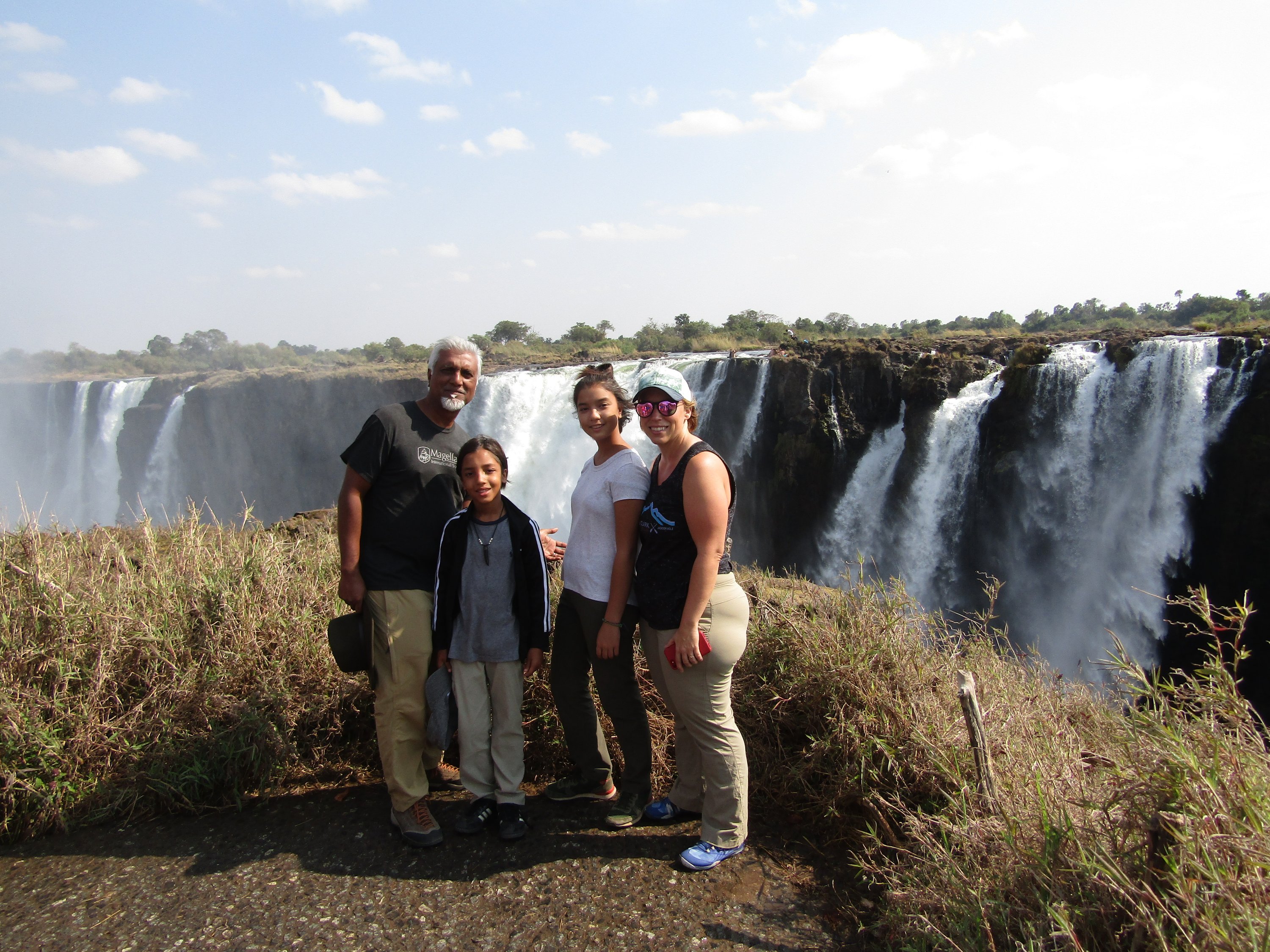
Victoria Falls, the actual waterfall, is the reason for the season. The real name of the falls is Mosi-Oa-Tunya, the smoke that thunders. But except by locals it is called by the name of its dead colonizer empress. Falls are measured by their height, width, and volume of water. Victoria Falls isn’t the tallest, widest, or greatest by volume. But when all three are considered together, according to their publicity department, it comes in first. Iguasu and Niagra are second and third respectively. The Zambazi river tumbles about 100 m down one side of a deep steep narrow cravase caused by a volcanic lava flow a couple of million years ago. To observe the falls you walk along one or the other side of the gorge. The dry side facing the river is in Zimbabwe. The international border is down in the middle of the gorge. The river side is in Zambia. We were on the Zimbabwe side. Just a bit up-river there is a point where four countries meet. In addition to Zambia and Zimbabwe, there’s Namibia and Botswana. Not countries I would be able to say much about.

When the river is full during the rainy season, water flows over the entire length of the gorge. This was the driest our guide has ever seen the river in his 30-something year old life. Only parts of the gorge had water flowing over. Entire islands had arisen out of the river on the edge of the falls. But it was still pretty darn impressive. On the Zambia side, dare devels can take a trip to Devil’s Pool – a natural pool of water on the very edge of the falls (if you look carefully to the right of Jo’s head in the photo below, you’ll see Devil’s Pool with a few people). Vivian expressed interest in going there. Evan held Jo or my hand every time we got close to the edge of the gorge (most overlook spots didn’t have guard rails or obstacles of any sort). Same family, raised the same way, very different risk appetites.

One morning we went across the land border to Botswana to spend the day at Chobe National Park. On the Botswana side of a small town called Kazungula, we saw a lot of trucks. A bridge is being built across the Zambazi to connect Botswana to Zambia. Meanwhile, trucks are ferried one at a time across the river. The line of trucks is 20 km long. Trucks wait a month to cross.

Chobe is considered one of Botswana’s leading parks. Our guide must have had a set path – we went on a loop along the river and then back up through the interior of the park. Compared to what we had gotten used to in Tanzania and Kenya, Chobe (or perhaps it’s just our guide/tour company) needs work.

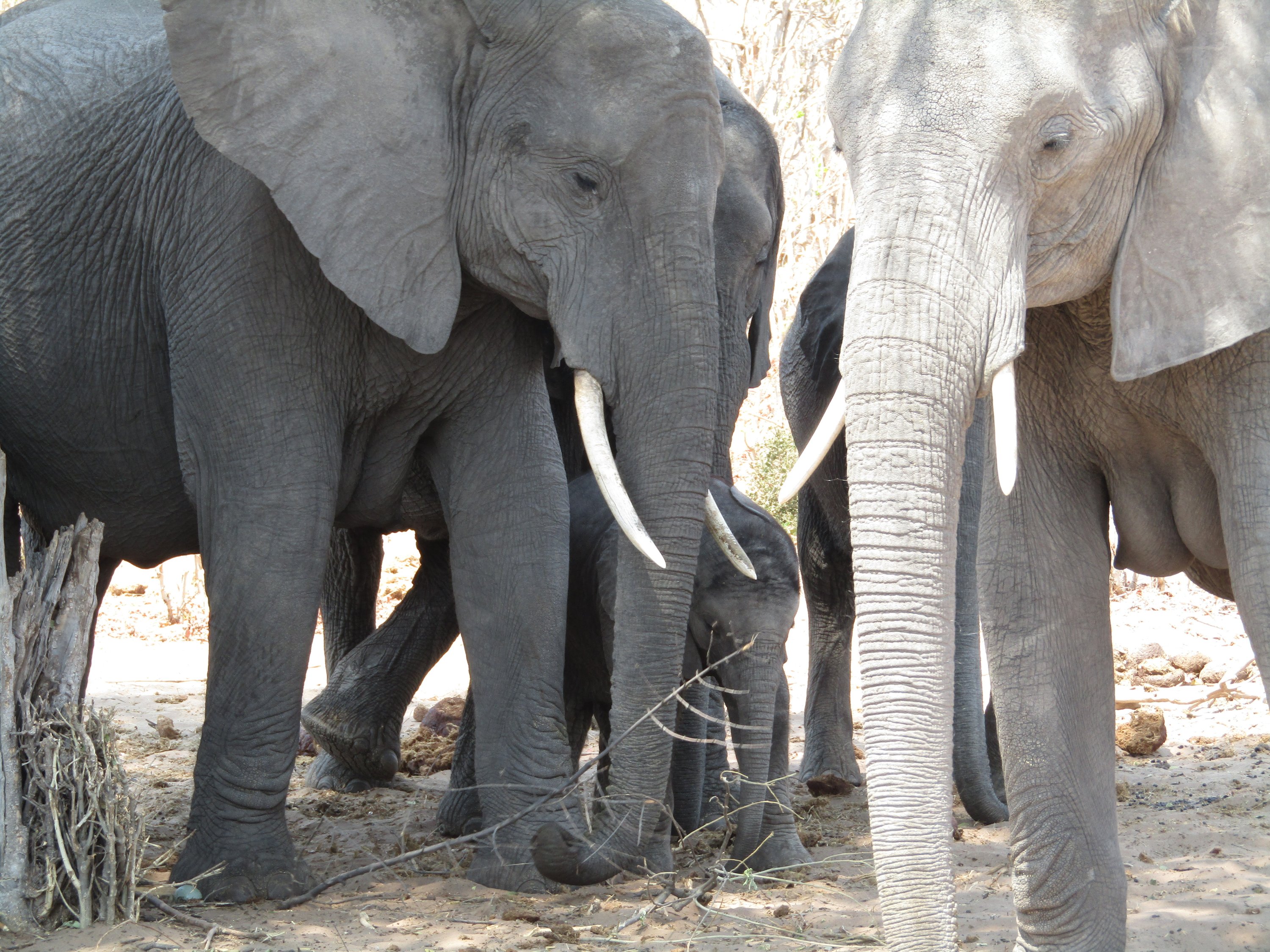
Botswana has the largest population of elephants in Africa and is recognized as a leader in conservation efforts. We got to see the elephants close up. Hidden in the brush, we saw a calf that our guide estimated was a week or two old. As soon as the mother saw our 4×4, she protectively rushed towards her baby.

A little bit later we saw similar behavior from a herd. As we approached them, we could see two young calfs. By the time they were closer, they had protectively surrounded the kids. Look at the two photos below taken within seconds of one another and see how the babies have been protected in the second photo. We now call this the elephant formation and when we are in dodgy places like Cape Town and we need a little more security, I mutter “elephant” and Evan and Vivian get in between Jo and me.

There’s one more thing I’l like to point out in these three photos. Elephant boobs. We’ve noticed calves suckling on mother elephants before but I had no idea what they were reaching for. If you don’t have as sharp an eye for elephant boobs as I do, look at the elephant on the right in the first photo and look between her font legs at her – well – breast. And in the next photo look behind her front leg. I have added a third photo if you still need help.

Elephants pay attention to their skin. Here’s a video of an elephant kicking up some mud and them giving himself a mud bath. Whole herds do this often. While it’s great for their skin, the area around waterholes and rivers look like craters on the moon. Animals besides humans also change their physical surroundings, though not as dractically.

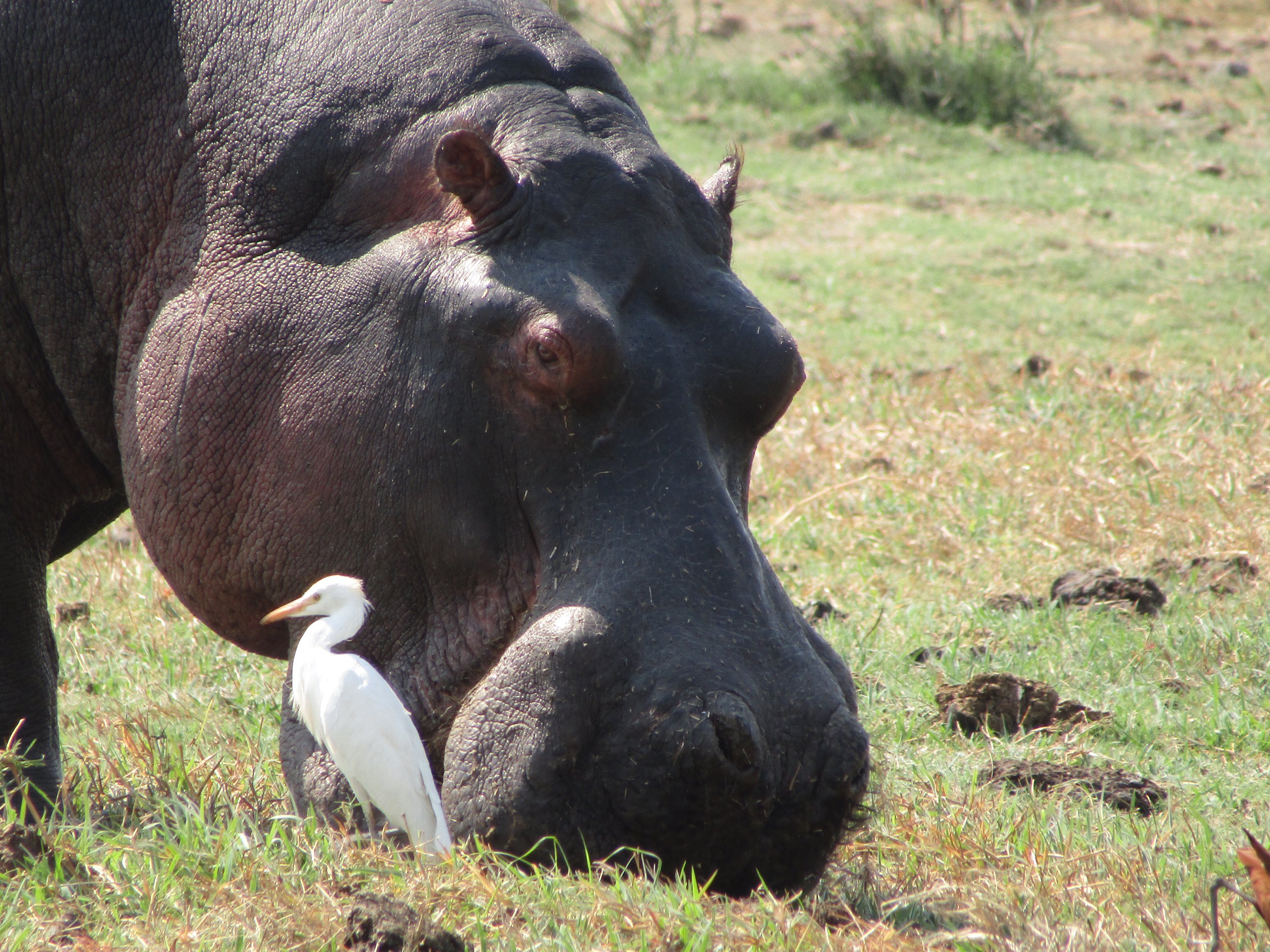
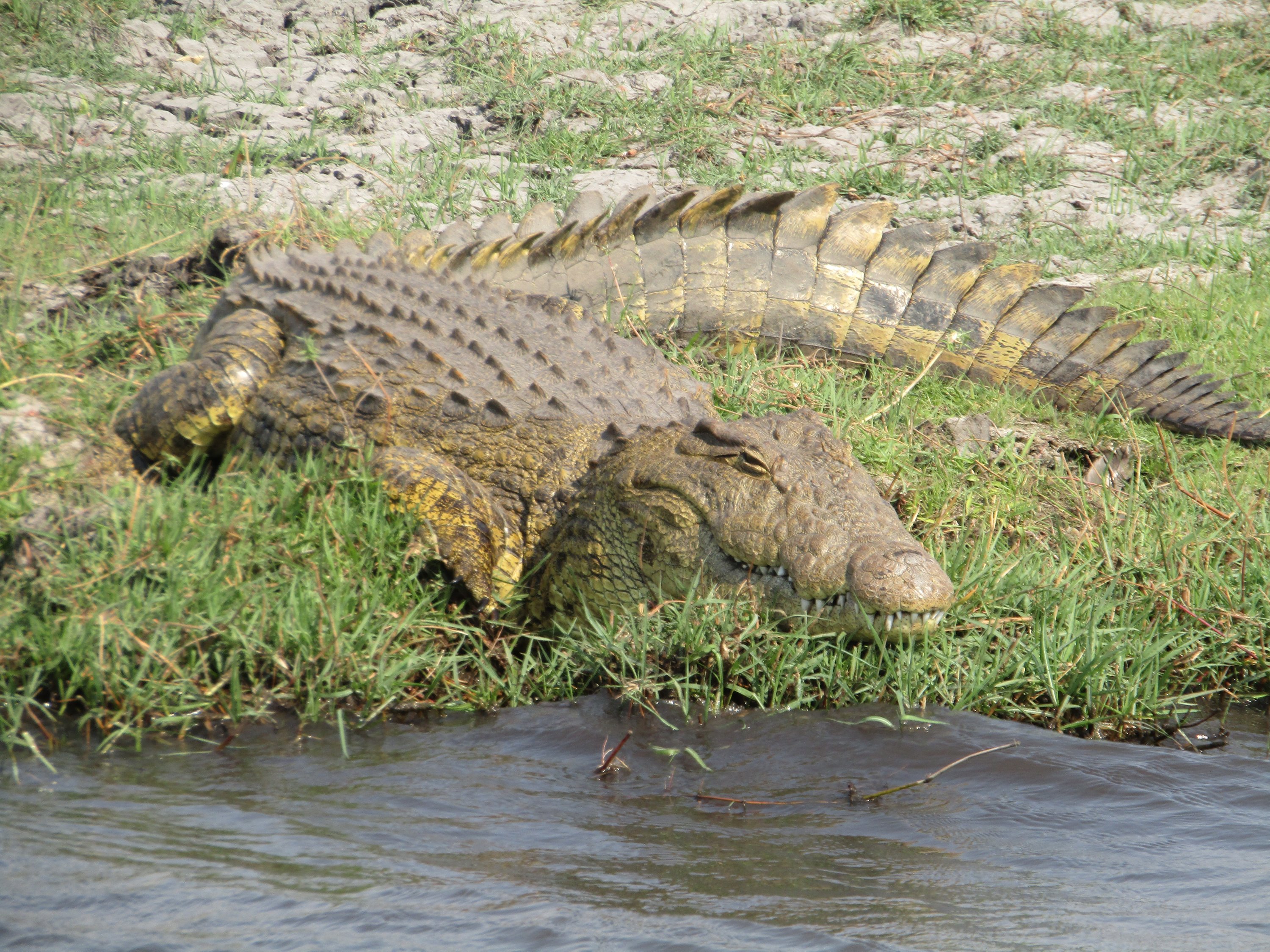
After a hot morning at Chobe (this is the first time I’ve been uncomfortably hot in Africa – though it is still cooler than in Texas), we took an afternoon boat safari on the Chobe river along the islands bordering the park. We got close to wildlife like crocodiles, elephants, buffalo, hippo, and a lot of birds. That made up for a guide who didn’t say much. Vivian couldn’t give a shit and she mostly slept.

Another thing about elephants is that they are fastidious eaters. An elephant can eat up to 300 kg of food every day and drink 200 liters of water. But the food’s got to be clean. This elephant is carefully washing the dirt and grit off a clump of grass before eating it – to take care of its teeth. If its teeth don’t make it, the elephant can’t eat all that food that it needs, and then it dies.

Speaking of dying, Mugabe died in Singapore earlier today. On the drive back from Chobe in Botswana to our lodge in Zimbabwe, our driver who is Zimbabwian spoke about life under Mugabe. Our driver, who I won’t name, is an atriculate speaker – even Vivian and Evan sat up and listened. He told us what it felt like when a lifetime of savings vanishes overnight due to hyper inflation. At it’s worst, one USD was worth more than 80 billion Zimbabwain dollars, and then the government just killed it’s own currency with no warning, leaving it’s citizens peniless. Much of the economic collapse of the country started with Mugabe’s land reforms which took profitable working farms away from white Zimbabwains and redistributed them to black Zimbabwians with no farming experience, he said. And he bitterly added that Mugabe’s friends and family got the best land. Unemployment is over 80% and the few working people support their families, parents (who lost their pensions), and their communities. After using a collection of foreign currencies for the last decade (our restaurant bill lists the total in multiple currencies), Zimbabwe recently floated a new currency again. But banks and ATMs don’t have any cash. People get paid by direct deposit into banks. And then they use barter or debit cards to buy stuff. Which is fine, except that everyone still remembers the last time the banks and the government screwed them over, so let’s say there is some PTSD. I asked our driver if he expects his children will see a better tomorrow. He wasn’t hopeful. He mentioned how the new president had ordered the army to open fire on civilians during demonstrations earlier this year. Currently protests are banned in Zimbabwe. Some Zimbabwians are thinking fondly back to the Mugabe days. Social studies lesson of the day for Vivian and Evan.

Names

Our guides names are a constant reminder of how cultures differ. In Zimbabwe we met people with names like Reason, Memory, Given, Blessing, and Innocent. In Botswana we’ve met Sixteen, Four Four, Action, Bulldog, Tiny, Boxer, and T. T uses the first letter of his first name, Tshenyo. On the day he was born his village was ravaged by people from Zimbabwe. His mother named him Tshenyo, which means Vandalism in her language. Here are Jo and the kids with T and Boxer. Take a guess who’s who.

In Kenya, we met Amos who later admitted that his real name was Kura. One day back when he was a kid he was on a bus and he saw a cartoon out the window.

Knock-knock
Who's there?
Amos
Amos who?
A mosquito

And that became his name – or at least his tourist name.

School Cape Town

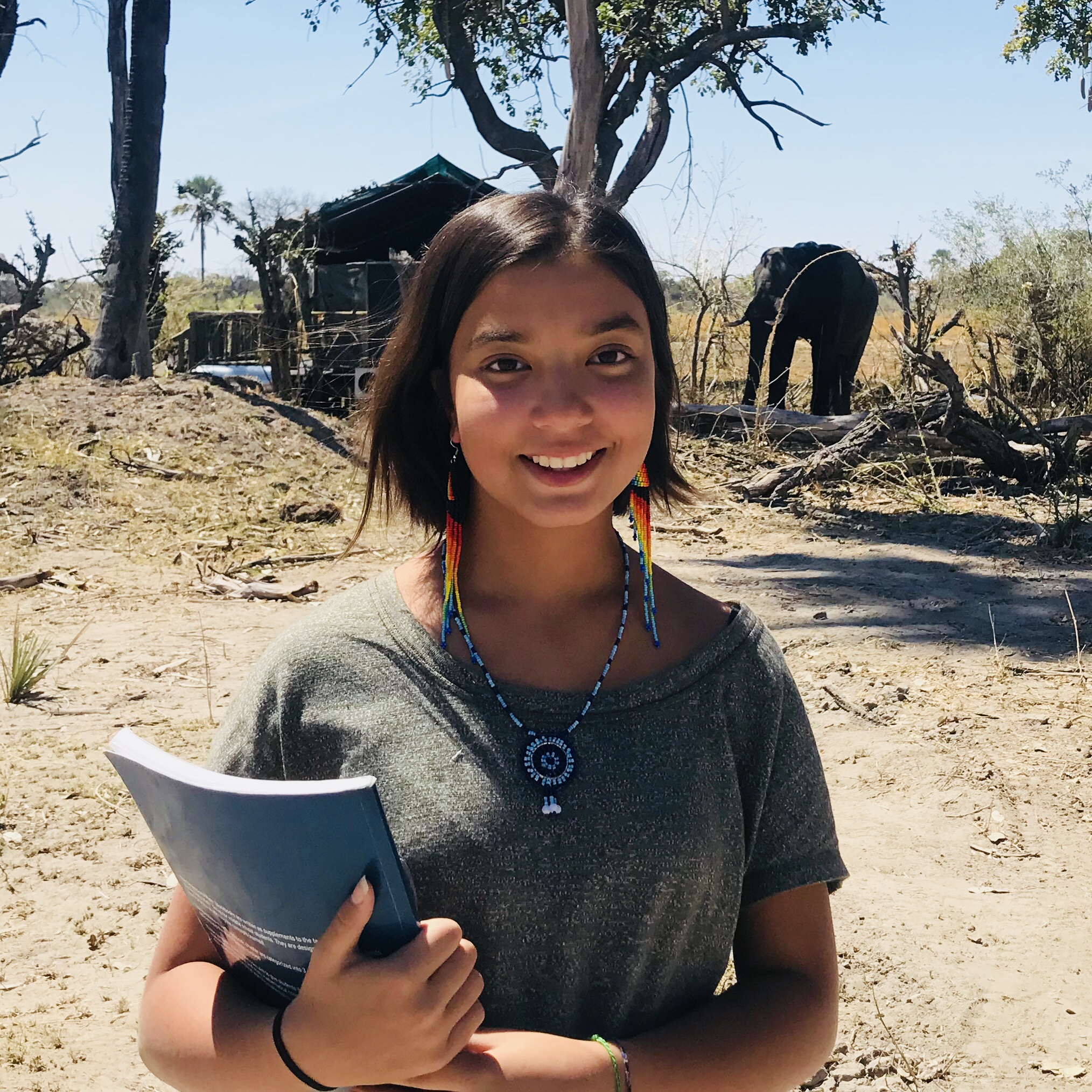
Learning isn’t always easy or fun. My impression is that Vivian and Evan tolerate going to school because they get to hang out with their friends. Take the friends away and you’re left with just the teacher and your lessons. Take the teacher away, and it’s us homeschooling the kids. Doing it on the go is even weirder. Without a fixed schedule or classes or lesson plans, everything is up for grabs. But we have settled into a basic pattern. Vivian does her math problems from her Singapore math book. She asks me if she doesn’t know or understand something. I check her work and if there are systematic errors, we go back and learn some more. Often Vivian puts on her earbuds, zones into her music, and sits wherever – like in our tent in the Okavango delta, and does her work. Sometimes we go to a lounge at a lodge and work there, but the other day she had to wait, math book in hand, while a large female elephant wandered around.

If you noticed, I haven’t mentioned Evan. He is Jo’s problem. Every day I think of Ms. Carrol who was his teacher last year. I hear she is being nominated for sainthood. About time.

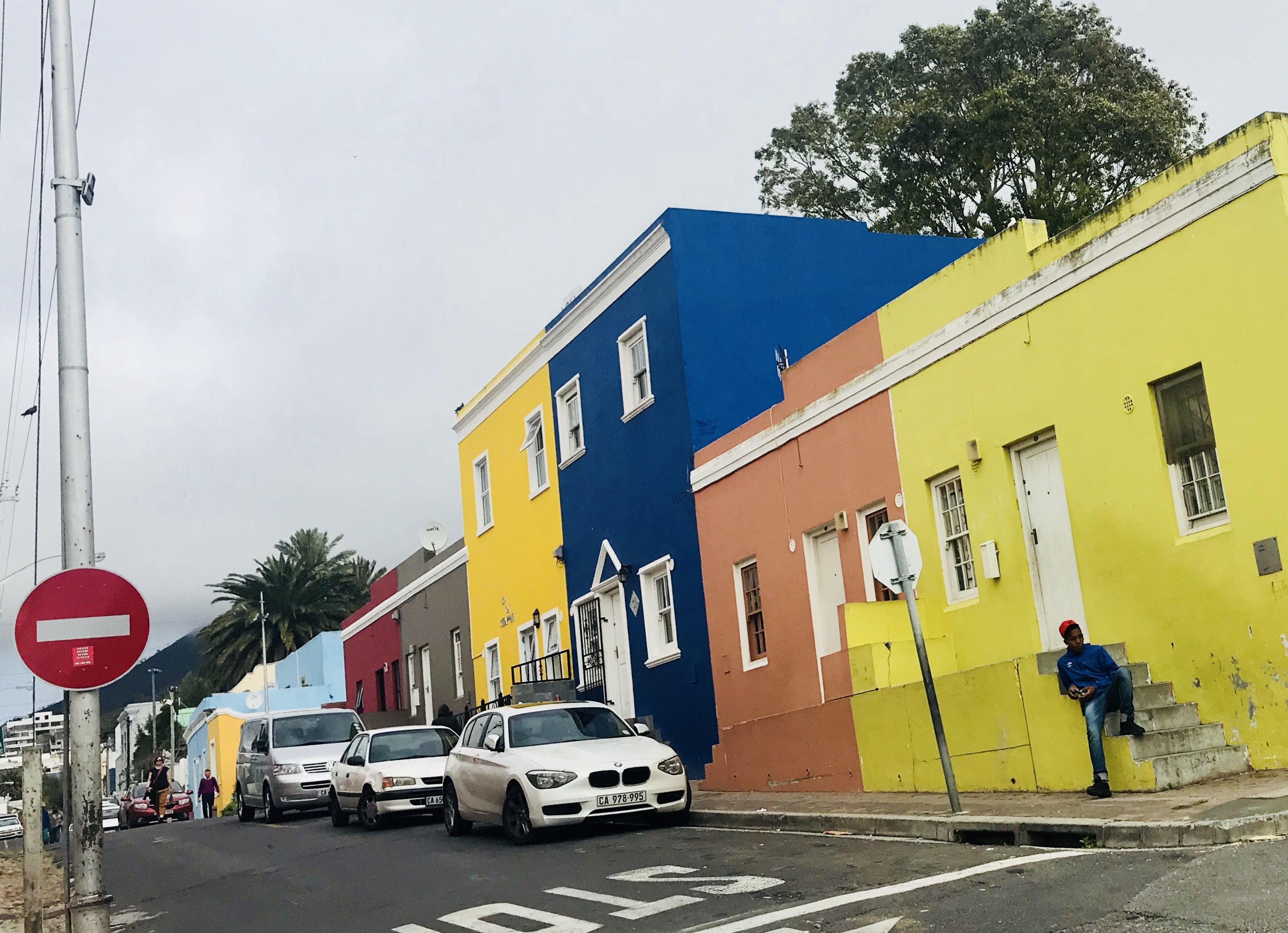
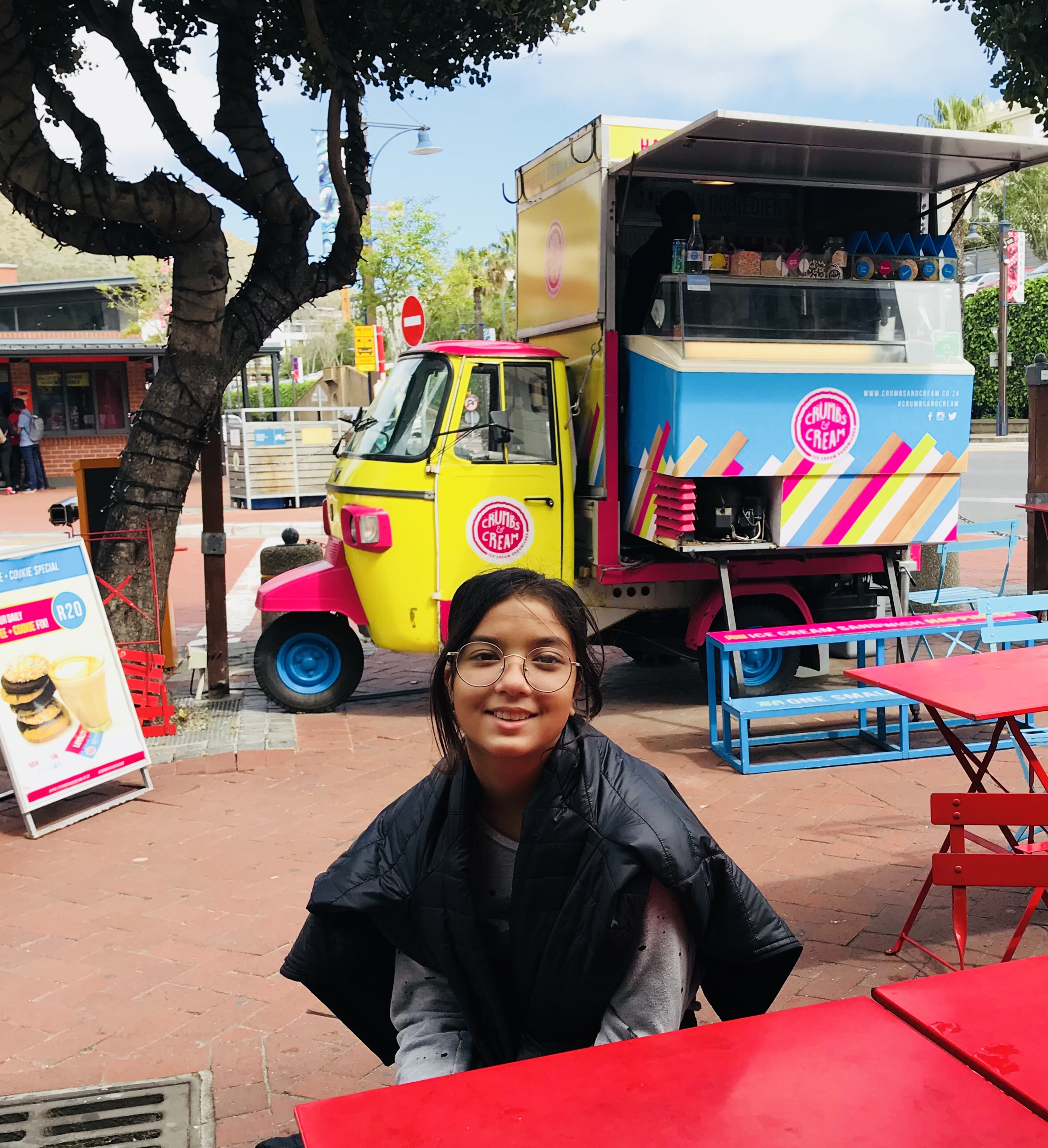
Yesterday, Jo had planned a pretty amazing school day in Cape Town. We got our PE in early – with a 5 km walk from home down to the water front, stopping for pancakes along the way. We took a diversion through the colorful Bo Kaap neighborhood and the kids got a lesson on apartheid, slavery, segregation, racism, and gentrification. Then recess at a food tuk-tuk serving ice cream cookie sandwiches followed by science class at the Two Oceans Aquarium, especially the sting ray feeding event, and the discussion on plastics and marine life including graphic photos of plastic bags pulled out from the stomachs of dead and dying turtles, sharks, whales, birds, and other animals.

You use a plastic bag for an average of 12 minutes before it is disposed. We consume 2 million plastic bags worldwide every *minute*. And while we are doing that, the Texas Supreme court ruled last year that local plastic bag bans are in violation of state law. Our esteemed Attorney General sent letters to 11 cities in Texas including Austin telling them that their local plastic bag bans were illegal and unenforceable. I’m not kidding. We have used one plastic bag in the last two months in four countries in Africa. Damn shithole countries.

Later we had an unexpected social studies class. The Uber driver that evening was listening to a talk show on the radio where the host was discussing violence against women in South Africa. We got into a nice discussion and got some interesting perspectives. The driver said that real change will happen when people stop the violence not because of fear of the law or because someone in watching them, but because they understand it is wrong.

And we ended the evening with a Spanish class (so we are stretching this life-as-a-classroom concept a bit). We went and saw the Dora The Explorer movie. Dora (“Dua”) was Vivian’s favorite cartoon character when she was a little kid. After a healthy doze of teasing from Evan, and a bit of self-conscious embarrassment, Vivian has recently come around to owning her love for the cartoon. And we enjoyed a dinner of movie snacks. Can you say “delicioso”?

Safari to City

Jo and the kids complained and I thought I had perhaps booked too many safaris. Too much time bouncing in 4x4s getting lashed across the face by spiny desert trees. Too many elephants and zebras and impalas. But in the end when it was time to leave Moremi Crossing, it seemed too hurried. We said goodbye to Tiny, our gregarious manager who had been to Hyderabad, Sheraan, the nineteen year relief manager who was shy at first, Action, our tracker who can read the desert dirt like an open book, and Four Four who drove the the 4×4 with an unusual gentleness and said sorry every time he hit an unexpected bump. And we said our personal goodbyes quietly to the bush and all that we would miss. The daily rhythm of waking up early and going on drives. Spectacular African sunrises and sunsets. Elephants and hippos seemingly destroying the camp at night. The poor buffalo with the broken front leg who had escaped from the lions and the hyenas and still somehow was alive every morning on the bank of the river. The chance encounters with mongoose ripping the baby python to shreds by the lounge.

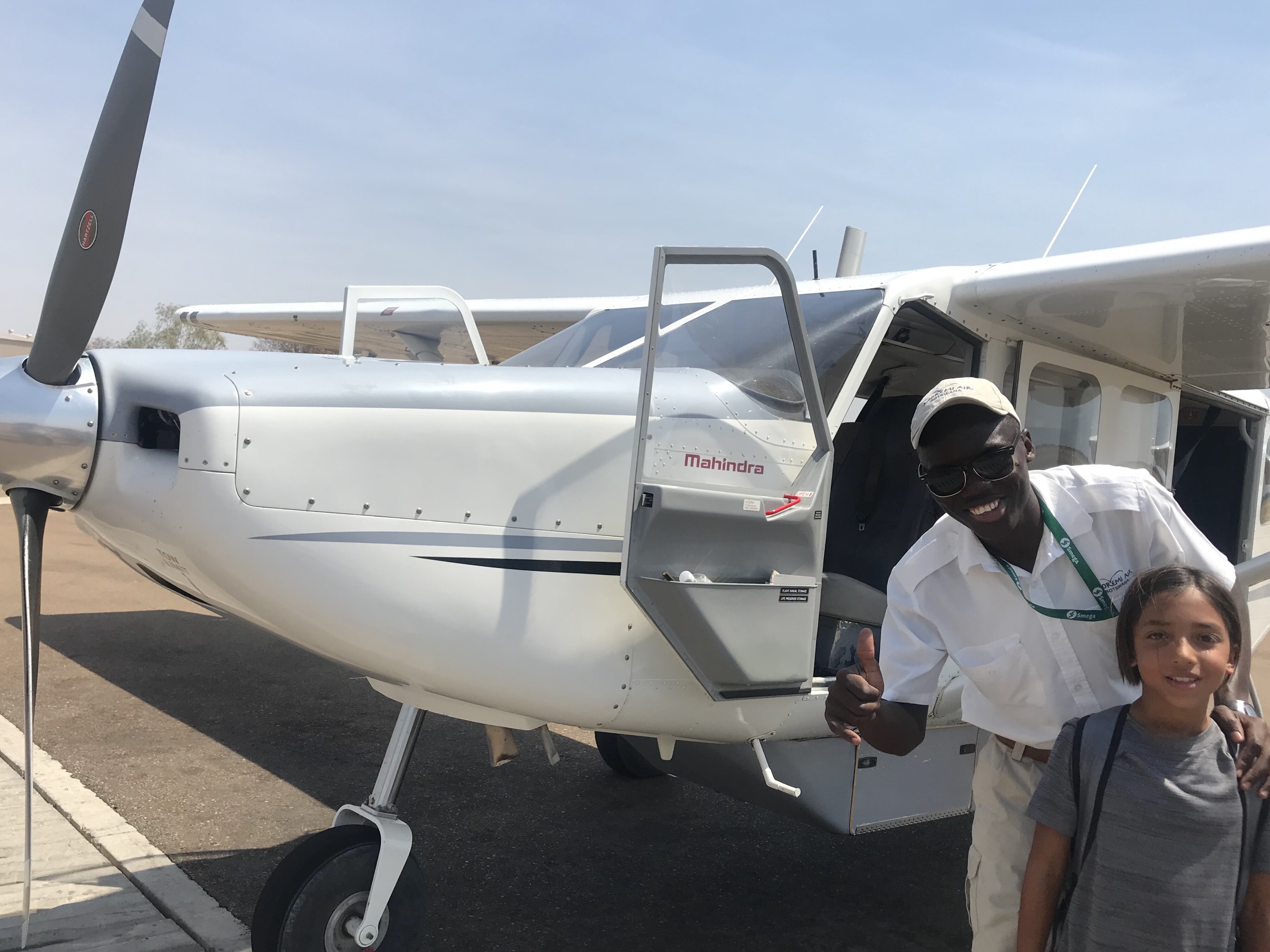
A pilot and small plane took us to Maun where we transferred to a larger schedule flight to Cape Town. And then an Uber to a jewel of an AirBnb halfway up Table Mountain. We walked down for dinner to a cozy Italian restaurant in the hip Kloof Street neighborhood and sat at a table in a building with stone walls and glass windows and complete strangers and suddenly the bush is a distant memory, a dream that is slipping away.

Maasai Mara

[Note: this happened in late August]

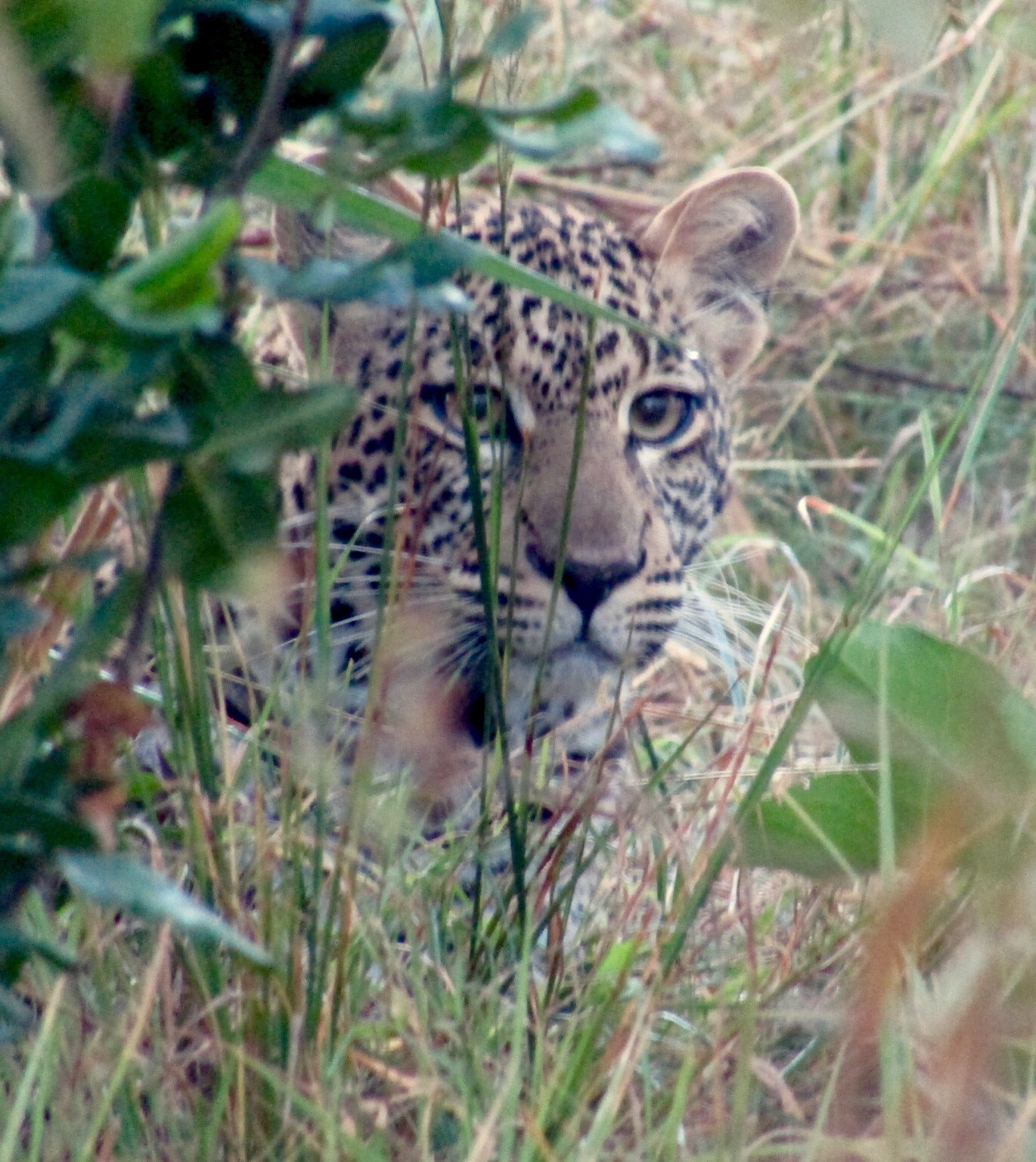
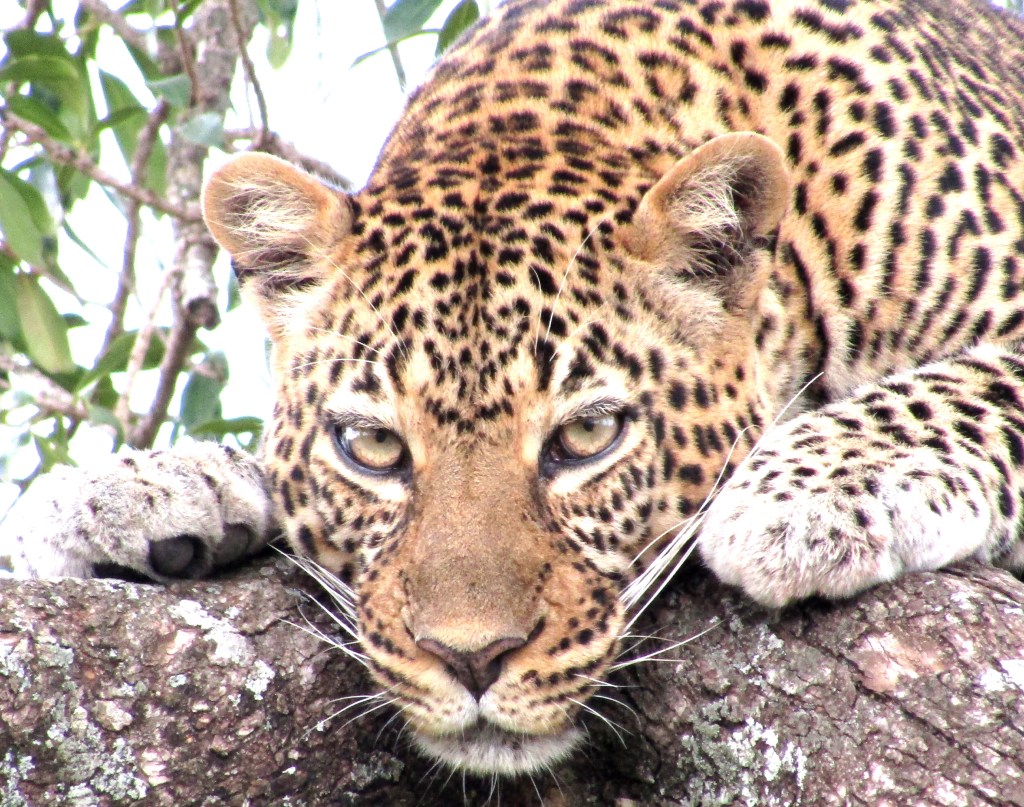
When we arrived in Maasai Mara we were more than a bit complacent. After all we had recently finished 10 days at Tanzania’s three top game parks with some of the best guides in the business. We had even seen leopard – one of the rarest of the predators of Africa. All that remained was rhino.

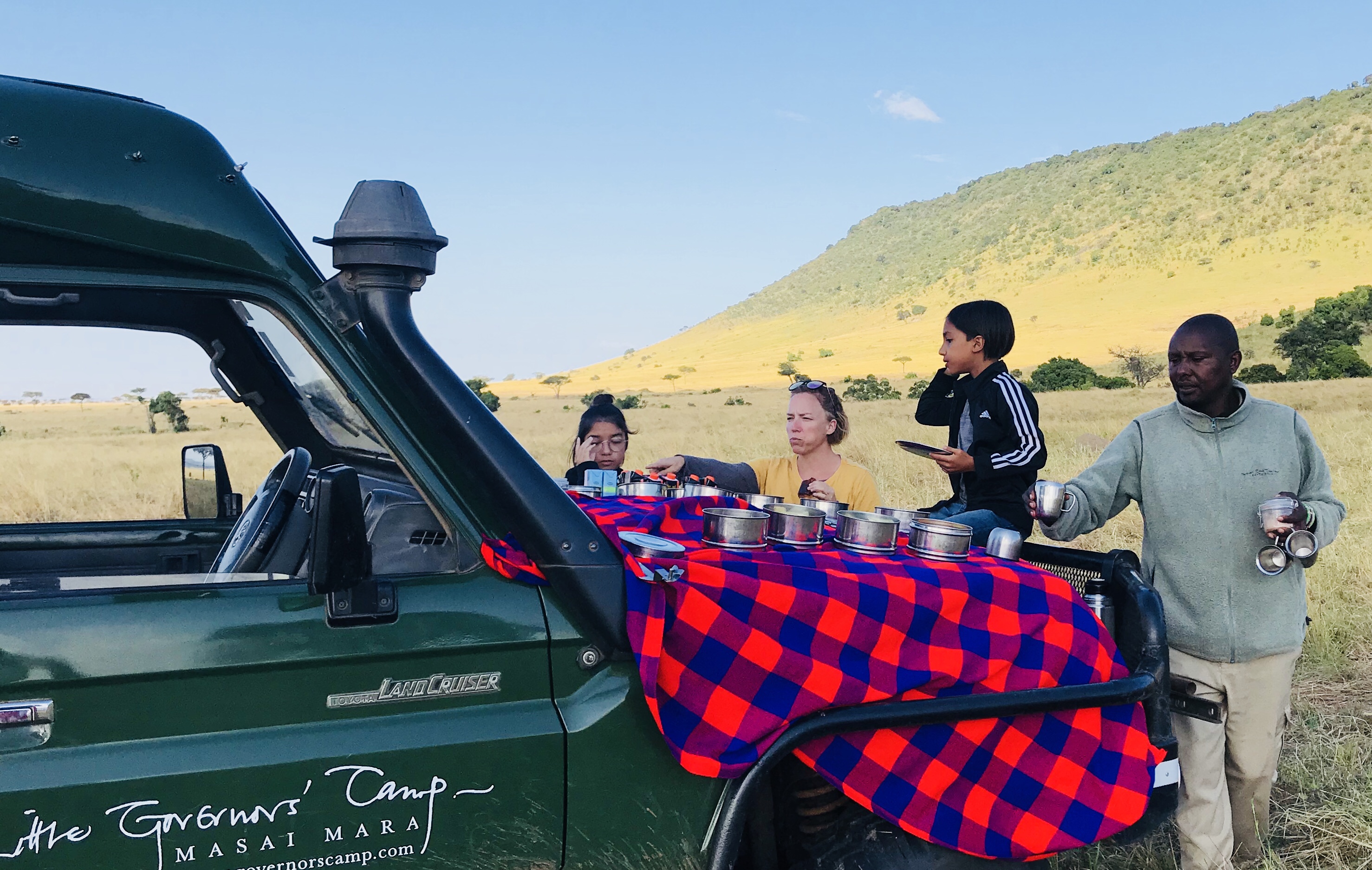
The Little Governor’s Camp is a hangover from the British days if there ever is one. Our manager is George, an elderly Scotsman who has lived in interesting places most of his life. The camp is a collection of a dozen tents around the edge of an escarpment that went three quarters of the way around a wetland down below. There is a bar / lounge tent, a dining tent, and an shaded area in front of the escarpment. It is a short walk down to the Mara river where a boat and boatman await to take you across to the safari 4x4s on the other bank. The daily regimen isn’t easy – wake up call with a hot drink of your choice at your tent at about six in the morning (in a tea cozy, with biscuits). First game drive from 6:30am to 11ish with an option of taking a picnic breakfast (which was an elaborate affair with thermoses and tiffin boxes) or returning for a quick breakfast and going back out again. Lunch under the trees till about 1:30pm. The second (or third, if you came back for breakfast) game drive starts at 3:00 pm and runs till sunset. Back home for hot showers in wood-trimmed bathrooms attached to the tents, drinks outside around a brazier of glowing charcoal at sunset, followed by dinner in the mess tent.

Our guide was Berard, who on the last day told me that his name was (pronounced) Cashew (I’m not sure what the spelling of his name is) and that he had taken to calling himself Bernard after coming across the name in a book. He was a self educated Maasai.

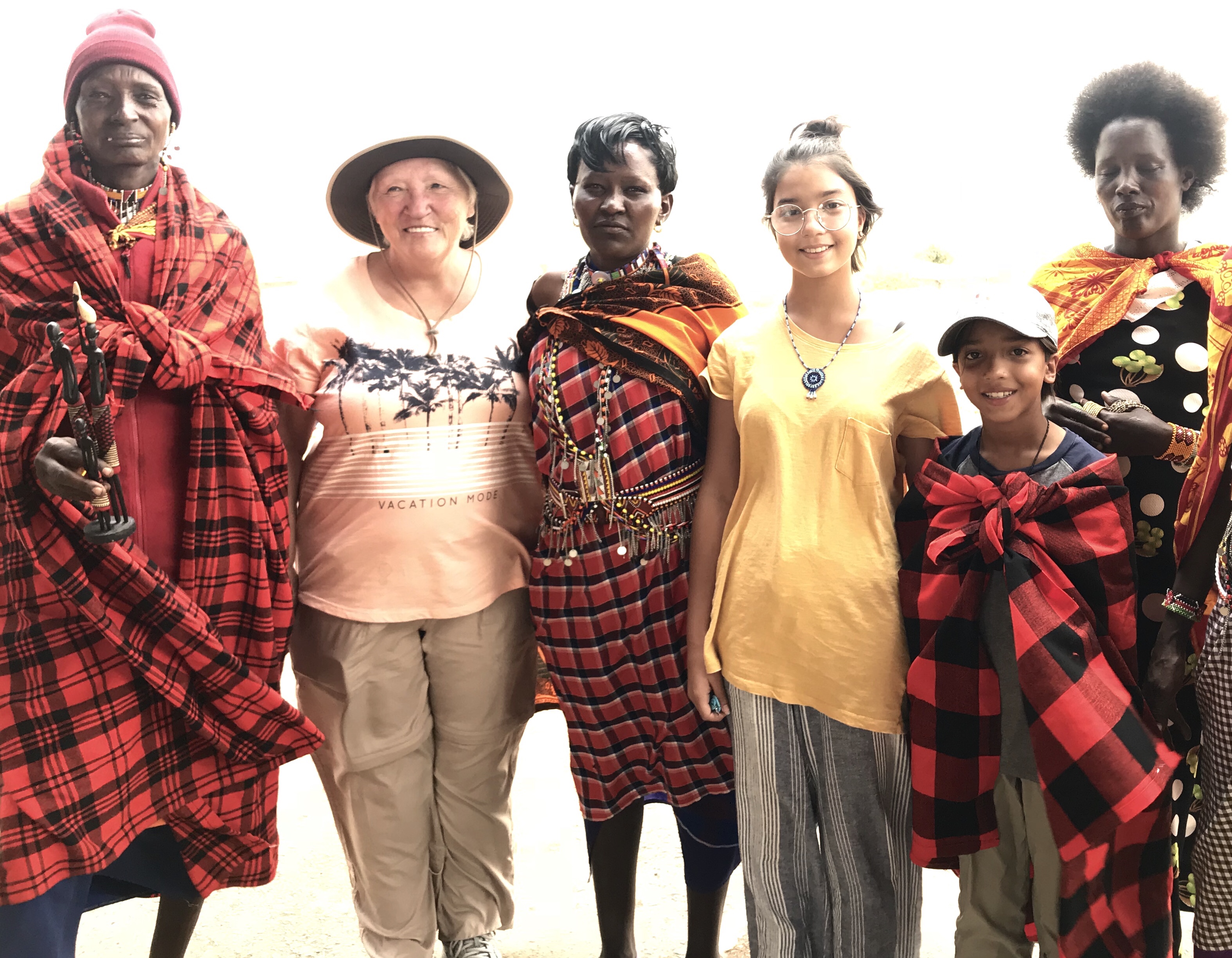
In the first few hours out we saw a rhino. Over the next three days we witnessed amazing wildlife close up. We got to learn a good deal about the Maasai firsthand from Bernard, and drove out of the park to meet a few Maasai ladies who were making and selling jewelry outside the park gates. I’ve picked out the highlight photo reel from our time in Maasai Mara.

That’s not our airplane. It was a much bigger aircraft at another landing strip we passed. Apparently about three weeks ago it had hit a wildebeest while landing and lost it’s landing gear on the port side.

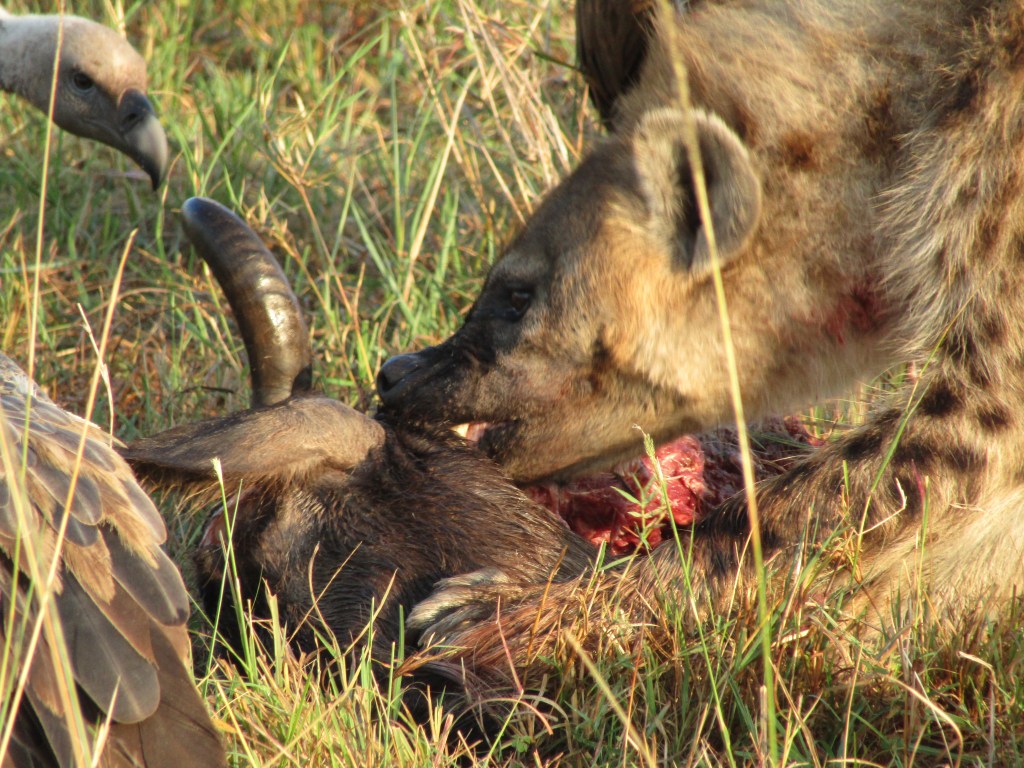
Of all the memorable things in Maasai Mara, it’s easy to tell you which one stands out. One morning we were out following a hyena. He found a carcass of a wildebeest and proceeded to eat from it very noisily while a wake of vultures circled and jumped in for a mouthful when they saw an opportunity.

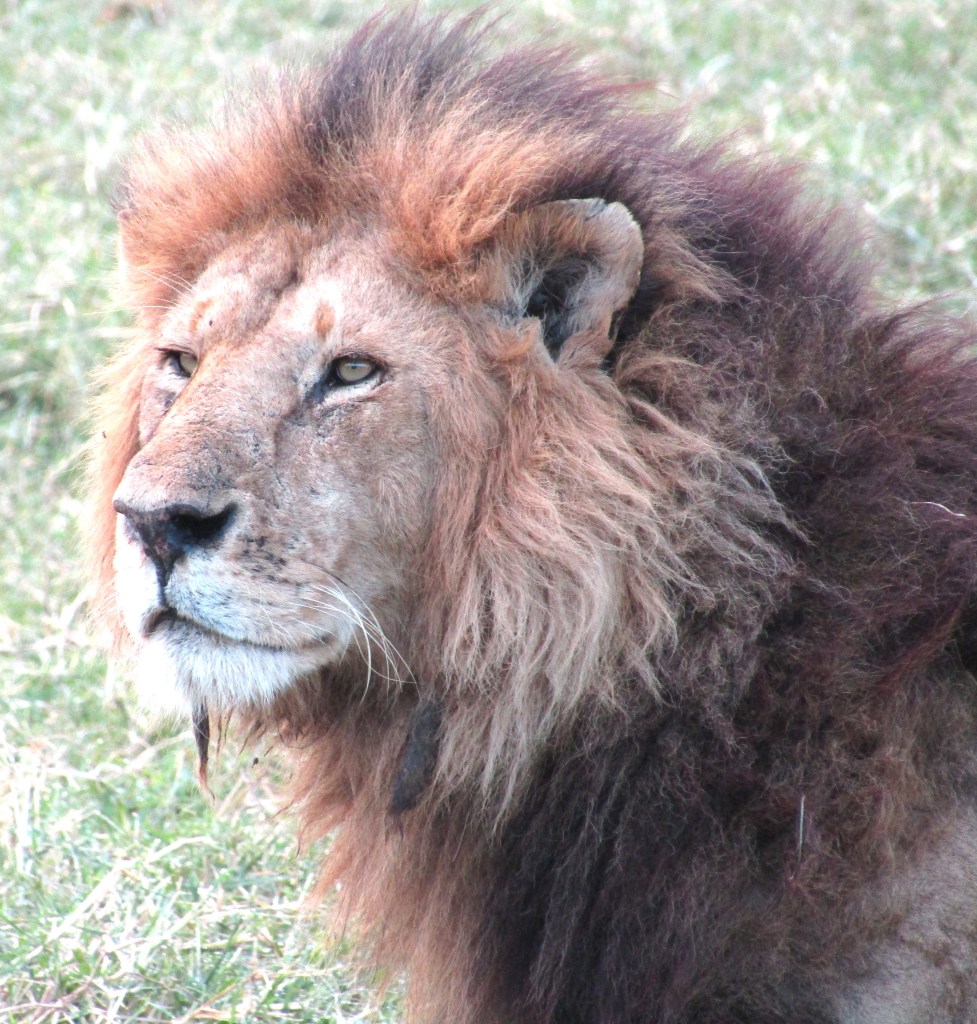
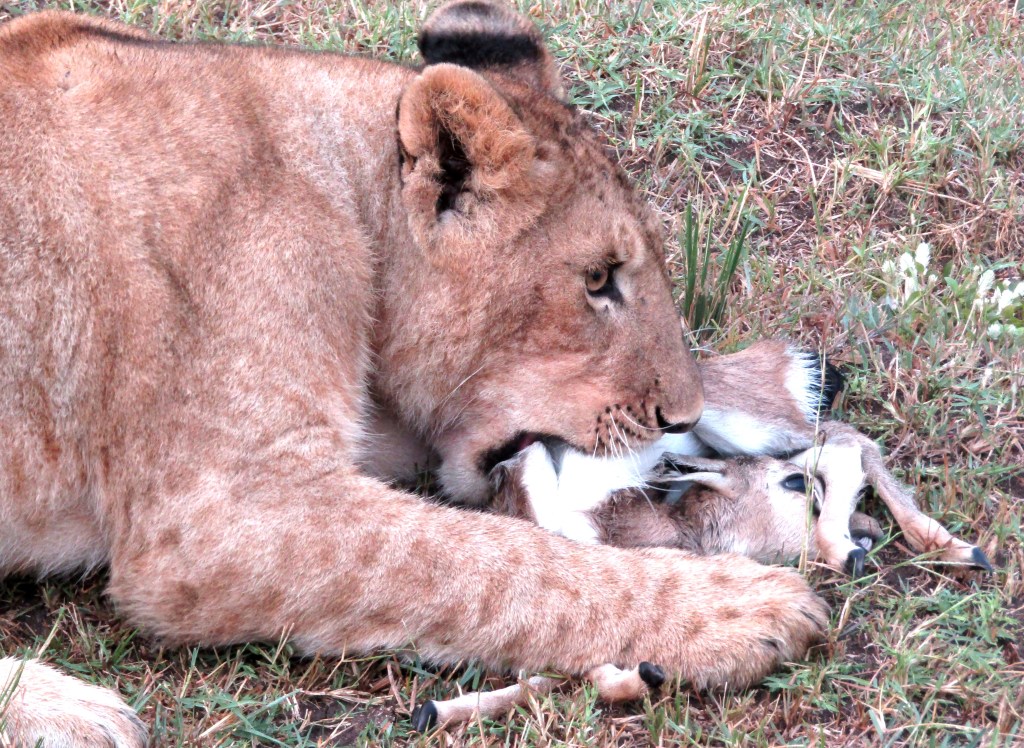
Then we saw a large pride of well fed lions a short distance from the carcass. One big lioness walked up to within two feet of the front of our 4×4. Jo took out her iPhone and started videoing the lioness. When the lioness got right in front of the 4×4, just as she was walking over a shallow gully, she suddenly looked down, and dipped her head into the gully. Just as Jo wondered why a lioness would stick her mouth in the dirt, the lioness raised her head, holding a tiny squirming baby gazelle in her jaws. It looked like she just picked it up instinctively though she had just eaten and had a full belly. As soon was the rest of the pride saw her with the fresh prey, they started running towards her. She took off. Eventually she gave the gazelle to one of her male cubs who ran around with it proudly, fending off his siblings. The mother lioness did not help him, but she did keep the two other adult lionesses from approaching her cub, though it wasn’t done aggressively. The pride played and jumped on each other and rolled over and ran around while the young lion cub ate and licked on the baby gazelle. We watched for at least an hour and Vivian and Evan commented on how similar the big cats were to their distant domesticated cousins. And Jo wanted to take one home. All the while we also left terrible for the baby gazelle and an adult female who watched from a distance who we assumed was the poor mother. Cuteness and deadliness in the same beasts. Birth and death next to each other. Sometimes horror. But no evil.

Sand Island

We like beaches. So I’ve worked a few into our travel plans. Our very first are the famed beaches on the Kenyan coast. We started at the Baobab Resort in Diani Beach for a few days. It is a nice place with good rooms, huge buffets, three swimming pools, a beautiful beach of fine white sand, and it’s all inclusive, including alcohol : ). But eventually we don’t want to be in a hotel.

Sometimes I surprise myself by my planning. Or may be it is dumb shit luck. Turns out that for the next few days we were booked at a “self-catering” cottage on a beach about 15 km north of Baobab. We drove up to Sand Island and all five of us took a collective deep breath and let it out slowly.

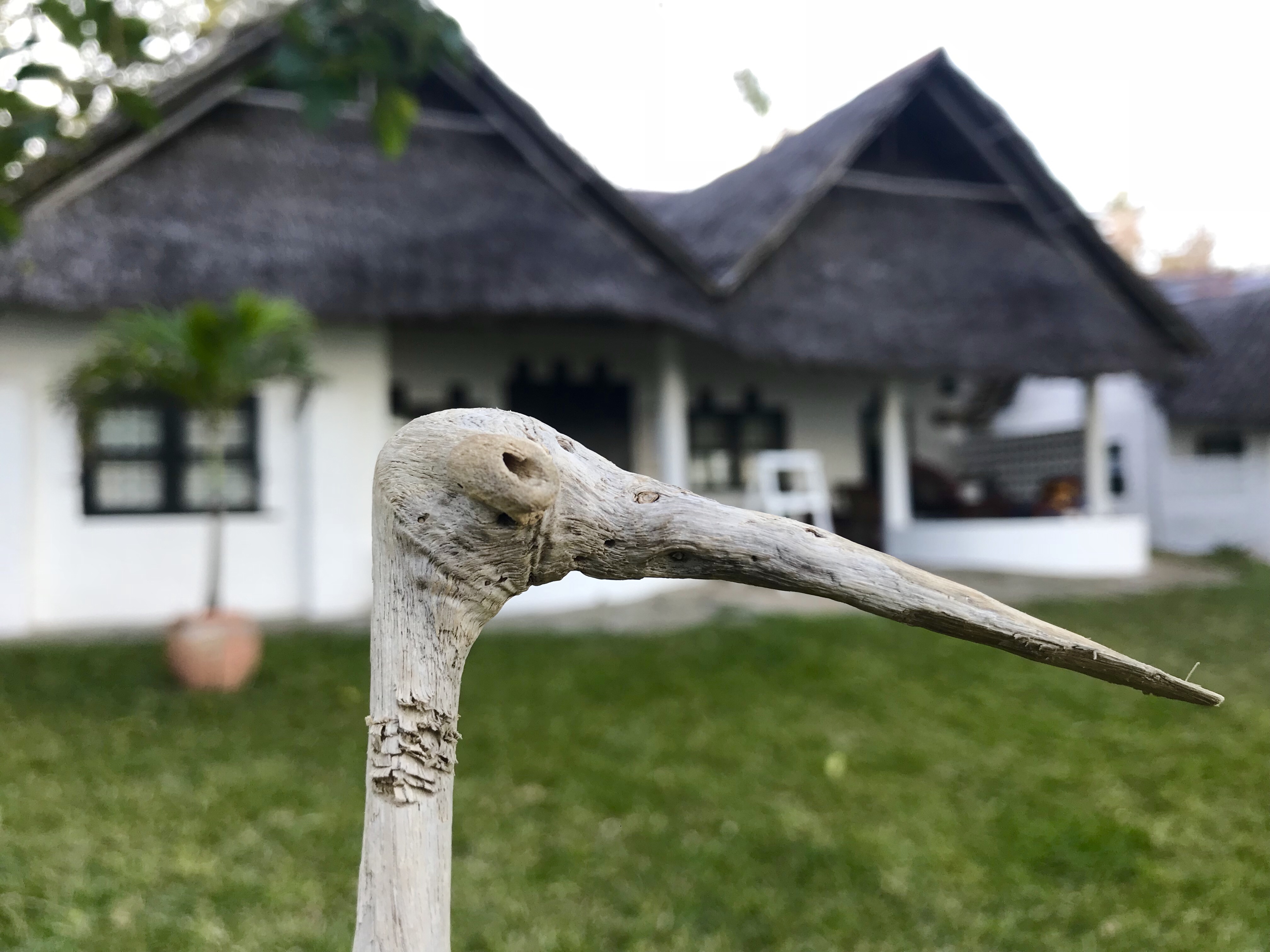
Simple thatched whitewashed cottages. Rustic furnishings. Ancient baobabs. Palm trees heavy with coconuts swaying in the breeze. A rolling open lawn leading down to a beautiful empty stretch of sand. A tranquil turquoise lagoon with a sand island! Rollers crashing on the reef.

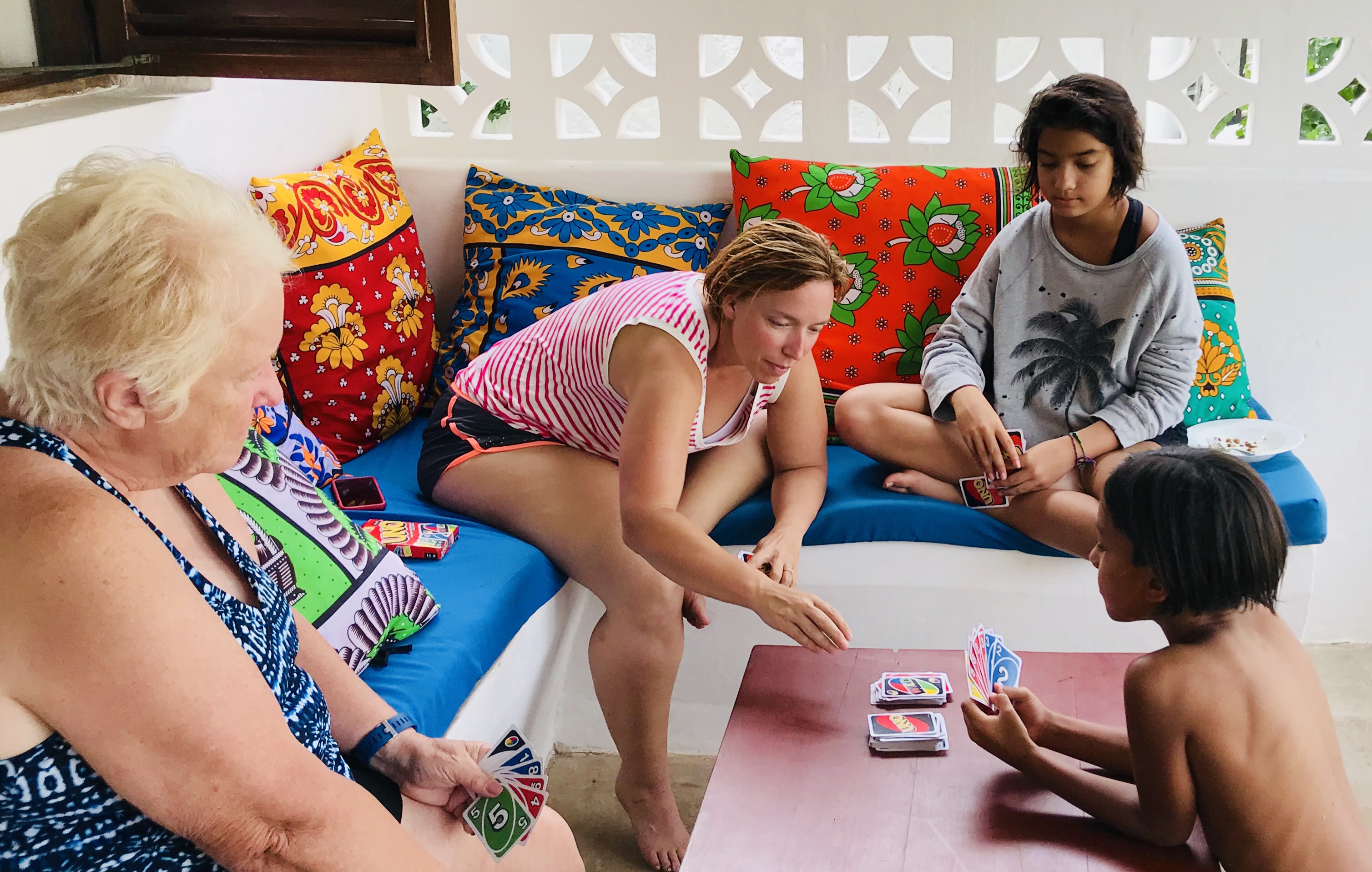
Next morning Jo and I sat on a palm log bench at the beach at sunrise and did nothing for a long time. A lone fisherman walked into the lagoon and up to the sand island. The kids woke up slowly and read in bed for a while. We made eggs and bacon and toast and oatmeal for breakfast and sat outside at the dining table and ate. And read some more and played Uno. And enjoyed the sights and sounds of the ocean.

We got samosas from a lady who they call Mama Samosa. And Binty, our cook, helped me buy fresh fish from the fisherman who told us he would bring back fresh squid for us tomorrow. And we got some fruit from the fruit guy. And four fresh green coconuts with their tops cut from the coconut guy. And I made arrangements with someone called Amos for a guided snorkeling trip to “starfish village” at noon. There are lots of brightly colored starfish right there in the sand, he said. Sure, I thought.

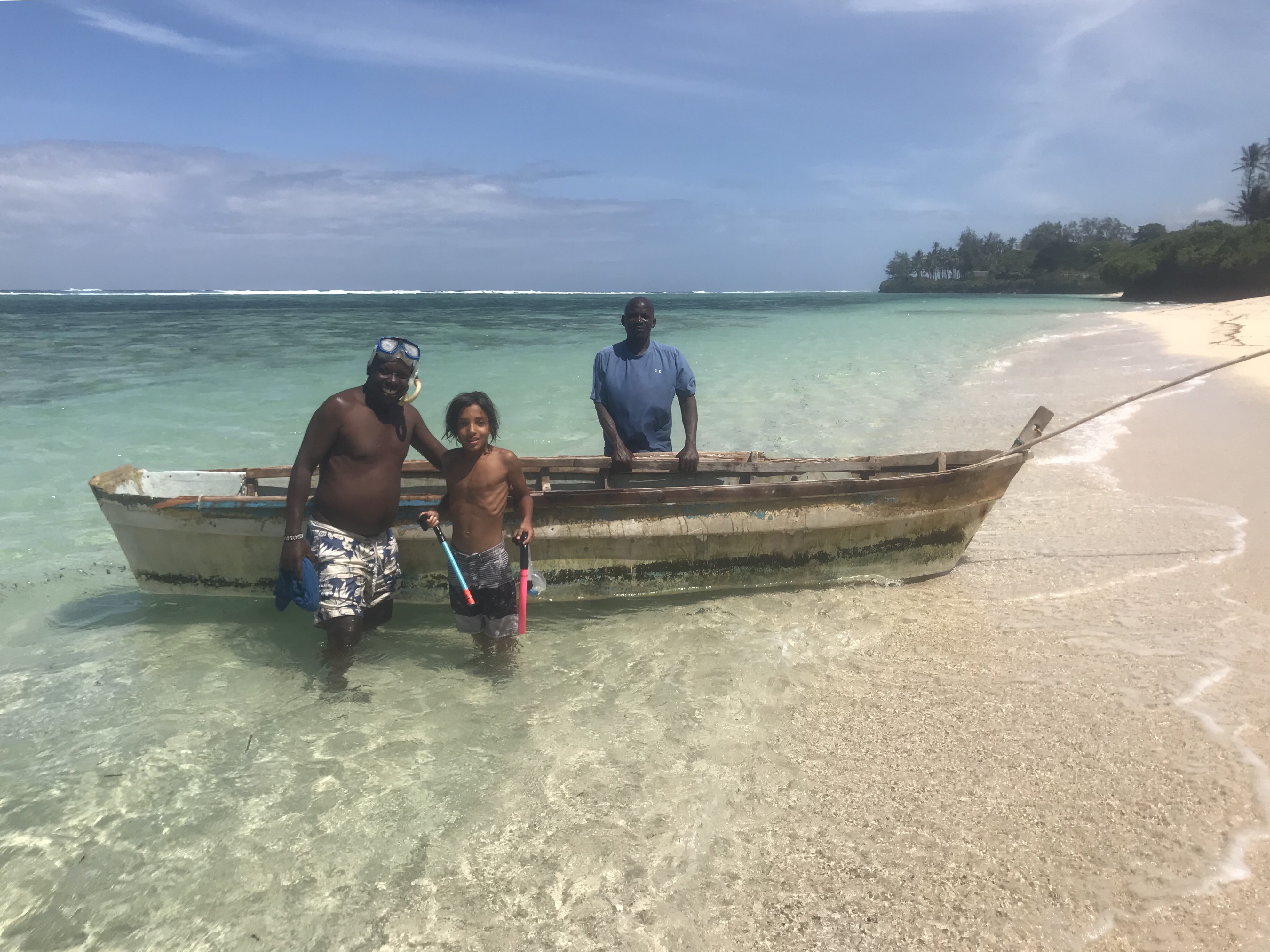
We rode out to the starfish village in an aging bleached fiberglass and wooden boat poled by Amos over the shallow waters of the lagoon. Soon Amos was pointing out large colorful starfish on the sandy bottom and in the sea grass. We jumped off onto a sand bank in a couple of feet of water and Amos returned a moment later with a pile of starfish. They looked like plastic fakes. But Amos handed them out and we turned them over and their suckers were waving out of the five slits along their bottom side. One tried to attach itself to Evan’s hand. Definitely not fake. Amos was a bit of a naturalist and told us about starfish. Then he explained that locals used to collect the starfish to sell to tourists and the population was depleted. So the fishermen and Sand Island cottages formed a coalition to protect the starfish. Now the fishermen make some money by taking tourists out to see the starfish. We marveled at how quickly starfish move. One climbed up to and over Jo’s reef shoe in minutes. Then we got ready to snorkel back. But there was a problemo. Sea urchins. Thousands of them covering the bottom of the shallow lagoon just a few feet down. Stick your knee or hand or elbow in the wrong place and you’ll get a painful reminder. We were wearing reef boots borrowed from the Sand Island office so our feet were safe. After a couple of attempts Evan didn’t want to snorkel. Jo and Vivian were doing an amazing job – it was Vivian’s first attempt and Jo’s second (her first hadn’t gone so well, 14 years ago during our honeymoon in Hawaii but that was also when I hit a giant sea urchin and got a dozen foot long spikes in my knee).

Back to Kenya. By this time, the old boat had gone to give another group of tourists a tour. Just as Jo and I were wondering how a non-snorkeling Evan would get back to the beach about half a kilometer away, Amos asked if he could carry Evan back. Evan readily agreed. And so the three of us carefully snorkeled back and looked at reefs and fish and other marine life while Amos carried Evan and walked back bare feet through fields of sea urchins. The kids will remember this adventure!

photo credit to “JB in Nairobi” (http://jbinnairobi.blogspot.com)

The next day the fisherman did return with a kilo of fresh prawns and four largish squid. Binty cleaned the seafood and taught me how to make coconut fish curry. I watched how she extracted milk from the coconut. She brought in a big folding wooden contraption with a small circular metal grating blade on one end, sat astride it and grated the insides of two fresh green coconuts. Here’s a photo I have borrowed from a blog on African cooking. The grating contraption is called a mbuzi, which is the Swahili word for goat.

photo credit to http://newafricancookbook.blogspot.com/2011/09/

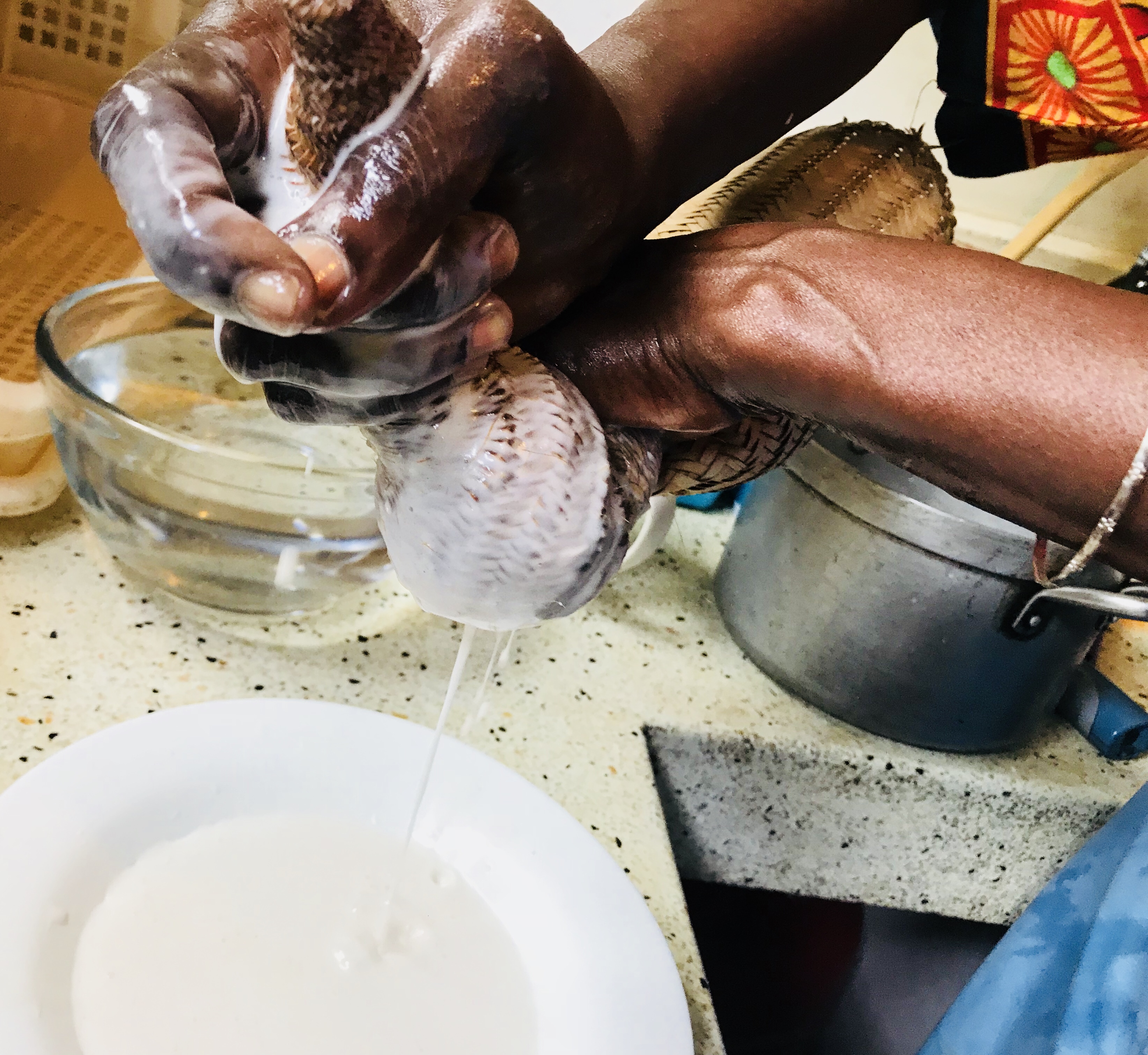
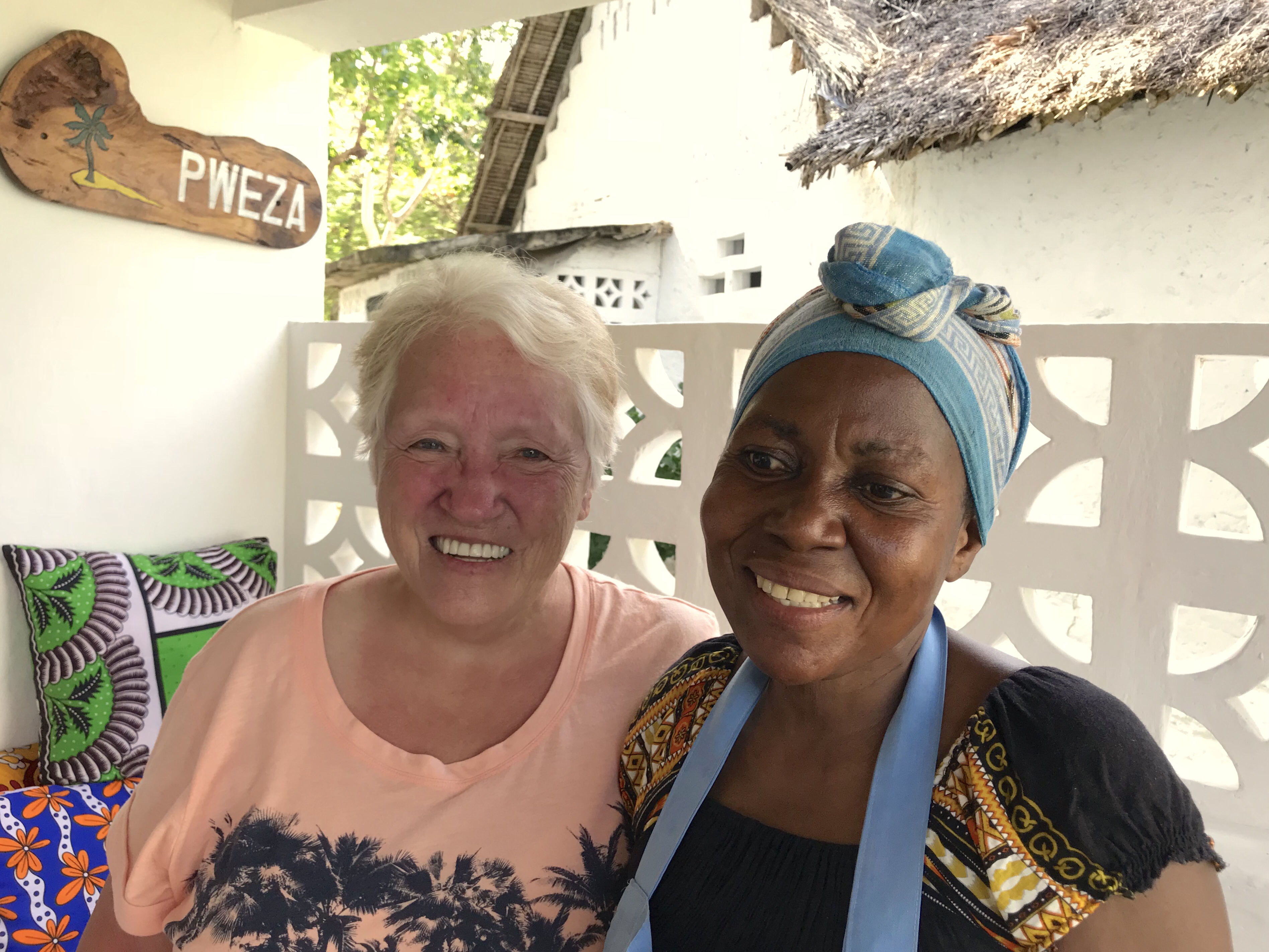
Then Binty poured the finely grated coconut into a long tightly woven tube closed at one end. I had seen it hanging in the kitchen the evening before and wondered about it. It’s called a kifumbu and it is alternately wrung and fluffed to squeeze the milk from the coconut. I got three drops when I tried. Here’s a photo of Binty’s hands working the kifumbu. And a photo of Carol and Binty. Along with excellent coconut prawn curry, Binty made us fresh hand battered calamari rings. Yum. Evan’s favorite food in the whole wide world. The next day we had fresh charcoal grilled snapper and calamari.

Evan asked Amos if he could keep the mask and snorkel a bit longer and mastered snorkeling by himself. We spent many a lazy hour wading over to Sand Island in low tide or walking along the beach and watching the ghost crabs scuttle away from us. One afternoon we got back in the boat and went to Africa Pool – an African shaped indentation in the lagoon a couple of miles south. Carol gamely joined us didn’t complain even when we almost tipped the boat over multiple times. Both Vivian and Evan enjoyed snorkeling at Africa Pool and there were a lot fewer sea urchins.

It takes a few days to settle into a slower rhythm of life. You wake up with the sunrise and look at the tides. Games of Uno on the sun drenched patio punctuate hours of reading and silence. We find different places in the house and property where we go off to, reuniting at meal times. Gringo, the white cat, and Kimmel, the old black lab, show up when we eat. We go to bed with ocean breezes coming in through open windows and the music of rollers breaking on the reef in our ears. Just when we think we can do this for ever it is over and we are off to Ukunda airstrip for our flight back to Nairobi and the world outside.