Back some time last fall, a group of parents and kids met at the front steps of Grace Garden to take a picture and make a donation. Half of these kids are high school juniors. The other half are 8th graders. More than a decade ago they used to walk up these steps every morning and through the doors behind them into a world of love and caring and friends and fun and teachers and learning.
Coincidentally or through some Bene Gesserit-ship, the older kids from the fours families are the same age (Vivian and one of the tall boys in the back were born a day apart), as are the younger kids. The families have travelled, hiked, camped, dined, and hung out together through the years. There is zero overlap in the schools these kids attend and perhaps because of that the kids aren’t close. But they all know each other well and are happy to chill together when they are thrown into the same physical space.
A few weeks after this photo op, I went for a friend’s birthday party to Thailand. I’ve known Sharath since the beginning to time. Vivian went with me. I think she appreciated the bonds between old friends. May be some of these people will visit each other in a few decades. Wouldn’t that be something?
If you know your Ted Lasso (my first quote from a TV show in the 17 years of this blog), you are familiar with Dani Rojas’ smiling face and “Football is life”. Outside of going to school or playing video games in his room, Evan plays soccer. Hence the American version of Dani’s quote.
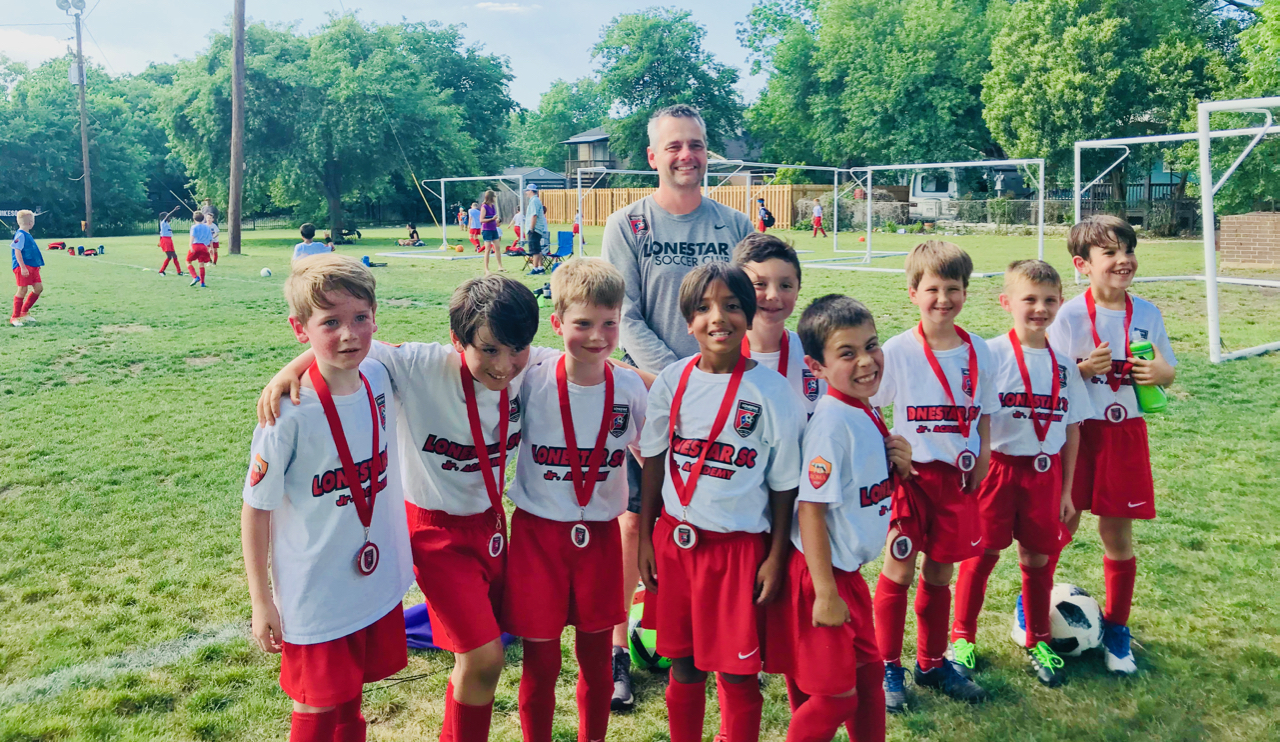
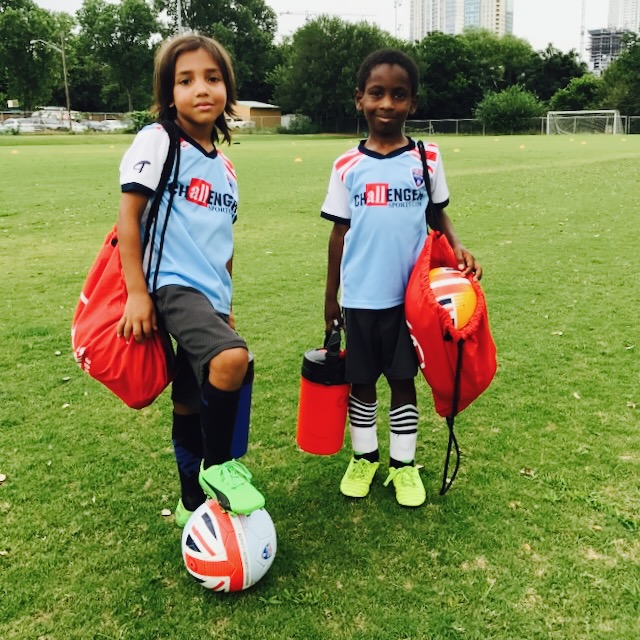
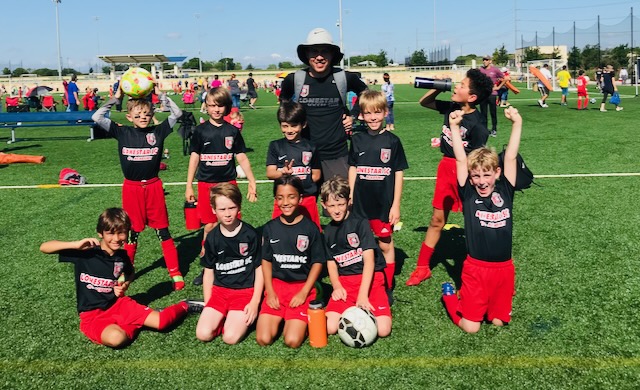
Evan has been playing soccer since he was big enough to kick a ball, starting with Soccer Shots at Grace Garden and the Russian coach at Magellan in the early years. He spent most of his club soccer years at Lonestar with some amazing coaches like Coach Stevens, Coach Luis Papandrea, and most recently, Coach Jason. Stevens famously crept up on his young players and pushed them so they learnt to fall gracefully and get back up quickly, a skill Evan highly values even today. Stevens used to yell “There’s no walking in soccer.” When the season finished we made a t-shirt for him that said that. Papandrea used to look up at the sky and yell a player’s name from the sidelines during matches. That was all the communication they ever got but that was all they needed to jolt them into a higher gear. Papandrea moved Evan to defense, and Evan has been a central defender since. Jason joined the team when a previous coach left abruptly after telling parents to not expect much from the boys. Jason promptly took the team to multiple tournament finals and a championship.
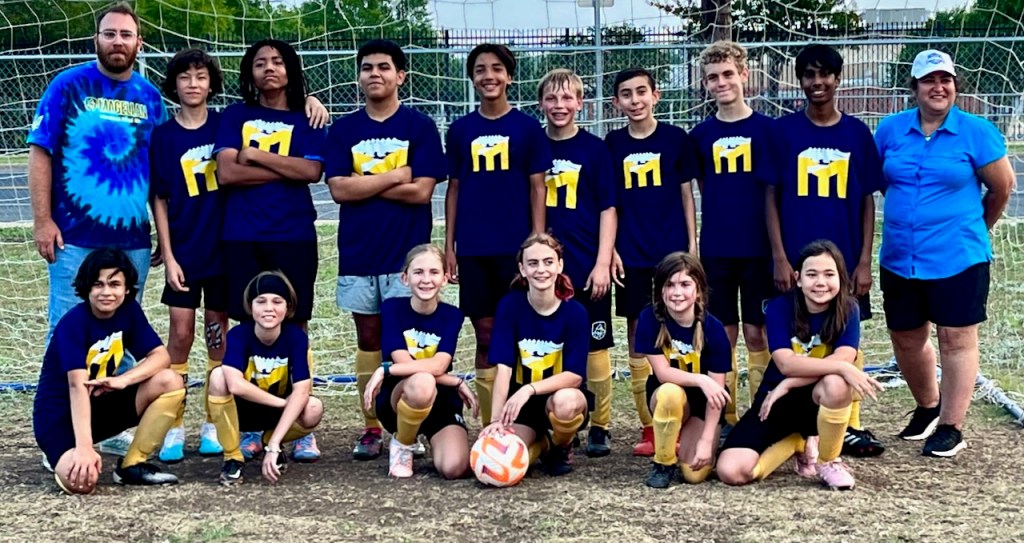
The last one is his school team from 7th grade. They were undefeated for most of the season but then lost in the play-offs. There is boy in this photo who has played with Evan for many years. And 3-4 other boys who used to be at Magellan but have continued to be friends and play on the same soccer team. For a few years back there, from early spring onwards several of us parents (ok, dads) would conspire to keep the key group of friends together for another soccer season.
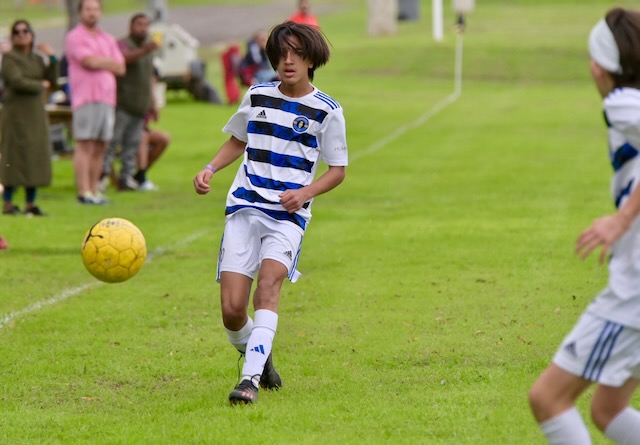
We parents traveled a bit with the kids for tournaments, ate ice creams after games, and saw each other on weekends and practice at the sidelines. The kids horsed around in hotel swimming pools or on one occasion took over an entire hotel for a game of hide and go seek. Sometimes, outside of my family, this soccer family is the most familiar and frequent visitors in our lives. As soccer parents go – we are pretty chill. We’re there to encourage our kids and have some fun. As you can see, for the first several years of Evan’s soccer career, the only photos I have of him are smiling with a medal after a tournament. Contrast that with the lovely action photos below and those in a previous post (Memphis and Mesa). Last year Evan and four boys moved to a new club based out of San Antonio and promptly doubled the number of games they played. Evan was suddenly in practice three nights a week and had to be driven to San Antonio for Saturday and Sunday games. And occasionally to games at cities like Memphis and Mesa. Thanks to a player’s mother I got some great photos of Evan in action. Soccer is life!
Till one day late last year when Evan had enough. He wasn’t having fun and I was burnt out from the driving. With bittersweet emotions, he gave up the rest of the club season. Evan still hopes to play school soccer this season and will most likely tryout in high school next year.
Jo and I didn’t expect Evan to go to college on a soccer scholarship. We just wanted him to do something fun. He went further and played harder and better than we expected. When he was on the pitch he was fully committed. One of my favorite pastimes in the last two seasons has been to see Evan defend. Someone with the ball jukes Evan or one of the other defenders and suddenly he is free and heading towards the goal with the ball. The fans of the other team start cheering him on. Evan turns around and gives chase. Our parents know what is going to happen. Evan runs like a dart. He makes himself pointed and sleek and moves faster and faster. Most of the time he catches up with the player and takes the ball away. The player looks around incredulously wondering how someone caught up to him. After the game a parent usually asks me how he trains. I tell him that he lays in bed whenever he’s not at school. What does he eat? Uh, ramen noodles. It’s the truth.
Evan had a great group of friends at soccer. He will miss seeing Adrian, Niko, Sevi, Vincent, and Roshan four or five times a week. I will miss hanging out with their parents. We had fun. Evan learned a lot from soccer. He learned being in a team, contributing to the team, winning with grace and losing with a smile. I hope some of these lessons and friendships stay with him. Me – I have my weekends back. Last weekend I camped with friends at Enchanted Rock. This weekend I went skiing with Vivian. Evan’s old team had tournaments both weekends.
Soccer is life. But life goes on, actually pretty nicely.
It is time to bid farewell to 2023 (good riddance, some might say).
Jo and I celebrated 19 years of wedded bliss—or something like that : – ). Vivian and Evan are growing faster than weeds in a summer garden. Vivian, our Renaissance teenager, dabbled in art, crocheting, caving, cooking, hanging out with friends, and devouring books like they’re going out of style. She did a pre-college summer stint at RISD with a lot of help from Uncle Alu and Aunt Michelle.
Evan, the soccer player and science buff, is gearing up for high school. When he’s not defending his goal or dissecting the secrets of the universe, he’s busy breaking the Shin Ramyun consumption record and exploring the virtual realms of computer games. Oh, and we can’t forget our animal crew—Zeus, Ouiser, and the newest addition to the family, Phineas the kitten, who has turned our home into a feline playground-nightmare.
We managed to squeeze in some family adventures, too. While Vivian was honing her creative skills at RISD, the rest of us went off to Sardinia to sail along the Costa Esmeralda in a 46-foot cat with Jen and Gegg and his two boys. It was a blast—aside from the day of the ten foot waves.
Jo and I racked up our fair share of travel miles, both separately and together. From Alaska to Barcelona, Big Bend to the Finger Lakes, Utah to Nebraska—we covered some serious ground. Evan and I ventured to Memphis and Arizona for soccer tournaments. And there were weddings in New York and Bangkok and birthday parties in Florida, Thailand, and California. We partied like it was 2023!
On a more somber note, 2023 wasn’t exactly a banner year for the world. Wars, economic turbulence, and environmental missteps* took their toll. We’re crossing our fingers that 2024 brings a much-needed dose of peace. Ah, but there is the Trump dilemma—will he win the elections or rise by insurrection? One way or another we’ll know before I write the 2024 Christmas letter.
As we turn the page on 2023, we’re sending our warmest wishes for a joyous and peaceful new year. May it be filled with love, laughter, and peace.
-chatGPT and others (99% of this post was generated by prompts to AI tools)
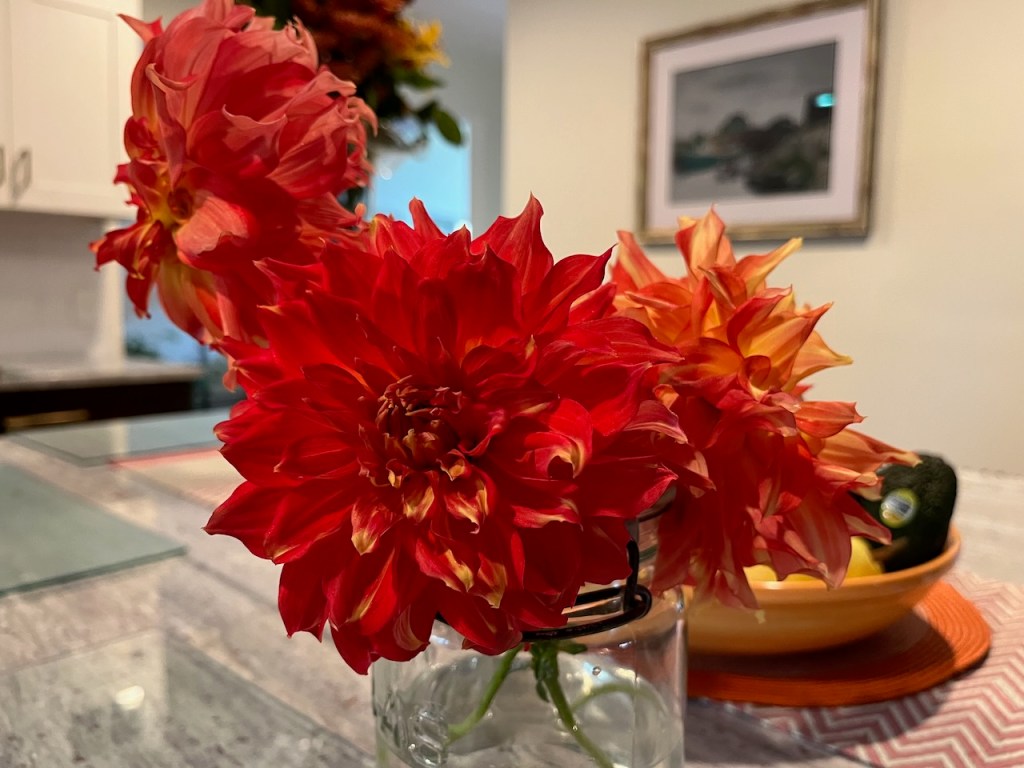
While I was on the east coast with Vivian back in Fall, Jo and I reached a milestone of being married for 19 years, a nice round number in base 19 I suppose. Jo and Evan were back in Austin. I called a good florist in Austin who was willing to go through a bouquet flower by flower. I replicated the colors of our wedding centerpieces and made sure that there were no lilies. This is the photo they sent when they dropped it off reluctantly at our doorstop (“Sir, it’s 76 degrees and sunny in Austin and the flowers shouldn’t be outside for long”).
It has been a good 19 years. For the first two, Jo and I travelled a lot. The next 17 were keeping the kids alive. Somewhere in there we spent two different years living or traveling abroad. My dad lived with us in Austin for one year. For the last year we have been involved in a back-yard redo. We’ve made it through that and are still mostly nice to one other. Two years ago I got back to working for the first time in our marriage and Jo hasn’t yet flipped. But she 100% oversaw Evan’s high school application process, is the adult in the room for Vivian’s college apps, keeps the fridge and pantry stocked for their lunches and snacks, and plans all the travel. I occasionally count ‘em to make sure we still have two kids.
When we met 19 years ago I changed the oil in my car and mowed the lawn. I couldn’t tell you where the oil filter is or has been in the last half a dozen cars I’ve owned. Things change. But as I finish this post that I started six months ago and watch Jo and Vivian and Evan discuss playlists over an outdoor lunch in El Valle where we are for spring break, I do know a few things that thankfully haven’t changed.
Here’s to the next 19, sweetheart. Happy belated anniversary : – )
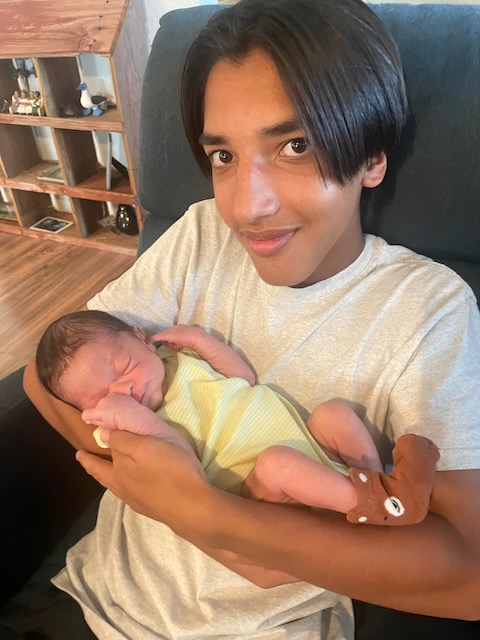
Last month we welcomed the newest member of the fam, the first of the next generation among all six Clark and Chatterjee siblings, Quinn and Noah’s lovely baby B. He is the chillest kid ever and he even snuggled up to my belly. The last baby in the family was 13 years ago. As you can imagine, the ladies are bonkers over the handsome fellow. Carol is officially a great grand mama and Jo is a great aunt. Nicolle and Michelle are very proud grandmas. Vivian and Evan had fun meeting their second cousin, and in approximate Hindi/Bengali-to-English family naming schemes, their nephew, B.
Over the last couple of months the kids and I have travelled one kid at a time a few times. Vivian and my trip to Brooklyn was sandwiched between two trips with Evan for soccer, the first to Memphis, and the second to Mesa. Jo and I aren’t particularly rabid soccer parents. Evan isn’t a bad soccer player. He tolerates playing the game. But he has no interest in soccer outside his play – he would not be able to pick Messi in a lineup. Till this year we and Evan’s friends’ parents had opted for a local league. Most games were in Austin with occasional matches in San Antonio and tournaments in Houston. For completely accidental reasons that I am to blame for, this year Evan and a few of his friends have ended up in a team that plays in the local league in San Antonio and a regional travel league. Which is why we are on our way to Mesa. I am secretly hoping the boys bomb so we don’t have to travel to California for the nationals next. Odds are in my favor. This is a new team and needs to play together for a bit to be less sucky. They are beating every team in the local league and getting their asses handed to them in the travel league. A teammate’s mother has taken it upon herself to be the team photographer. She is pretty good. Thanks to her, here are some of Evan’s antics from the field.
Mesa was a blast. Not because they won. In fact they lost every game. But we were there to have a good time. Some of these kids were together at Magellan years ago. The parents meet at the sidelines often twice a weekend and three times at practice so we know each other well. Evan and I had gone to Milan last year with one of these boys and his dad.
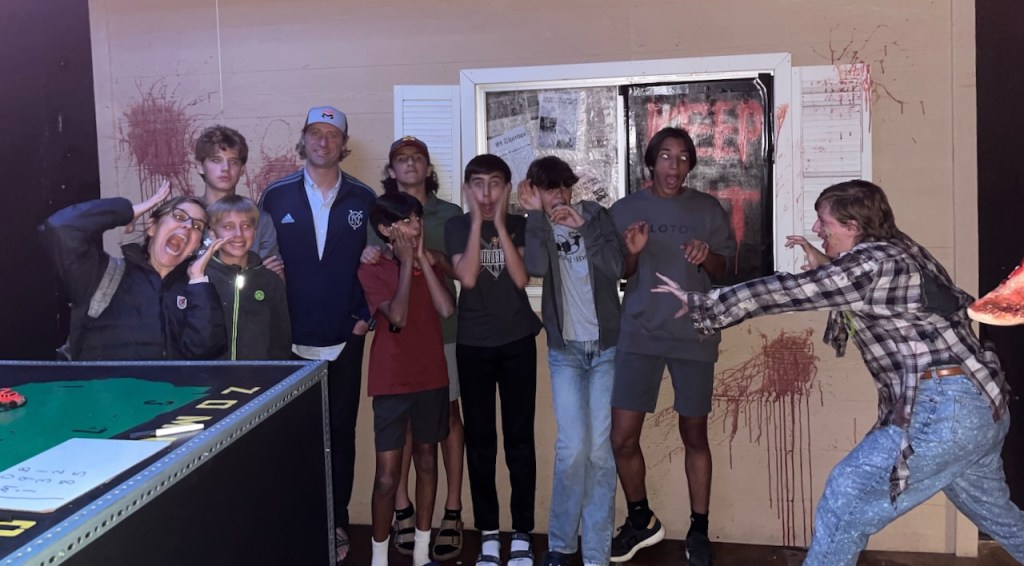
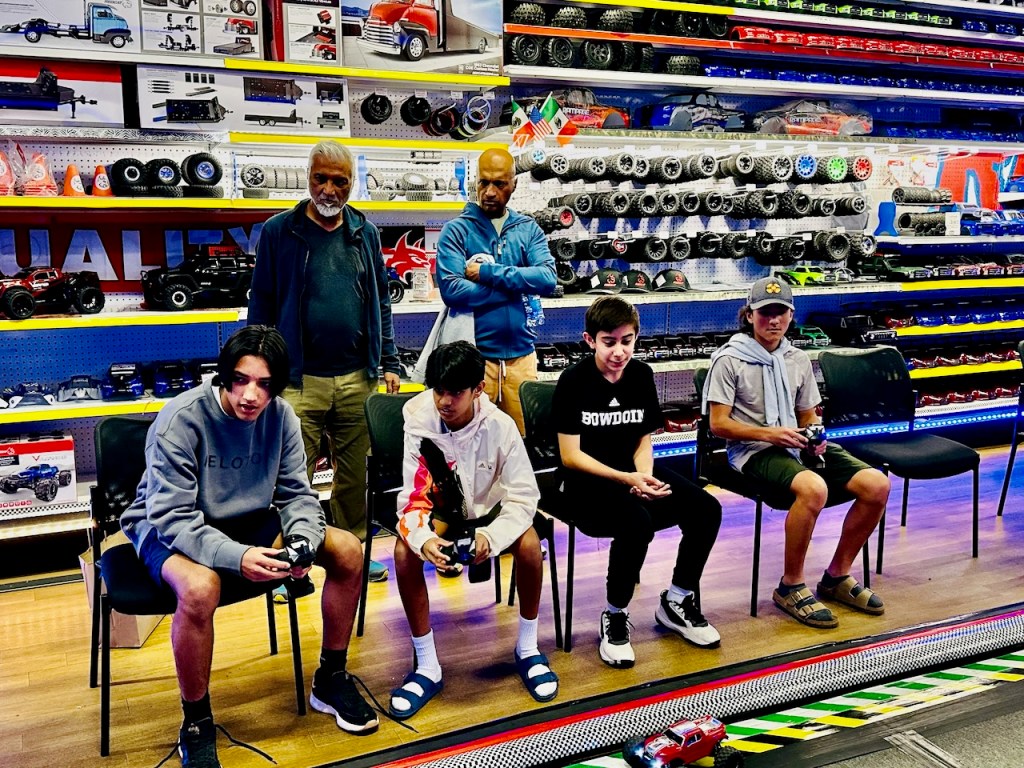
One night the boys celebrated a birthday with a zombie escape room experience. Then we went out for a super cheesy fun dinner at Beni Hana. Yes, they still do the volcano and the Japanese egg roll. We saw The Marvels in Imax and then cruised a retro mall (I don’t think they knew it was retro) till closing time. The kids raced RC cars and bought retro (by design) clothing from an Adidas store.
The Phoenix area is a sprawl in the desert. Highways and malls and big box stores and single family developments stretch in every direction. I managed to get out one morning and hike in the South Mountain Preserve. But we mostly drove back and forth to the tournament facilities and ate and drank and chatted. I dare say Evan enjoyed himself.
I’m sitting in the cafe car of Amtrak NE Regional 82 making its way from New York to Providence. Earlier this morning after a fabulous brunch in Brooklyn (the American breakfast came with a bowl of daal- that’s Brooklyn), I gave Vivian a kiss on the top of her head and told her I’d see her in three days. I took a couple of subways to the new Moynihan Train Hall in mid-town Manhattan and hopped on my Amtrak. Now I am watching the city scape slip by in the distance. The bustle of New York is soon replaced by the coastline of Connecticut. Fall colors on one side. Marshes, small harbors, occasional views of the Atlantic. At this moment the train is rumbling over an ancient bridge that was built by people on the Mayflower.
I spent the next three days with Alu and Michelle at their lovely home, visiting the beautiful Rhode Island shore, and eating fresh local seafood. It went by quickly. On Monday Alu and I sat upstairs and downstairs nursing our zoom calls. Alu and Michelle dropped me off at Kingston station and I reversed my steps back to Brooklyn in time for supper with Leela and Vivian at the neighborhood taqueria (very good for so far from the border) set between a Colombian piqueteadero and an Ecuadorian coffee shop. The sidewalks were full and Leela seemed to know everyone. Except the fentanyl users sitting on dairy crates across from Wyckoff Heights medical center – the literal ground zero for Covid in the US.
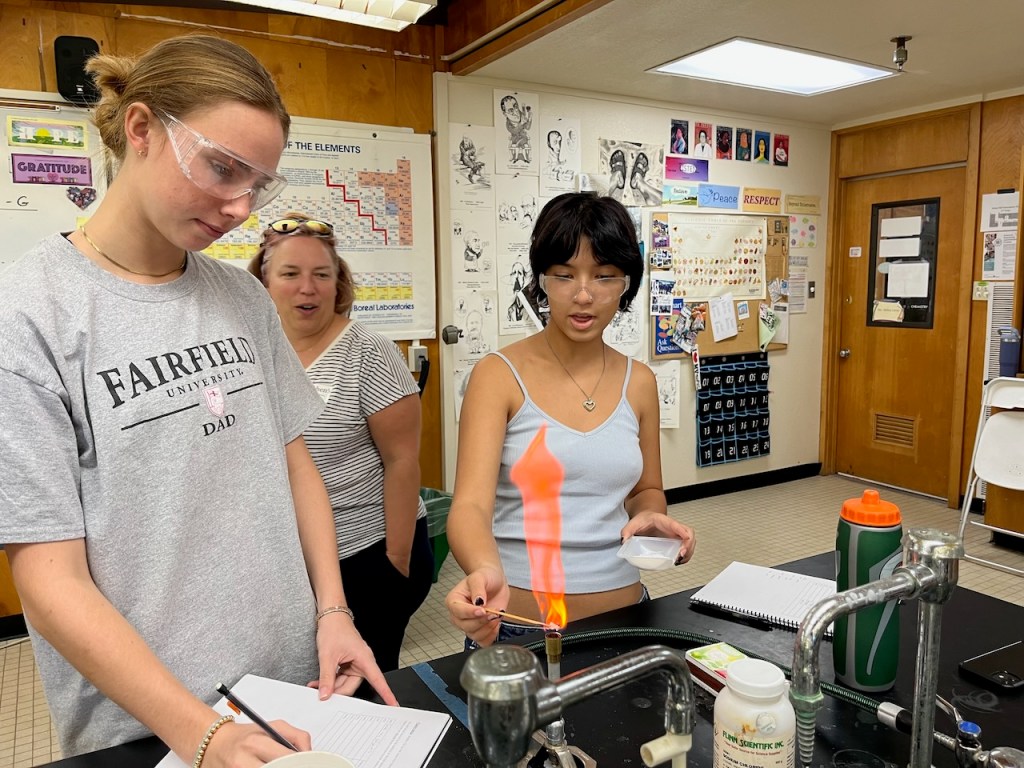
The day before Vivian and I left for Brooklyn, JoEllen and I were at St. Stephen’s for Parents Day. Her English teacher did a close reading of a couple of pages of the Great Gatsby, extracting insights from students like I never got from reading Norah Burke’s Jungle Picture under Ms. Christian’s watchful eye at HPS. In Physics, the students paired up to do an experiment to determine the coefficient to static friction (we probably did this in a couple of grades before in India). For history, the students discussed the claim “Economic crises make fascist government more likely” in the lead up to WW II but a highly relevant topic today. In the math class, the teacher rolled 60 six-sided dice and removed all the sixes. He asked student to formulate and solve an equation for how many tries it would take on average to have just one dice left. The students joined in groups of 3 or 4 and searched for an equation and solved it (in this case, solve for n where 60 x (5/6)n = 1). The teacher kept up with the dice and plotted his results after each try. An overhead camera showed his experiments next to an online graph of his results. It took him 23 tries. The theoretical average is between 21 and 22, which the students computed about the time the teacher was done. Not bad. Then in Chemistry they placed samples of salts in a Bunsen flame and recorded the color of the flame. They were given Planck’s equation and his constant and the approximate wavelength of different colors of light. Vivian and her friend observed strontium chloride’s flame and calculated the energy of a single photon of the brilliant red light emitted to be equal to 2.97 x 10⁻¹⁹ J. Then they had to explain the basis behind Planck’s quanta and the experiment. I was duly impressed. We were doing far more complex experiments in Mr. John Mathai’s chemistry lab in our 11th grade. But we were rarely tying it back to advanced theory like this.
The atmosphere was relaxed. The kids had all handed in big projects the evening before. Parent’s day is a compressed half a day class schedule followed by a long weekend. Students and staff would be back on campus on Tuesday. Everyone was exchanging holiday and travel plans. When Vivian was asked what she was doing, she said “I’m going to visit my cousin in New York”. Which caused my left eyebrow to rise by a millimeter but I didn’t question it. We skipped school lunch because we needed to pack and get to the airport. On the way to the airport I asked Vivian about the cousin bit. She said – “ok, next time you can explain that I am going to visit my dad’s childhood friend’s daughter”. Jo and I agreed that “cousin” was a very good substitute.
So next morning when we met Praveen and Leela for breakfast in Brooklyn at the place with the daal, I told them how Vivian had made Leela her cousin for purposes of explaining her travel. Leela said “Oh – I’ve been telling my friends for the last week that my cousin is coming to visit”.
Time seems to be flying by. Jo has been in Nebraska twice in the last two weeks and has probably crossed back over the Red River sometime this afternoon. Vivian is enjoying her first weekend alone at home. I’m sitting at Memphis airport watching Fedex planes take-off every few minutes (about 400 planes loaded with overnight packages go through FedEx’s Memphis every day). Evan is sitting across from me, computer on his lap. He’s supposed to be working on his Mandarin homework but he could be playing video games. He is here for soccer and had two hard games with zero subs yesterday and today, so he claims he’s a bit tired. Earlier in the morning we had a nice brunch at Paulette’s. From our table outside (74 degrees) we see the giant cottonwoods on this bank of the Mississippi and bits of the double arches of the I-40 bridge to Arkansas. Large swaths of sandy river bank are visible on both sides of the meandering wide river.
On Friday night Vivian had three friends over and I dropped them off and picked them up from the Arctic Monkeys concert at the Moody Center (dad/climate change joke that made them all groan “so, y’all are off to see the tropic monkeys?). They seemed to have had a great time without involving alcohol or other substances, which is good, especially given that she is going to have free reign of a home and car for the next two days.
We get back home on Sunday night and everybody is back together again. Ouiser is the most excited by this. The kids have whiled away another perfectly good weekend and get down to finishing up homework around the dining table which is rare. They have entered a new phase in their relationship. Vivian now sees Evan as more grown up. They have an easy chit chat about teen fashions and language and chemistry experiments. Vivian occasionally asks Evan for help with a word in Spanish. Or a question about nuclear waste. He is happy to prove that he’s up to snuff. Jo grabs her book and heads to bed after a long 12 hour drive. I drag my computer upstairs to stare at data. “Don’t stay up too late.” “And turnt out the lights”.
Evan’s school has been fortunate enough to have excellent science teachers. Recently he was assigned a paper and asked to understand it, and then present the information to the class. The paper is at https://pubs.usgs.gov/fs/fs-0095-00/fs-0095-00.pdf and is titled “The Sun and Climate” and is five pages of closely formatted text with several graphs. The required 25-35 references follow on page 6. The article, unlike an article in a scientific journal, does not list any authors. So I will credit Walter E. Dean of the USGS whose name appears at the end as a contact for more information.
I didn’t set my eyes on a scientific paper till I was in graduate school. Yes – not even undergraduate college. We were given study materials, typically in textbooks, and if you mastered what was between those covers, you were golden. I am excited the this is what is expected of Evan at the beginning of 8th grade. So I took more interest in this than I normally would. Evan created his set of notes. It took him hours and hours. The text is written in a form that makes it harder to understand than what an 8th grader is used to (“The most prominent cycle in the Castile is a salinity cycle with an average period of about 2,500 years in which the cycle begins, in the extreme, as a laminated limestone with thin calcite and anhydrite laminae. The anhydrite laminae then become thicker, and the cycle ends, in the extreme, with anhydrite and halite varves.”). I asked Evan to email me his notes from the paper.
In seemingly unrelated news, yesterday Vivian sent me a text from school saying that her teacher asked her to download an app called DigiExam on to her personal laptop. She wanted to know if she could wait and come home and chat with me about it. A quick look at their website and reviews shows that DigiExam is a Swedish app that helps teachers and institutions administer exams with less or no supervision. Your laptop on which you take the exam is your proctor. It takes periodic snapshots of your screen. It turns on your laptop camera and records you (and anything else in it’s view). It analyses your eye movements to see if you perhaps have another source of content close by like another computer screen that you are consulting frequently. It does not allow other tabs to be opened in your browser and records what tabs you do try to open. Same with other apps on your computer desktop. The idea is for instance to discourage you from opening another tab to ChapGPT and copying and pasting your questions and the AI’s responses. Very good. Can it be turned on and off remotely, and who will be able to do that? Or even worse, is it on all the time? Here’s a question I expect at a future congressional hearing once DigiExam becomes required everywhere, from a concerned congressman: “If my daughter sits in her underwear and takes an English exam at home, is that camera recording her? Who has access to that recording and for how long? Is there a room full of low-paid remote nannies somewhere offshore sifting through videos of kids that the software flagged for one reason or another?”
Why did Vivian’s school take the draconian step of ask students to download and install surveillance software on their personal computers (which she didn’t)? The rise of AI is causing panic. While policy makers ask abstract but important questions (“is critical writing worth teaching any more?”, “is the college essay dead?”), the poor English teacher does still need to grade that pile of 11th grade homeworks comparing Whitman to Dickinson. If half the class used ChatGPT it wouldn’t be fair.
Back to Evan. I sat him down this morning and opened a tab to ChatGPT.
ME: You are a science journalist
AI:Certainly! I can act as a science journalist and provide you with information on various scientific topics or write articles on specific subjects of interest. Feel free to ask me any questions or provide a topic you’d like me to cover, and I’ll do my best to provide you with accurate and engaging information.
ME:Please read the following text and categorize it according to the school english grade level that it would be appropriate for. The text is:
[I copied and pasted the first two paragraphs of the USGS paper]
Many geologic records of climatic and environmental change based on various proxy variables exhibit distinct cyclicities that have been attributed to extraterrestrial forcing. The best known of these are the changes in Earth’s orbital geometry called Milankovitch Cycles, with periodicities of tens to hundreds of thousands of years. However, many cycles seem to have subMilankovitch periodicities, commonly on decadal and centennial scales, similar to those of known solar cycles. A direct connection between solar irradiance (solar constant) and weather and climate has been suggested for more than 100 years but generally rejected by most scientists, who assume that the effect of solar variations would be small. However, recent satellite radiometer measurements and modeling studies indicate that small changes in total solar irradiance could produce global temperature changes of the magnitude suggested for climatic events such as the Little Ice Age (A.D. 1550–1700). The best known and documented solar cycle is the 11-year sunspot cycle (Schwabe Cycle; fig. 1), during which the number of dark blotches (sunspots) on the sun’s surface increases from a minimum to a maximum then back to a minimum over a period of about 11 years. The origin of sunspots is not fully understood, but thanks to satellites such as the Solar and Heliospheric Observatory (SOHO), scientists are learning rapidly. What is known is that during the period from A.D. 1645 to 1715 very few sunspots were observed. This period is called the Maunder Minimum (fig. 1) after E.W. Maunder, superintendent of the Solar Department of the Greenwich Observatory in England, who continued the observations of the German astronomer, Gustav Spörer (Eddy, 1976). Spörer noted a dearth of sunspots during a 70-year period beginning about A.D. 1645, and during an earlier 90-year period beginning about A.D. 1460 (now called the Spörer Minimum). An early association between sunspots and terrestrial phenomena was the observation that the number and intensity of aurora borealis sightings were greatest during sunspot maxima when the sun was most active (active sun), and lowest during sunspot minima (quiet sun). Another terrestrial observation was that the Maunder Minimum coincided with the coldest part of the Little Ice Age.
AI:The text you provided contains a high level of scientific terminology and concepts related to geology, climatology, and solar phenomena. It would be most appropriate for students at the high school level or above, typically for students in grades 11 and 12 who have a strong interest in science or are studying advanced science courses. This text would also be suitable for college-level students studying geology, climatology, or astronomy.
The text discusses topics such as Milankovitch Cycles, solar irradiance, sunspot cycles, and their potential effects on climate. It assumes a certain level of prior knowledge in these fields, making it less accessible to younger students or those without a strong science background.
Evan smiled when he read this part. Then I asked the AI to produce the kinds of notes that Evan had be asked to.
ME:Read the following text and extract as brief bullet points the most important concepts discussed. Please do not add new information not contained in the text. The text is: [followed by the same first two paragraphs from the USGS paper]
AI:Important concepts discussed in the text:
Geologic records show cyclic climatic and environmental changes attributed to extraterrestrial forces.
Milankovitch Cycles are well-known Earth’s orbital geometry changes with long periodicities.
Some cycles exhibit shorter periodicities, resembling solar cycles.
There’s a historical debate about the connection between solar irradiance and weather/climate.
Recent measurements suggest small solar irradiance changes can impact global temperatures.
The 11-year sunspot cycle is the best-known solar cycle, with sunspots on the sun’s surface.
The Maunder Minimum was a period with very few sunspots from A.D. 1645 to 1715.
Sunspots were studied by scientists like Gustav Spörer and E.W. Maunder.
Aurora borealis sightings were linked to sunspot activity.
The Maunder Minimum coincided with the coldest part of the Little Ice Age.
As a comparison, here are the notes from Evan’s brain for the same first two paragraphs:
The orbital geometry changes over time and is called the Milankovitch cycles
Periodicities of tens to hundreds of thousands of years
There are sub-Milankovitch cycles usually on the scale of centuries and decades
Similar to known solar cycles
A direct connection between solar irradiance, climate, and weather has been suggested for more than 100 years but has been rejected by many scientists who assume the effects of solar variations would be small
Recent satellite radiometer measurements have indicated that small changes in the solar irradiance could cause changes on the scale of the Little Ice Age (A.D. 1550-1700)
Best known and documented solar cycle was the 11 year sunspot cycle (Schwab Cycle, fig.1)
Number of sunspots increase from minimum to maximum to minimum again over an 11 year period
The origin of sunspots is not fully understood
We are learning rapidly because of new solar satellites (such as SOHO)
During 1645-1715 the amount of sunspots was very low
This period is called the Maunder period after E.W. Maunder
E.W. maunder carried on the observations of German astronomer, Gustav Spörer
Gustav Spörer noted a dearth of sunspots over a 70 year period beginning a about A.D. 1645 and a 90 year period from A.D. 1460
One of the first connections they noticed was that the number and intensity of aurora borealis were greatest during the sunspot maxima
The sunspot minima coincided with the coldest part of the Little Ice Age
I was duly impressed by both Chat GPT and Evan (I had watched Evan do a large part of this work so I knew he did it the hard way). I don’t think DigiExam is the answer, though that won’t stop many schools from jumping on that bandwagon. But if I were a teacher or a parent (one of which I am) I’d be pretty concerned about the effects of AI on our kids’ education (and their lives). By the way, here’s the rest of Evan’s notes about that paper:
Recent studies have shown that the production of radio production (carbon 14) is related to solar activities
Radiocarbon is produced by the bombardment of nitrogen 14 in the atmosphere by neutrons from outer space, which are called cosmic rays
An increase in solar activity (more sunspots) is accompanied by an increase in the “solar wind,” which is an outflow of ionized particles, mostly protons and electrons, from the sun
Carbon 14 concentration in the atmosphere is lower during the sunspot maxima and higher during the sunspot minima
Carbon 14 concentration in the atmosphere is recorded in the tree
A relationship between carbon 14 and age can be made
Expressed as 𝚫C14
Represents the radiocarbon levels compared to the levels in the 19th century
They have reconstructed the 𝚫C14 for the past 11,000 years using decedal and bi-decedal wood samples (fig. 2A)
Shows that the C14 production was higher during the mid-holocene era (approx. 7,000 years ago)
Then steadily decreased until approx. 1,000 years ago
When you remove the long term trend you can see that there are cycles with periods of about 2,000 years
Called the Hallstadtzeit cycle (fig. 2B)
Looking at the last 1,000 years you can see that the C14 production was higher during the Maunder and Sporer minima
There were also peaks at A.D. 1300 and 1050 which have been named the Wolf and Oort minima
These cycles in C14 production last and, by relation solar activity, have periods of about 200 years
The sunspot minima precede the C14 maxima by about 20-60 years wich is how long it takes for the effect of solar activity on 14C production to cycle through the atmosphere-ocean system
When they perform a spectral analysis on the C14 cycle there are other peaks in addition to the 2,000 and 200 years (fig. 4)
Some prominent ones are at 400 and 88 year intervals
88 year is called the gleisberg cycle and is thought to be the result of amplitude modulation of the Schwabe cycle
A 22 year periodicity called the “double sunspot” or Hale cycle may also be because of amplitude modulation of the Schwabe cycle
Satellite radiometry over the last 20 years has shown the the total solar irradiance varies 0.1 percent during the 11-year cycle
A change in total solar irradiance over one 11-year corresponds to about a 0.5 – 1.0 C change in the global tropospheric temperature
Total irradiance is highest during the sunspot maxima and lowest during the sunspot minima
May seem counterintuitive because the sunspots would make the sun dimmer but the bright area surrounding a sunspot (faculae) cause the sun to brighten at peak activity
It is estimated that during the Maunder Minimum, total solar irradiance was reduced by 0.2 percent relative to a present quiet sun but total UV radiation was reduced by 1.04 percent
Important because UV radiation modulates the ozone production
Ozone production regulates the middle and upper atmosphere
Crowly and Kim estimate that a total warming of 0.8-0.9ºC occurred between the minimum of sunspot activity during the Maunder Minimum and the maximum sunspot activity during the mid-20th century
According to Lean and others the surface temperature of the earth has increased 0.55 C since 1860
About half of this could be due to the solar warming since the Maunder minimum
However 0.36 of the 0.55 has happened since 1970 and only 0.11 of that can be accounted for by solar forcing
The rest could be due to greenhouse warming or some other cause
The period of low 14C production between about A.D. 1100 and 1250 is called the Medieval Maximum of sunspot activity (fig. 3)
Coincides in time with a warm interval called the Medieval Warm Period
The general solar activity was low during the period of 1300-1900
Two distinct lows, the Sporer and Maunder minima
Only in the 20th century has the solar activity increased to the levels of during the medieval maximum
There has been an observed connection between solar activity, geomagnetic storms, and the climate
strong solar-geomagnetic disturbances in the troposphere during winter were often followed within a few days by a deepening of subpolar low-pressure systems over the North Pacific
A weaker magnetic field lets more cosmic easy in which results in more C14
The cosmic ray reflux also affects cloud microphysical processes
Dust records show centennial-scale variations of increased dustiness during periods of reduced solar activity
Cycles of 200 years in the dust records match with the Suess cycles in radiocarbon
The mid-Holocene may have been a time of increased eolian activity for much of North America (particularly in the Great Plains)
A varve-calibrated eolian dust record for the last 1,500 years in Elk Lake shows distinct cycles with dominant periodicities of 400 and 84 years (fig. 6)
The Elk lake record is one of many that show cycles that match up with solar cycles
The dust record in the GISP2 ice core exhibit shows distinct cycles of 11, 22, 90, and 200 years, believed to be associated with the Schwabe, Hale, Gleissberg, and Suess solar cycles, respectively
Suess solar cycles, respectively (Ram and others, 1997; Ram and Stolz, 1999). The physical connection between solar activity and dust is postulated to be variations in precipitation patterns in the Greenland dust-source areas caused by changes in cloud cover and cloud microphysics, which in turn are affected by the cosmic-ray flux
The varve thickness record shows cycles with an average period of about 20 years superimposed on longer cycles with an average period of about 200 years. Could these be related to “double sunspot ” (Hale) cycles and “Suess wiggles”? In fact, could the dominant 2,500-year cycle in the Castile Formation be related to the dominant 2,000-year cycle in the 14C spectrum (Hallstadtzeit Cycle
A modern example is titanium concentration in sediment samples from the gulf of california
Have a striking cycle over the last 200 years with about 10 year periods
The average titanium concentration in the record illustrated for core BC6 in figure 10 (0.35 percent) is more than twice the average titanium concentration (0.16 percent) in sediments deposited over the same time interval recovered in core BC50 (fig. 9)
These cycles match up with the 10-12 year cycles of precipitation observed in tree rings
Could variations in rainfall and river flow on the west slope of the Sierra Madre somehow be connected with the solar sunspot cycle as are changes in precipitation postulated for dust sources in Greenland ice cores?
It can be said that if you look hard enough anything can relate to the solar cycles
The challenge to geologists and atmospheric scientists is to test these correlations with reasonable models of how solar cycles could affect the atmosphere and geologic processes at the surface of the Earth.
I like to take pictures of the books my kids return home with. Here are Evan telling Jo and Vivian what he selected from the bookstore for his birthday, and a picture of the books, followed by what Vivian picked up during a trip to Book People earlier this week. There appears to be little overlap in their reading lists but in fact they have read a lot of the same YA fiction. Someday I’ll stack up my last few books and add here. And Jo, who seems to be focused on reading about college these days.
























 Notes from Dad