(This post is out of chronological order. I should have posted it around Aug 20th). After ten amazing days of safari in the Serengeti we finally drove up to the Kogatende airstrip on the edge of the Mara river after breakfast for our airplane trip back to Arusha.
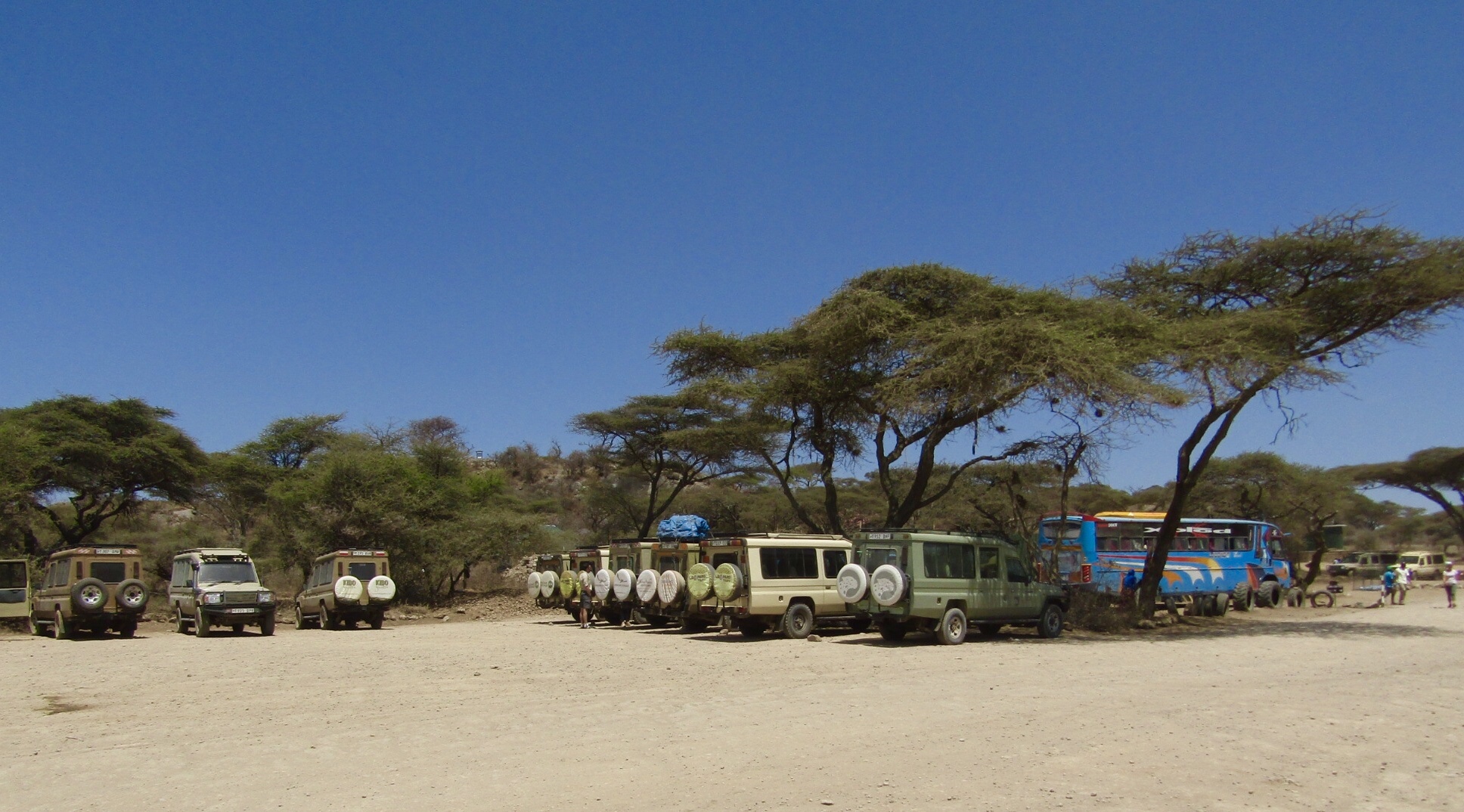
The “departure lounge” of the airstrip is a melee of 4x4s. Here’s what it looks like.
An airplane taking off had to abort because some wildebeest wandered on to the airstrip. Two of the 4x4s had to drive down the dirt runway to shoo them off. There isn’t a control tower or any thing else besides the dirt strip and a guy with a clipboard. Just the basics.
I got to sit in the copilot’s seat. The pilot seemed only slightly older than Vivian. Unfortunately I can’t fly. Fortunately my expertise wasn’t needed.
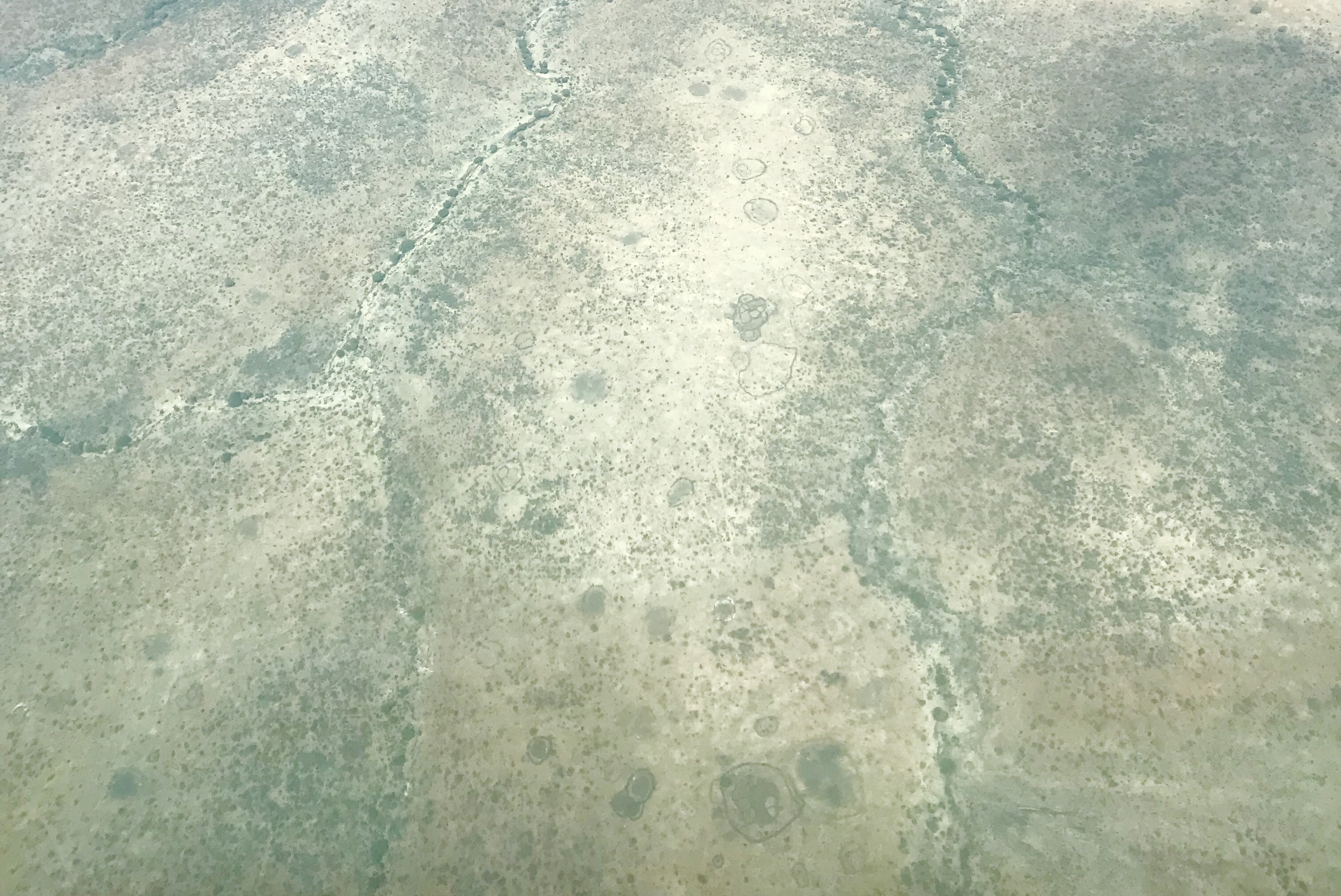
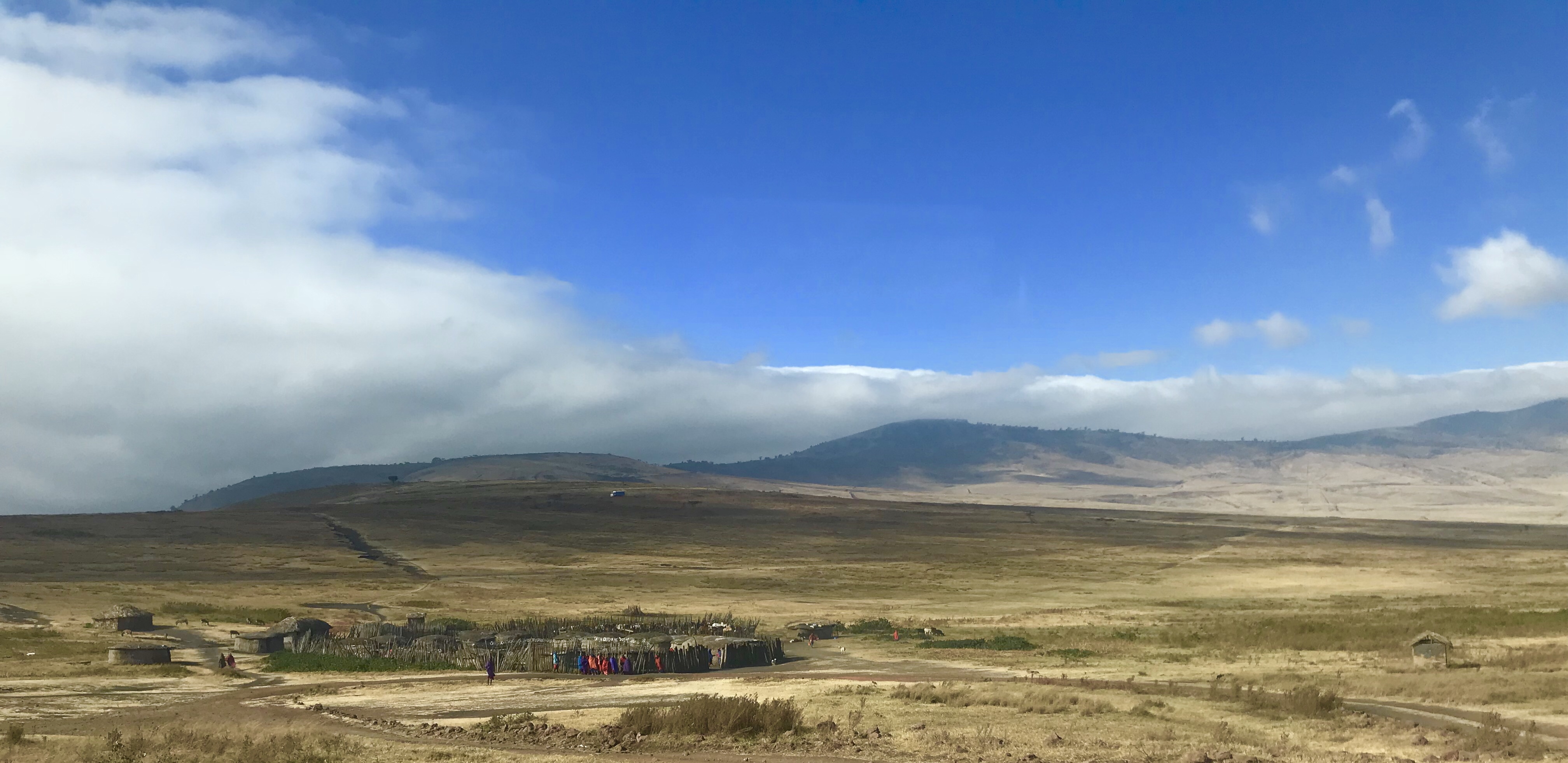
We flew over the Serengeti and then portions of the Ngorongoro Conservation Area. From about 8,000 feet up you can see the rounded fences made up of dried acacia branches that the Maasai use to corral their sheep and cattle. The land looks barren and moon-like from up here. But it’s teaming with life.
Here’s us landing at Arusha. The view from the cockpit (insert Bevis and Butthead style laughter heehee hee).
Tomorrow we are going to visit a school in Mathare – one of the largest “slums” in Nairobi with a population of over 600,000. The kids that attend this school are poor. Many have not been able to pay their tuition for years. The founder of the school, Vincent Enos, is a young man who had trouble going to school and college himself because he didn’t have money to pay his tuition, and is now giving back. The school year has just started – today is the first day.
This evening I am working with Evan so that he is prepared to say a few things about himself and ask the 4th graders at the school some questions if the opportunity to do so presents itself. If he isn’t prepared in advance, the chances of him ad libbing are close to zero. I really want him to have some interaction with the students at the school. Opportunities like this are rare. When Evan doesn’t make much progress by himself I decide it’s time to get more involved. I ask him to write down 5 points about himself, his school, and his life, so he can speak for about one minute. He really doesn’t want to. There are tears. It takes us an hour. I am impatient. He is miserable. I am rethinking the wisdom of dragging two ungrateful privileged turds around the world.
Next morning we both feel better. The family grabs a quick breakfast and we Uber to a cafe at a posh development next to Mathare where we meet Vincent. He drives us to the school in Mathare. It looks like a hole in the wall. We walk into the first class which is probably 10 x 10 feet and has more than 15 kids and two teachers. These are the littlest ones and are in pre-k. The kids burst into a song about welcoming us to their school. We look down at their desks and see tiny letters made from play dough. This is how they learn their letters. The teacher tells us that by the end of the year the kids will be able to read. The medium of instruction is English. They kids also learn Swahili at school. And they speak their mother tongue at home. They will be tri-lingual, like most Kenyans we meet, with almost first language proficiency in three languages. When it’s time to say thank you and move on to the next class, I shake hands with this beautiful bright faced student in front of me. Then we quickly realize that all four of us are going to have to shake hands with every kid in class : – ). I worry that Jo is going to never leave. Everyone is shyly smiling and electricity is passing around the room.
Vivian talks to the 7th graders a bit. She shows them how she draws amine faces and eyes. The class only has eight kids. Two say they want to be doctors. Two pilots. One engineer. One football player. They are quiet and shy.
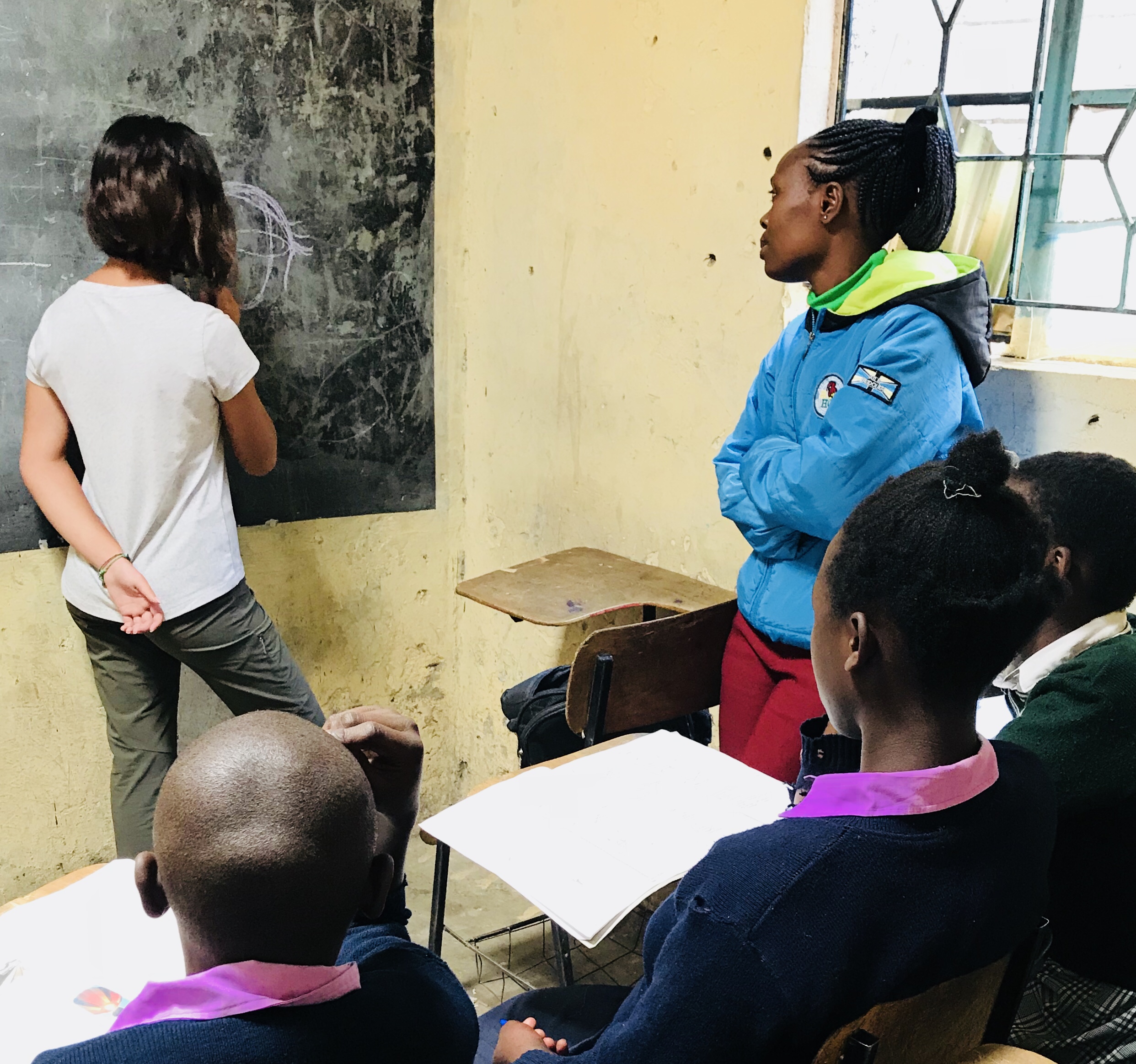
Vincent shows me the bathrooms. They are clean but I have to try hard to not gag from the smell of the sewers. Infrastructure and slums don’t go together. Across from the bathrooms is one long room that houses four classes next to each other. Blackboard are painted on to the walls. There are four teachers. We spend quite a bit of time here. Vivian and Jo chat with the kids and the teachers.
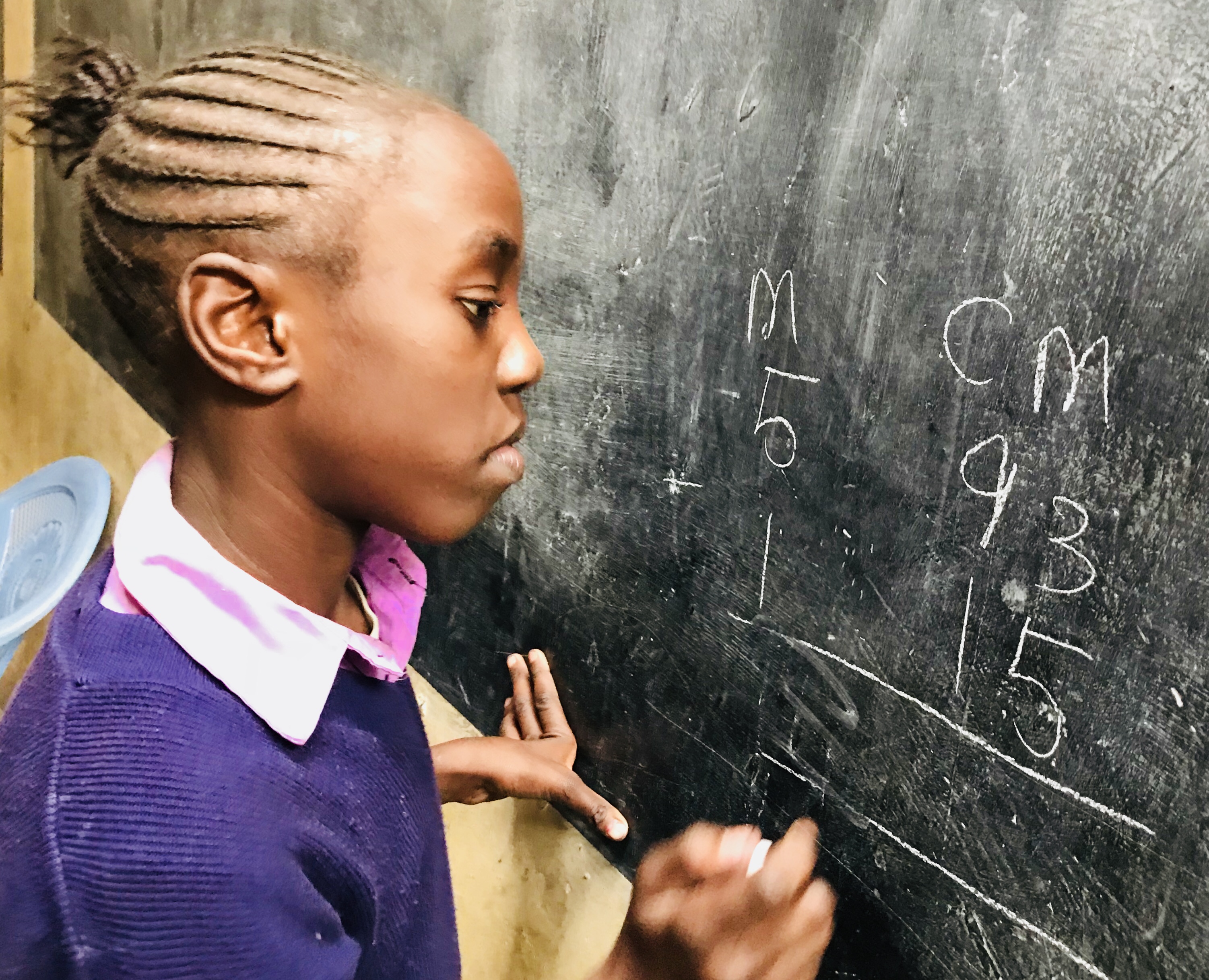
I pick up a text book and ask the student in the front row is she’d come up to the blackboard and solve the problem on the open page in her textbook. She is very serious and with a little help gets the problem right. The teacher, Mr. Edwin, gentle, smiling, tall and bony is his threadbare suit jacket, reminds me that it is only the second day of the school year. Later we find out that Edwin is related to Obama.
Vivian shows the kids some of her sketches on an iPhone. They are intrigued. I am amazed by how easily Vivian gets into discussions with them – even when she’s having to lead and do most of the talking. She discusses school and volleyball and art with the kids. She asks if they have hobbies. One boy about her age gets up from the back and walks over to the blackboard. He’s got a grin on his face. He hikes up his torn shorts and does something between a dance and a strut. Everyone chuckles.
Jo and I occasionally try to get Evan involved. He loosens up and chats a bit here and there. We coax him into saying a few words in Spanish and Mandarin. We discuss what everyone’s favorite subject is (a reliable ice-breaker). Evan says his is recess. Not everyone understand. Then Evan adds that his second favorite subject is lunch. The class erupts into laughter. Jo asks him if he wants to show them how he does the floss. He does a quick demo. Then another kid walks up beside him and they do the floss together.
And just like that it could be Evan and a friend at Magellan back in Austin. Thousands of miles apart in every way, yet so similar in an unguarded moment.
Later we go chat with the staff. They tell us many students live with one adult, often an older sibling. A lot of them come to the school hungry and rely on the school lunch for their one meal of the day. They can’t afford text books. The principal explains that when you are reading from a passage, it’s hard when there are only two textbooks in the classroom. He says that there are very limited options for showing the kids experiments and doing any practical learning. I think back at Magellan and how Evan and his classmates do a couple of hands-on project for every unit of inquiry. But he says that kids do well after they graduate. The teachers help to get the students placed at high schools and find funds for their continuing tuition. The biggest challenge? Money. This week there isn’t enough for the all important lunch. The school is behind on its payroll and teachers haven’t got paid. “At the end of the day we have to go back to our homes and our families.” adds a teacher. I find out that the school has about 280 students from pre-k to 8th grade. Its annual budget is about $75,000.
Later that day we meet some Kenyan entrepreneurs. When they hear about our morning adventures they are curious to know what Vivian and Evan thought about the school. Vivian says that she was impressed about how badly the students want to learn. Back home we have everything and we aren’t really serious about school or learning, she adds. Evan nods in agreement. That realization may be the most interesting and important thing our kids have deduced during our travels so far.
I don’t often use god quotes, being an atheist and all, but here is a fitting one from Karen Blixen, author of “Out of Africa”. God made the world round so we would never be able to see too far down the road.
We’ve been on the road for month and it is already further down then I had been able to see from Austin or even last night.
One day around 6 days into the safari I asked the kids to do something for me. It was pretty easy and it required one of them to walk back to our tent about 200 yards away from the lounge tent. They both refused. I explained there would be consequences. Still firm “no’s”. So I took their iPads and kindles away for 3 days. I thought they would be despondent and mad and depressed the whole time. I was willing to put up with that.
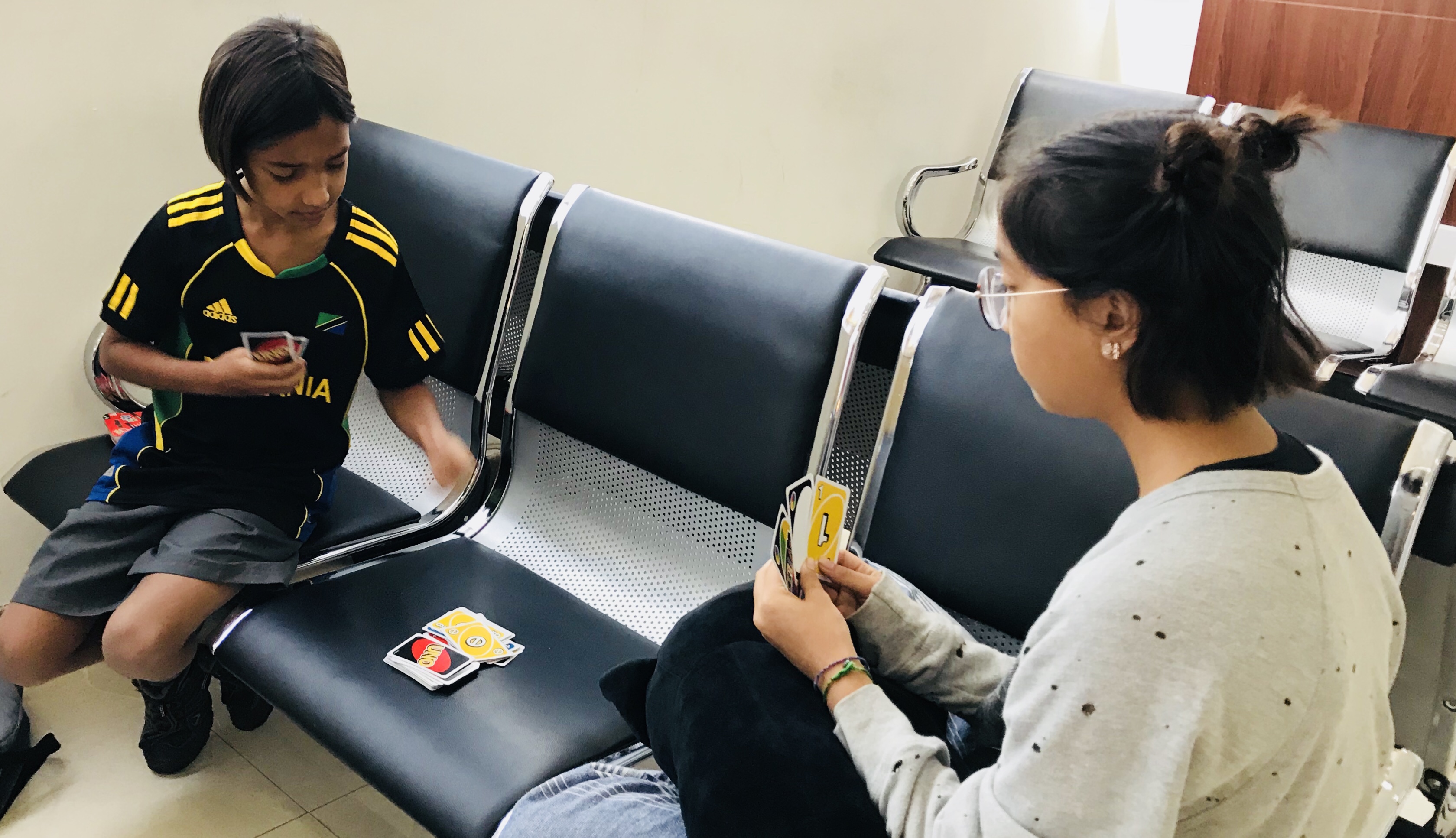
They were upset for 5 minutes. Then I heard laughter from the tent. Peals of laughter. This continued for the next several days. They horsed around with each other. They played endless hours of Uno. The interacted with us. They were bloody human again.
Northern Serengeti has a lot of flies. Between noon and about 4 pm, especially in areas near water, they are thick as wildebeests. Not to take anything away from the raw beauty of the place and its animals, but you can’t hold a camera steady when you’re swatting at a hundred flies. These are the garden variety flies. Then there are the tsetse flies that can give you sleeping sickness. They are bigger, like horse flies, and they take a chunk out of you when they bite. Most tsetse flies in northern Serengeti don’t carry the sleeping sickness parasite so your chances of getting the disease are low. Bug repellent doesn’t really help. Avoid wearing blue or black – they are attracted to those colors.
Flies and wildebeests aside, northern Serengeti is teeming with animal life. After we witnessed multiple wildebeest river crossings, Joshua and Philip took us on drives in search of some of these other inhabitants.
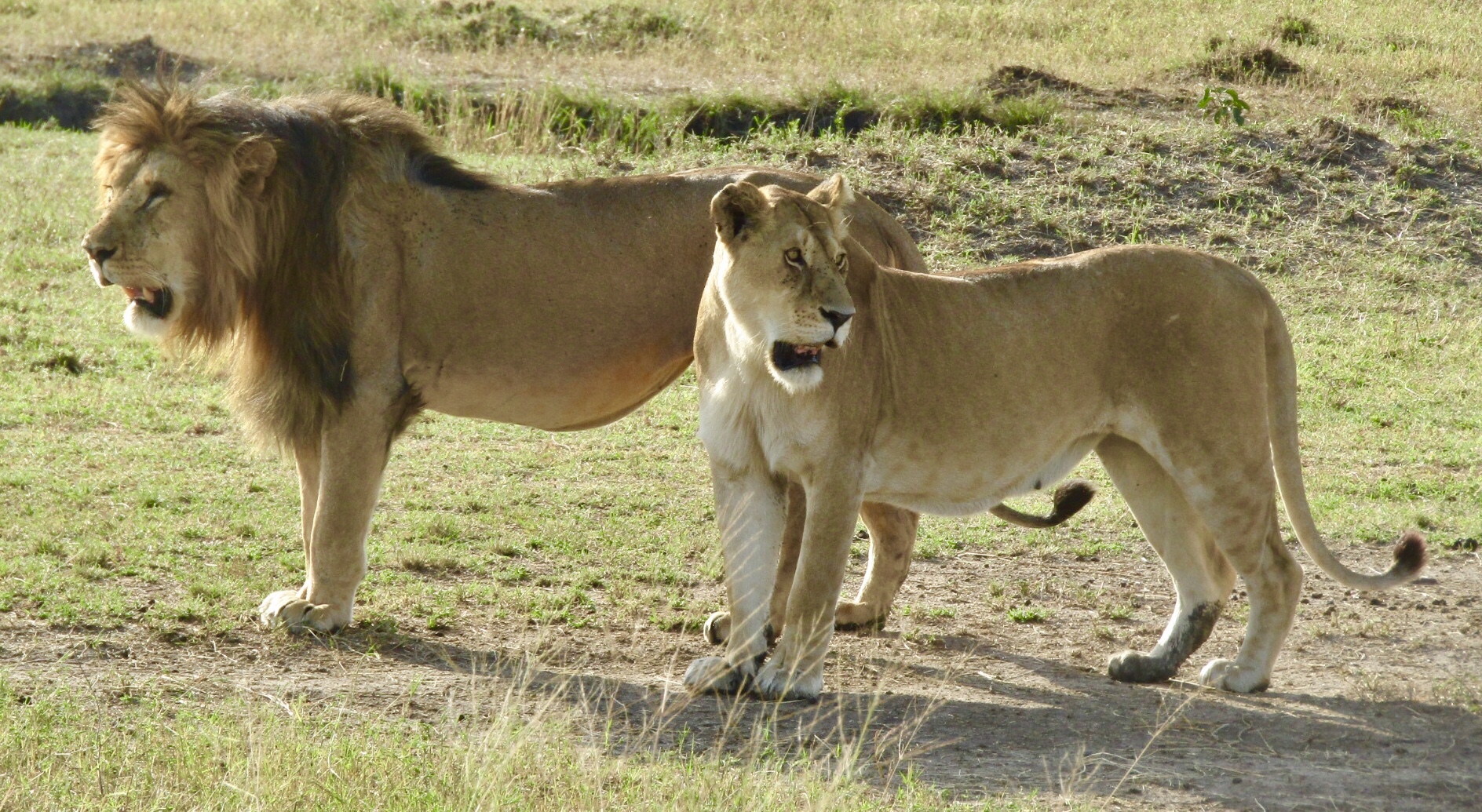
This lovely couple emerged from a korongo (Swahili for gorge). Joshua called them a honeymoon couple. The male lion and one female lioness from the pride wander off together for a few days of serious copulation. We’re talking 20-40 times a day though each go only lasts 10-20 seconds. They did look pretty happy and confident – all that sex and being on top of the food chain.
Speaking of food chains, the number of dying or dead wildebeest is able to support a healthy population of hyenas, jackals, and vultures. We saw groups of over 20 vultures, sometimes with a couple of jackals mixed in feeding on dead wildebeest.
One evening we spotted two male cheetahs hunting together. They wandered up to a herd of wildebeest who scattered around the cheetahs. The wildebeest looked totally confused but Joshua explained that their semi-random zigzagging movements were actually designed to confuse the cheetahs.
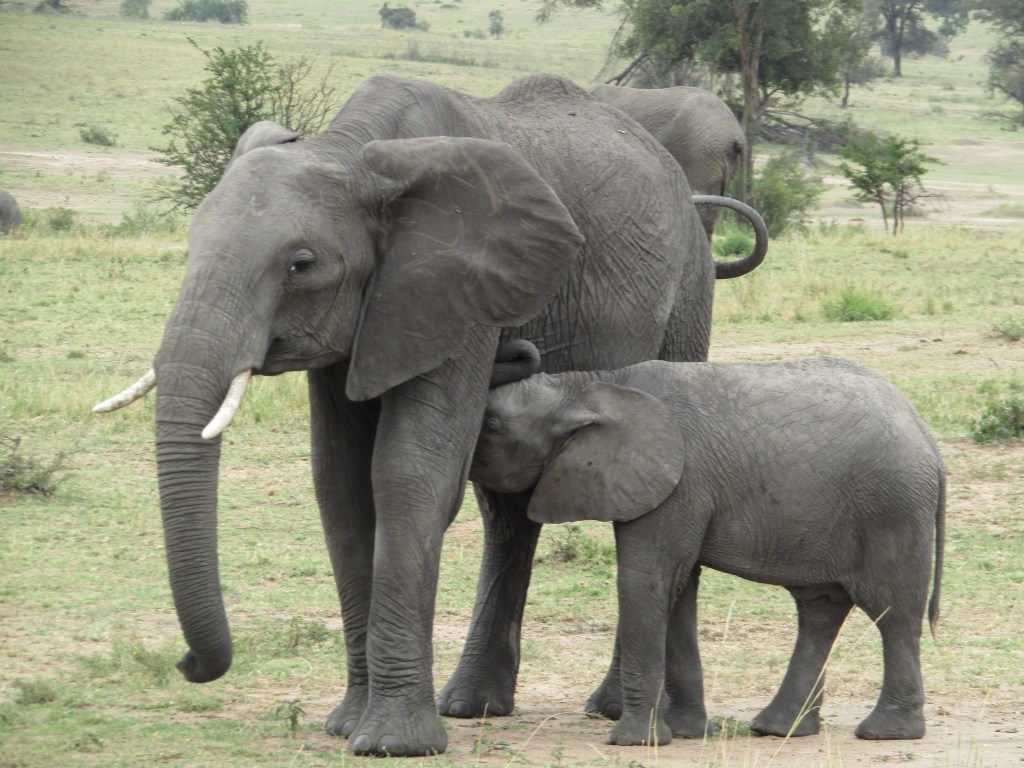
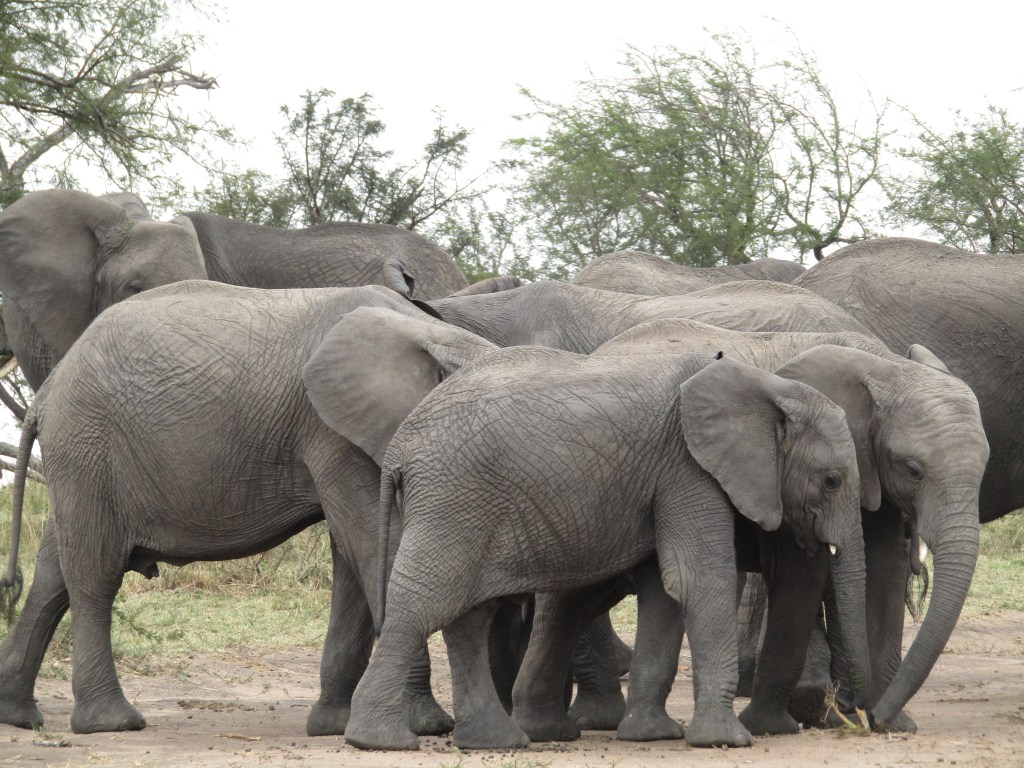
We found many large herd of elephants. One had several females and juveniles, one stately matriarch, and three small baby elephants that were still nursing.
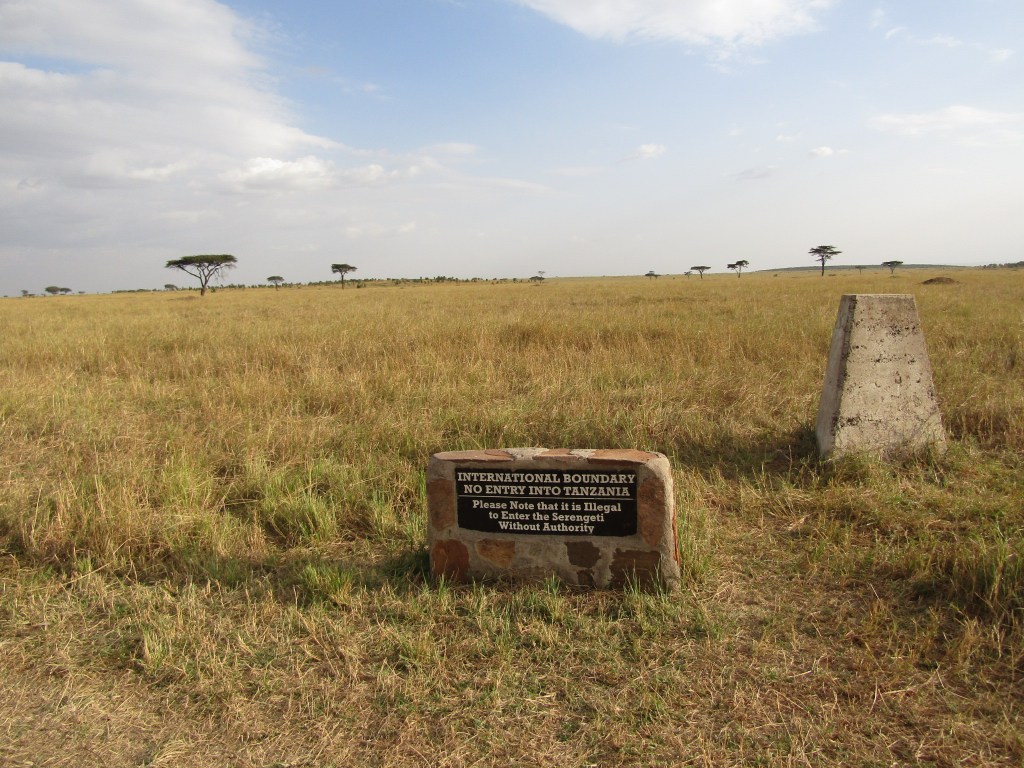
We crossed the international border between Tanzania and Kenya which was marked by a signs on the Tanzanian side. The land as far as the eye can see is gently rolling grassy plains with occasional hills. The animals don’t pay any heed to man-made invisible international boundaries.
There was at least one joke in our 4×4 about how the Kenyans were going to build a wall to stop the massive migration crisis and that they had convinced their voters that the wildebeest would pay for the wall.
Wildebeest are funny aminals. Even their name is wierd in English, though the etymology is straightfoward in Afrikaans (“wild cattle”). There are almost twice as many wildebeest in Serengeti as there are people in Austin. If you’re stuck on Mopac or the interstate at rush hour, you know that’s a lot of wildebeest. Wildebeest are migratory. They love short green grass so they follow it in a giant 2,800 km circuit every year. In February and March they have about half a million babies in the flat endless plains in south-eastern Serengeti. It rains from March to May here so they are assured an abundance of short green grass. The herds graze here till the rains end in May when they start moving in large numbers to the area near the Grumeti river in north west Serengeti. By July and August they start moving further north and cross the Mara river into northern Serengeti and across the Kenyan border into the adjoining Maasai Mara National Park. They stay here through the dry season and then with the short November rains they start moving south east back to the short grass plains, arriving by December. Then the cycle starts all over again. By migrating and following the food, the wildebeets swell to larger numbers than the ecosystem would have been able to support if they had been non-migratory. Though they probably don’t know that.
The herd population is fairly stable. That means there are a lot of dead wildebeest every year. They die from thirst, starvation, exhaustion, and predation by hyenas, lions, crocodiles, and other beasts of prey. About half a million gazelles and a quarter million zebras travel portions of the migration route with the wildebeest. The zebras particularly can been seen moving alongside the wildebeest. Incidentally, the zebra eat long grass. So they don’t compete for the same food as the wildebeest. Zebras a better at sensing prey animals, and wildebeest have learned to be very skittish, reacting quickly to a zebra who has detected a lion. In fact, wildebeest react to the safari 4x4s much more skittishly than any other animal we saw. All the animals are familiar with the 4x4s since birth. Beside wildebeests, other animals do not to fear the 4x4s. Most of them completely ignore you even if you are only a few feet from them as long as you are inside the ubiquitous 4x4s. But not the wildebeest. They buck and jump every which way and then they gallop away till then get turned around and realize that they are headed straight back at you and then chaotically gallop away again, in the process scattering a few dozen other wildebeest into panic.
As we drew closer to the Mara river we noticed huge herds of wildebeest. In the early morning or evening hours they move in long almost single file. Occasionally they gallop to catch up with the ones in front of them, but just as randomly they stop, turn around completely, and sometimes stampede in the opposite direction. In the heat of the afternoon they collect in tens or twenties under the scant shade of whatever trees there might be, motionless like statues. But the emergent trend through all this was a movement in the northen direction towards the Mara river, genetically driven to cross the river and head to the short green grass of Maasai Mara at this time of the year.
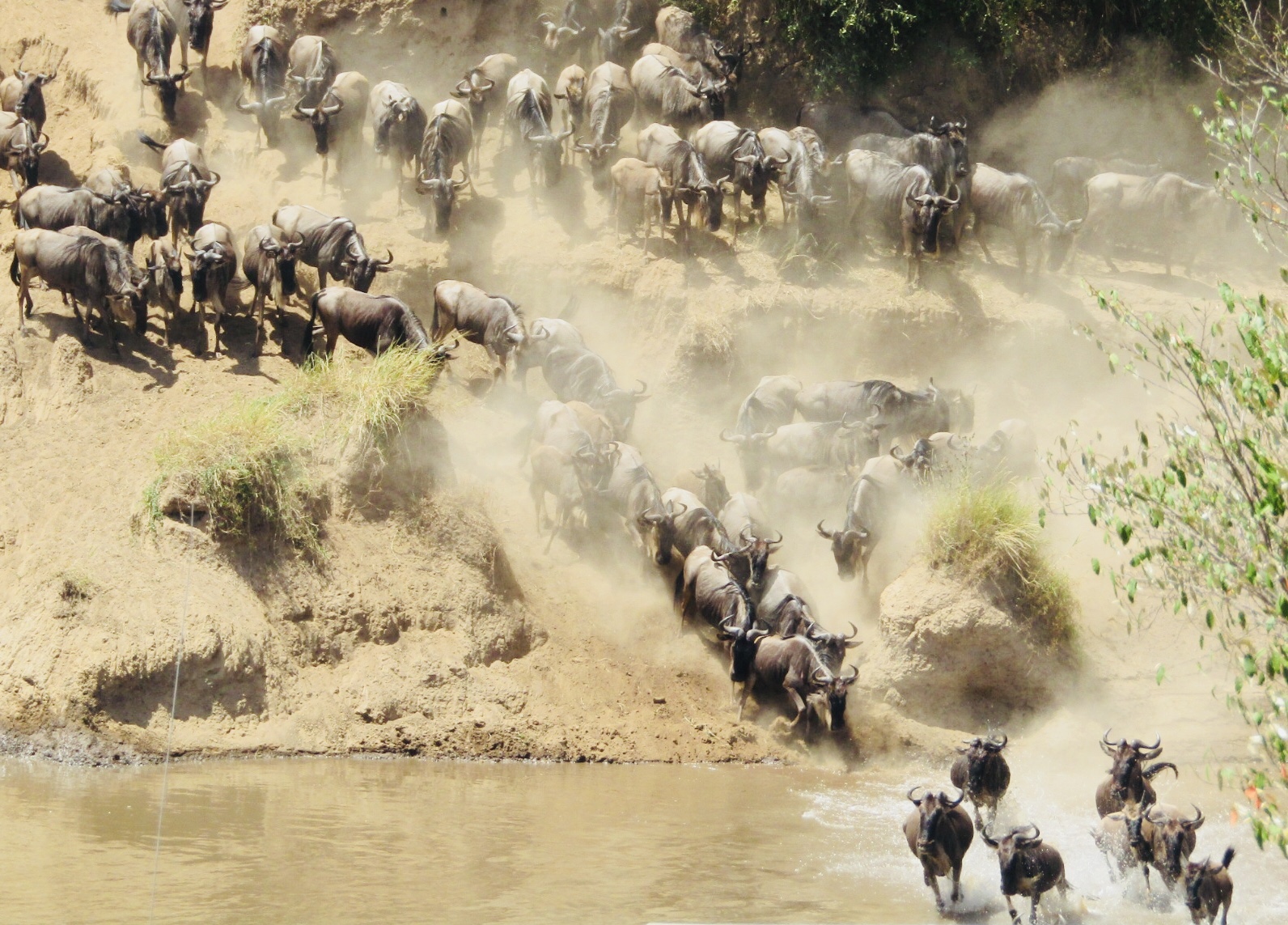
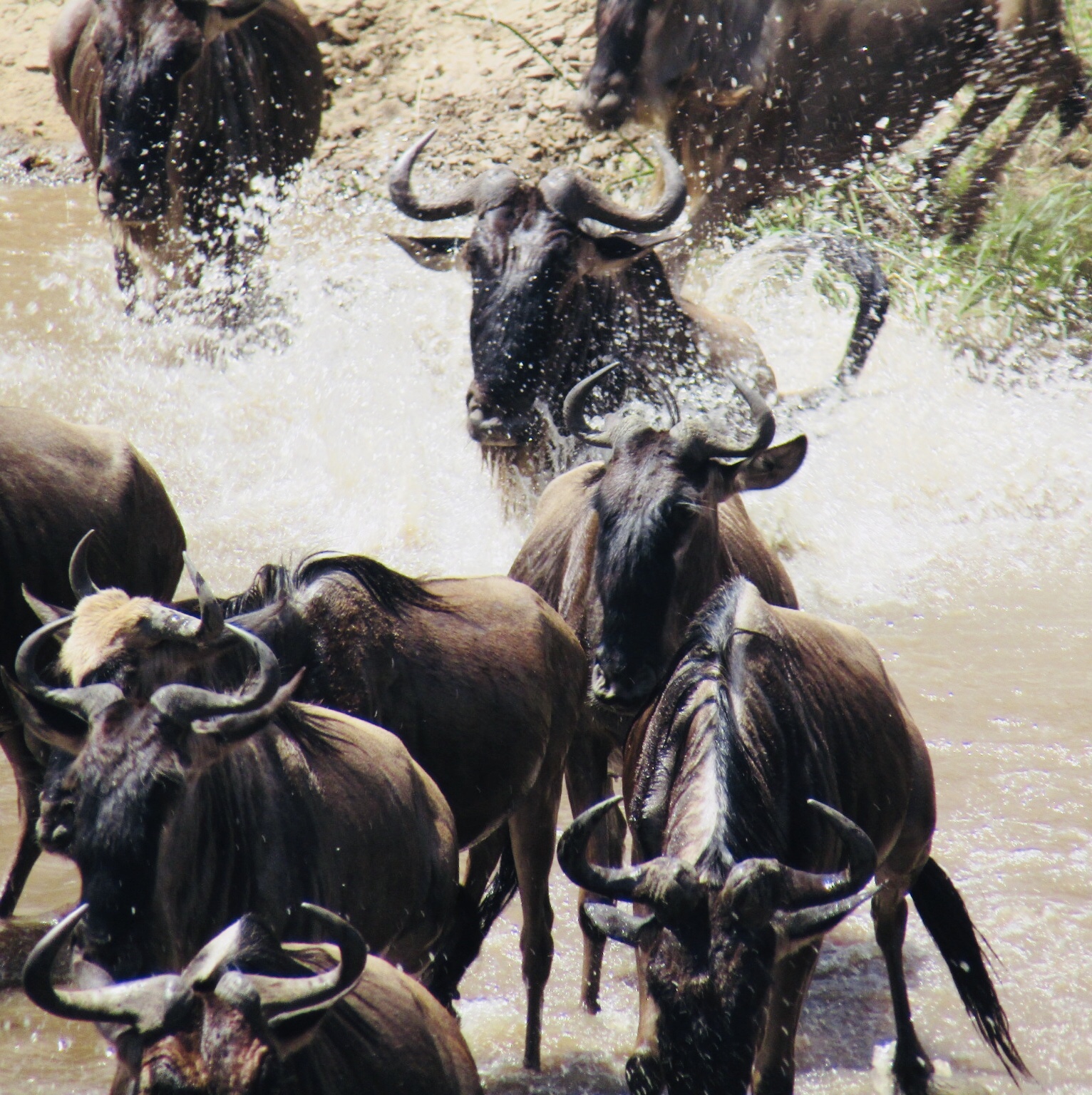
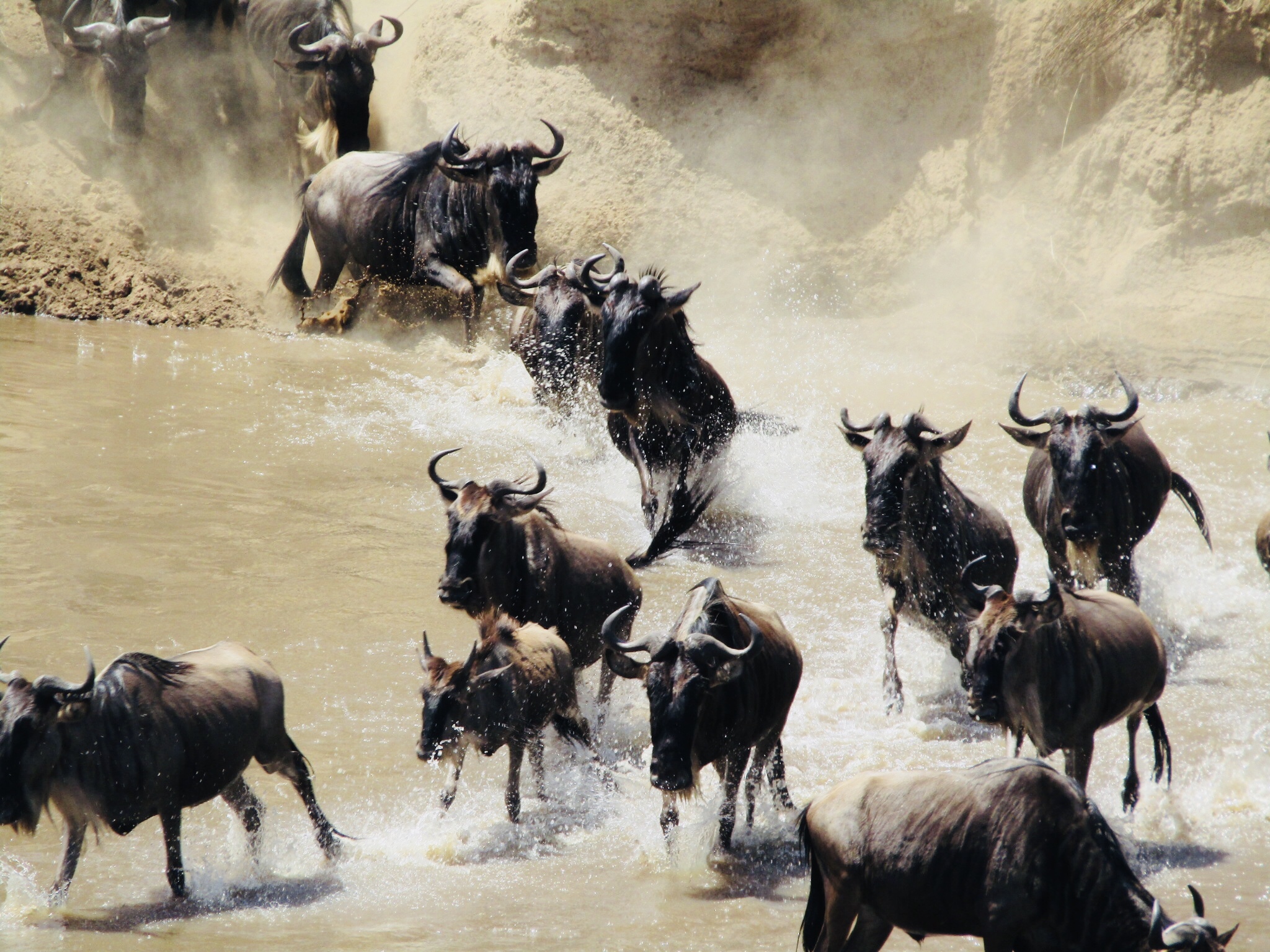
The first river crossing that we saw was pretty dramatic. They all are. Including dry washes and smaller creeks, we witnessed at least 6 crossings in three days. A herd had collected on a bluff overlooking the river. There was a wooded area in the middle. The way down to the river was via a steeply inclined path. The rest of the bluff was too tall to climb down. We were positioned on the other side of the river, back from the edge and hidden from view. When we got there, we joined about 20 safari 4x4s. But they must have been waiting for a long time because they slowly drove away till we were the only ones left. Meanwhile, the wildebeest milled around but made no move. Once a while one or two would walk purposefully towards the steep path down, but they always changed their mind and wandered away. Joshua told us that one animal needed to take the first step. It isn’t a leader. Wildebeest don’t have leaders. Just someone to trigger something in the brains of a dozen wildebeest around it, and the rest follow in a classic example of a herd or mob.
We passed the halfway point in the safari today but we again have a long drive. From our haven on the western side of central Serengeti near where we saw so much wildlife on and around the banks of the Grumeti River, it’s time to drive to the Mara River at the northern end of the park. Serengeti is big. For my fellow Texans who like the Big Bend National Park, the distance from the Persimmon Gap entrance in the north to the Rio Grande Village at the Mexican border on the south east is about 75 km. Today we are going to drive from the middle of Serengeti to its northern edge, a distance of more than 170 km.
Our first stop after a couple of hours is a hippo pit. The river is choked with hundreds of hippos laying in mud and their oozing excrement. They periodically grunt, swish their short little tails, climb on top of each other, bite a couple of butts, and go back to sleep. At first sight it is disgusting. But being vegetarians, their shit isn’t particularly smelly though we are a mere couple of feet above them on the river bank. And after a while the entire communal slothiness of the thing grows on you. You start picking out a baby here and a mother there or a couple of playful juveniles in the middle or a bad tempered butt biter who farts a lot. Vivian and Evan get quite engrossed in hippo watching like the rest of us. Eventually we all have to tear ourselves from the spectacle when our short break is over and we have to get back to our 4x4s.
After a while we are back in the endless plains of the Serengeti but the land is more gently rolling here and the grass is increasingly growing greener. We start seeing bigger and bigger herds of wildebeest heading north mixed in with only slightly smaller number of grazing gazelles and herds of zebra, eland, impala, and did-diks darting between the trees.
Joshua cautiously pulls off the main dirt road and drives to a low tree under which we discover a resting lion and a young lioness. We drive a hundred yards away to another shady spot to see a huge lioness. Then it becomes clear that we are looking at a pride of lions resting after a kill. One cub is still tugging at the buffalo carcass. Everyone else is resting and licking their own and each other’s bloody chins.
We spend a long time looking at this scene play out. Then Joshua reminds us that we still have a way to go. An hour later we pull into Mara Under Tents – our first real tented safari lodge.
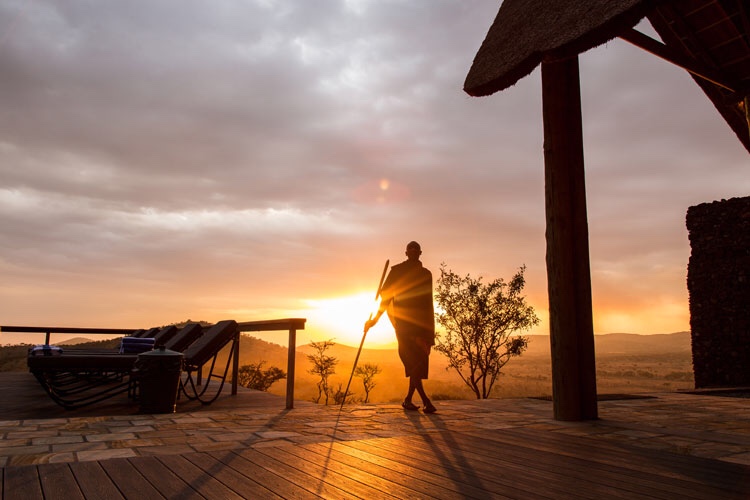
Last night our Maasai warriors, spears and all, escorted us back to the “tents” after dinner and cigars by the pool. This morning we woke up early, had a quick breakfast and got back in the 4x4s with Phillip and Joshua for a full day of game viewing in central Serengeti.
[photo credit to the Lahia website]
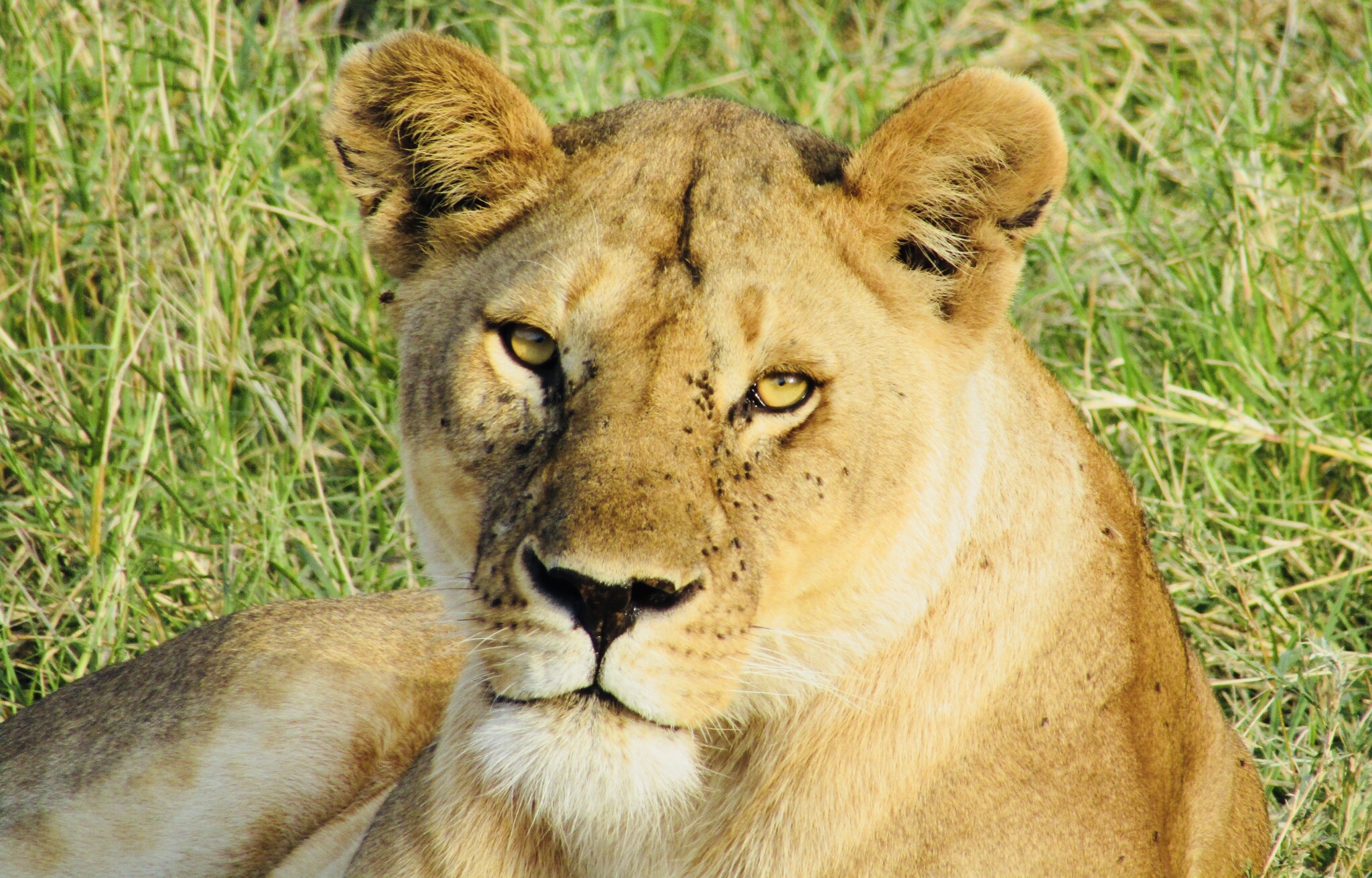
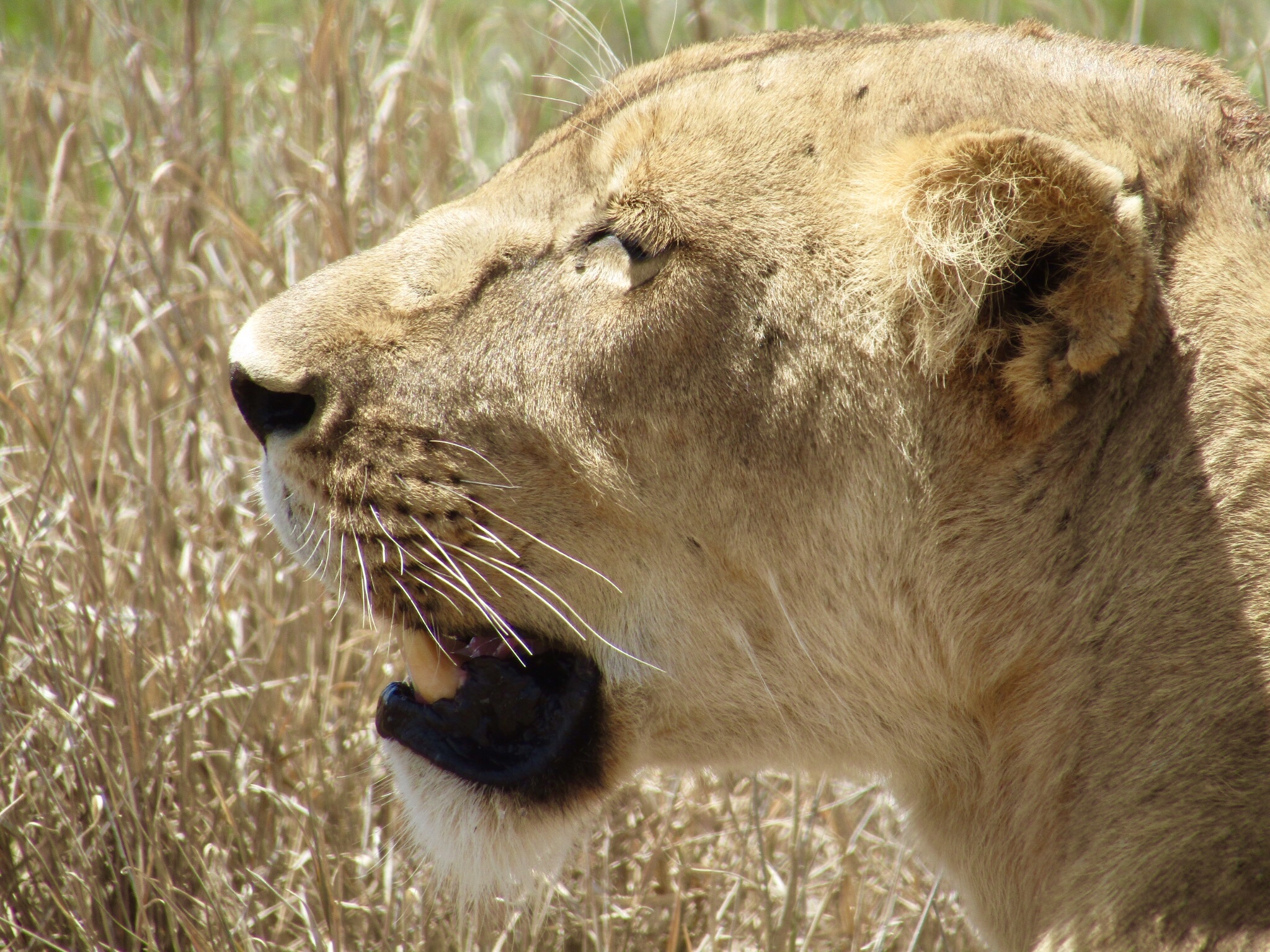
Less than 30 minutes out of camp, Philip cautiously pulled off the main dirt road towards a river crossing. In the mostly dry river bed was a herd of elephants. On the other side was a large family of baboons. And right in front of us was a pride of a dozen lionesses and cubs. Here’s a closeup on the main Mama. Even Vivian and Evan sat up and noticed.
A few more miles down the road we almost ran into a huge elephant. He was a bit away from his herd and stepped out on the dirt road at about the same time we came around a bend. Philip quickly swerved right while the elephant crashed into the brush on the left. Then he recovered his balance and seem to take a few belligerent steps towards us before backing up into the brush again, but he kept his face towards us and flapped his ears. He was clearly ready to take this argument to the next level. We left him in the brush, passed his herd a few minutes later, and headed down the road, keeping the river bed to our left. A bit later we were rewarded with a rare sight.
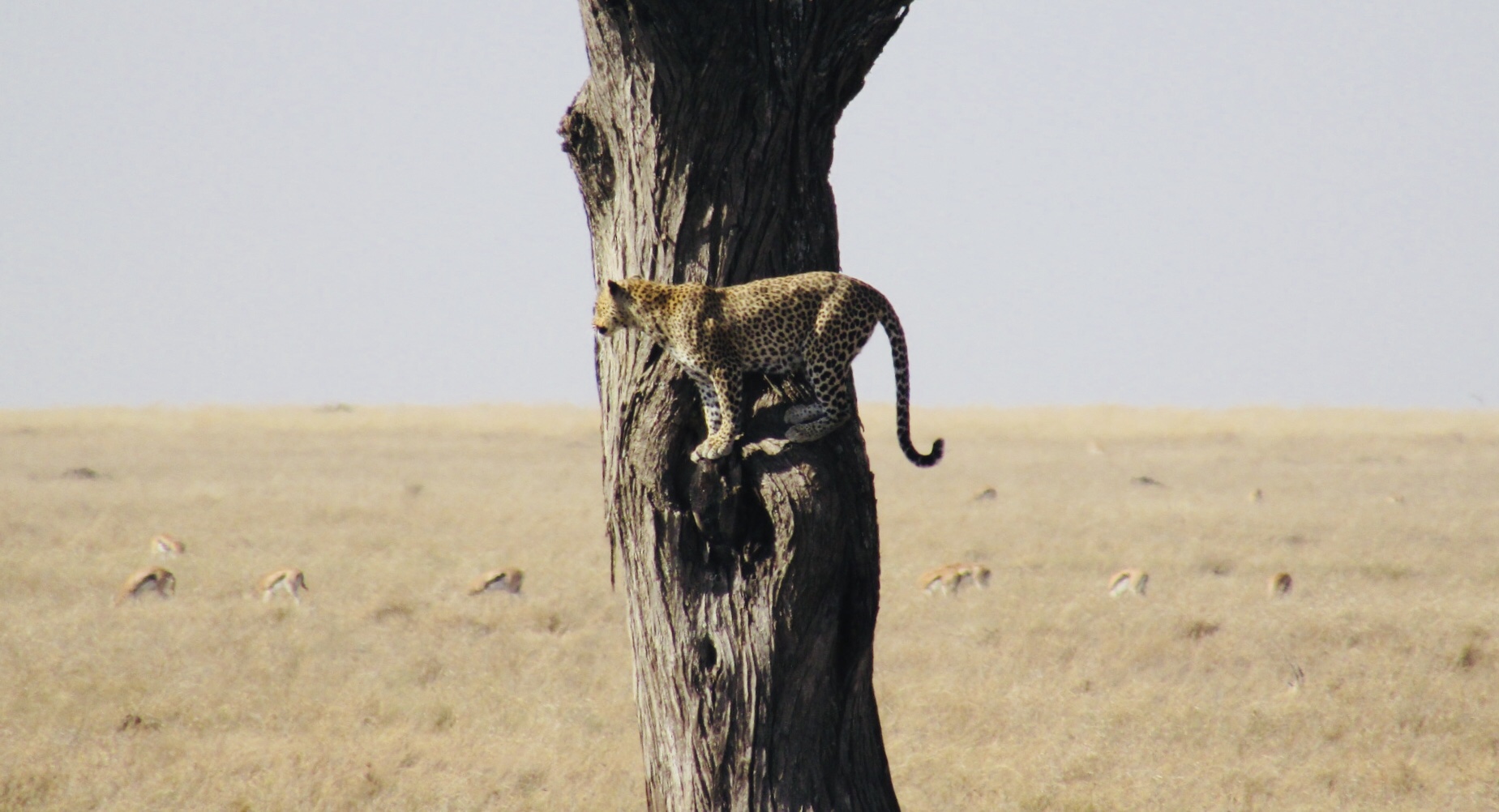
A leopard mother and her young cub were hanging out at the foot of a tall acacia tree. While we watched, the mother made her way gracefully up the tree and proceeded to plonk herself down on a big branch like it was the most comfortable bed in the world. The cub wandered off into the brush. We waited for an hour and watched, during which the mother occasionally changed positions and then eventually walked down the branch towards the trunk. We drove around to the other side of the tree and saw that she was feeding on a gazelle carcass that she must have killed and dragged up the tree earlier. The cub was nowhere to be seen.
Still later we drove off to see a cheetah that had been spotted a few miles away. Upon arriving we saw a beautiful cheetah sitting under a tree. Nearby, there were three large vultures in the tall grass. Philip conjectured that the carcass from her kill must have attracted the vultures. Then we noticed a herd of elephants come over the horizon. They were moving roughly in the direction of the cheetah resting under the tree. Game watching is like fishing. It’s mostly waiting. We waited.
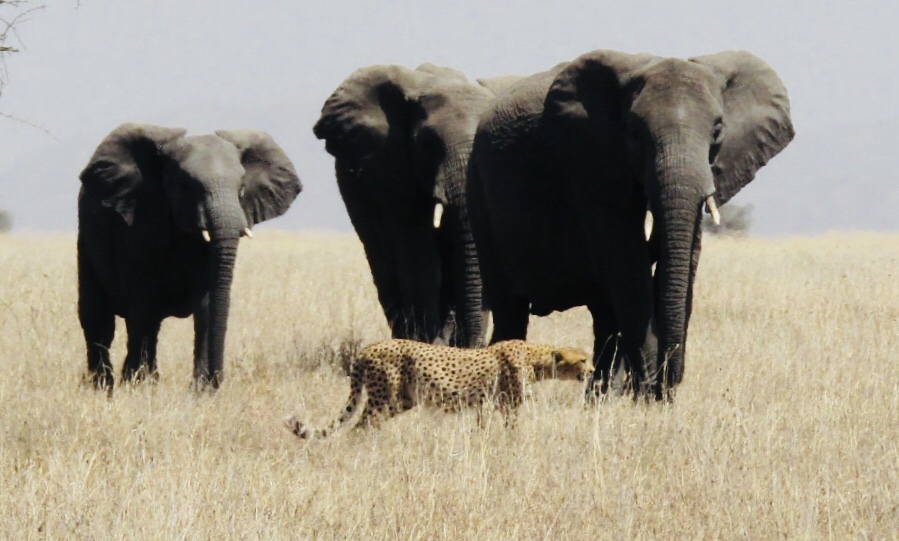
Eventually the elephants arrived. They either smelled the carcass or the cheetah or both and raised their tusks to sniff the air. Then they ambled at their leisurely pace straight towards the tree and the cheetah hiding in the tall grass. We held our breaths and waited. At the tree the herd split up around it, and the bigger elephants walked right up to the cheetah. The cheetah at that point decided that hiding wouldn’t do, and in the photo below, you can see it getting up and walking away from the elephants.
And that’s how we spent most of our morning. Later we waited for a lioness who was crouched down on a grassy bank to attack gazelles that approached the water hole but that didn’t materialize during our wait. So we went back to the mother leopard in the tree. Her cub had reappeared. He scrambled up the tree and ate on the gazelle carcass while the mama continued to sleep on a branch. The mothers in our safari truck joked about how it must be the mama leopard’s time off and that she had left the kid a snack and didn’t want to be disturbed.
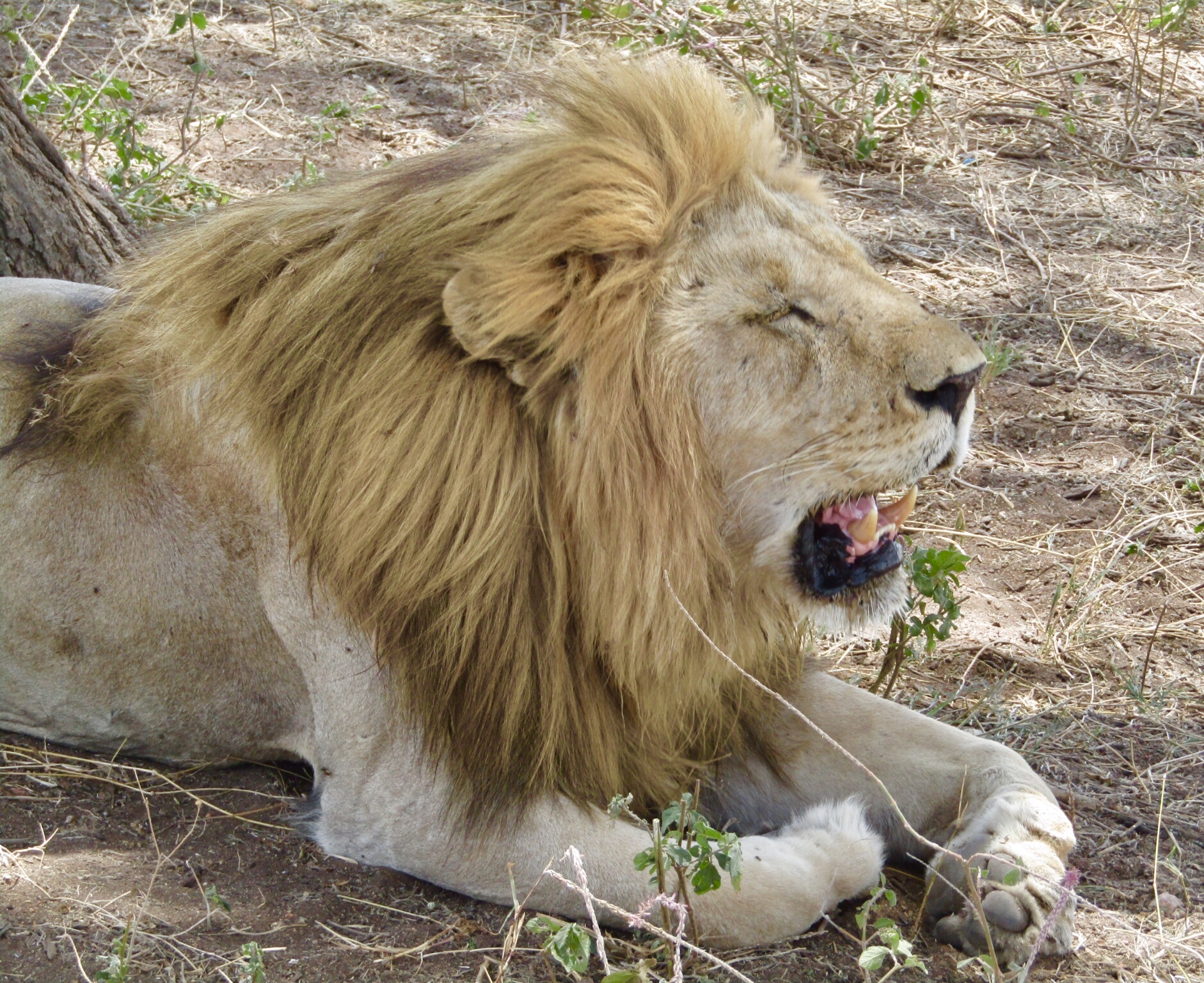
We ended that afternoon driving up to another lion – in this case an old dude resting under a tree. And then back to the large pride of lionesses and cubs from the morning, a passing herd of zebras and wildebeest, and then back to our safari lodge. Vivian and Evan swam, we drank excellent wine by the pool, and had a lovely dinner. Another day in paradise.
[thanks to Prabhu for this lovely photo of zebras]
Last month archeologists and Tanzanians celebrated the 60th anniversary of the discovery of the “Early Man” fossils in Olduvai Gorge in a remote portion in Tanzania. There is a nice brand new museum funded by the EU and two huge replicas of skulls at the intersection of the dirt road that leads to the 45 km long archeological site. If there is a haloed spot in the search for our ancestors, it’s Olduvai.
We reached it after a two hour journey on bumpy roads through treeless dusty valleys on the northern side on Ngorongoro dotted with Maasai villages and herds of cattle, and then eventually the endless plains of Serengeti (it’s what the word “Serengeti” means).
Olduvai is a screwed up word for Oldupai, the wild sisal succulent that grows in the gorge. The Leakeys (mostly Mary) found fossils of early hominids from 1.9 million years ago, Homo erectus from from 1.2 m.y.a, Homo sapiens from 17,000 years ago, and the earliest stone tools. Add to that the fossilized footprints from Laetoli 45 km away which are, at 3.7 m.y.a, the oldest evidence of our ancestors rearing up on their hind legs. Olduvia provided us some of the earliest and most solid proofs of human evolution and put to rest “theories” of the earth being 6000 years old. It also showed us that we are all Africans. So in the big scheme of things I was just as interested that Vivian and Evan see this corner of the world as any lion or elephant or wildebeest. Evan posed beside a replica of Lucy (from Hadar in Ethiopia, 1,500 km up the Rift Valley) and seemed suitably impressed. I wanted to spend a few days here but in the interest of moving things along we hung out for a couple of hours during which I did my best to soak up the feeling that people go to The Vatican, Mecca or Bodh Gaya for. My faith lives in places like this. Aaah – the smell of scientific method in the air!
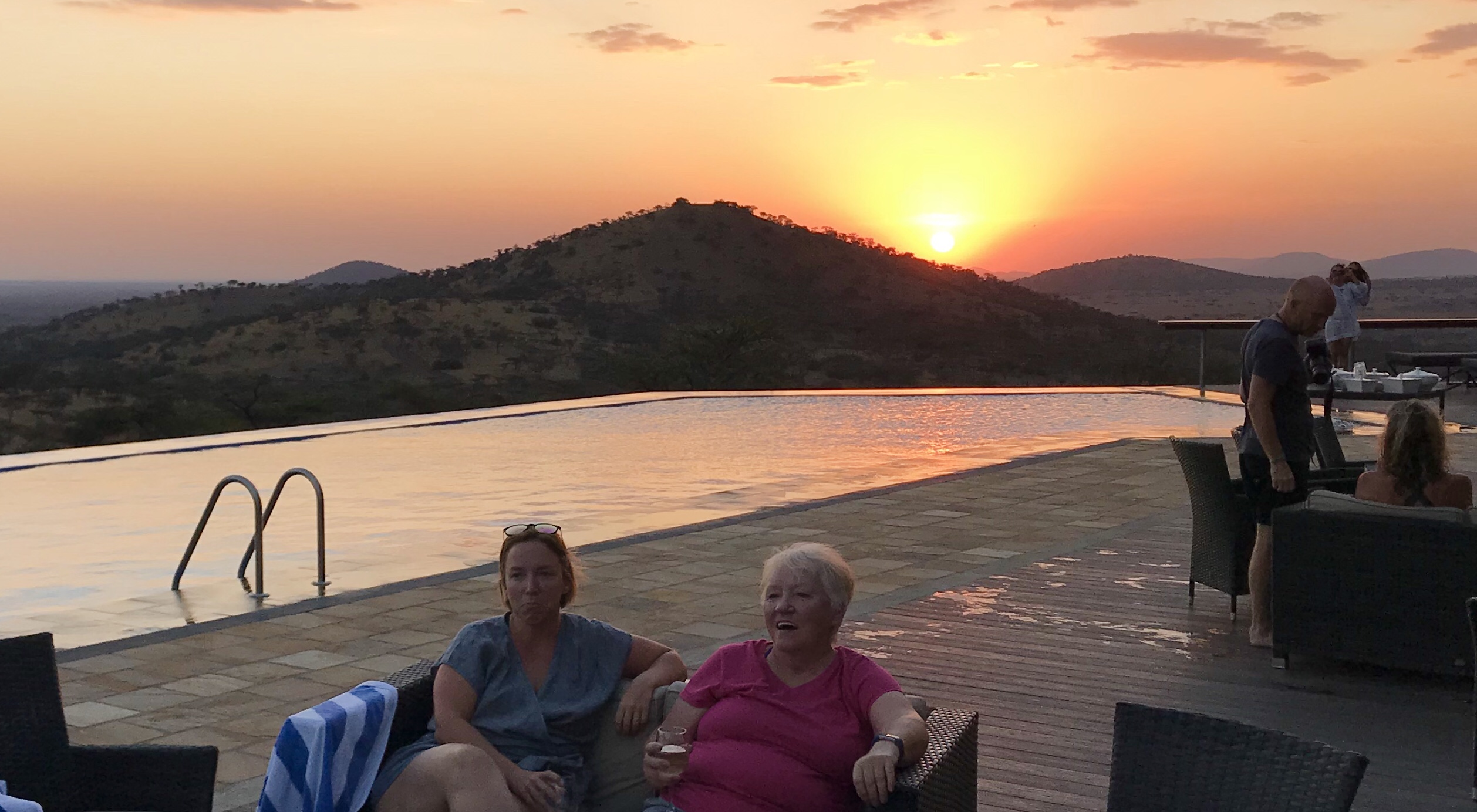
After several more hours of driving through dusty endless featureless plains filled with gazelles, zebras, ostriches, and an occasional hunting lioness, a brief stop at a rest stop that felt like it was out of a Mad Max movie, more bumpy dirt roads, and winding up a hillside, we suddenly appeared at a safari lodge where they welcomed us with chilled white towels and champagne. And an infinity pool with a view of a hundred miles of Serengeti under us. And a sunset from a Fauvist painting. Vivian echoed all our thoughts. “Daddy,can we spend the rest of the year here?”
The kids are settling into their traveling lifestyle. So far, 10 days into their year of travel, they have hit the books for about 30 minutes one day. Meanwhile, the stuff they leave in their hotel / safari lodge rooms at checkout has steadily decreased.
We stayed the night before at the very edge of the Rift Valley looking over the infinity edge pool (too cold for me) into the seemingly infinite shores of Lake Manyara shrouded in mist. Yesterday we drove up to an amazing property called the Retreat at Ngorongoro, just outside the Ngorongoro Conservation Area and had a lazy afternoon and evening and used the fireplaces in our rooms at night to warm up. In the morning we loaded into our 4x4s and headed from an elevation of about 4800 ft up to 7000 ft at the rim of the Ngorongoro crater which was completely covered in fog and clouds. Philip drove us around the rim and down into the huge crater floor. The rim is heavily wooded steep and the crater is flat and grassy. Once we were down in the crater, the clouds had burned off and we were left with a brilliant blue sky and a perfect day. The crater was formed about two million years ago when the caldera of a volcano collapsed into itself, and Wikipedia bills Ngorongoro crater as “the world’s largest inactive, intact and unfilled volcanic caldera.” It is a Garden of Eden for wildlife – no humans live inside the crater.
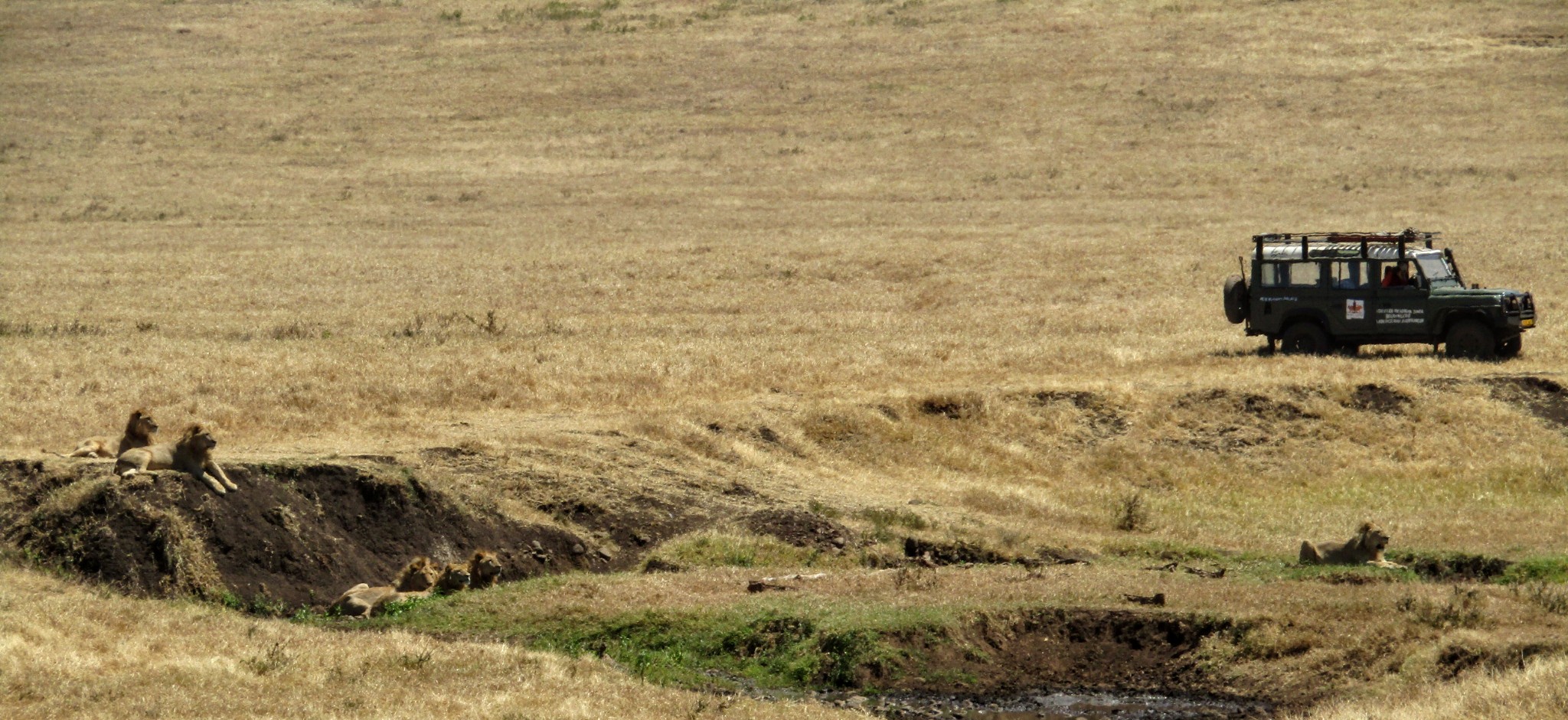
We explored the crater floor till lunch time. A lot of that time was spent looking at a bachelor group of six young male lions. They were resting on top of and under a bluff when we discovered them, and at various times, they sat up and expressed interest in a passing lone buffalo but they didn’t move much. If you look at the third photo down you can count the six lions. There is an army green safari truck in the photo whose lone occupant is the Lion Lady, Ingela Jansson. She is studying the whiskers of the six lions which is how researchers identify them.
Over a boxed lunch of grilled chicken and fruits, Ingela explained her work to us. Our group of two safari trucks and thirteen visitors are customers of Austin and Arusha based Fair Trade Safaris which helps fund conservation efforts in several places, including Ingela’s work. Ingela explained that about 20 years ago she realized that the main pressure faced by lions were humans, the pastoral Maasai who share the Ngorongoro Conservation Area with the animals (unlike the national parks which are exclusive zones, the NCA is a mixed use land, allowing animals and a few tens of thousands of humans to co-exist). So she created a system to lion guardians based on a system that had been shown to work in Kenya, where a Maasai warrior is a full time member of her group, and his job is to keep track of and facilitate the safety of lions and cattle (and humans) in his home area. Ingela’s experience has shown that pride in being a guardian of lions, having a well-paid responsibility, and keeping his people and the lions safe is a suitable proxy for being the brave Maasi warrior who under other circumstances would have killed the lion.
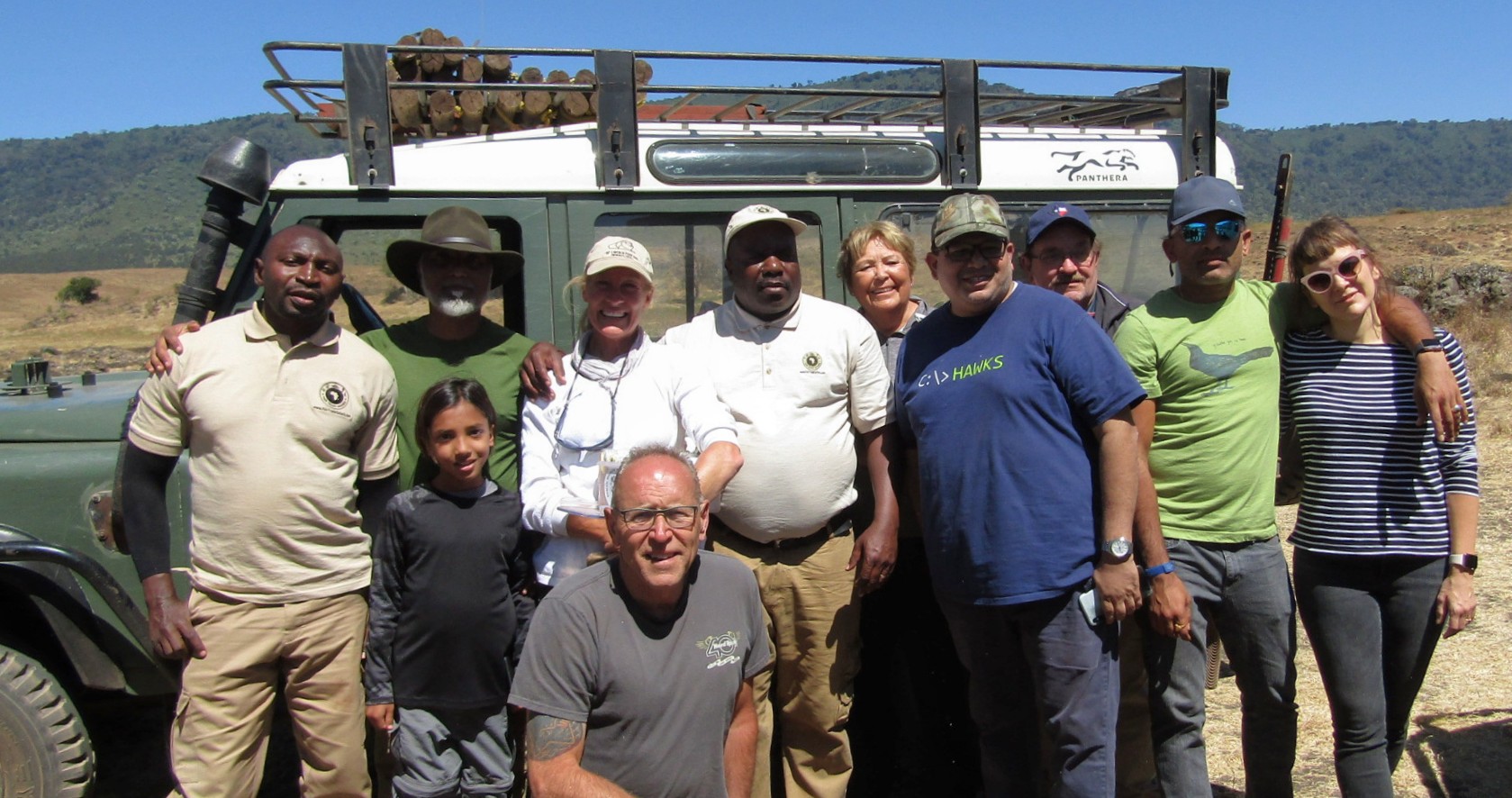
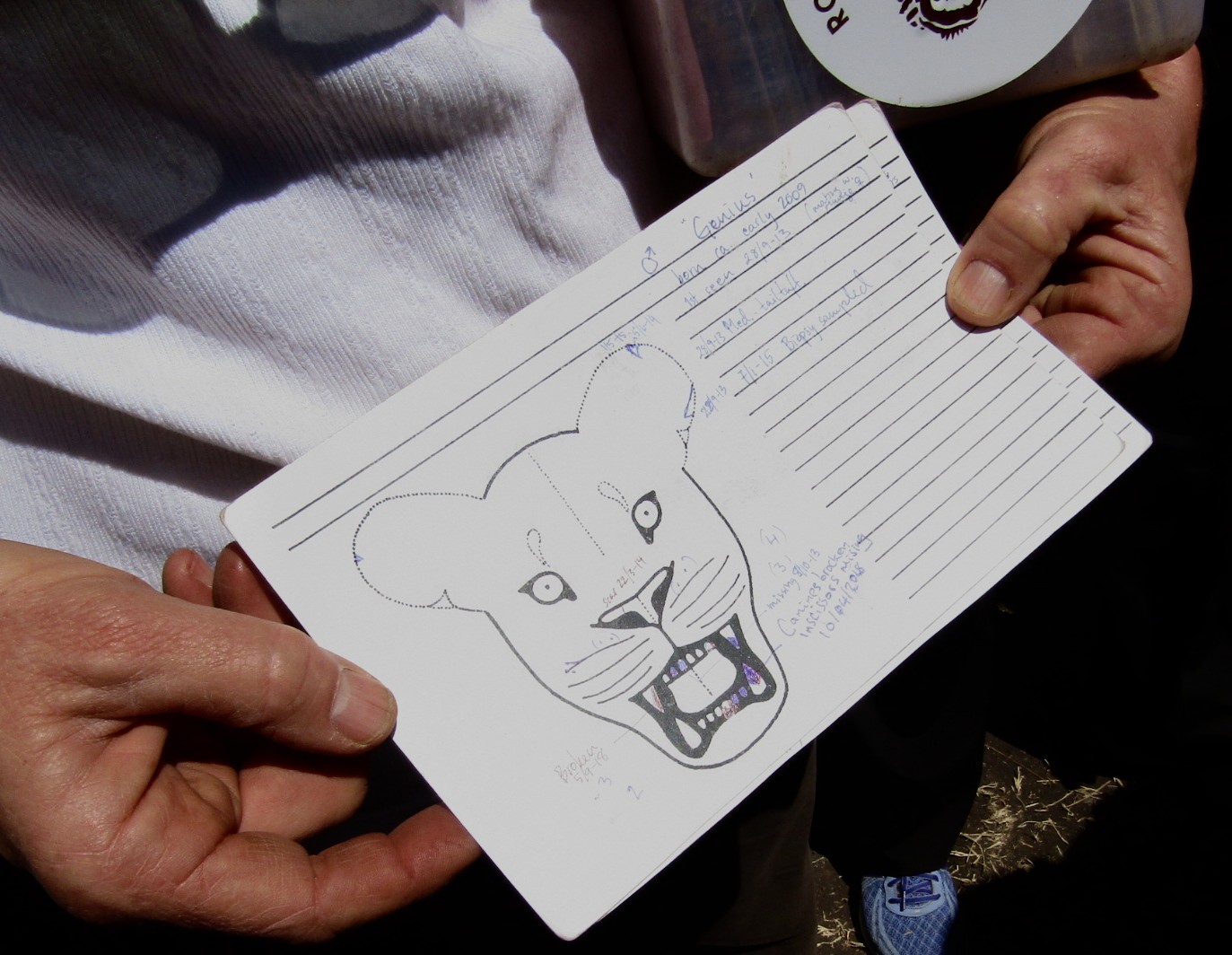
Ingela then shared a box full of cards with the whisker marks, parentage, age, and other details of every lion in the area. We looked at the six we had seen earlier in the morning. Evan had the opportunity to rename one of them Leo after his friend (like most others it carried a number, in this case MASEK-89 or something like that). So, Leo – if you get around to Ngorongoro, you may be able to see your namesake one day! In the group photo, Evan is standing in front of me, and to his and my left is Ingela, the Lion Lady.
The very first stop on our safari is Tarangire National Park – one of Tanzania’s premier parks that often gets overlooked in favor of more glamorous cousins like Ngrongoro and Serengeti. Joshua drove us there in about three hours from Arusha, explaining the lay of the land and its people along the way. We got there at lunchtime, ate our boxed lunches, and drove into the park.
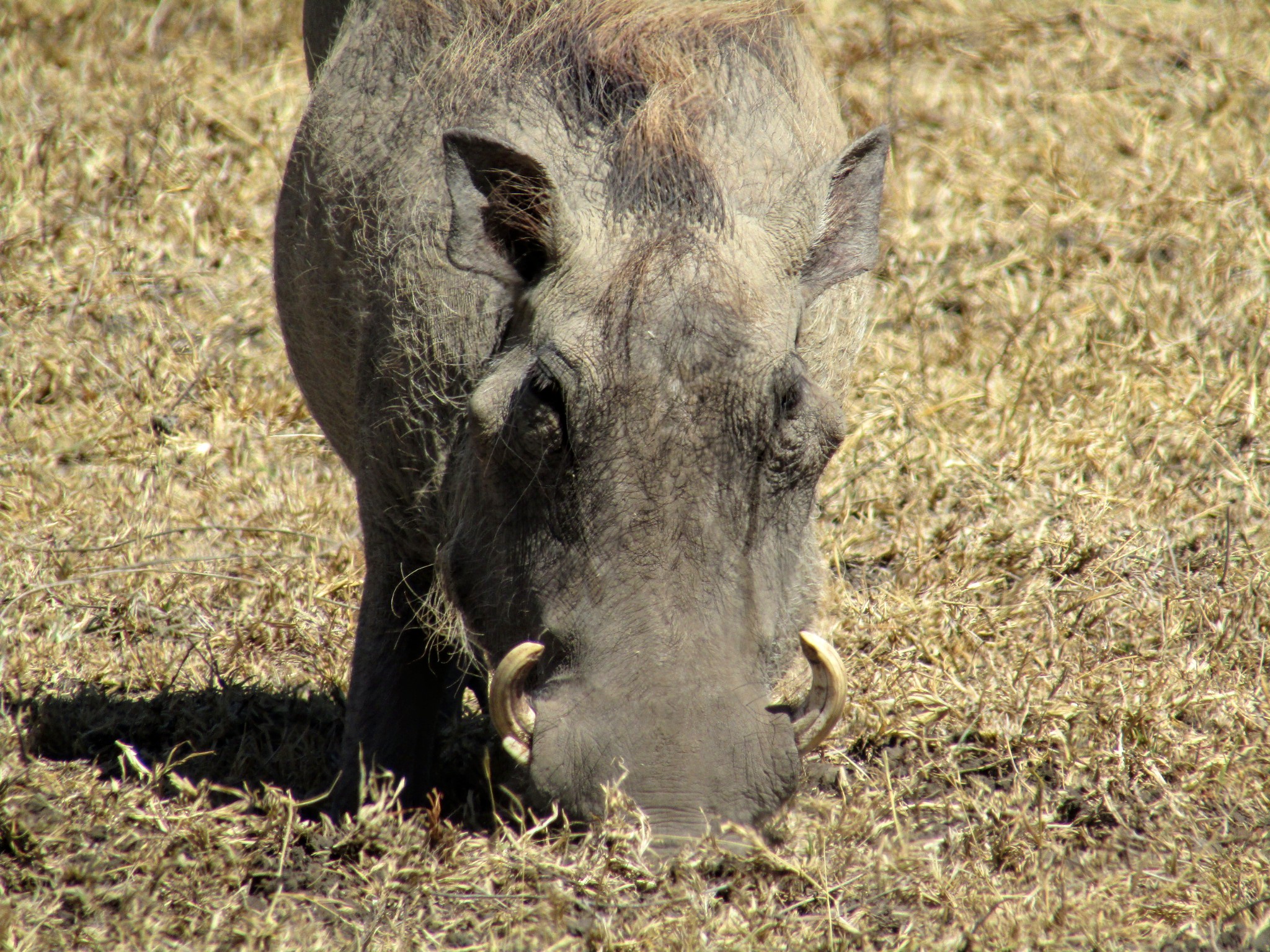
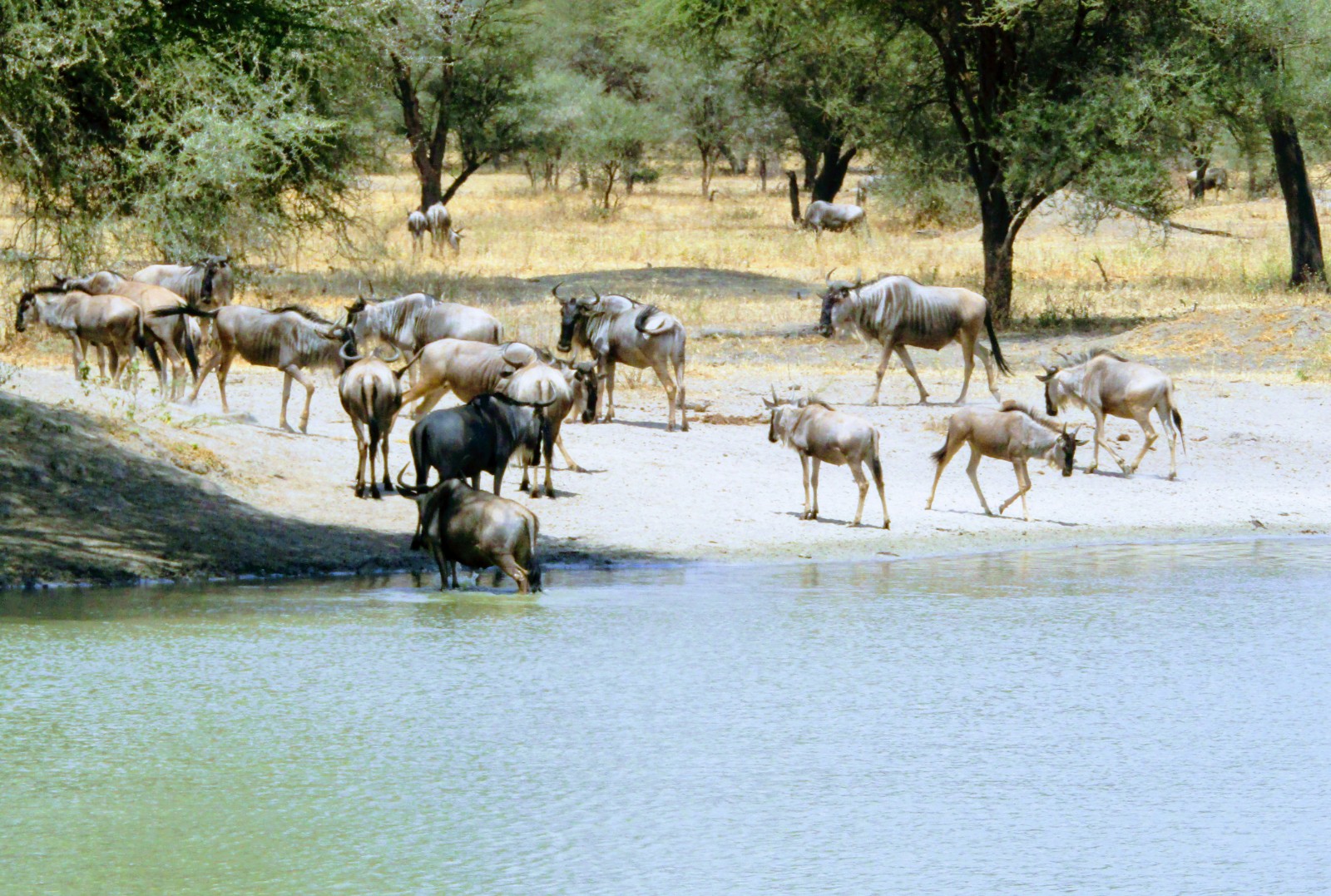
We came up to a watering hole and saw a large number of wildebeest, zebra, and an odd warthog or two. Wildebeests are amazingly unattractive animals and seem to have been badly welded together from discarded portions of cattle, horses, elks, deer, and other animals. Geeks of a certain vintage will recognize them from the cover of the O’Reilly Gnu book (yes, they are indeed gnu). Their other claim to fame is that they are the most popular prey animal on the African savannah.
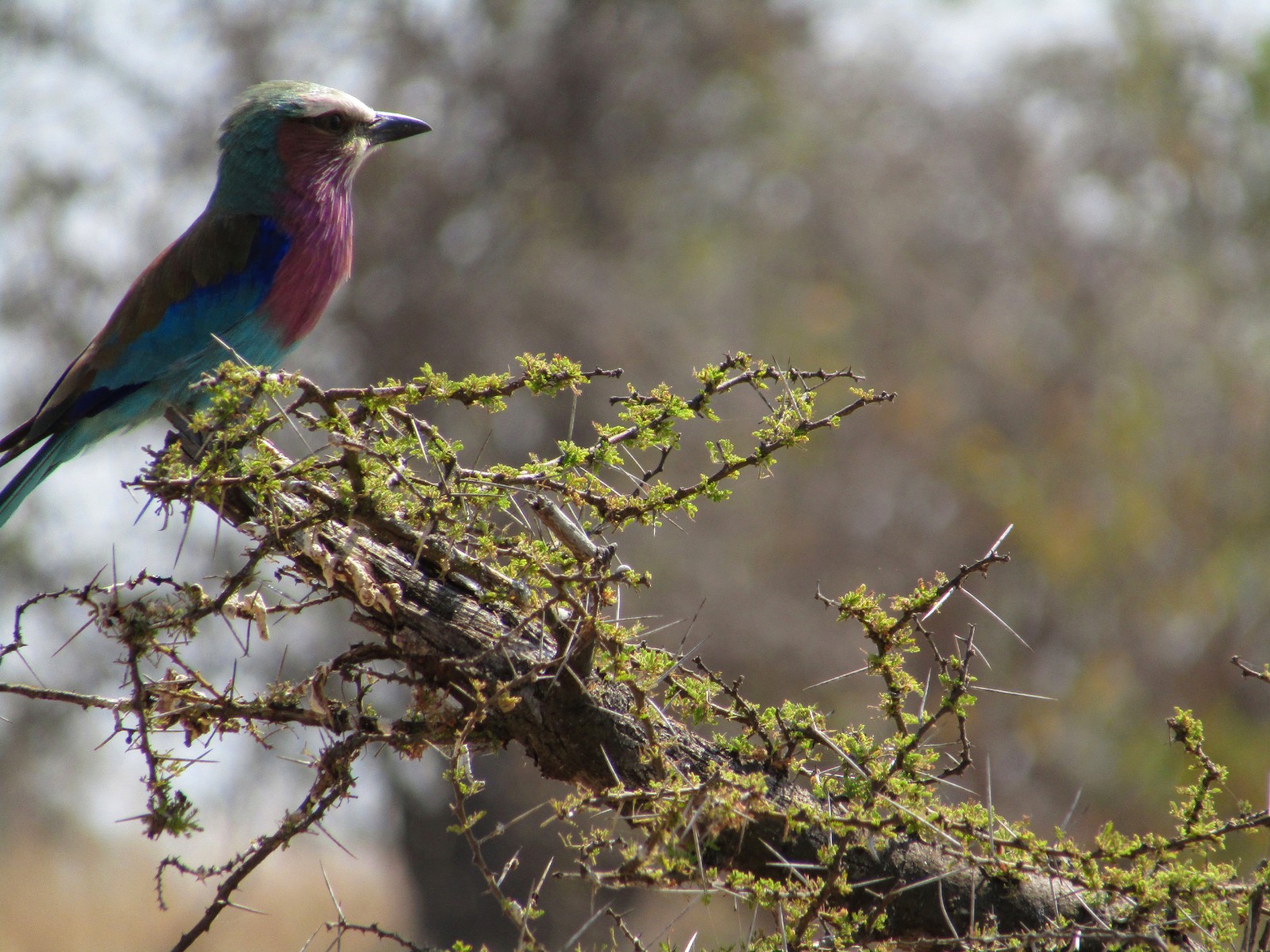
We saw Baobab trees, lions, elephants, baboons, lilac breasted rollers, secretariat birds, and other amazing wildlife. And spent our first real day of our vacation together without any real disasters. About 360 days to go!























 Notes from Dad