Last month archeologists and Tanzanians celebrated the 60th anniversary of the discovery of the “Early Man” fossils in Olduvai Gorge in a remote portion in Tanzania. There is a nice brand new museum funded by the EU and two huge replicas of skulls at the intersection of the dirt road that leads to the 45 km long archeological site. If there is a haloed spot in the search for our ancestors, it’s Olduvai.
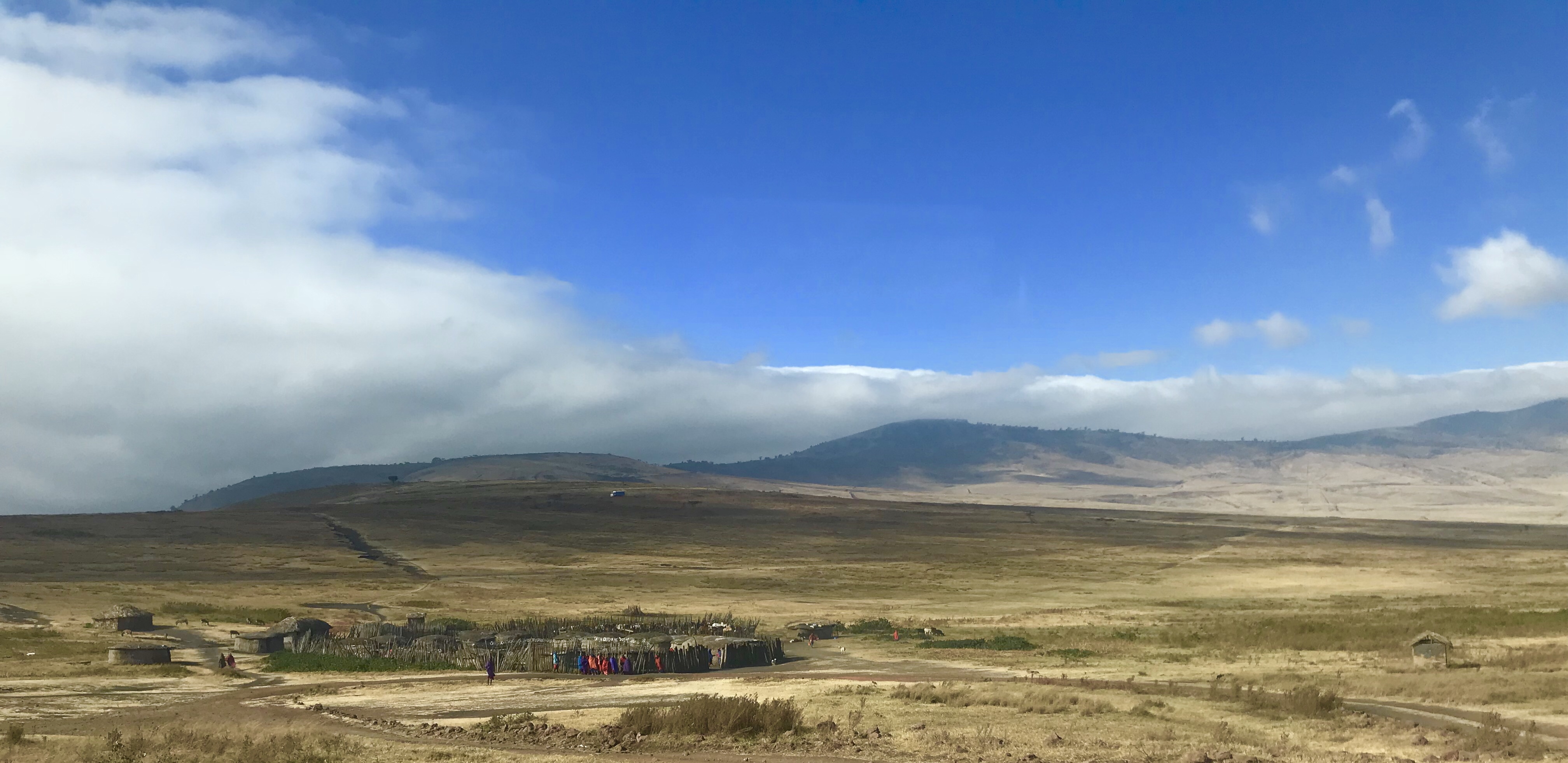
We reached it after a two hour journey on bumpy roads through treeless dusty valleys on the northern side on Ngorongoro dotted with Maasai villages and herds of cattle, and then eventually the endless plains of Serengeti (it’s what the word “Serengeti” means).
Olduvai is a screwed up word for Oldupai, the wild sisal succulent that grows in the gorge. The Leakeys (mostly Mary) found fossils of early hominids from 1.9 million years ago, Homo erectus from from 1.2 m.y.a, Homo sapiens from 17,000 years ago, and the earliest stone tools. Add to that the fossilized footprints from Laetoli 45 km away which are, at 3.7 m.y.a, the oldest evidence of our ancestors rearing up on their hind legs. Olduvia provided us some of the earliest and most solid proofs of human evolution and put to rest “theories” of the earth being 6000 years old. It also showed us that we are all Africans. So in the big scheme of things I was just as interested that Vivian and Evan see this corner of the world as any lion or elephant or wildebeest. Evan posed beside a replica of Lucy (from Hadar in Ethiopia, 1,500 km up the Rift Valley) and seemed suitably impressed. I wanted to spend a few days here but in the interest of moving things along we hung out for a couple of hours during which I did my best to soak up the feeling that people go to The Vatican, Mecca or Bodh Gaya for. My faith lives in places like this. Aaah – the smell of scientific method in the air!
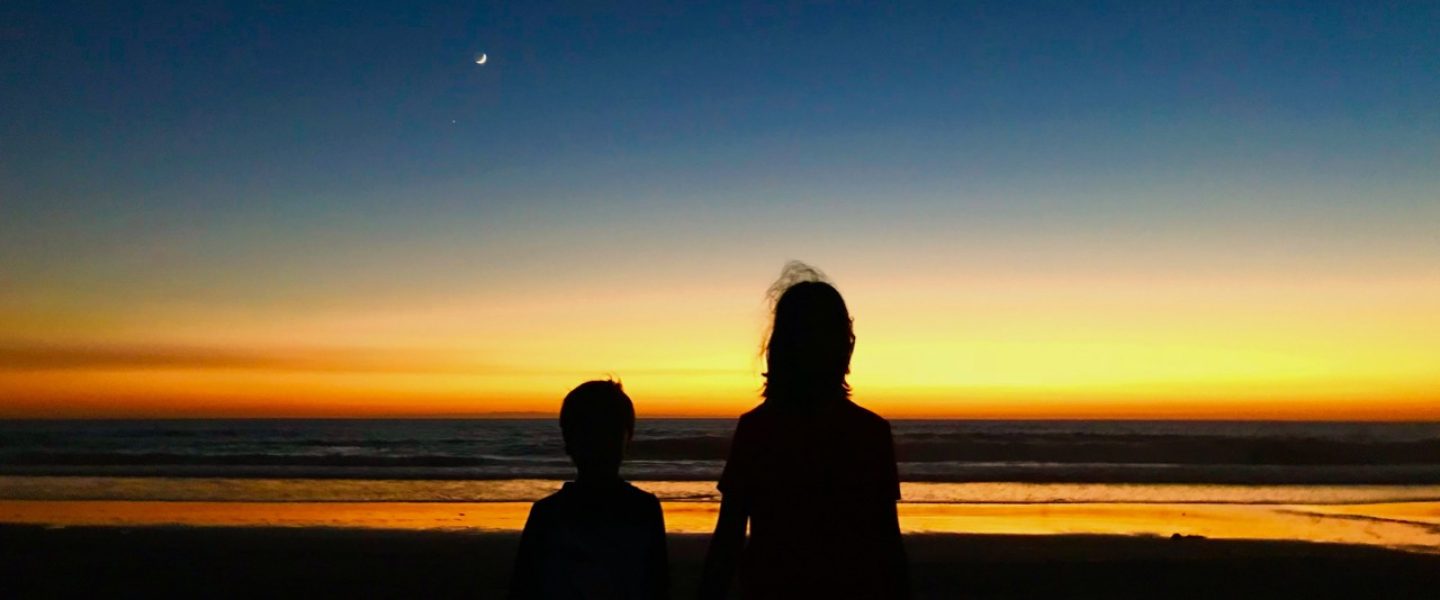
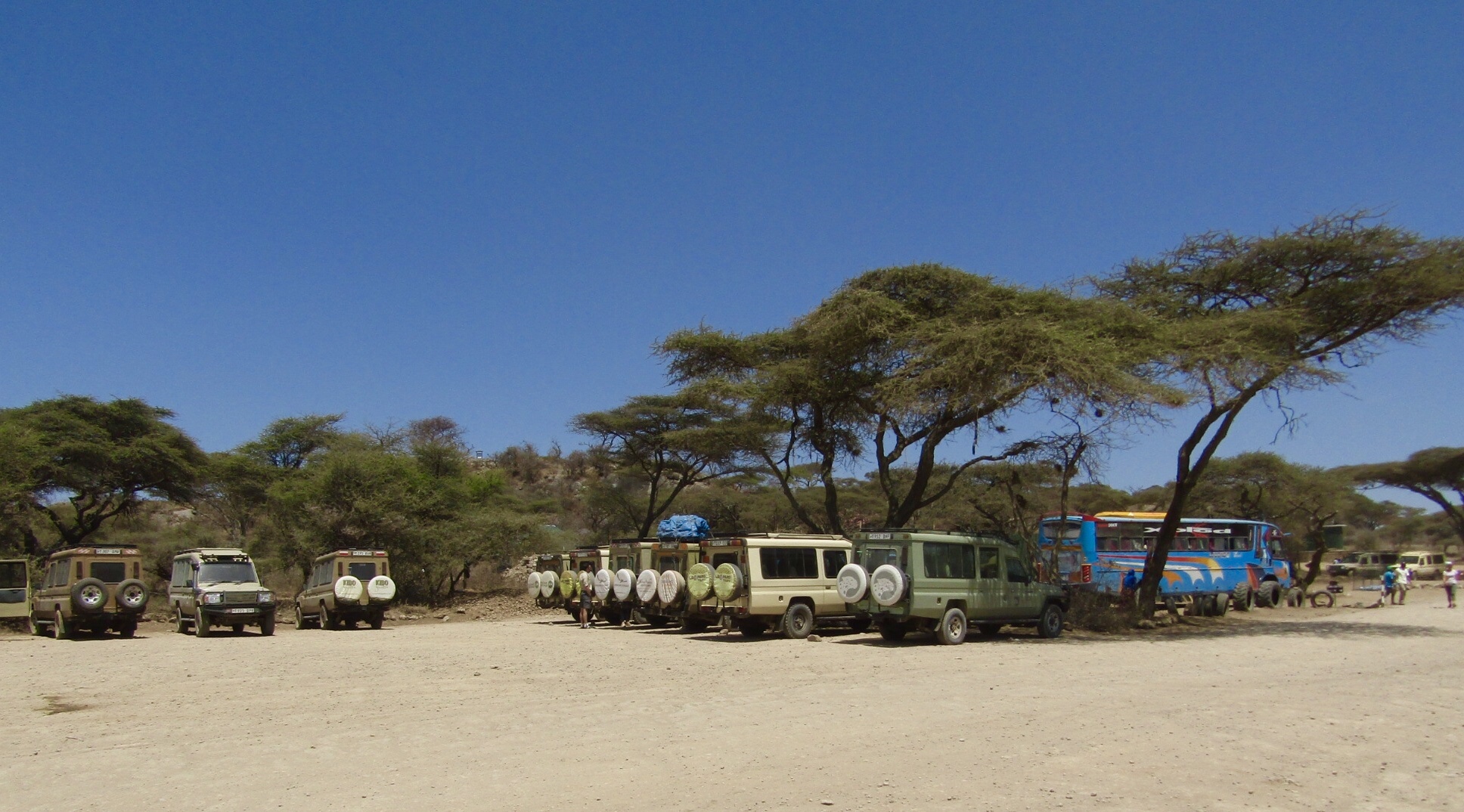
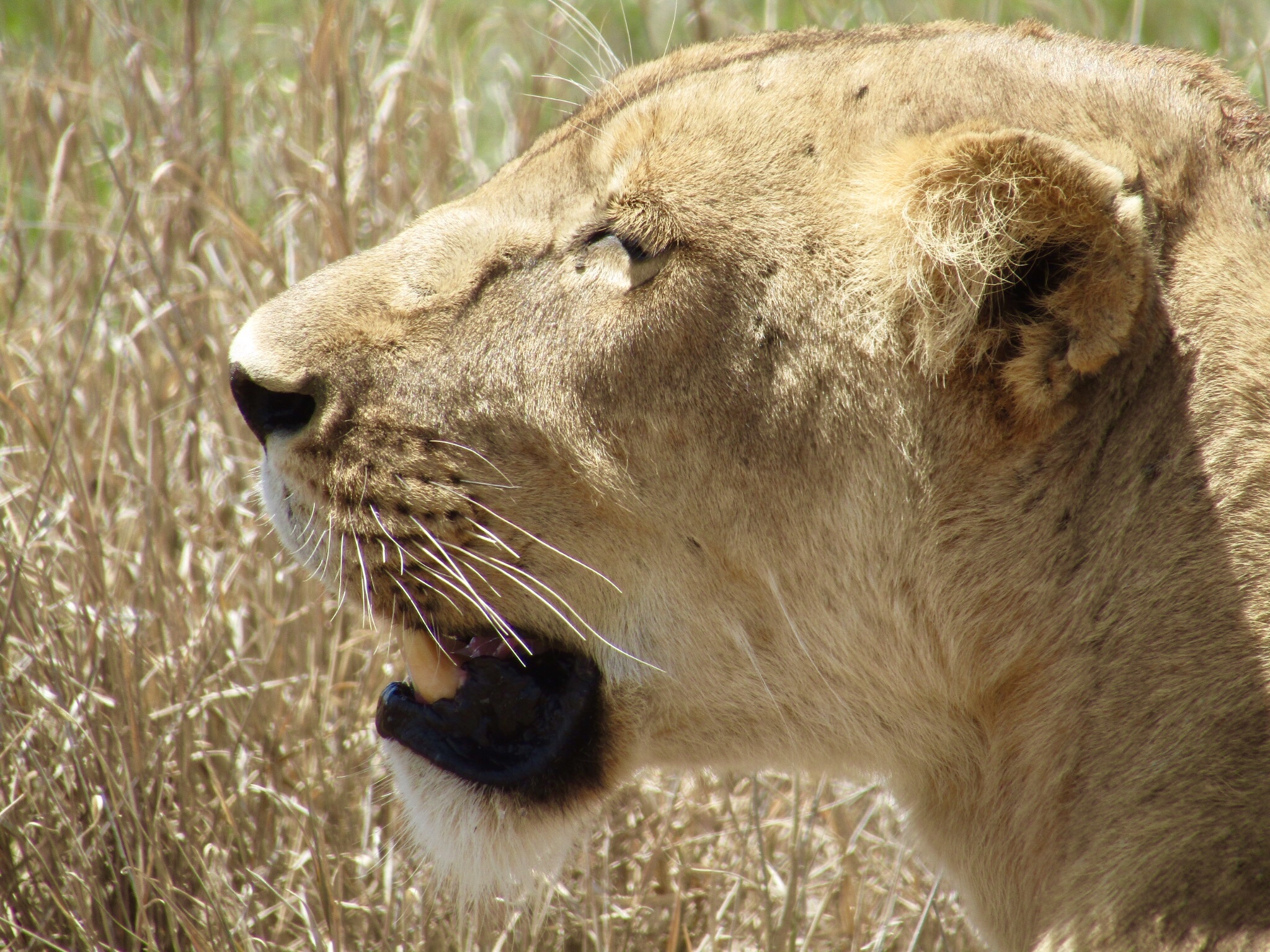
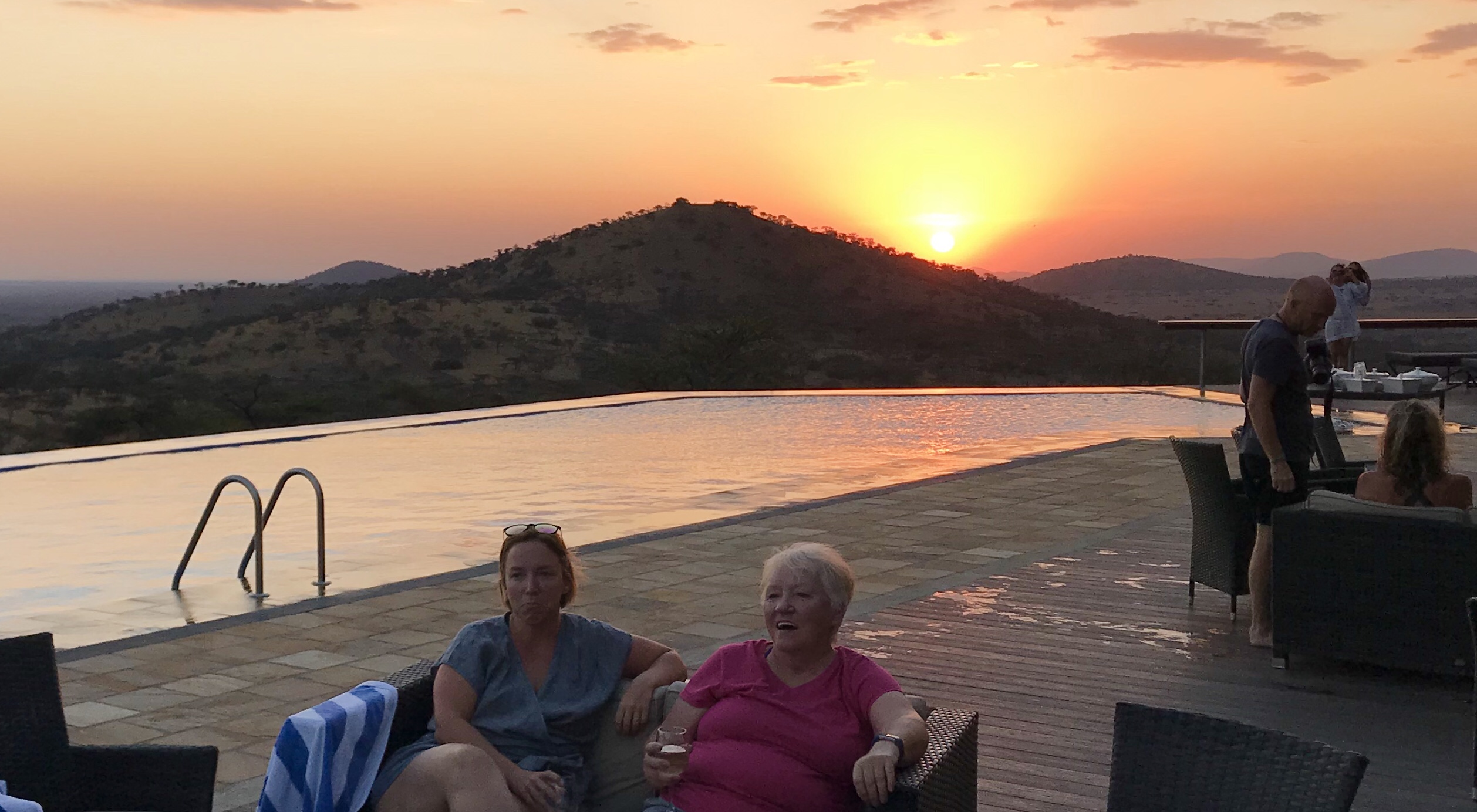
After several more hours of driving through dusty endless featureless plains filled with gazelles, zebras, ostriches, and an occasional hunting lioness, a brief stop at a rest stop that felt like it was out of a Mad Max movie, more bumpy dirt roads, and winding up a hillside, we suddenly appeared at a safari lodge where they welcomed us with chilled white towels and champagne. And an infinity pool with a view of a hundred miles of Serengeti under us. And a sunset from a Fauvist painting. Vivian echoed all our thoughts. “Daddy,can we spend the rest of the year here?”
The kids are settling into their traveling lifestyle. So far, 10 days into their year of travel, they have hit the books for about 30 minutes one day. Meanwhile, the stuff they leave in their hotel / safari lodge rooms at checkout has steadily decreased.
We stayed the night before at the very edge of the Rift Valley looking over the infinity edge pool (too cold for me) into the seemingly infinite shores of Lake Manyara shrouded in mist. Yesterday we drove up to an amazing property called the Retreat at Ngorongoro, just outside the Ngorongoro Conservation Area and had a lazy afternoon and evening and used the fireplaces in our rooms at night to warm up. In the morning we loaded into our 4x4s and headed from an elevation of about 4800 ft up to 7000 ft at the rim of the Ngorongoro crater which was completely covered in fog and clouds. Philip drove us around the rim and down into the huge crater floor. The rim is heavily wooded steep and the crater is flat and grassy. Once we were down in the crater, the clouds had burned off and we were left with a brilliant blue sky and a perfect day. The crater was formed about two million years ago when the caldera of a volcano collapsed into itself, and Wikipedia bills Ngorongoro crater as “the world’s largest inactive, intact and unfilled volcanic caldera.” It is a Garden of Eden for wildlife – no humans live inside the crater.
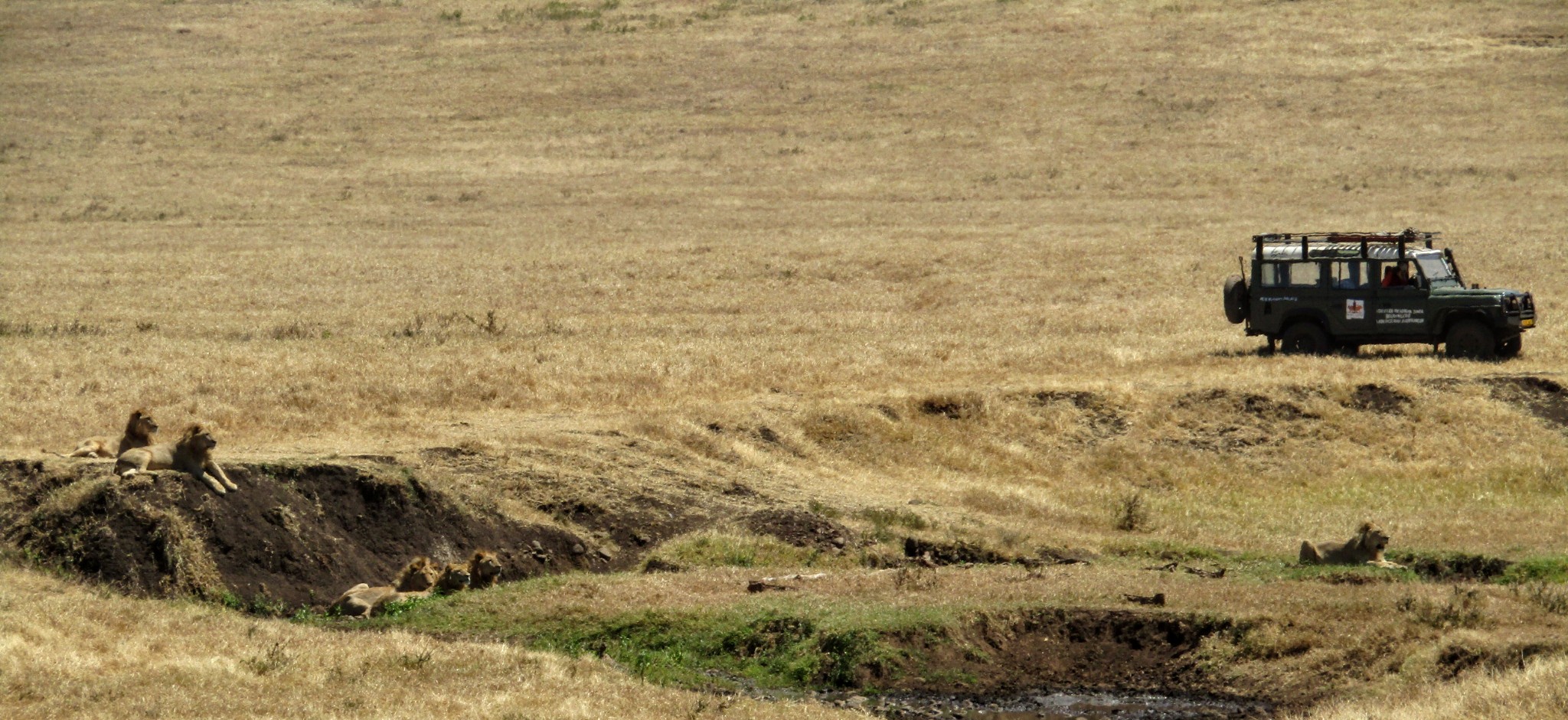
We explored the crater floor till lunch time. A lot of that time was spent looking at a bachelor group of six young male lions. They were resting on top of and under a bluff when we discovered them, and at various times, they sat up and expressed interest in a passing lone buffalo but they didn’t move much. If you look at the third photo down you can count the six lions. There is an army green safari truck in the photo whose lone occupant is the Lion Lady, Ingela Jansson. She is studying the whiskers of the six lions which is how researchers identify them.
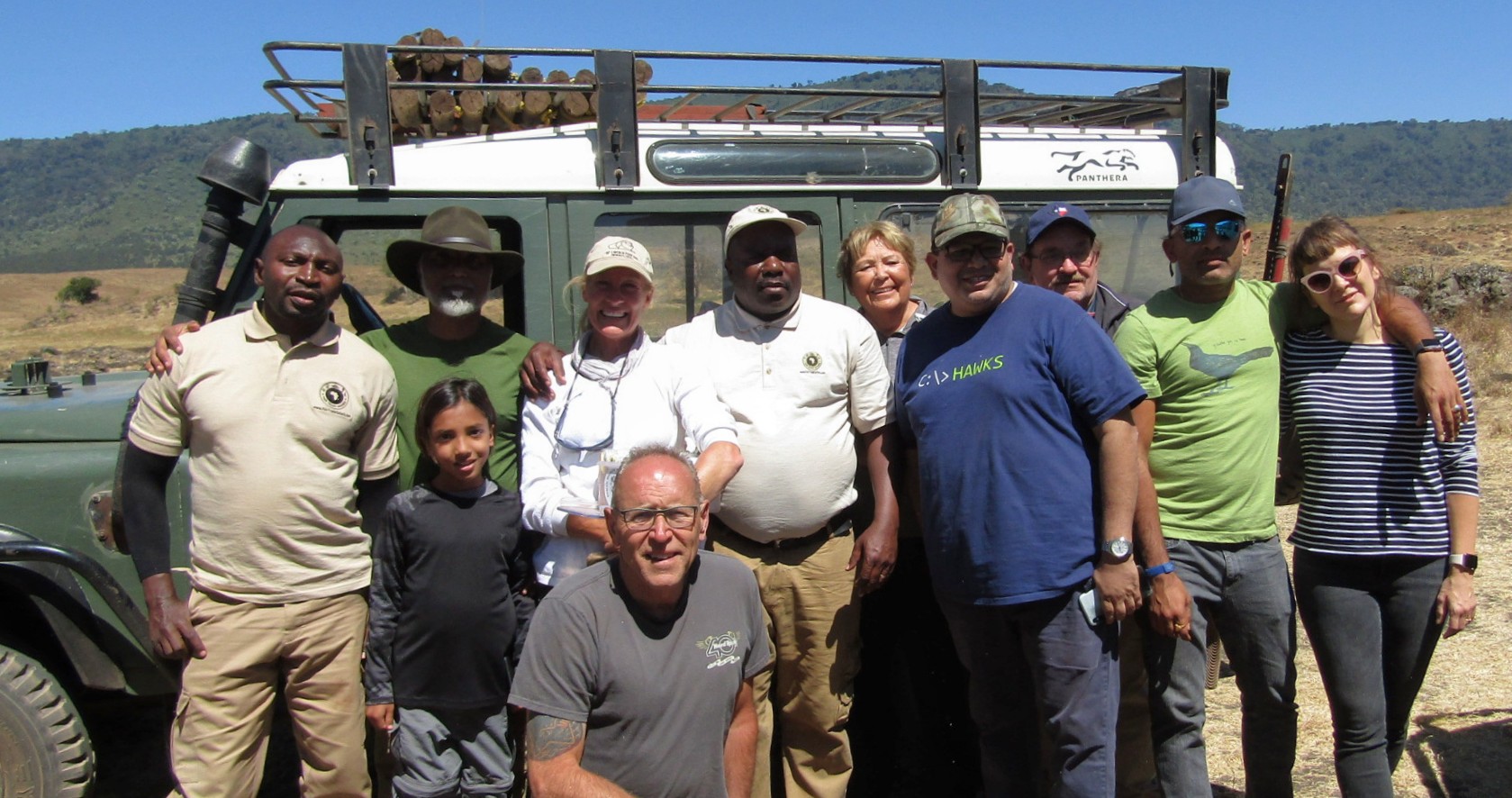
Over a boxed lunch of grilled chicken and fruits, Ingela explained her work to us. Our group of two safari trucks and thirteen visitors are customers of Austin and Arusha based Fair Trade Safaris which helps fund conservation efforts in several places, including Ingela’s work. Ingela explained that about 20 years ago she realized that the main pressure faced by lions were humans, the pastoral Maasai who share the Ngorongoro Conservation Area with the animals (unlike the national parks which are exclusive zones, the NCA is a mixed use land, allowing animals and a few tens of thousands of humans to co-exist). So she created a system to lion guardians based on a system that had been shown to work in Kenya, where a Maasai warrior is a full time member of her group, and his job is to keep track of and facilitate the safety of lions and cattle (and humans) in his home area. Ingela’s experience has shown that pride in being a guardian of lions, having a well-paid responsibility, and keeping his people and the lions safe is a suitable proxy for being the brave Maasi warrior who under other circumstances would have killed the lion.
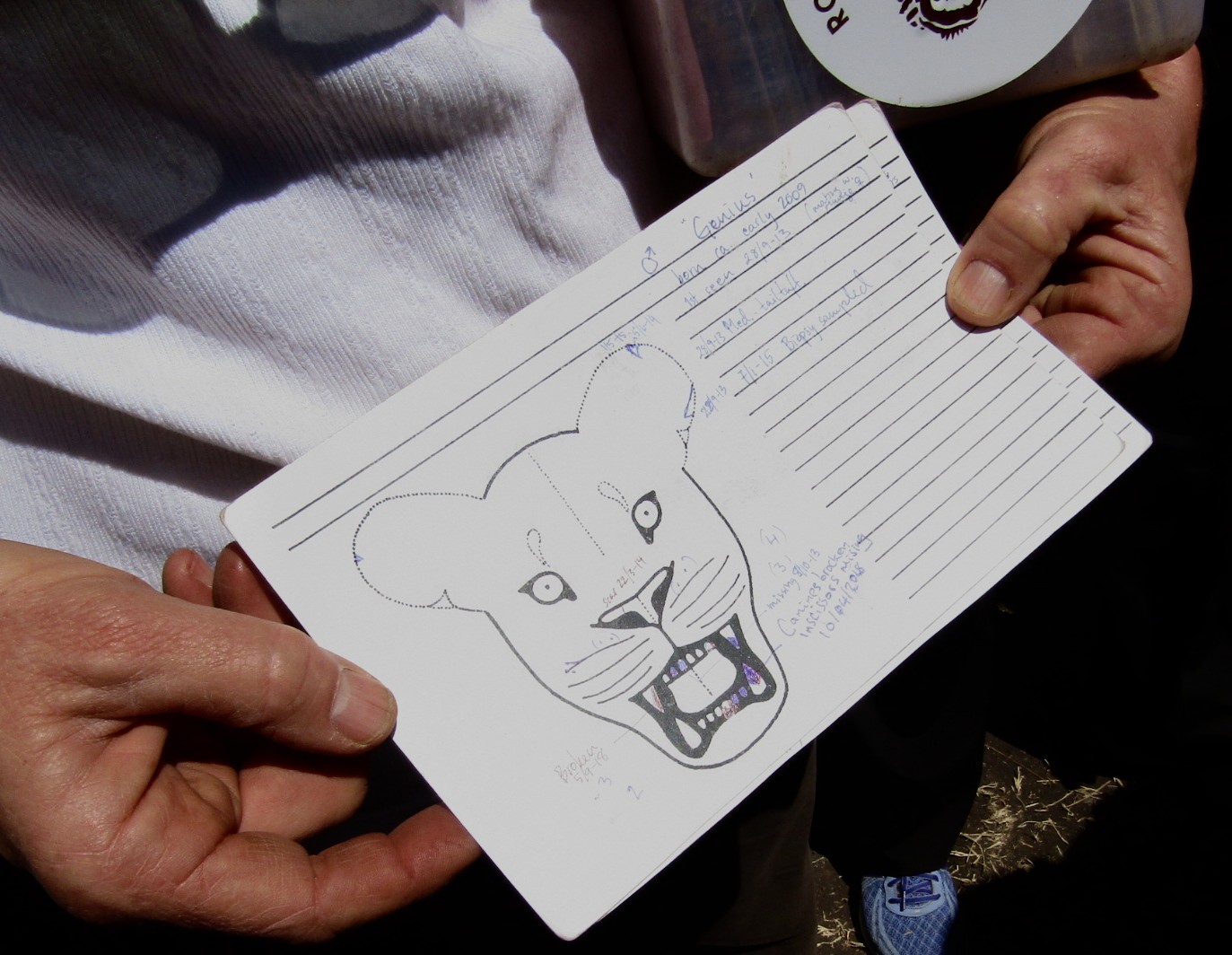
Ingela then shared a box full of cards with the whisker marks, parentage, age, and other details of every lion in the area. We looked at the six we had seen earlier in the morning. Evan had the opportunity to rename one of them Leo after his friend (like most others it carried a number, in this case MASEK-89 or something like that). So, Leo – if you get around to Ngorongoro, you may be able to see your namesake one day! In the group photo, Evan is standing in front of me, and to his and my left is Ingela, the Lion Lady.
The very first stop on our safari is Tarangire National Park – one of Tanzania’s premier parks that often gets overlooked in favor of more glamorous cousins like Ngrongoro and Serengeti. Joshua drove us there in about three hours from Arusha, explaining the lay of the land and its people along the way. We got there at lunchtime, ate our boxed lunches, and drove into the park.
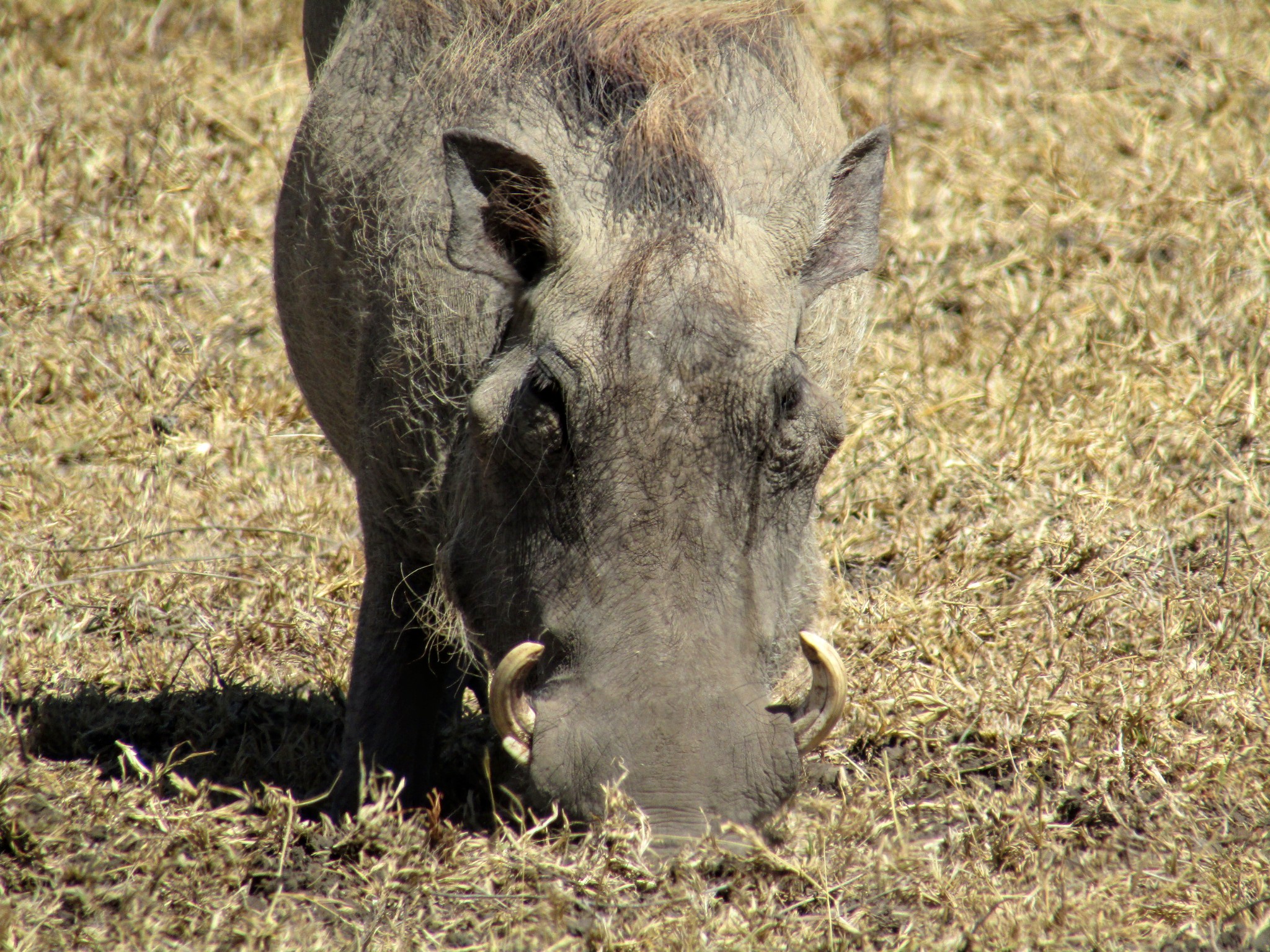
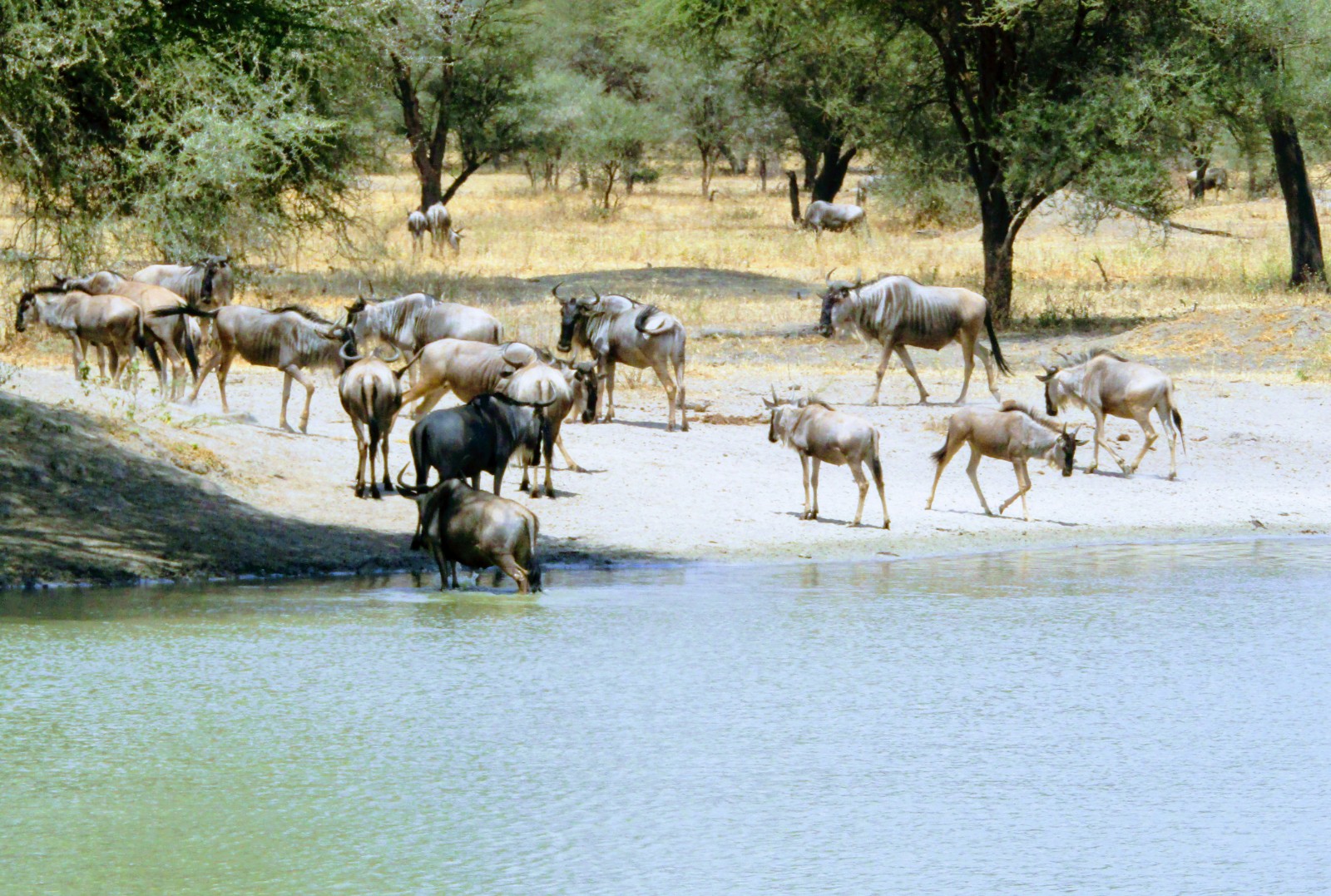
We came up to a watering hole and saw a large number of wildebeest, zebra, and an odd warthog or two. Wildebeests are amazingly unattractive animals and seem to have been badly welded together from discarded portions of cattle, horses, elks, deer, and other animals. Geeks of a certain vintage will recognize them from the cover of the O’Reilly Gnu book (yes, they are indeed gnu). Their other claim to fame is that they are the most popular prey animal on the African savannah.
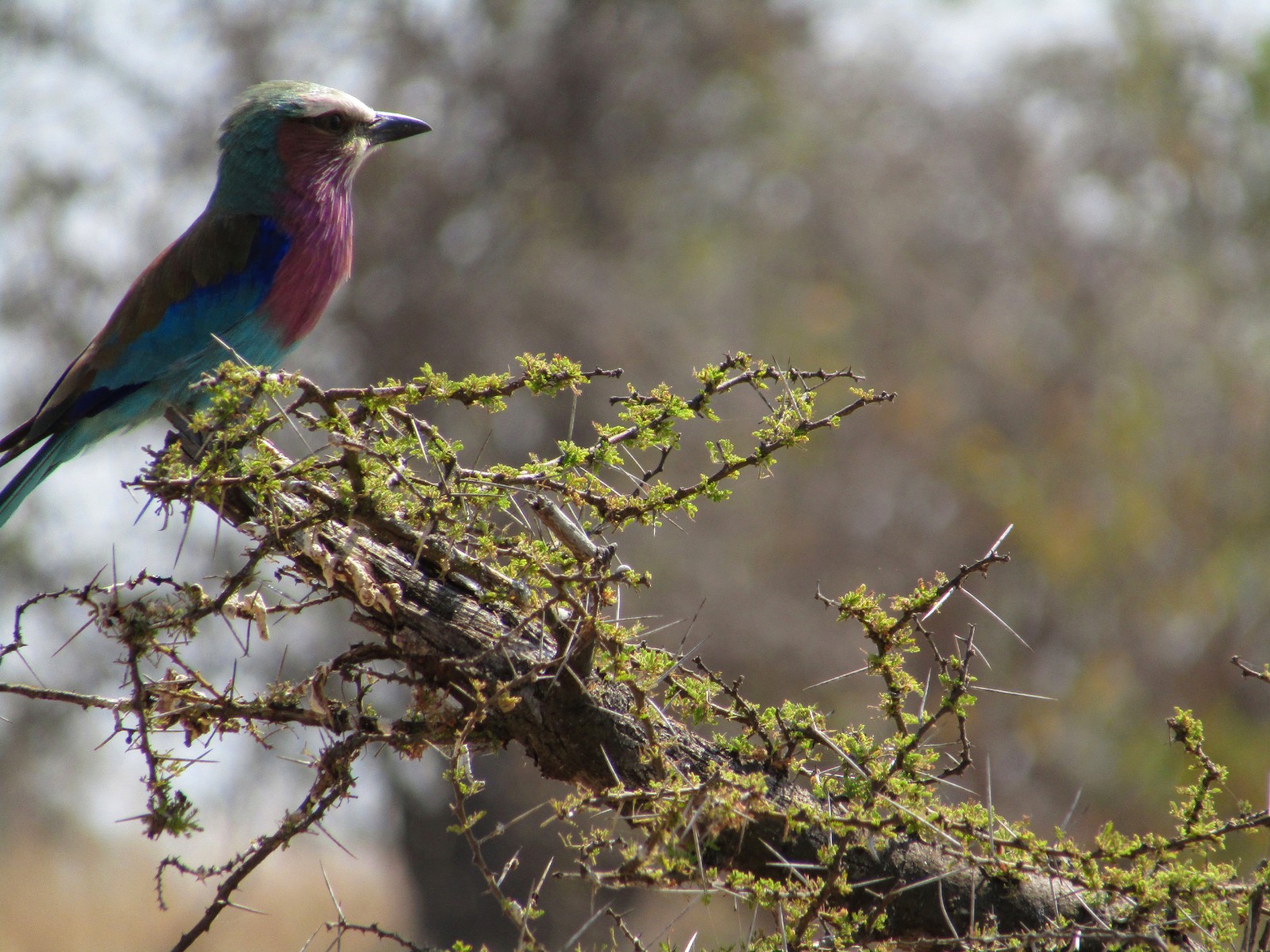
We saw Baobab trees, lions, elephants, baboons, lilac breasted rollers, secretariat birds, and other amazing wildlife. And spent our first real day of our vacation together without any real disasters. About 360 days to go!
While I write this post from the comfort of my hotel room in Arusha, Jo, the kids, and Carol left Austin this morning. Or they tried to. After an eight hour delay they finally made it to JFK past 1am, then to their hotel for a short rest before continuing on to Doha and Arusha tomorrow. Jo was in low spirits at one point. I tried to cheer her up by saying that we’ll only be doing this for one year. She wasn’t amused. I hope to see their shinning smiling faces tomorrow afternoon here at the hotel.
If someone tells you to start climbing from Barafu camp (elevation 4,680 m or 15, 354 ft) at midnight, and reach Uhuru Peak (5,895 m or 19,341 ft) , the highest point in Africa, by sunrise you should rightfully tell them to bugger off.
So the six of us, and three guides and three other support crew headed off up the steep rise north of camp with our headlamps on and dressed in all of our warmest clothing. By the time we got to the Rock – the first steep climb, you could see a snake of headlamps reaching towards the stars. We knew we’d be climbing for six or seven hours.
Soon I was an automaton. Just putting one step in front of the other. Not letting the wind push me over. Climbing. Stopping and forcing a sip of half frozen water down throat. Then getting back up and following Nita’s backside up the mountain. My eyes were glazed and I felt like a sleepwalker. My hands were freezing. So was my snack – the Kit Kat in my pocket. The snake of headlamps went higher and higher and I followed. I stopped at one point to put on my balaclava. It made my face feel warm and dry for 10 minutes. Then my snot froze around the nose opening and it felt like I was wearing a block of ice. I was too tired to take it off.
I was aware enough to analyze how I felt and while the easy answer was “like shit”, there was really nothing wrong. So I kept at it. Still – this was firmly in the no fun zone.
Then dawn came and a glorious sunrise lit up the whole continent under me (thanks for the photo, Nita). My senses were all pared down to just keep me climbing, but even in that state I felt the sunrise. The snake of headlamps faded out in the daylight and the abstract was replaced by a huge mountain still above me. I had been steadily climbing for five hours in the darkness. How could there still be so much to go? But the sun was on my back and I put one step in front of the other. Stella Peak finally appeared. I was on the crater rim. Yassin gave me a huge hug and pointed the way up. I could see the wide sweep of the rim to my left, towards the final prize, Uhuru peak. I had expected the rim to be flatter. But the going did get a lot easier. I started looking around. Enjoying the white blue-green vertical ice faces of the glaciers. Looking down into the crater floor. I met Aaron and Bernard returning from Uhuru. Only 20 minutes, they said. Like the last round of a workout, I walked faster than all night and suddenly there was Uhuru, with it’s shabby chick wooden signage. It was 8:45 AM.
There was a big contingent from a cancer or urology group from Omaha taking photos at the peak. It took them for ever, but by then I was a functioning human again. I could speak and eat and drink and look around. Gaspar and I took photos. We chatted. I thanked him. After a while we headed down. In three hours we were back at Barafu camp. I still couldn’t eat, but rested a bit. Then the walk to Mweka camp – at least four hours below. It was pitch dark by the time we got to camp. We started that day in the dark and ended it likewise. Still couldn’t stomach the thought of food. But got a good night’s sleep. Next morning, Day 7, was an easy 9 km hike from Mweka camp down to Mweka Gate and suddenly we were out of the park and Kilimanjaro was behind us.
Done. I climbed the mountain, but with a ton of help and support. And I learned more about myself than I did about Kilimanjaro. Would I recommend it? Absolutely. About 5 hours of feeling miserable out of a week of fun. I can work with that.
Thank you, Gabriele, Onsemo and Yassin, for putting a great group of people together to take us safely up and back down. Thanks, Jen, Sam and Kevyn, for keeping the old bones moving. Thanks, Aaron for agreeing so readily to jump into this adventure. And thank you, dearest Jo, for giving me the time and space to continue to do stupid shit. And you thought I’d fall off the mountain… : )
After Aaron left for the airport at 2:30 AM this morning, when I walked back into the hotel lobby in Arusha, the security guard seemed confused. I explained that my friend was headed home but I was not. Where was home, he asked. “America”, I said. The man’s face furrowed with concern. “I hope he is safe. Lots of shooting”. I assured him that America was a very safe country and that there was no reason to worry. Then I came back upstairs and checked some stats. We come in at 4.9 homicide deaths for 100,000 people in the population. Better than Somalia, but not as good as Rwanda. Incidentally, we take better care of our mentally ill than those two countries. And play a lot more violent video games than them. Hmmm – I’m so fucking confused…
Back to Kilimanjaro. At 5,895 m (19,341 ft) it is not ranked in the top 200 peaks in the world because all of those are in the Himalayan or Hindu Kush ranges. It is the tallest peak in Africa and the 4th tallest in the world according to an obscure ranking called prominence – which measures how much taller a peak is compared to it’s surroundings. It’s supposed to be the tallest mountain that you can walk up. A seven year girl from Austin and an 89 year old woman have climbed it. The fastest ascent took only 4 hours and 56 minutes, and then the dude sprinted back down in less that 2 hours. Most amazingly, Kyle Maynard – who was born without arms or legs, crawled up unassisted every step of the way to the top of the mountain in 2012. About 30,000 people attempt to climb up to the top of Uhuru peak each year. Two thirds make it. One thousand are evacuated due to acute altitude sickness. Somewhere between 10 and 30 die. Altitude sickness strikes unexpectedly – we saw a porter being evacuated who had made the trip many times before. Putting it in perspective, this may be the hardest thing I have attempted – the hike to Everest base camp / Kalapathar was a walk in the park. But I’ll try not be offended if a seven year old limbless girl passes me on the way to the summit of Kilimanjaro.
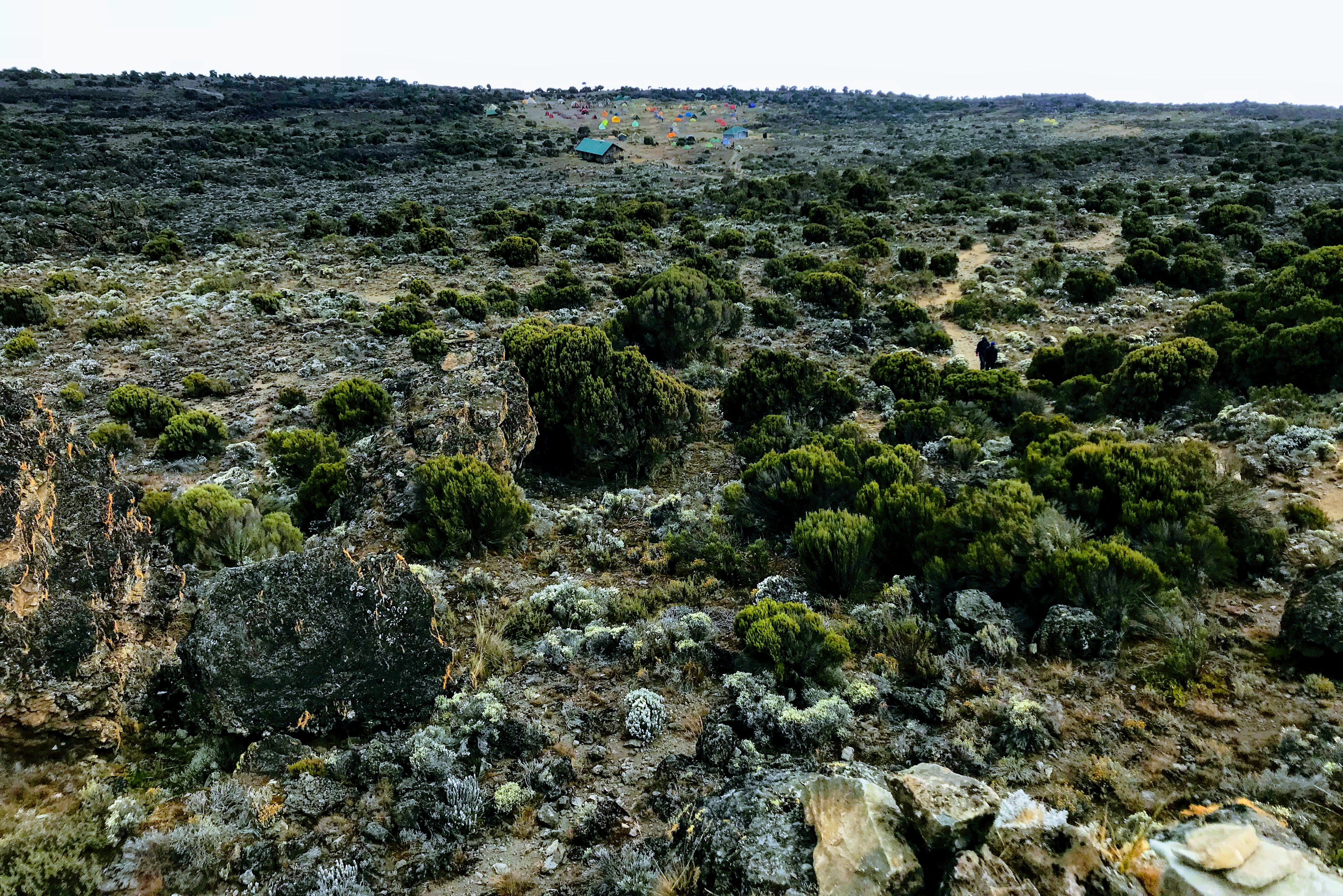
On the second morning we wake up at Machame camp with the smell of composting toilets indelibly mixed in with the morning tea and breakfast. Today is a short but steep day. Over 1000 m of elevation gain in about 5 km. We get to Shira camp (3,850 m or 12,631 ft) nice and early. A couple of the guides take two of us on a side hike after lunch. Here’s looking back down towards Shira camp. You can see the registration hut and the colorful clumps of tents in the distance. If you like the stark Martian beauty of alpine landscape, this place rocks.
Day 3 is interesting. We climb from Shira camp in the morning to reach Lava Tower at lunchtime. Lava Tower is at 4,600 m (15,091 ft). It’s getting harder for me to find oxygen in the air. Kibo peak and Arrow glacier rise up like a giant to our north. But after lunch we descend through some stunning scenery into the beautiful Barranco valley all the way to Barranco camp at 3,900 m, ending the day with a paltry net gain to 50 m. It rains the last hour but not too hard. We should have stopped and pulled on our rain gear. We are wet and cold and grumpy by the time we crawl into our tents. The camp is immersed in a thick soupy fog-cloud. A Boy Scout could get lost between the mess tent and the toilet tent. It rains all afternoon and starts getting seriously cold. Ice forms on our tents. In spite of Chef Manasi’s best efforts, the food is beginning to taste like ass. And Aaron says I’m snoring louder each night.
After midnight the clouds clear and the night sky is spectacular. I feel I can reach past the stars to the Magellanic clouds. As the purple light of dawn approaches, it’s obvious that our tents are at the edge of a precipice. The sheer drop into the Barranco valley is balanced by an ominous wall of rock rising straight up on the other side. Shit – it’s the Barranco Wall which is the first item on our to-do list today.
What are you doing, staring at the night sky instead of sleeping, you ask. We have been told to hydrate like sea sponges, and we are taking Diamox – both in efforts to stave off altitude sickness. But the combination makes me want to leak like the Exxon Valdez. So I am cozy and almost warm in my sleeping bag. Then I have the urge to pee. I ignore it. Eventually my urine-soaked brain realizes that the problem isn’t going away. I unzip my bag. Grope for a light. Put on a warm layer, hat and gloves. Unzip several zippers and flaps in the tent which seem maximized for making very loud sounds – all while trying to not wake Aaron. Find my boots. Pull them on. Lace them up (no one wants to drag their laces through the dirt of the toilet tent). Bend down, twist, push head out of tent, do a Turkish get-up, run to the toilet tent. Yell knock-knock. Pull down the toilet tent zipper. Rush in and try to hit the tiny shitter before I piss on everything because my penis feels like an uncorked magnum champagne bottle at the winner’s podium at F-1. Then reverse the process, though with the added benefit of being fully wide awake and cold but in possession of an empty bladder. Finally back in my bag and almost warm. And then I have the urge to pee.
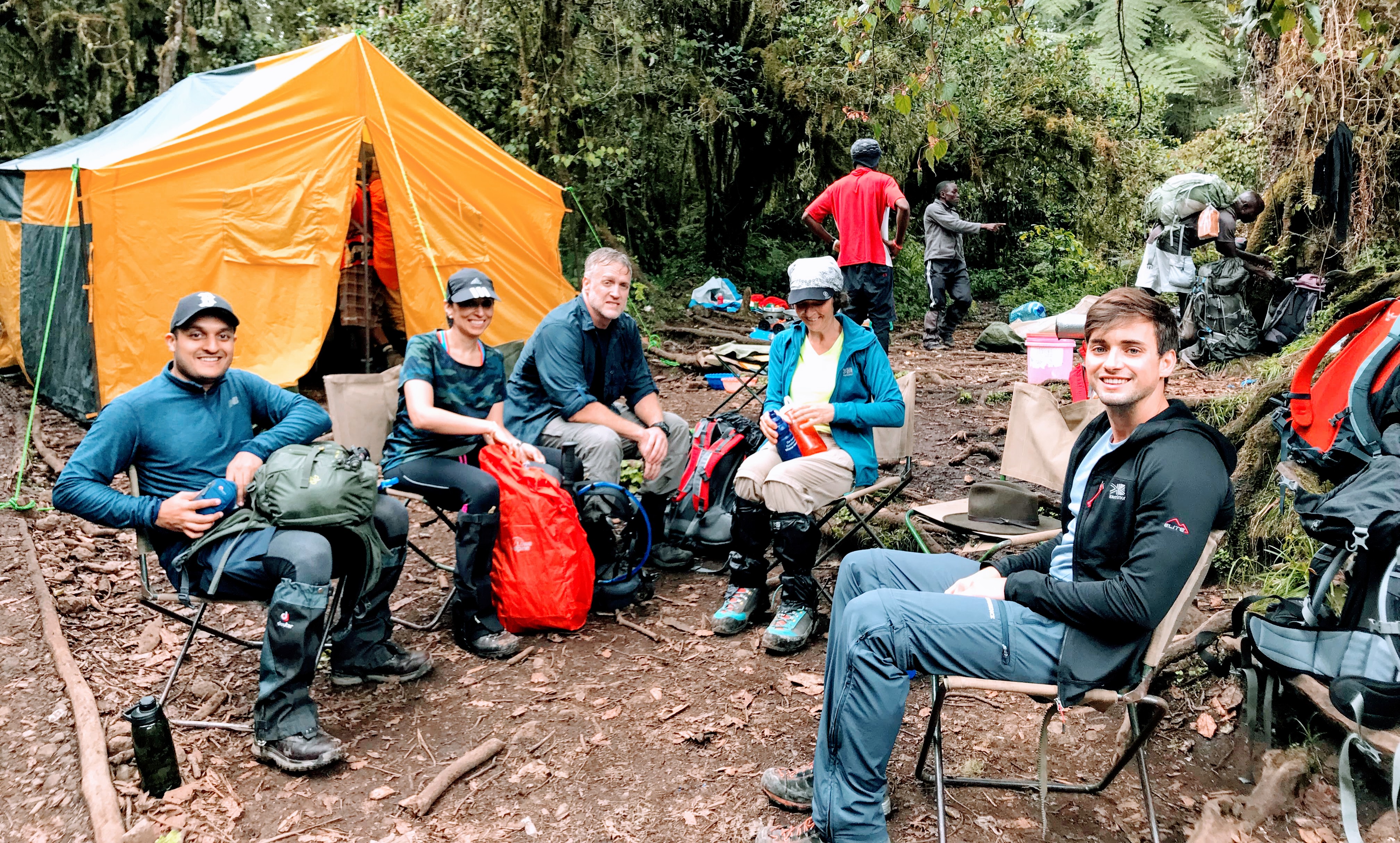
There are six of us. Besides Aaron and me, there is a son and mother pair from Austria. Bernard is a medical student from Salzburg. He’s the kid of the group and at the prime of his life. When he’s cold which is often, he does mini jumping jacks. While I try to find a rock to sit on. Christine is a doctor in Vienna and though she doesn’t start conversations, she’s nice to be around. And she hikes like a robot mountain goat without a hint of tiredness or emotion, her first step as perfect as her last. The other pair are Indian cousins from London. They are funny, especially Nita, who is sinfully easy to joke around with. She’s a banker and is as good at giving verbal shit as she is at getting it. Ajay is young and in pretty good shape though he seems to be coming down with a combination of a stomach bug and mild altitude sickness. It’s a good thing the mess tent has a dirt floor.
One night we celebrated Nita’s birthday. Chef Manasi produced a birthday cake with icing and all – made in a kitchen tent using a gas stove and a saucepan at three miles above sea level. The whole crew comes in and sings Nita happy birthday in every known African dialect. Then they sing her many other songs, eventually serenading her good night (lala salama). These guys are seriously nice. They treat us better than I treat my kids. And I bet I get paid only slightly less for my efforts.
Back to the Barranco Wall. As we wake up and drink our tea and wash our faces on the morning on Day 4, we unwillingly start noticing how small and insignificant and precarious the climbers on the wall look. And how big and inhospitable the wall is. Here’s a great photo Nita took of Bernard standing at the edge of our camp with his camera and taking a photo of the Barranco Wall. We put on our day packs, but we look about as excited as a bunch of wet cats going in for prostate exams. The crew sense we are feeling pretty blue. They burst into catchy camp songs. We get sucked into the tempo and rhythm of the jambo jambos and bomba bombas and join in. Soon everyone is dancing and clapping hands and singing whatever we can. Ten minutes later we leave camp smiling and warm and ready to tackle the Barranco Wall.
Outside of the summit, the Barranco Wall is the media hog of Kilimanjaro. But it’s reputation far exceeds it’s bite. It is an 800 foot climb diagonally up a craggy cliff face with lots of hand and foot holds. The guides help us at exactly the right places while the porters still run up the wall – occasionally having to throw their loads up to a higher point and then climb after them. Looking down isn’t a good idea though. We make it up in less than two hours. Christine later tells me that she is terrified of heights. She was in front of me the whole way and I had no idea. Robot mountain goat.
We cross some deep valleys, the last of which is the Karanga valley, and end Day 4 at Karanga camp, with only a net 60 m gain to show for our efforts. Kibo peak rears up above Karanga valley marbled with ice like a fat rib eye. The summit looks doable.
Day 5 is easy. Short hike from Karanga camp to Barafu camp at 4,680 m (15,354 ft). It starts snowing and then sleeting on us about 30 minutes out of Barafu camp. The air is thin, I force some instant ramen soup down for lunch, skip the early dinner, and am up in the pitch darkness and chilling wind at 11pm to start getting ready for the summit climb. One way or another the shit meets the fan tomorrow.
Climbing Kili was on the top of things I wanted to do in Africa. I needed to get it out of the way early in the trip, while I still had some of Jen’s pre-holiday conditioning. But that meant leaving Jo to finish buttoning up everything in Austin and then travel the first leg to African with the kids by herself (though from the word on the street, I hear she is happy to have me out of the way so she can “finally get some shit done”).
We are to start on July 28 and take seven days to summit Kilimanjaro and clamber back down. Aaron and I meet our motley crew of four other fellow climbers and lead guide, Yassin, in Arusha the evening before. Yassin, checks and weighs our gear to make sure it is less than 15 kg. My old Northface duffel comes in at 11 kg which includes the heaviest rental sleeping bag in the world weighing a whopping 3 kg. But no worries – I’m not getting anywhere near my bag – there are porters for that.
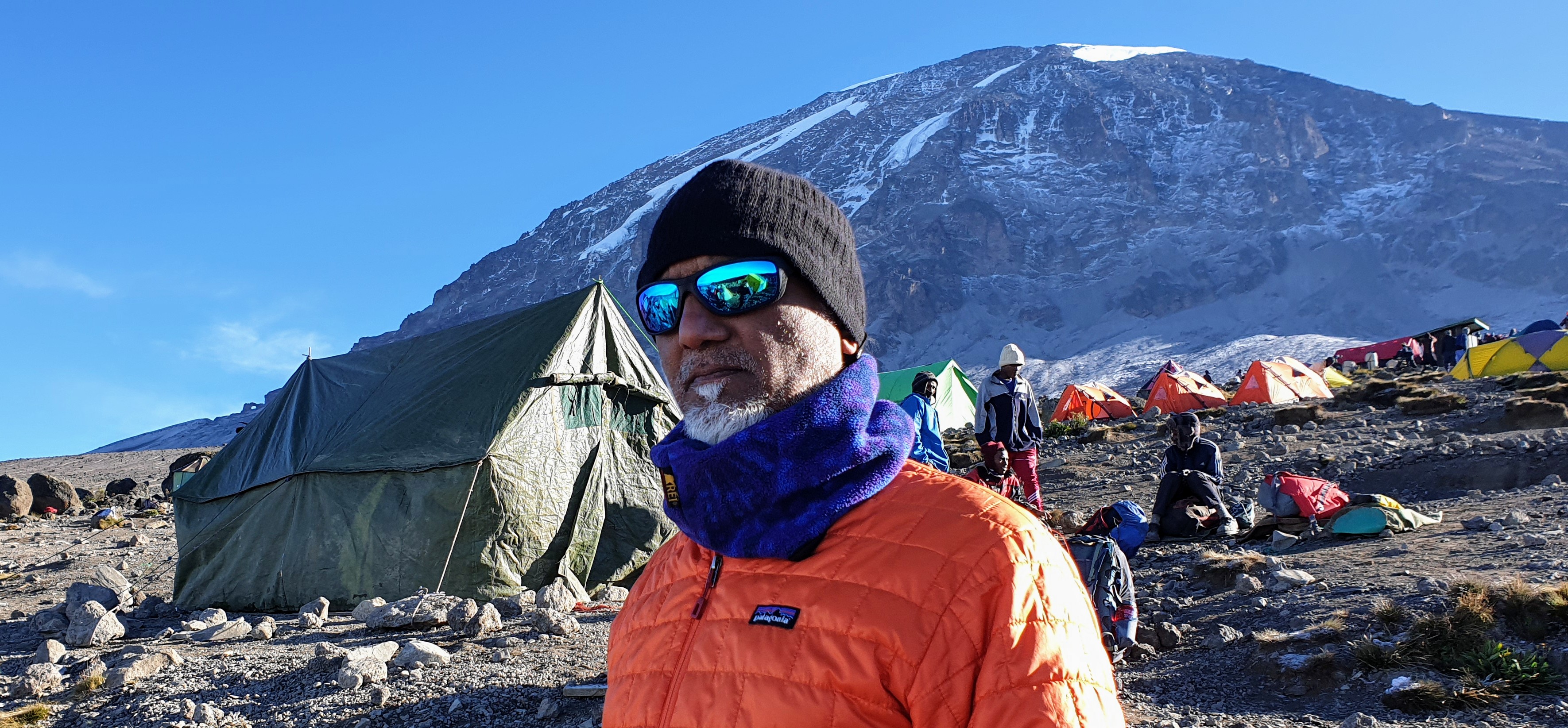
The next morning we are driven to Machame Gate (evelation 1800m or 5906 ft) where we meet the rest of our support crew of about 20-25 people. It is busy but not overly so – perhaps 5-10 other small groups also setting out. After registration and weigh-in (to ensure that porters don’t carry more than 20 kg each, and to get an initial weight so people don’t leave trash on the mountain), we set off. The porters mostly balance their main load on their heads. With lots of smiles and nods and “jambos” they soon zip past us carrying their loads. They aren’t massive in a body-builder / weight-lifter way, but all stringy and tough and typically dressed in well-worn t-shirts from major football clubs or name brands, sweat pants, and pretty run-down shoes or hiking boots. Yassin introduces us to our other guides – Frank, Johnson and Yassin Jr, the camp manager Gaspar, the chef Manasi, and a couple of other key people in the crew. Our path is a nicely graded road that snakes steadily upwards through dense “montane forest” – or temperate rain forest. Lots of huge trees, giant ferns, moss and epiphytes that would grow on your ass if you stood still long enough. The road gives way to a narrower tidy graded trail which then turns into a single file path with frequent muddy steps of various sizes and tree roots designed to trip.
Our first major stop was for lunch. Due to being the first day and all, Yassin had informed us that it would be a cold lunch. We reached a clearing on the trail and there was a large yellow and grey mess tent set up with a table and enough chairs for 7 of us. Chef Manasi served us quiche, cake, fresh fruits, and kachumbari (a fresh tomato and onion salad with large chunks of avocado and lots of lemon). Waiters provided soap and water for us wash hands before lunch. Everything was served on real plates and metal silverware. We finished with hot tea.
While I was still mulling over how little had changed since Dr. Livingstone, we were introduced to a young man who was our toilet guy. He walked us over to a tall narrow tent (like a tent version of a sentry box outside Buckingham Palace but with a huge zipper running down the entire front) and gave us a tour of our toilet. Inside was a smallish white plastic shitter with a little trap door into the shit container below, a pump to flush water, and a metal container slightly larger than a big coffee mug with a matching metal lid for used TP. All nice and clean and very doable. The toilet guy’s job was to empty an clean the toilet multiple times a day and to carry it all up and down the mountain – tent, toilet, and all. We quietly agreed that he had the shittiest job.
By the way, lest you think I’m a total jerk, the tour company had assured us that “Urth Expedition is a proud partner with the Kilimanjaro Porters Assistance Project (KPAP), a local non-profit organization that is dedicated to the fair treatment of porters and crew on Kilimanjaro. KPAP is the local initiative of the International Mountain Explorers Connection (IMEC) and performs the monitoring activities for IMEC’s Partner for Responsible Travel Program. We gladly follow strict standards in more than 10 areas of treatment criteria to assure that we are responsible, fair and have good treatment practices towards our mountain crew. Each trip is reviewed by KPAP to insure compliance. Because of our partnership with KPAP, you can rest assured that you are choosing a company that can make you confident you are making an honorable choice by being a part of the commitment to a humanitarian cause.“
A few hours after lunch, as we approached our first camp I thought it was easy going and I felt like a champ. By camp, we would have hiked about 11 km and gained about 1000 m. On the trail we occasionally we’d step to one side to let porters hurry past us up the mountain with their 20 kg bags on their heads. They had to take down the mess tent and toilet and all the other stuff after lunch and get past us up to camp and set it all up before we got there. All that while the guides told us over and over again to go “pole pole” – pronounced polay polay, meaning ‘slowly slowly’ in Swahili. Or perhaps “pussy pussy”.
acclimatize/əˈklʌɪmətʌɪz/verb: become accustomed to a new climate or new conditions; adjust.
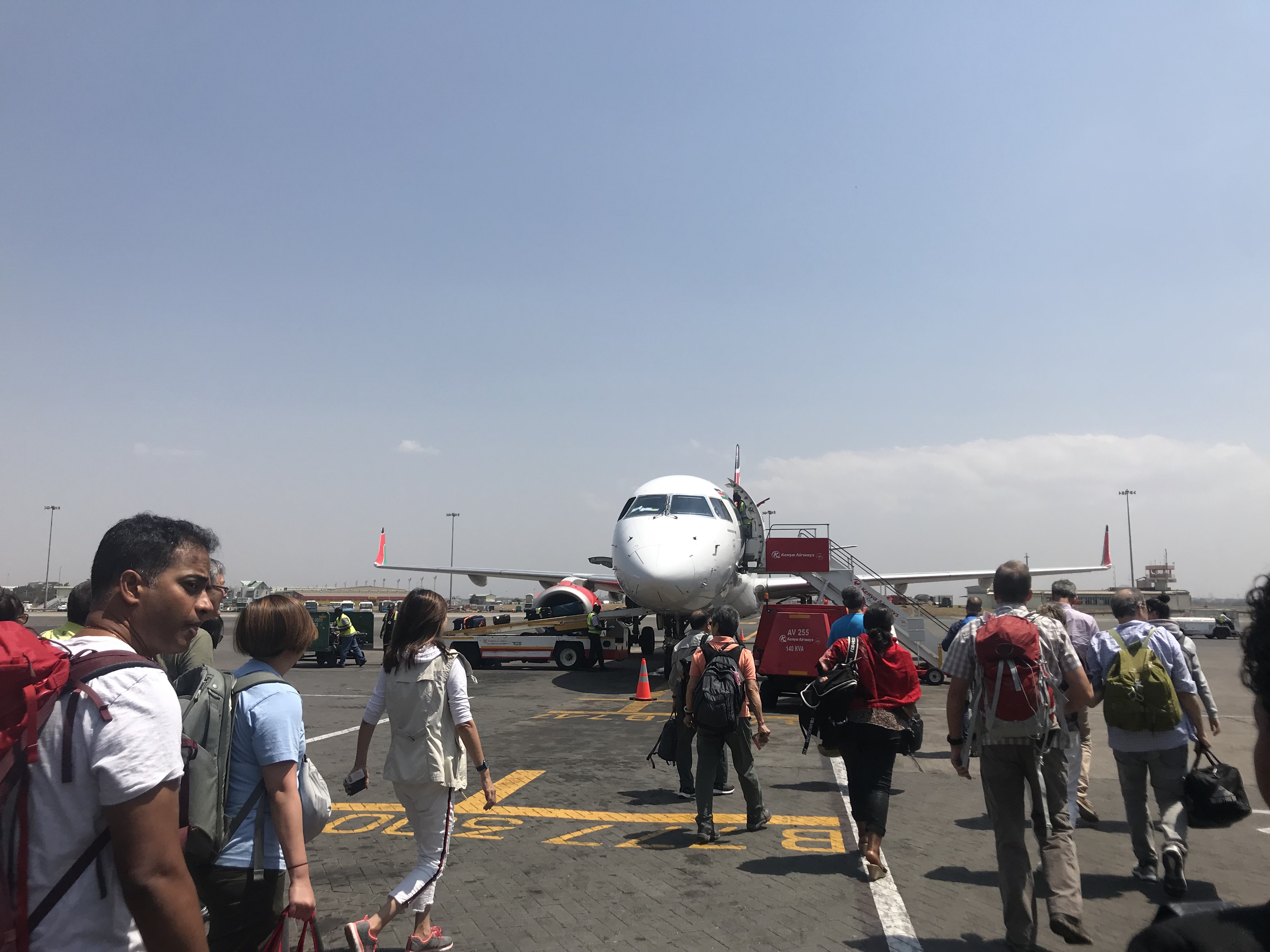
I’m acclimatizing to the altitude, which is why Aaron and I are here a few days before the climb. Arusha is at 4,600 feet above sea level. There’s a mountain outside my hotel so tall that my incoming Kenya Airways flight from Nairobi had to fly around it. Kili towers at 19,400 feet. That’s the elevation of Denver added to the height of Mt. Whitney, the tallest point in continental USA.
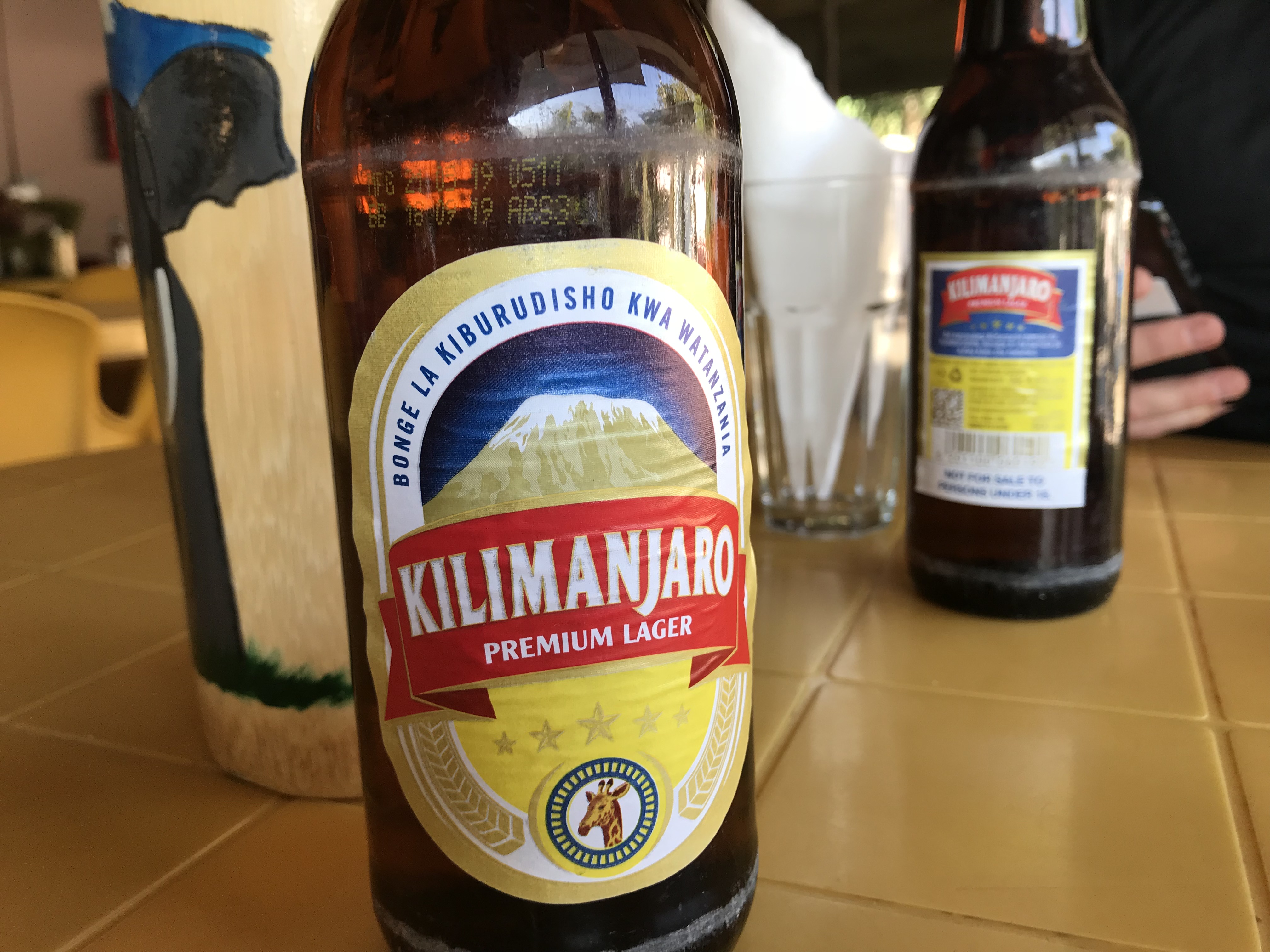
Tanzania seems easy to slide into. Aaron and I are drinking beer with eminently marketable names like Kilimanjaro and Serengeti. We tried our first plate of ugali with nyamo choma (corn flour porridge – though in a consistency that you can cut with a fork or almost break off with your hand, and grilled meat). We have level zero Swahili down – keeping our asantes and karibus straight in a culture where people are constantly thanking or welcoming you.
I’m also acclimatizing to amazing weather – lows of 55 °F. Living out of my duffel bag in hotel rooms. Excellent coffee. Strangers. And knowing that different is the new normal for a while – which is slightly daunting but pretty thrilling.
When you live exactly where you want to, why would you ever leave? But it’s time.
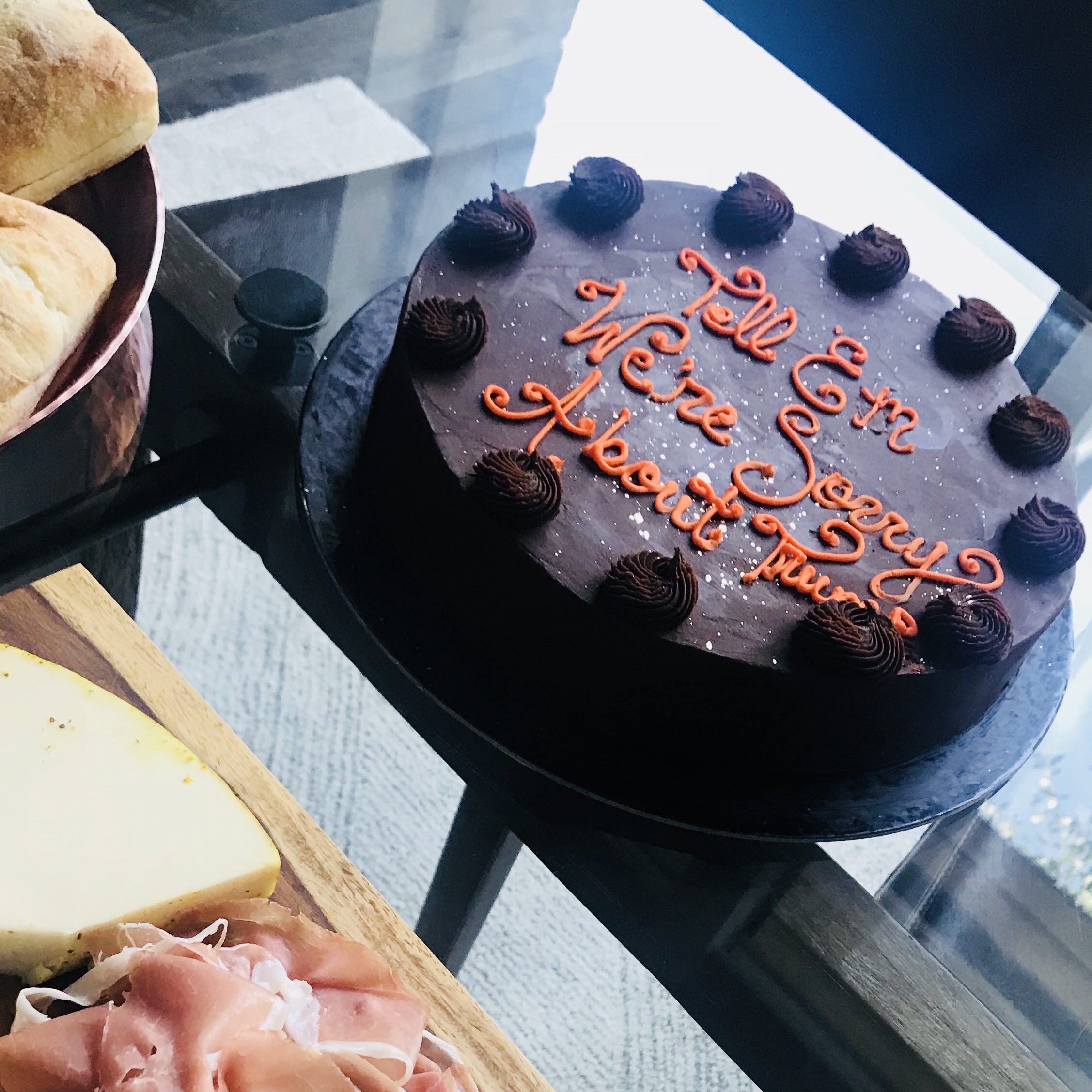
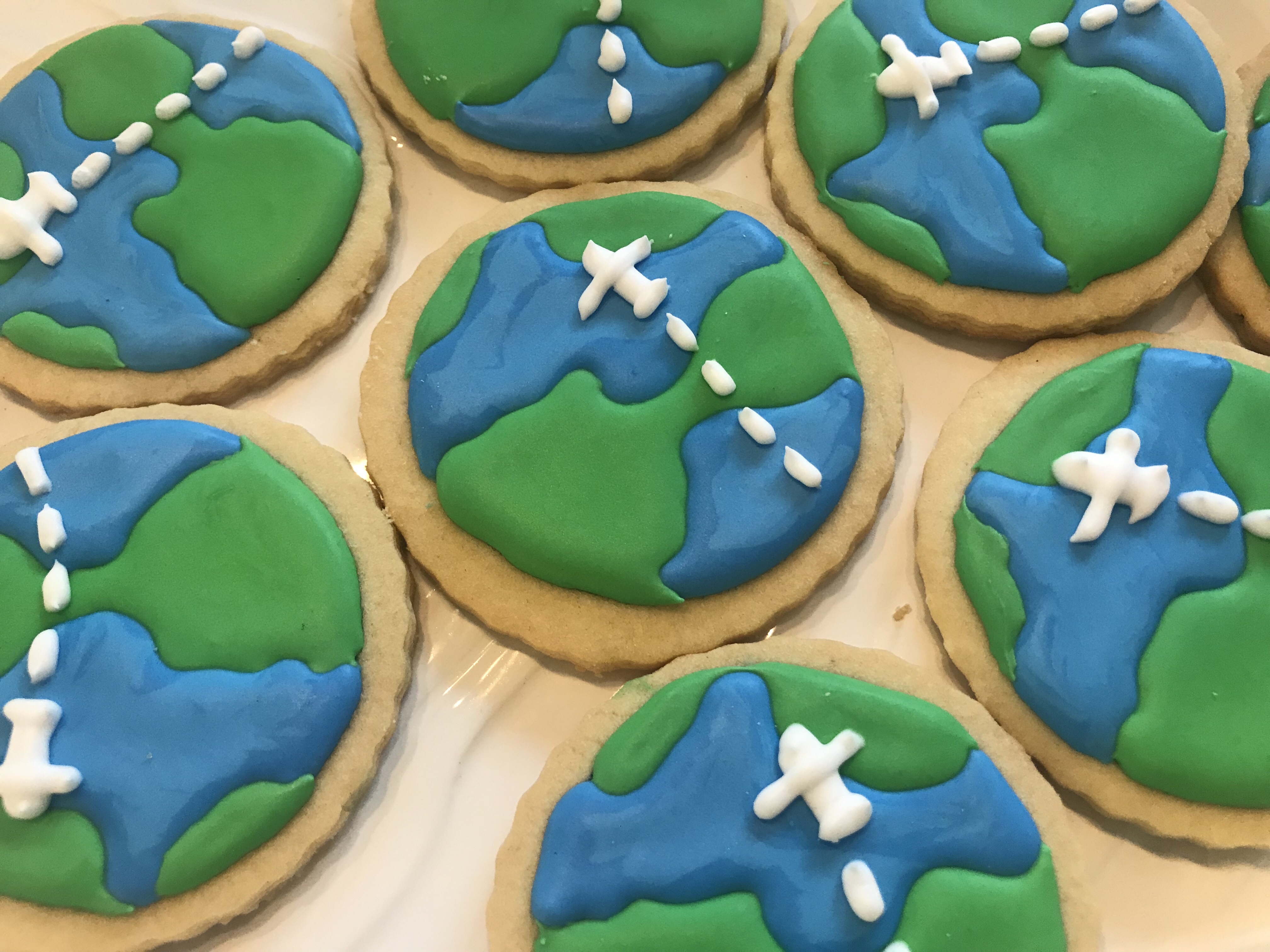
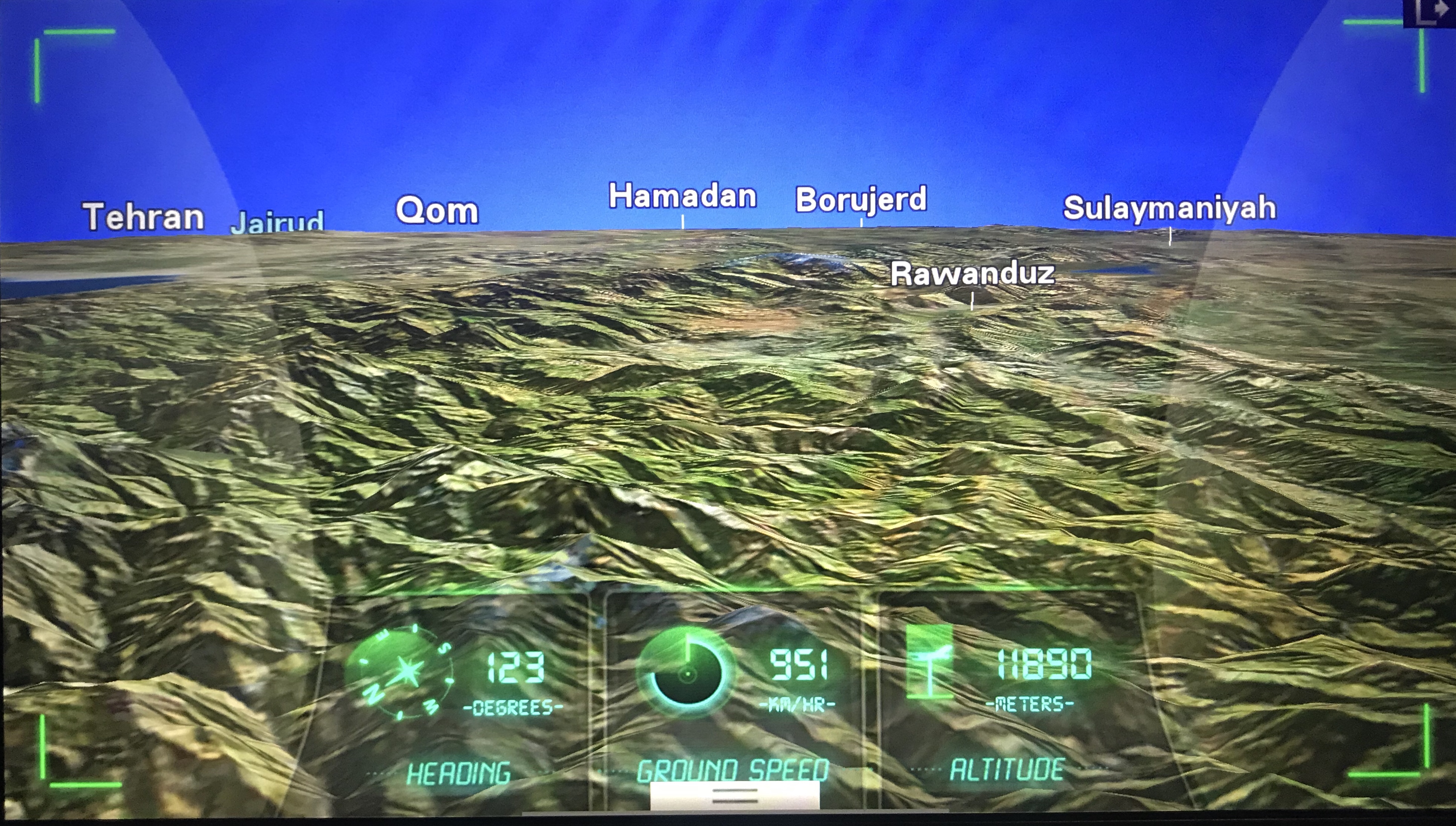
Our dear friends, neighbors, and family sent us on our way with sweet goodbyes. Eleanor hand baked and iced (is that an acceptable short for “applied icing on”?) those cookies. And as my aircraft hurtles towards Iranian airspace, the cake’s wisdom is impeccable.
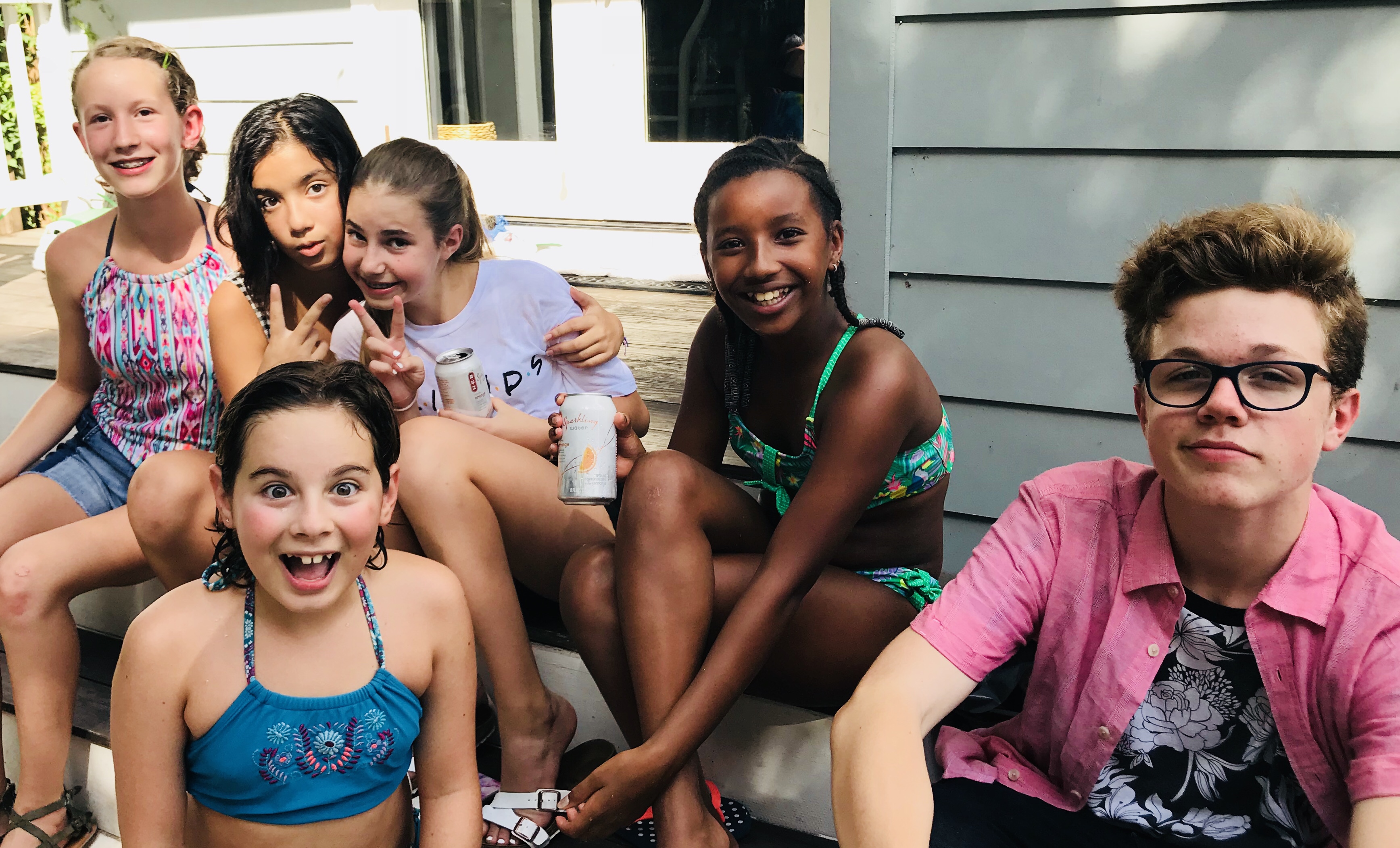
The kids and Jo still have a few days to go. They are frantically having sleep overs and soaking up the last bits of time with their friends.
After spending tonight at an airport hotel in Nairobi I’ll be looking at Kilimanjaro by tomorrow afternoon. I’ve heard the first view of the mountain is breathtaking. If my checked-in duffel bag doesn’t make the connection, instead of sight-seeing with Aaron I’ll be hitting the markets of Arusha! Kwa heri.
Nine years ago one night my wife had a brilliant idea just as my head was about to hit the pillow. “Let’s move to India for a year” she said. We did. When we finished that epic trip I recorded our experiences in a post titled Vacations Never End. We said that we will most certainly do it again. It’s that time.
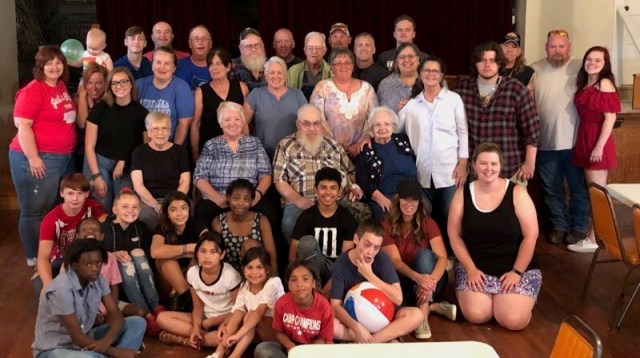
We are busy packing. Packing up the house because we are renting out the White Wooden House while we are gone. And packing for the trip, though we are traveling light. We’ll have about the same amount of luggage as when we went to Nebraska last month for a week. Though we’d be lucky to meet as many people around the world as we did in Nebraska – here’s a photo of some of Jo’s family – children, grandchildren, and great grand children of Carol’s parents.
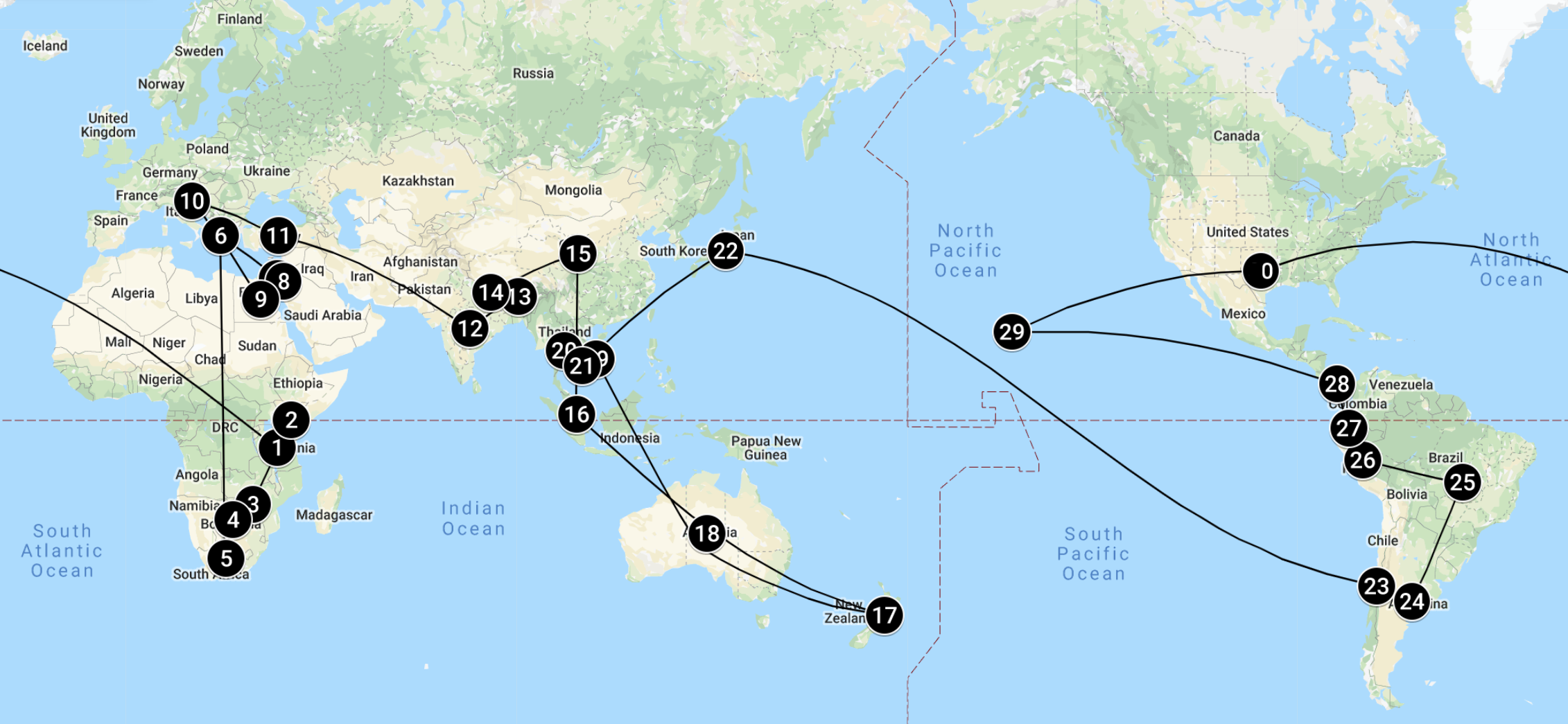
Here’s the map of where we are going, but be warned that our plans will be fluid. As of now we only have stuff booked to when we arrive in Cape Town on September 13th. We’ll stay longer where we like and skip out of what we don’t. If you have a hankering to see some place we are going, tell us and we’ll firm up the dates and meet you there. As long as you bring me some Salsa Doña from Austin. Adios till next year and we leave you to deal with the Donald. Bwahahahaha.