Cartoon Faces

A couple of weeks ago a new deep learning based app took the internet by storm. It turns a photo of a face into a Disney style cartoon. Here’s the fam by Voilà AI. Cute!


In the foreseeable future Artificial Intelligence and Machine Learning will change our lives in ways we can’t imagine yet. In the mid 1990s my research group at Motorola was using ML to solve difficult problems in semiconductor manufacturing. In 2000 the startup that I cofounded was extracting meaning and relationships from text using a whole battery of learning tools. But we were mere babes in the woods. The technologies have gotten tens of thousands of times better since then.

Most counties in the US use AI based software to determine parole, sentencing, and pre-trial bail. I’m reading a book (The Alignment Problem by Brian Christian) that discusses one such very widely used program in some detail.

This program attempts to predict if a criminal will recidivate in the next two years. A journalist from ProPublica checked to see how it did by comparing its output to what actually happened over the next two years. It turns out that the program was about 60% accurate in being able to predict the recidivism rate for both white and black criminals. Sounds fair.

Of the 40% whose recidivism rate was wrongly predicted by the software, all mistakes were not the same. Blacks who were later found to have been at lower risk were far more often labeled by the software as high risk. And whites who were later found to have been at higher risk were more often labeled by the software as lower risk. More false positives for blacks and more false negatives for whites.

If you’re black and criminal the algorithm screws you over compared to if you’re white and criminal even though the accuracy of the predictions for both races are similar. That’s not very fair.

We can’t really check for recidivism. But we can check to see if you were caught committing a crime again. As black communities tend to have more policing, the chances are higher that you would be caught if you are black and committing a crime and we would incorrectly conclude that blacks recividate more than they actually do and possibly respond by further increasing the policing of black neighborhoods, which you can see is a positive feedback loop.

Once the journalist posted these results things took a bizarre turn. New research shows that because the base rate of arrest and re-arrest is greater in the black community it is mathematically not possible to have the same accuracy *and* the same error profiles for the two communities. You have to give up one or the other. As a result of this work we have a deeper understanding of fairness and how to prioritize different aspects of it. At the same time, we also see how tiny biases in a positive feedback loop can result in huge differences over time. We all started as blue green algae and then time and evolutionary pressures split us off into millions of species as varied as an amoeba and an oak. We aren’t ready to put the machines on auto pilot. We need to make sure they aren’t imposing their own evolutionary pressures that are unknown to us but whose effects will alter the way we live as surely as nature does.

Warren Buffet supposedly once said, “What the human being is best at doing is interpreting all new information so that their prior conclusions remain intact.” Apparently unless we are very careful, our AIs will do the same. ML algorithms have something called a utility function. The goal of the algorithm is to maximize the utility function. Two AI researchers paid their older child a reward to take their younger child to the potty once he was ready to be potty trained. What could go wrong? The older child was incentivized to make sure the younger child didn’t pee in his pants. But in actuality he was incentivized to maximize his rewards. Apparently after a while he was excessively hydrating his younger sibling in prefect accordance with maximizing his own utility function. In AI circles there is the parable of the paper clip maximizer. Here’s the summary [ from https://www.lesswrong.com/tag/paperclip-maximizer ]:

First described by Bostrom (2003), a paperclip maximizer is an artificial general intelligence(AGI) whose goal is to maximize the number of paperclips in its collection. If it has been constructed with a roughly human level of general intelligence, the AGI might collect paperclips, earn money to buy paperclips, or begin to manufacture paperclips.

Most importantly, however, it would undergo an intelligence explosion: It would work to improve its own intelligence, where “intelligence” is understood in the sense of optimization power, the ability to maximize a reward/utility function—in this case, the number of paperclips. The AGI would improve its intelligence, not because it values more intelligence in its own right, but because more intelligence would help it achieve its goal of accumulating paperclips. Having increased its intelligence, it would produce more paperclips, and also use its enhanced abilities to further self-improve. Continuing this process, it would undergo an intelligence explosion and reach far-above-human levels.

It would innovate better and better techniques to maximize the number of paperclips. At some point, it might transform “first all of earth and then increasing portions of space into paperclip manufacturing facilities”.

It starts out as an innocent cartoon AI and ends up converting the known universe into paper clips. Hello future!

Post Pandemic Travel

We dropped this gal off at doggy camp for a few weeks of high distraction training / boarding vacation early this morning and then got dropped off at the airport ourselves.

I should be worrying about flying with germs floating in the air. The flight from Austin to Chicago was one hundred percent full. The gates at Midway where we are waiting to board the flight to Providence are packed tighter than sardine cans while most of the rest of the airport is relatively empty. Almost everyone is in masks though you occasionally see more than one nose poking above and beyond. But instead I’m worrying about Ouiser. Did she get enough playtime today? Who gave her a belly rub? Hope they remember to scratch her chin in the morning. And most of all, what is going through her doggy brain. Either that she’s been deserted or we’re about to walk in and get her.

This is the first time the kids or I have been on an airplane since March 16 2020 when we landed in Austin after a marathon set of flights from Temuco to Santiago to Toronto to Austin. I still stare out of airplane windows like a five year old. Here are a couple of photos coming into Chicago.

The kids fell back into travel mode but they have more devices this time around. Vivian is constantly on her phone, snapping or listening to music while Evan is carting his large gaming laptop around and playing Minecraft in airports.

We got delayed in Chicago but we just boarded our flight to Providence. We’ll be at Alu’s by midnight insha allah.

And Vivian Graduates

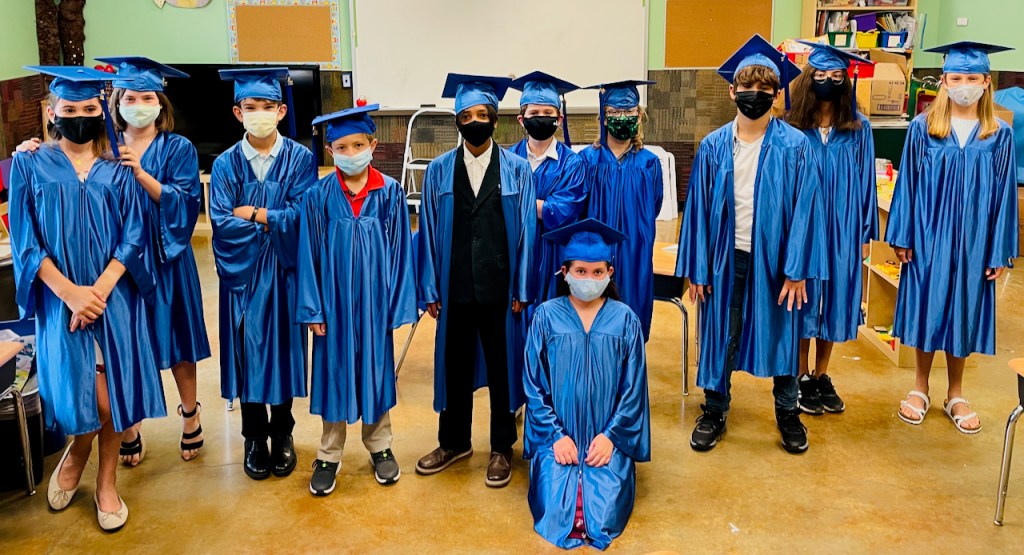
Vivian graduated a few days after Evan. Hers was marginally more momentous. She finished middle school. Her high school could not be more different than her old school. And she is the only one among her friend who is headed there.

Here’s a video that Jo took on her iPhone from the 8th row of the church where Vivian spoke at graduation. The audio quality sucks. Vivian did a good job. She didn’t share her speech with us beforehand so we didn’t know what to expect. Thankfully her favorite writing teacher did take a look at it and made some minor changes. Like using “excited” instead of “horny”.

Vivian’s school had planned a nice ice cream social outside on the lawns after graduation. Friends, faculty, and parents mingled one last time. It is sweet to see the goodwill and friendships that surrounded Vivian and her friends here. And like I did and still do for HPS, they feel a very strong sense of connectedness with the school and the community here.

Evan Graduates

Evan graduated at the end of the school year.

Many of Evan’s friends who have shared classrooms and lunch tables and recess all these years are now headed in different directions. But his middle school building is just across a parking lot where, in August, he will rejoin about two thirds of his mates. Not much will change. In fact he expressed his cynicism about this graduation business. “I don’t know why we are celebrating. I mean, you dropped me off at school every morning. Of course I graduated”.

Then he got a buzz cut that he and I have been campaigning for, and we dropped him off at summer camp. Two weeks of no devices and no air conditioning and staying dressed in his swim trunks most days. He was very brown and visibly taller when we picked him up. Also, he had lost his voice. He loses his voice every year at summer camp. This year though, he proudly and hoarsely whispered, he had lost it by the end of the very first afternoon.

There is reason to celebrate for growing up another year during a rather unusual year. Congratulations, kiddo.

Goodbye, My Friend

A couple of nights ago, Navaneet died in his sleep in California. It was not unexpected. When I dropped him off at Austin airport six months ago, we fully expected not to see each other again.

His beloved wife Praveeta died unexpectedly almost four years ago. At that time Navaneet’s prognosis didn’t look very good either. He had cancer and a few months before that doctors had given him a few months. He was on borrowed time. A year after that Madhunad and I visited him in Baja Norte in Mexico. We called ourselves El Grupo de Amigos. We started each the day with an amazing lazy breakfast and ended it sitting and contemplating the starry sky over the mountains in his backyard. In between, the conversation and laughter came easily and we toured local vineyards and restaurants all day. That became a hallmark of the hours of phone calls and the thousands of whatsapp messages that followed since then.

Navaneet shone like a beacon of life. Vader would have clearly said that the force was strong with this one. Navaneet’s second innings, to borrow a term from cricket, was inspiring. El Grupo continued our phone calls. Not once would you have ever guessed that one of us was dying faster than the other two. We were like a trio of school children. Our conversations were filled with zest and wonder and laughter, and sometimes tasteless humor.

El Grupo got back for a reunion in the middle of Covid when Navaneet blew into Austin from California like a breath of fresh mint in an ice cold mojito. We roamed the cafes and bars of South Congress and raised a ruckus. These photos are from the very last time El Grupo was together.

This spring, Navaneet began to finally slow down. The conversations with El Grupo on the phone continued to flow like good wine and bad dad jokes. After Easter, Navaneet opted for hospice care at home. He recounted his last visit with his doctor gleefully when he joked that because he had his second jab, he wasn’t going to die from Covid. The doctor apparently could not comprehend how someone who was days away from death could be so full of life.

A month ago, El Grupo put our collective heads together to discuss Navaneet’s impending death. Rather than have a memorial after he was gone, Madhunad suggested that we should get friends and family together to celebrate Navaneet’s life now. Navaneet readily agreed that it would be more fun for him if he were still alive. So we organized a zoom call with his friends from all over the world. Navaneet loved it and so did everyone else.

And now he is finally really gone but his laughter and love for life lives on.

The Soccer Life

Since the start of the last school year till Sunday, soccer has been a pillar of normality for Evan (and me). Practice on Monday and Wednesday evenings with his best friends, and blow-out victories on weekend matches became a part of the weekly schedule. The club managed their Covid protocol well and we never felt or were given a reason to worry.

Evan grew as a player and a team mate and felt he was recognized as a cornerstone of his team – calmly stopping most offensive attacks long before they got to his goalkeeper. Weekend after weekend they usually shut out their opponents and scored at least five goals. After a lead of six or seven, our coach usually instituted a policy of three unbroken passes before taking a goal shot which slowed their scoring down. But by the end of this season, the problem was winning. There was too much of it. They hadn’t lost a game. The last time Evan played club soccer was the 2018-19 year (he missed the 2019-20 year due to travel). Between the last two years that Evan played, he lost one game – the finals of the tournament at the end of the 2018-19 year. There is much to learn from losing a soccer match: congratulate your opponents, admit to yourself that they played a better game, then get back up, learn from it, and move on. I felt one loss over two years really wasn’t enough.

So a few parents and I convinced the club to extend our season by playing against harder teams from higher level leagues. They obliged and the team played four very good teams over the last two weekends. These boys were bigger, faster, had better ball control, and played a more strategic game. Our team rose to the challenge and beat two of these teams. They also had their first two losses of the season handed to them. The last one stung a bit. After being up 2-1, they lost the match 2-5, with the last goal being scored as the whistle blew. Oh the indignity.

After the game I hung back and walked behind the boys on the longish walk from the pitch to the car park. One poor kid was openly sobbing. Another was just holding it together. But most were doing great – pranking each other and laughing and joking. Then I heard it. “I bet they bribed the referee”. “They had to have”. “He made horrible calls”. “He was really bad or blind”. “I can’t believe he called that hand ball on us”. “I can’t believe he didn’t call that hand ball on them”.

It went on. From one kid it spread like a cancer to a few others. When we got to the car and we started driving back, I asked Evan how he was. “It was a great game. I really had to run for a change. I’m hungry – what should we eat?”

I breathed a sigh of relief. He finally had a couple of losses. And Evan hadn’t resorted to fables or conspiracy theories to convince himself that he had actually won when he had plainly lost. It was the cherry on top of a fantastic year of soccer. But what the devil are we going to do with our weekends now? Besides making fun of losers….

Gotcha

Last week we celebrated Ouiser, Skittles and Zeus adopting us one year ago. Skittles disappeared over a month ago. We suspect she was picked up by someone. She is cute and friendly and was without a collar during a pandemic. I’m pretty sure she is leading a fantastic life somewhere. But dammit you lousy cat burglar.

Evan still sleeps in uncomfortable positions for hours when Zeus lays on top of him. To move would disturb Zeus. And Ouiser greets us all every morning and everytime we walk in through the front door like we are the best thing since bacon treats. A year into our expanded family experiment we couldn’t be more content.

Here are some photos of Ouiser (and Vivian) from our recent camping trip to Canyon Lake for Michelle’s 50th birthday and of Zeus who wasn’t invited to camp and of Skittles before she was kittynapped.

Energy

A few weeks ago, one evening the kids and I had one of those magical dinners. Jo was back at Lariat Ridge hanging out with Carol who is recovering nicely after her second knee replacement surgery. I had taken the kids to Havalah for their haircuts straight after school. We stopped at Central Market on the way home and bought a loaf of freshly baked rosemary bread and two juicy prime ribeyes (32,000 liters of water down the hatch). I thinly sliced the steaks across the grain like Japanese yakiniku. Everyone liked it. My cheap wine tasted great. We sat in the lovely spring evening outside and chatted for a couple of hours.

It took me about 20 minutes to get the grill hot and cook the ribeyes. I spent less than a pound of propane, say 500 grams in the metric world.

When we backpacked in the Ouachita National Forest over spring break, I used 100 g of propane over four days from one of those pocket sized gas canisters that directly screw into an ultralight stove to cook. We boiled water each night for Vivian, Evan and my dinners and for Princess Vivian’s oatmeal in the morning (Evan and I ate cold granola for breakfast). We consumed 25 g of propane per day compared to 500 g to grill the ribeyes in the backyard. The energy in 25 g of propane can be stated in many different ways. Let’s drop into my teacher Daniel Sam’s physics class back at HPS for a quick review, ‘de man.

Energy is defined in physics as the capacity to do work. Work is the force applied on an object times the distance that the object is moved. Force is measured in newtons (N) in Système Internationale (SI) units and distance in meters (m). The unit of work in SI is joules (J) – one J is a force of one N applied to move an object by one m. So a J is also a N-m. As force is mass times acceleration, work and energy are mass x acceleration x distance, or mass x distance2 / time2 which makes a joule the same as a kg m2/s2. If you pick an average sized lemon which weighs exactly 102 g and move it from the floor to a table 1 m high, you have worked against gravity which has a downward acceleration of 9.8 m/s2. You have done 1 m x 102 g x 9.8 m/s2 or 1 J of useful work and if you used a 100% efficient machine it needed 1 J of energy. If you personally did the work you also moved your upper body’s weight against gravity, so you did a lot more work.

Speaking of doing work for no good reason, a calorie is another way to measure energy. We run into the calorie mostly when we are trying to burn more of it or eat less of it. Officially it is the energy needed to raise the temperature of one gram of water through one degree Celsius. A calorie is equal to about 4 J or four lemon pick-ups. A kilo calorie (kcal) is a 1000 calories. When a 12 oz can of Coke says in contains 140 Calories, it really means 140,000 calories. But because no one wants to drink that many calories we drop a few zeros like the peso. Food labels in the US frequently call a kcal a Calorie and spell it with a capital C.

Back to the lemons. When I pick a lemon off the floor to a meter tall table I expend about 0.1 kcal. Don’t quote me on this – I went through some approximate calculations involving toe touches and other stretches because lemon picking isn’t yet an Olympic sport. So 0.1 kcal is 100 calories with a small c or 400 J. Remember we said that the useful work done on the lemon was just 1 J. My body spends 399 J bending down and straightening up while doing 1 J of useful work on the lemon.

I burn about 1860 kcal or 7440 J even when I sit on my ass all day which does not happen infrequently. This number is based on my gender, weight, height, age, and other factors. This is the energy needed to pump blood and maintain my body temperature and think and digest food and do other stuff that keeps my body alive. My liver, spleen, and brain account for almost half of my body’s resting energy needs. If I get off my ass moderately, I need to absorb about 2400 kcal or 20,000 J of energy from food per day. Remember this number. There will be a test later.

One somewhat basic definition of you is that you use energy to create order from chaos. Living things are more organized compared to the world outside them. The chemical energy stored in food along with oxygen from the air we breathe is converted into complex ordered molecules. Some of these molecules do the work associated with living, like reproducing, growing, digesting, healing, and moving. Some molecules store excess energy in my belly fat. And like everything else in our known universe, some of the incoming energy is lost as heat, increasing the entropy of the universe forever. Plants additionally use energy from the sun. Other living things eat them thereby absorbing a portion of the sun’s energy stored in complex ordered plant molecules as chemical energy. The sun and other stars get their energy by smooshing hydrogen atoms into helium atoms. CSNY sang that we are star dust. A less lyrical addendum is that we live on star power.

Recall that energy is the capacity to do work. Power is the rate at which work is done. Returning to our trusty lemon, if a 100% efficient machine moves the lemon very slowly over the course of a year, and another one moves it in a second, the amount of work done by both is 1 J. But the fast machine uses a lot more power. To be exact, it expends 1 J per second, or 1 W (watt) which is the SI unit of power. Conversely, one W-s is one Joule because multiplying power with time gets you back to energy. Think of energy as the capacity of a tank of water and power as the flow rate of water out of the tank. A common measure of energy is the kWh (kilo watt hour), and is 1000 (for the kilo) x 60 (for the minutes) x 60 (for the seconds) J or 3.6 x 10⁶ J. Electrical energy is often measured in kWh. If you loaded up a 100% efficient battery with 1 kWh and powered a 100% efficient lemon picking machine, the machine would be able to pick up 3,600,000 lemons. A fully loaded Tesla car battery stores 100 kWh of energy to move you and itself through 640 km.

There are other units used to measure energy. A British Thermal Unit or BTU which should be renamed to an American Thermal Unit is an archaic unit used in less advanced places and is similar to the calorie except that uses pounds and Fahrenheits instead of grams and Celsius. A TOE or Tonne Equivalent of Oil is the energy released with you burn a tonne of crude oil. Consider it the calorie content of one big ass can of oil. A megaton is the energy released when you explode one million tonnes of TNT. A BTU is equal to about 1000 J or 1 kilo J. A TOE is approximately 42 giga J. A giga is a billion or 9 zeros. A megaton is 4.2 peta Joules (15 zeros). The biggest nuclear bomb, the Tsar Bomba, released 50 megatons of energy during its explosion.

Last year the world used 1.4 x 10¹⁰ TOE or 588 exa Joules (18 zeros) of energy. That is approximately 200 x 106 J per man, woman, and child per day. Do you recall how many joules we decided you need to eat to stay alive and engage in moderate activity each day? Of course you do because like me you find all this utterly riveting. So that explains 1/10,000th of my daily energy consumption. Where do I use the remaining 199,980,000 J per day?

I’m looking into it. Feel free to leave a comment with the answer.

Evan’s 11

Happy birthday to my favorite male child.

You see those “I march to different accordion” type bumper stickers. You’ve always had your own accordion. Or tuba, or something that only you can hear. And often that means you aren’t easy to parent and even harder to teach, but you are teaching me the virtues of patience. You may construe that as a backhanded compliment. So here are some direct ones. You are caring. You are funny. You never carry a grudge. You laugh easily at the world and yourself. You try to come across as a thick skinned stoic, but you are a lover. You’re a nerd. You’re a turd. You think my jokes are funny.

What did one ass tell another? I love you to Uranus and back.

Ships

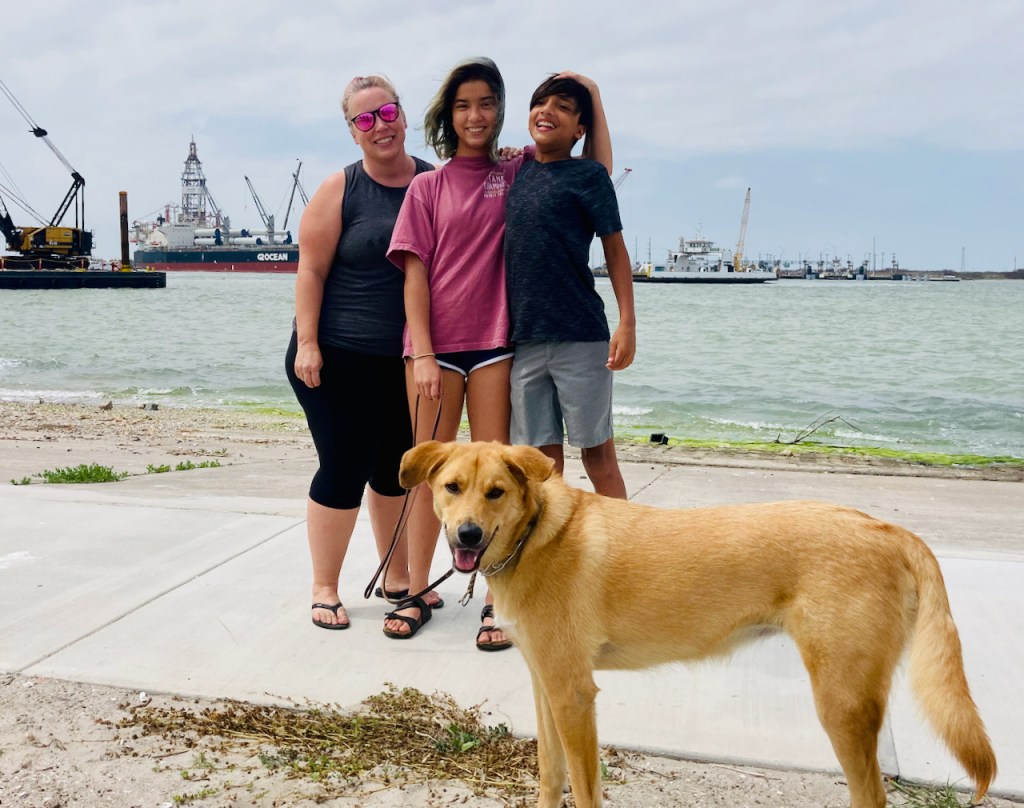
I find ships and things related to marine transportation eternally amazing. That the rest of my family doesn’t is eternally disappointing. Here’s a photo of them standing by the bay with Ouiser in Port Aransas. There’s all kinds of stuff in the water behind them. To the right of Evan is one of the ferries that run back and forth between Port Aransas and the mainland, a short 5 minute free service provided by TxDOT. We took it on the drive back to Austin even though it wasn’t on the fastest route. It’s nothing like the ferry that swallowed up our entire train on our trip from Hamburg to Copenhagen in 2014 but a ferry trip is fun.

To the extreme left of the picture there’s a construction barge with the yellow crane on it doing something to one of the ferry slips on the island side. And to the left of Jo, a ship owned by G2 Ocean is unloading what look like really giant pipe sections. The ship is the Gingko Arrow and arrived here from the port of Tuticorin in south India, carrying wind turbine towers. A few months ago it carried a load of wind turbine blades from India to here. It travels around the southern tip of India, sails across the Arabian sea through the Suez canal into the Med, out through the strait of Gibraltar, across the Atlantic, and to Port Aransas. It is amazing what you can look up on the internet about ship tracks, something we got familiar with during the Ever Given stuckage in the Suez. I love the photos of the tiny backhoe working away against the giant hull of one of the largest container ships in the world. And the memes for the backhoe and the hull with pairs of labels like “my New Year’s Resolutions” and “my Life”, or “the Paris Accord” and “Climate Change”, or “Reason” and “QAnon”.

A few minutes after I took that photo of the family on the bay in Port Aransas, we were treated to this marine parade. Jo captured it in the time lapse video. It was a giant offshore oil rig being carried on a giant ship pulled by a tugboat out front and restrained by two tugs in the back.

This is bp’s newest production platform for the gulf and is named the Argos. It was built in South Korea in the Samsung shipyards and then transferred to one of the world’s biggest heavy lift ships called the Boka Vanguard. How on earth do you transfer a giant oil platform on to a ship? By partially submerging the ship and then floating the cargo on top of it and then unsubmerging the ship again. Here’s a picture taken during the process in South Korea. The hull of the Vanguard is fully submerged, with portions of it’s white and grey superstructure visible like floating towers. The biggest one in left foreground contains the bridge and the accommodations and is located to the portside of the ship’s giant lift deck. The Argos is being towed into position over the Vanguard.

Here are a couple of photo of the same heavy lift ship, the Boka Vanguard, loading and carrying a cruise ship to dry dock in the Bahamas in 2019. And a link to a pretty fun video to watch the operation unfold.

The Argos is going to stay in Ingleside, a port next to Port A, for the next several months where it will be made ready for operations. Then she will be towed to a site 190 miles south of New Orleans and situated over on a very lucrative oil producing area called Mad Dog 2 (hence the name Argos, Odysseus’ dog). When fully functional next year, she will pump out oil from 14 wells almost a mile underwater and produce 140,000 barrels of crude a day. She is a new generation of oil platforms designed to function ultra efficiently and will be profitable even at crude prices of $30/barrel (West Texas Intermediate is trading at around $60 a barrel as I type this). bp has invested $9 billion into the Argos, and she has already taken over a million hours of work to put together. It is possible that when I pump gas at the Rosedale Market a year from now, it may have been sucked out of the ocean floor by the Argos.

When we see Evan heading for a disaster, we often joke that he was born during a disaster. The Deepwater Horizon oil drilling platform blew up in the gulf on the day of his birth. Eleven people died. Five million barrels of oil spilled into the waters of the gulf creating the worst ecological disaster in the history of oil exploration. It took six months to cap the oil well situated more than a mile underwater. bp paid almost $40 billion in fines, penalties, and expenses to clean up the mess. Oil slowly continues to leak out even today.

While Deepwater Horizon and Argos fulfil two very different functions (Deepwater drilled for oil, Argos extracts the oil from wells like the ones Deepwater drilled), they both indicate the incredible risks, engineering, and financing that go into satisfying our ever increasing need for energy. If all goes according to plans, Argos is expected to be pumping away till 2050, the year Evan turns 40!